World
The forces that shape this planet, the sky above it, the life in its seas and forests, and the matter and light around us.
46 plates
Plates 46
- Plate 40 Halley’s Comet Is Far Away. Its Dust Is Here. SpaceStart here Every late October the Earth ploughs through dust shed by Halley’s Comet, and the Orionids streak across the night. In 2026 the best night is October 21 to 22. Open →
- Plate 01 How Rain Carves a Mountain Earth & SkyStart here A single storm changes almost nothing. But the rain never stops. Open →
- Plate 02 The Wave That Hides in Deep Water Earth & SkyStart here Out at sea it is almost impossible to notice. At the coast it can drown a town. Open →
- Plate 03 The Shadow of the Moon SpaceStart here The Sun is about 400 times wider than the Moon, and about 400 times farther away. That coincidence lets day turn to night for a few minutes. Open →
- Plate 04 The Engine of a Hurricane Earth & SkyStart here It runs on warm water, and the turning Earth sets it spinning. Open →
- Plate 05 Why Summer Is Warm SpaceStart here Not because the Earth is closer to the Sun. In early January the Earth is at its closest — in the dead of the northern winter. Open →
- Plate 06 The Arithmetic of a Sunflower LifeStart here Count the spirals its seeds make, and you will arrive at a famous sequence of numbers. Open →
- Plate 07 Why a Rainbow Is Round Light & SoundStart here It does not hang anywhere in the sky. It is a ring of light 42 degrees around the shadow of your own head. Open →
- Plate 08 Why Snowflakes Have Six Points MatterStart here Every snowflake grows from one tiny six-sided crystal of ice. Open →
- Plate 09 No Bird in Charge LifeStart here Thousands of starlings turn together at dusk like a shape-shifting cloud of smoke. No one is giving orders. Open →
- Plate 10 How the Moon Moves the Sea SpaceStart here Why are there two high tides a day? Because the Moon pulls the near ocean toward it — and leaves the far ocean behind. Open →
- Plate 11 Curtains in the Sky Earth & SkyGoing further An aurora is light given off when electrons from space crash into the air high overhead. Open →
- Plate 12 Why the Moon Changes Shape SpaceStart here The Moon never changes shape. What changes is how much of its sunlit half we can see. Open →
- Plate 13 Why the Sky Is Blue Light & SoundStart here The sky is not reflecting the sea. The air itself is throwing the blue in sunlight across the sky. Open →
- Plate 14 The Cracks in the Earth Earth & SkyStart here A year’s 7,700 strong earthquakes fall mostly along a few lines: the edges of the pieces of the Earth’s shell. Open →
- Plate 15 How Sound Crosses the Air Light & SoundStart here Sound is a push passed along through the air. The air doesn’t travel to you; the push does. Open →
- Plate 16 Where Spots and Stripes Come From LifeGoing further A leopard’s spots and a fish’s stripes may come from the same simple recipe: two ingredients, one fast and one slow. Open →
- Plate 17 Why Ice Floats MatterStart here Freeze most liquids and the solid sinks in its own liquid. Ice floats. The secret is in the little hexagons water molecules build. Open →
- Plate 18 The Space Station Is Falling SpaceStart here Astronauts float not because there is no gravity in space, but because they and their station are always falling. Open →
- Plate 19 Where Volcanoes Come From Earth & SkyStart here There is no sea of magma under the crust. Magma forms in only a few kinds of places, and that is where volcanoes grow. Open →
- Plate 20 The Breathing Planet LifeStart here A tree’s wood is made mostly from air. Every summer the northern forests breathe in together, and the whole atmosphere holds less carbon dioxide. Open →
- Plate 21 Three Cones, a Million Colors Light & SoundStart here Sunlight holds a smooth sweep of colors, but our eyes see it with just three kinds of cells. Every color you see is those three cells taking a vote. Open →
- Plate 22 A Wire That Proves the Earth Turns SpaceGoing further A long, heavy pendulum swings above the floor. Hours later, its swing seems to have turned. What turned was the floor — the Earth. Open →
- Plate 23 Where a Compass Points Earth & SkyStart here A compass doesn’t point at the North Pole. It lines up with Earth’s magnetic field — and the magnetic pole it heads for keeps moving. Open →
- Plate 24 The Solar System Today SpaceStart here Where are the eight planets right now? The farther from the Sun, the slower they go, and the longer a lap takes. Open →
- Plate 25 Seeing Through the Earth With Earthquakes Earth & SkyGoing further No one has been to the centre of the Earth. We know it holds a liquid outer core and a solid inner core because earthquake waves went for us. Open →
- Plate 26 Why a Siren Changes Its Tune Light & SoundStart here An ambulance sounds higher coming towards you and lower going away. The siren hasn’t changed; its sound waves have been squeezed or stretched. Open →
- Plate 27 What Pushes a Rocket SpaceGoing further A rocket doesn’t push against the air. It throws a large part of itself backwards very fast, and the rest of it is pushed forwards. Open →
- Plate 28 Where a Bubble’s Colours Come From Light & SoundStart here Soapy water has no colour, yet bubbles shimmer with every hue. The colour isn’t in the soap — it is in how thick the film is. Open →
- Plate 29 A Curved Piece of Glass Light & SoundGoing further Light bends a little as it passes from air into glass. Shape the glass into a curve and light passing through every part of it can meet at one point — which is how magnifying glasses, cameras and your eyes work. Open →
- Plate 30 Why Clouds Don’t Fall Earth & SkyStart here An ordinary cumulus cloud holds hundreds of tonnes of water, yet it floats. The secret is how astonishingly small its droplets are. Open →
- Plate 31 Why Metal Feels Cold MatterStart here A metal spoon and a wooden spoon left in the same room are exactly the same temperature, yet the metal one feels much colder. What your hand feels is how fast heat leaves it. Open →
- Plate 32 Why Mountain Water Isn’t Hot Enough MatterStart here At the top of Everest, water boils at about 70°C — too cool to hard-boil an egg, however long you wait. The temperature water boils at depends on how much air is pressing down on it. Open →
- Plate 33 See the Flash, Then Hear the Thunder Earth & SkyStart here Lightning and thunder happen at the same moment, but light arrives almost at once while sound covers only about 340 metres a second. Count the seconds between them and you know how far away the storm is. Open →
- Plate 34 Why a Steel Ship Floats MatterStart here Drop a lump of steel in water and it sinks at once, yet the same steel built into a ship floats with ten thousand tonnes of cargo aboard. The secret is how much water the ship pushes aside. Open →
- Plate 35 The V Behind a Ship Earth & SkyGoing further A big ship, a small boat, even a swimming duck: the V-shaped wake behind them opens at almost exactly the same angle, about 19.5° on each side. Open →
- Plate 36 Where Is the Electron? MatterGoing further Textbooks often draw electrons as little balls circling the nucleus. In fact an electron has no orbit. It is more like a cloud: all we can say is where it is likely to be. Open →
- Plate 37 When Two Ripples Meet MatterStart here Drop two stones in water and their rings of ripples pass straight through each other. In some places they cancel out, and the water there barely moves. Open →
- Plate 38 Where Not Even Light Escapes SpaceGoing further A black hole packs so much matter into so small a space that not even light can get out. It is dark itself, but the light it bends around it draws a bright ring. Open →
- Plate 39 The Invisible Lines Around a Magnet MatterStart here Lay a sheet of paper over a magnet, sprinkle iron filings on it and tap gently: the filings line up in curves running from one end of the magnet to the other. They are drawing the shape of its magnetic field. Open →
- Plate 41 How a Phone Knows Where It Is InformationGoing further Thirty-odd satellites, 20,200 km up, keep announcing the time. A phone only listens, and from how late each announcement arrives it works out where it is, to within a few metres. Open →
- Plate 42 Light in a Glass Thread InformationStart here Shine a light into a stream of water and the light bends with the stream. Today the same trick traps the internet in glass threads as fine as a hair and sends it across the Pacific. Open →
- Plate 43 More Features Than Neurons AIGoing further A single neuron in a neural network often stands for several unrelated things. A model with just two neurons can arrange five features into a pentagon and keep them all. Open →
- Plate 44 Pictures Out of Noise AIGoing further Many AI image generators start from random static and remove it, one step at a time. A small network does the same in your browser, and a cloud of dots slowly condenses into a knot. Open →
- Plate 45 A Code That Survives Sand InformationStart here Bury part of a QR code in sand and a phone still reads it. The secret is in its spare bytes, which say nothing at all but can work out what went wrong and how to put it right. Open →
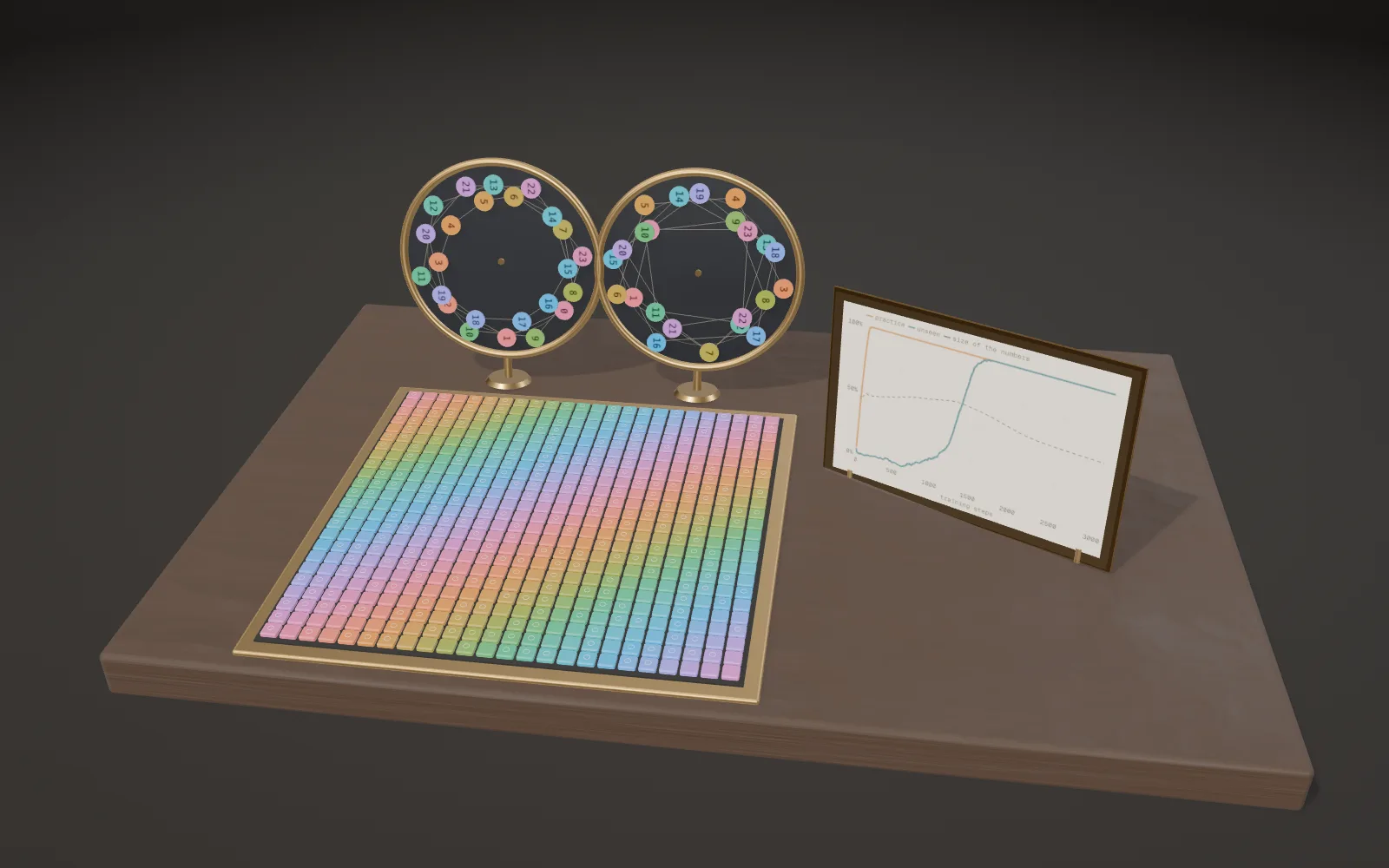
- Plate 46 Learning by Heart, Then Learning the Rule AIGoing further A small neural network learns to add hours on a 24-hour clock. It gets its practice questions right almost at once, by memorising them, and only long afterwards answers questions it has never seen. Inside, it has built clocks. Open →