Plate 36 · Matter
Where Is the Electron?
Textbooks often draw an atom as a tiny solar system, its electrons circling the nucleus like planets. A hundred years ago, scientists found that electrons don’t behave like that. An electron has no fixed path, only a cloud of places it might turn up.
Scroll
Not a Tiny Solar System
Hydrogen is the simplest atom: one proton for a nucleus, and one electron outside it.
If the electron really circled like a planet, it would keep giving off light, lose energy, and in far less than a blink spiral into the nucleus; the atom would not last. Yet atoms are stable. The electron must be something else.
A hydrogen atom · each dot is one place the electron might be found
Atoms Are Almost Empty
The nucleus is astonishingly small. Blow a hydrogen nucleus up to a marble 1 centimetre across and the electron would most likely be found about 300 metres away, as far as three football pitches end to end.
Apart from the electron’s thin cloud, there is nothing else between the nucleus and the edge of the atom. The atoms in your body are the same: nearly all their mass sits in a nucleus that takes up almost none of the space.
A Cloud of Chances
Where is the electron? We can’t know its exact position in advance, only how likely it is to be found in each place. Draw many of the places it might be as dots and you get this cloud: where the dots crowd together, the electron is most likely to be.
In hydrogen at its lowest energy the cloud is a round ball. The dots are thickest right at the middle, but a shell farther out has much more room, so the most likely distance from the nucleus is 0.053 nanometres.
More Energy, More Shapes
Give the electron more energy and its cloud grows and changes shape: some look like two balloons end to end, some like four leaves.
These shapes are called orbitals, but they are clouds, not tracks. The two colours show where the wave is positive and where it is negative, like crest and trough; which is which is only a choice. Inside an atom, an electron behaves like a kind of wave.
A Jump Makes Light
When the electron drops from a higher-energy cloud to a lower one, it gives off a little light. The energy difference is fixed, so the colour of the light is fixed too.
Dropping from the third energy level to the second gives red light at 656 nanometres. Many of the red-glowing clouds in space shine with this very light, given off by hydrogen atoms.
The animation fades one cloud into the other to show before and after; the electron does not flow across. To climb back up, it must first take in light of the same colour.
Hydrogen’s visible lines: 656 nm red, 486 nm blue-green, 434 nm blue-violet, 410 nm violet
Your Turn
Pick an electron cloud and turn it to see its shape. Switch on “Cut open” to see whether there are empty places inside.
Try thisPick 2s and switch on “Cut open”: where inside is the cloud empty?
What the model leaves out
The clouds are exact solutions of the Schrödinger equation for hydrogen, but drawing them as dots is only a way of showing them: the dots are not places the electron has actually been. A cloud has no real edge, it just thins out; here it is drawn until the chances become very small. Finer corrections such as the electron’s spin and relativity are left out. The twinkling is decoration: an undisturbed cloud does not change with time.
A common misreading
An electron is not a little ball circling the nucleus, and the word “orbital” invites that mistake. Pictures like “it is in many places at once” or “it whizzes around inside the cloud” also say more than we know. What quantum mechanics predicts, and experiments confirm, is how likely you are to find the electron in each place when you look. What it is “doing” when nobody looks is a question physicists still argue about.
Sources
Follow the question
 Plate 21Three Cones, a Million ColorsSunlight holds a smooth sweep of colors, but our eyes see it with just three kinds of cells. Every color you see is those three cells taking a vote.
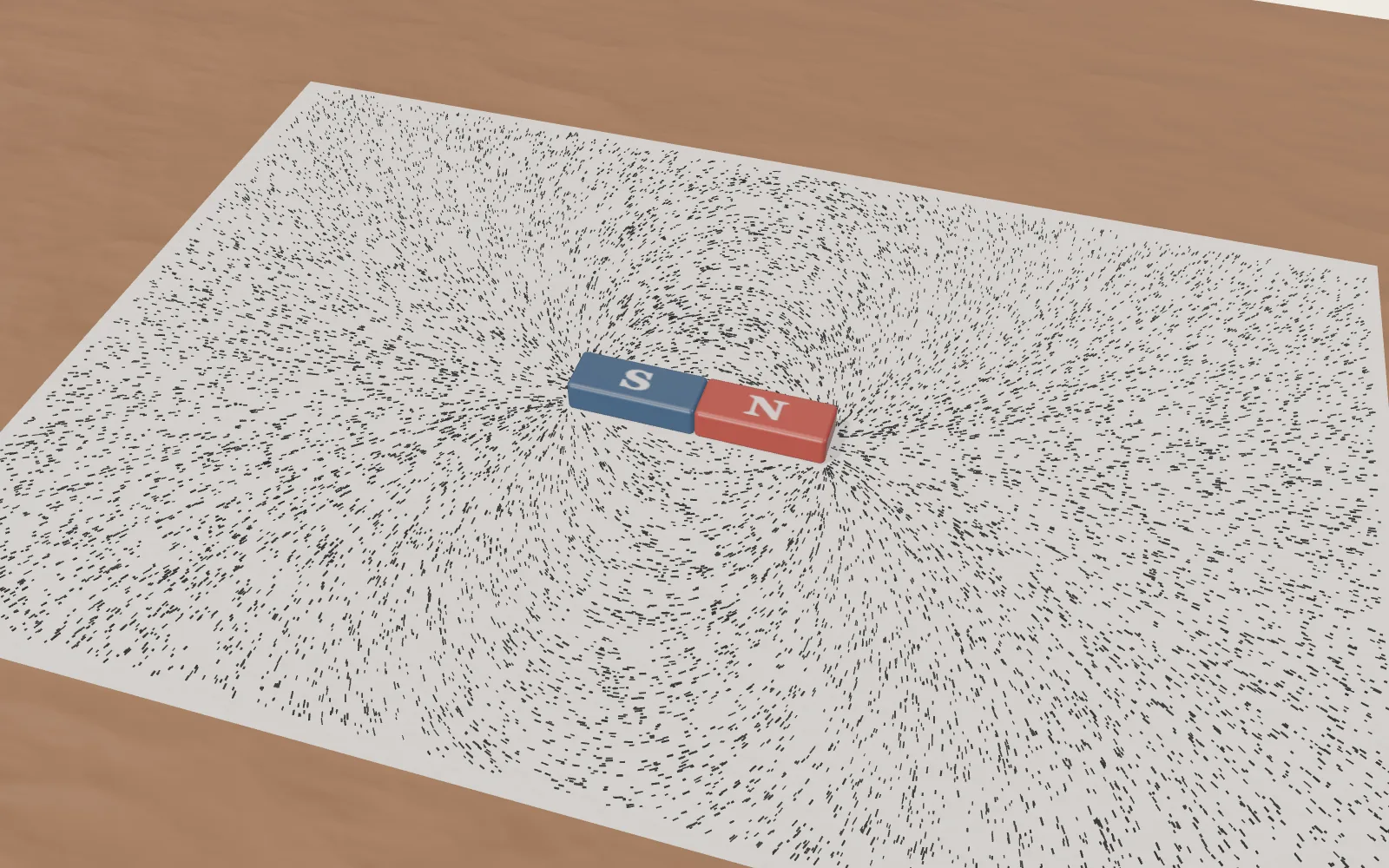 Plate 39The Invisible Lines Around a MagnetLay a sheet of paper over a magnet, sprinkle iron filings on it and tap gently: the filings line up in curves running from one end of the magnet to the other. They are drawing the shape of its magnetic field.