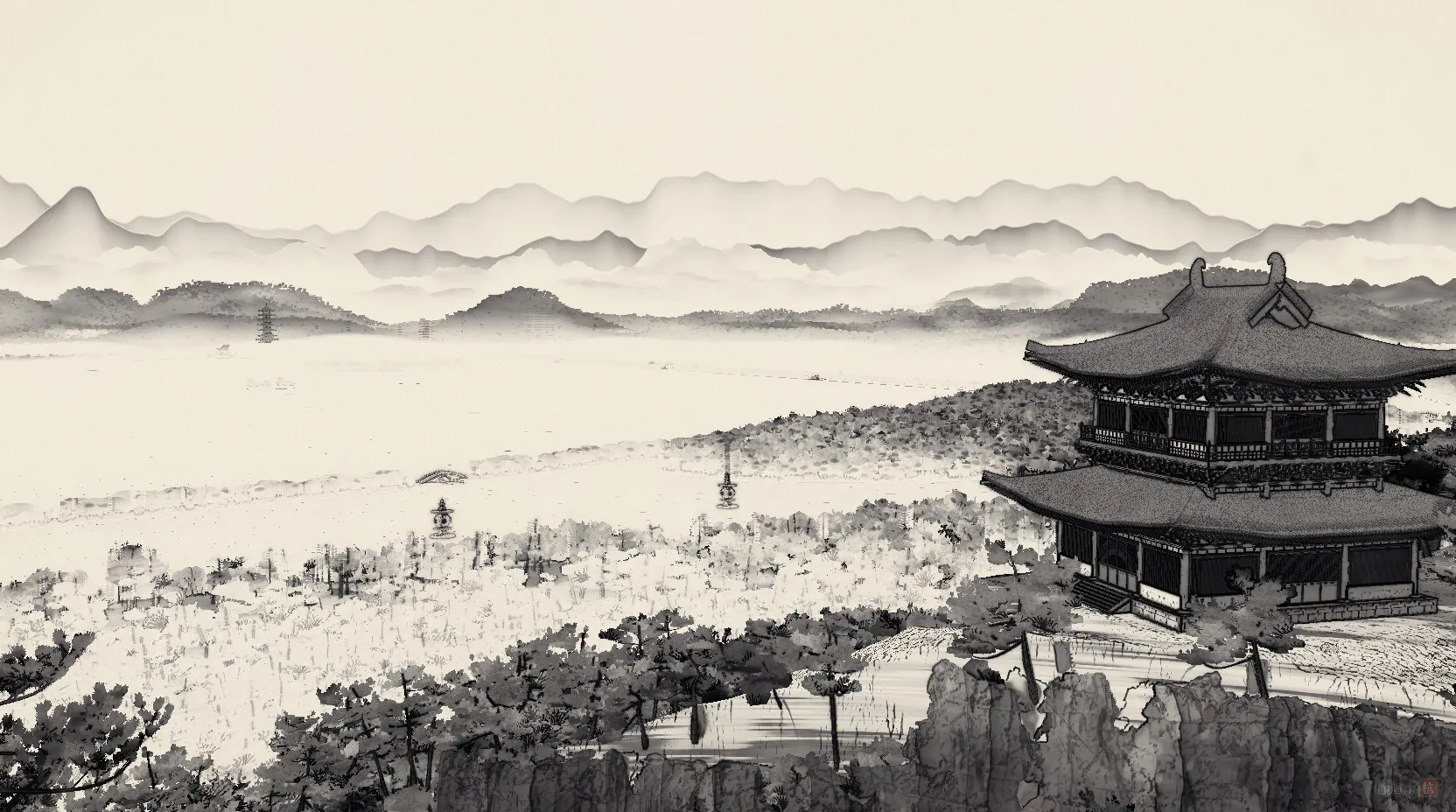
01Capital of the Southern Song · today’s Hangzhou
Lin’an
A lake of mist and a city of halls, raised again beam by beam from a building code nine centuries old.
Lin’an, capital of the Southern Song, is today’s Hangzhou. Its city and West Lake are generated entirely in code, with no photographs and no ready-made models. Every timber building is worked out from the rules of the Song building manual, the Yingzao Fashi (1103), and a brush written in code paints the 3D world in ink: outlines first, then texture strokes on the rocks and washes for distance, with mist, water and sky left as bare paper.
Enter Lin’an(opens in a new tab)Opens in a new tab · about 30 seconds to load · best on a computer
Source code ↗(opens in a new tab)GitHub · MIT licence
What to look for 4
-
01
A hall that begins with one timber’s cross-section
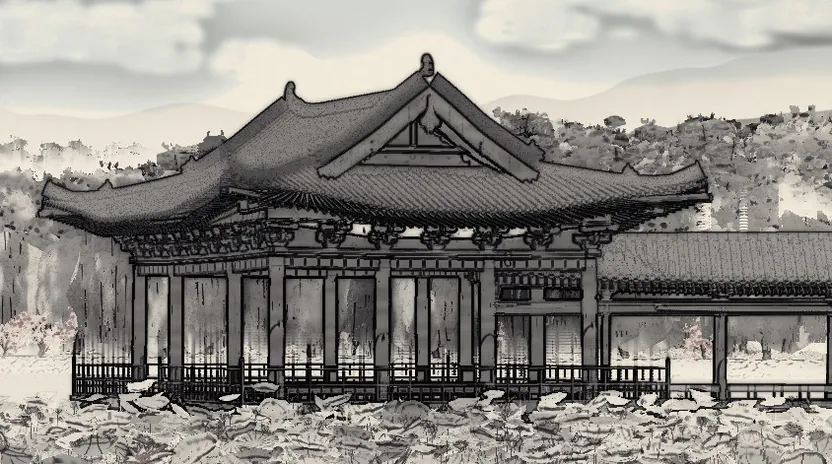
The Yingzao Fashi calls the cross-section of a standard timber a cai: 15 fen deep and 10 wide, in eight grades for buildings of different sizes. The height and depth of a building, the length of every member and the bend of the roof are all measured in fen, so choosing the grade sets the size of the whole hall. Under the eaves, bracket sets stacked tier on tier hold up the far-reaching overhang and pass its weight down to the columns.
See it in Lin’an · Lotus at Quyuan ↗(opens in a new tab)The manual’s rules, in code ↗(opens in a new tab)
-
02
Stones that hold each other up
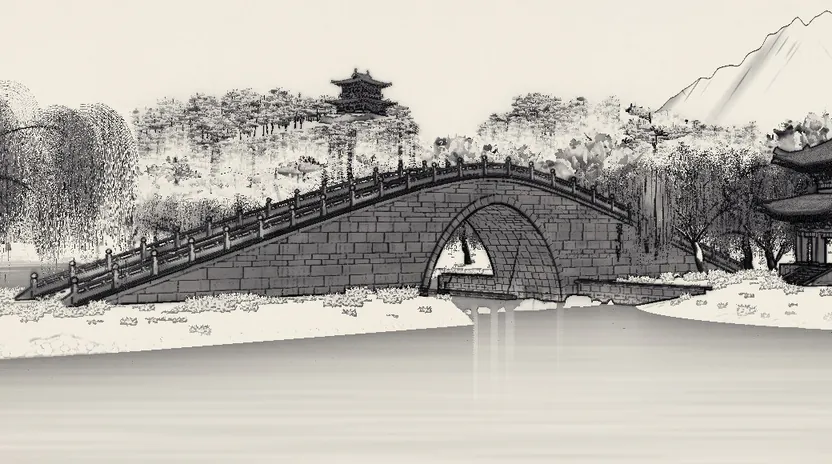
Each stone in an arch is squeezed between its neighbours. The weight on the bridge flows along the curve to the banks, so the stones are almost only pressed together, and stone is strongest when pressed. The curve also pushes outward, so its feet must rest on solid abutments. While it is built, a wooden frame holds the arch up; only when the last stone goes in at the top does it stand on its own.
See it in Lin’an · Broken Bridge in Snow ↗(opens in a new tab)
-
03
The tide that rises into a wall
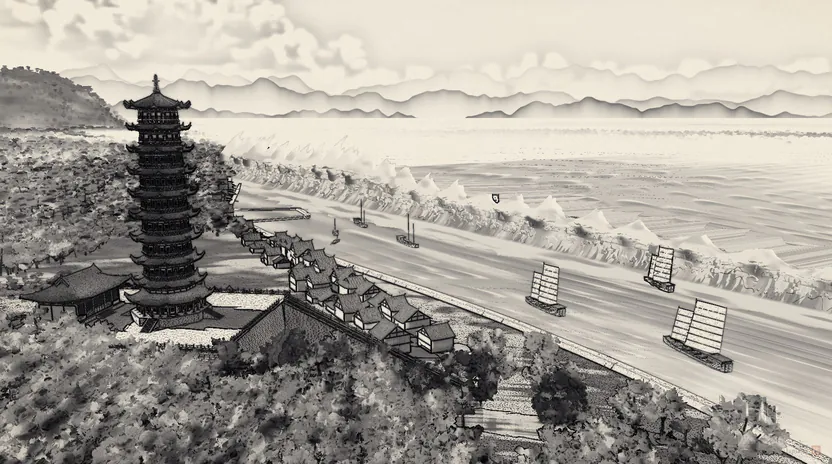
On a rising tide the sea pours from Hangzhou Bay into the Qiantang River. The bay is wide at its mouth and narrows inland, and the riverbed grows shallower. In the shallows the front of the tide slows, while the water behind it, still in deeper water, runs faster; it catches up and piles in, and the front stands up as a wall of water: a tidal bore. It runs strongest around the eighteenth day of the eighth lunar month, when the people of Lin’an crowded to the riverbank to watch.
Plate 10How the Moon Moves the Sea “The Shape of the Coast”→Plate 02The Wave That Hides in Deep Water “Shallow Water Makes It Stand Up”→See it in Lin’an · Liuhe Pagoda and the Tide ↗(opens in a new tab)
-
04
The lake was once a bay
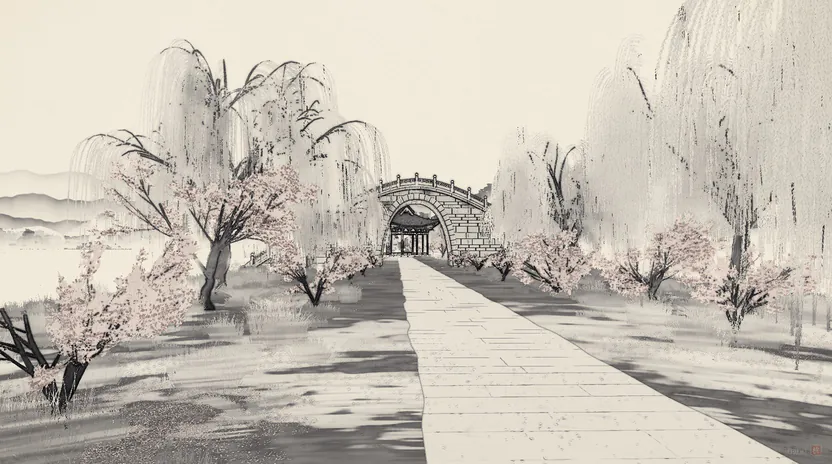
Long ago, West Lake was a bay at the mouth of the Qiantang. Silt carried by the river and the tides built up across its mouth until it was cut off from the sea, and a lake was left behind. Its bed kept silting up and filling with weeds. In 1090 the poet Su Shi, then governing Hangzhou, had it dredged, and the mud and weeds were heaped into a long causeway running north to south: the Su Causeway.
See it in Lin’an · Su Causeway at Dawn ↗(opens in a new tab)