Free-Electron X-ray Lasers
Electrons wiggling between magnets shine in X-ray flashes femtoseconds long, a billion times brighter at peak than the best synchrotrons.
Chapters · 15
- 01Peak Brightness, a Billion Times Over
- 02The Machines
- 03Light Knocks Out Electrons
- 04Superconducting Cavities
- 05Squeezing the Bunch
- 06Magnets Make Them Wiggle
- 07Electrons Line Up
- 08A Few Femtoseconds
- 09Cut Open: the Module
- 10The Gap Sets the Wavelength
- 11Diffract Before Destroy
- 12Molecular Movies
- 13Costs and Limits
- 14Taken Apart
- 15Tune an X-ray Beam
Scroll
Peak Brightness, a Billion Times Over
The flashes of an X-ray free-electron laser reach about a billion times the peak brightness of the best conventional X-ray sources, the synchrotrons; in average brightness the European XFEL is about 10,000 times ahead. Each flash lasts a few to about 100 femtoseconds, at a peak power of 10–100 gigawatts, with wavelengths down to about 0.05 nm.
It is not a laser in the usual sense: no mirrors and no laser crystal. What shines is a beam of electrons wiggling between magnets, and the light is amplified by many orders of magnitude in a single pass. The model follows the European XFEL’s layout: injector, superconducting linac, undulator and experiment hutch, with the kilometres of tunnel between them left out.
peak brightness about 10⁹ × the best synchrotrons · a few to about 100 fs
The Machines
The first hard X-ray free-electron laser was SLAC’s LCLS: on 10 April 2009, using the last third of SLAC’s two-mile copper linac to drive electrons to 13.6 GeV, it lased at 1.5 Å, 120 pulses a second. Its superconducting upgrade, LCLS-II (4 GeV), made its first X-rays in 2023 and reached about 93,000 pulses a second in December 2025.
Japan’s SACLA (first lasing June 2011) and Switzerland’s SwissFEL (inaugurated December 2016) took another route: shorter undulator periods (18 and 15 mm) and C-band copper accelerating structures, in facilities about 700 m and 740 m long, at 8 and 5.8 GeV. The European XFEL spends 3.4 km on a superconducting linac: up to 17.5 GeV and up to 27,000 pulses a second.
3.4 km · 17.5 GeV (European XFEL) · about 700 m · 8 GeV (SACLA) · 740 m · 5.8 GeV (SwissFEL)
Light Knocks Out Electrons
It all starts at a small cathode. The European XFEL’s gun is a copper resonator of one and a half cells with a caesium telluride cathode in its back wall. A laser (1047 nm, converted to ultraviolet in two stages) strikes the cathode and frees a bunch of electrons, and the cavity’s 1.3 GHz field pushes them away at once. A coil round the gun, the solenoid, holds the bunch together with its magnetic field.
The charge of a bunch can be set from 20 to 1000 pC. The LCLS cathode is copper; SACLA uses no laser at all but a thermionic gun.
caesium telluride cathode · ultraviolet laser · 20–1000 pC a bunch
Superconducting Cavities
The European XFEL’s accelerator lies in a tunnel about 2 km long (1.7 km of it accelerates): 96 modules hang from the tunnel ceiling, each holding eight nine-cell niobium cavities, 768 in all. The cavities sit in superfluid helium at 2 K (−271 °C), where niobium is superconducting and the microwaves lose very little in its walls. Microwaves at 1.3 GHz ring in them, and as an electron crosses each cell, that cell’s field is pushing it forward.
The cavities’ design gradient is 23.6 MV per metre. The electrons reach up to 17.5 GeV (user runs mostly use 14 GeV); then γ is about 34,000 and they are slower than light by only 4.3 × 10⁻¹⁰, 13 cm a second. On the floor under the modules stand the klystrons, pulse transformers and racks: one 10 MW klystron feeds four modules, 32 cavities.
96 modules · 768 niobium cavities · 2 K · up to 17.5 GeV
Squeezing the Bunch
Before compression a bunch is long and thin: at LCLS its peak current is only 33 A. The fix is a bunch compressor: four bending magnets send the electrons sideways and back, round a detour. The linac leaves the bunch’s tail a little higher in energy than its head; higher-energy electrons bend less and take the shorter path, so the tail catches up, the bunch gets shorter and the current higher.
LCLS used two stages in 2009: 33 A to 250 A, then to 3,000 A, a compression of about 90. The European XFEL has three, which split its linac into L1, L2 and L3: peak currents of 3–5 kA and bunches 3 to 150 fs long after compression.
33 A → 250 A → 3,000 A (LCLS, 2009) · 3–5 kA (European XFEL)
Magnets Make Them Wiggle
An undulator is two rows of permanent magnets, one above the beam and one below, their poles alternating. The electrons are pushed from side to side and follow a tiny slalom, sending a little light forward at every bend. The European XFEL’s SASE1 and SASE2 each have 35 undulator segments 5 m long with a 40 mm period; the 1.1 m between segments hold quadrupoles, phase shifters and beam position monitors.
The wavelength follows the undulator equation: λ = λu / 2γ² · (1 + K² / 2), where λu is the magnets’ period and K is set by the field (K = 0.934 · B[T] · λu[cm]). The period is centimetres, but γ² is around a billion, so out come X-rays of a fraction of a nanometre: 0.147 nm at 17.5 GeV and K = 3.9.
λ = λu/2γ² · (1 + K²/2) · 40 mm period · 35 × 5 m
Electrons Line Up
At first the electrons are scattered at random in the bunch, their light out of step and weak. The light is faster than the electrons and gains one wavelength on them every magnet period; on the way it speeds some electrons up and slows others down. The electrons gather into thin slices one wavelength apart; the electrons in a slice shine in step, the light grows, and the slices sharpen further.
This is self-amplified spontaneous emission, SASE: it starts from the electrons’ own shot noise, the power grows exponentially with distance and saturates after about 20 gain lengths. At LCLS the gain length is about 3.5 m and saturation comes at about 60 m; at the European XFEL, at 9.3 keV, about 100 m. Hence undulators more than 100 m long.
shot noise → exponential growth → saturation after about 20 gain lengths
A Few Femtoseconds
Each flash lasts a few to about 100 fs, at 10–100 GW peak; at the European XFEL a flash carries up to about 2 mJ (7–14 keV). The price of starting from noise is that no two flashes are alike: each is a cluster of spikes in time and in spectrum, and its energy varies from flash to flash.
The European XFEL’s superconducting linac can accelerate up to 2,700 bunches, 222 ns apart, in one 600 µs radio-frequency pulse; ten times a second, that is up to 27,000 pulses a second. A distribution system sends bunches to different undulator lines, so several experiments run at once.
10 trains a second × up to 2,700 · 222 ns apart
Cut Open: the Module
A module cut open: innermost, eight nine-cell niobium cavities, each about 1 m (1.038 m active), with 70 mm irises, each in its own helium tank full of superfluid helium. The wide pipe above is the helium gas return pipe; outside it, the insulation; outermost, the vacuum vessel. At the end sit a superconducting quadrupole and a beam position monitor.
Why 2 K: niobium’s losses fall exponentially with temperature, and only at 1.8–2 K do high gradients and very high quality factors come together; superfluid helium also conducts heat superbly. Each cavity has its own power coupler to a waveguide; twelve modules, cooled as one string, are the linac’s unit of installation.
8 cavities + quadrupole + beam position monitor · superfluid helium at 2 K
The Gap Sets the Wavelength
The undulator’s two rows of magnets sit on two girders that four spindles move apart or together. The European XFEL’s 40 mm undulators work at gaps of 10–20 mm, measured to about ±1 µm. A wider gap means a weaker field, a smaller K and a shorter wavelength: K = 3.9 at 10 mm, 1.65 at 20 mm.
So, without touching the electron energy, the gap alone changes the wavelength: at 17.5 GeV, from 0.147 nm down to 0.040 nm. The magnets are permanent and need no current: the European XFEL’s are planar hybrid (magnets and poles), LCLS’s neodymium-iron-boron magnets with vanadium permendur poles.
10 mm → K 3.9 · 20 mm → K 1.65 · 0.147–0.040 nm (17.5 GeV)
Diffract Before Destroy
In the experiment hutch the X-rays are focused onto a thin liquid jet carrying tiny protein crystals. Every flash destroys the sample it hits, but if the flash is short enough, the diffraction pattern is recorded before the sample is visibly damaged. Computer simulations proposed the idea in 2000.
In 2011 LCLS collected more than 3 million diffraction patterns from nanocrystals of photosystem I (about 200 nm to 2 µm), with pulses of 10, 70 and 200 fs, at doses of up to 700 MGy a flash, where conventional experiments tolerate about 30 MGy. In 2018 the European XFEL did the same at a 1.1 MHz pace: a jet 1.8 µm across, moving at 50–100 m/s, blown apart and back in less than 1 µs, in time for the next pulse.
over 3,000,000 patterns (2011) · 1.8 µm jet · 1.1 MHz (2018)
Molecular Movies
An ordinary laser pulse starts a reaction, and an X-ray flash arrives a precise time later: pump and probe. Change the delay, put the snapshots in order, and you have a movie of molecules moving. In photoactive yellow protein the chromophore turns from trans to cis between 100 fs and 3 ps after the light (LCLS, 2016); in myoglobin, once the iron–carbon-monoxide bond breaks, the whole protein moves within 500 fs (2015).
Timing is the hard part: in the 2016 experiment the jitter between laser and X-rays was about 280 fs, longer than the process itself, so a timing tool measured every pulse and the patterns were sorted after. In 2018 every stable intermediate of photosystem II’s water-splitting cycle was resolved at 2.04–2.08 Å.
pump → wait Δt → X-rays · 100 fs–3 ps (photoactive yellow protein)
Costs and Limits
Big and costly: the European XFEL’s tunnels lie 6–38 m underground, it cost about €1.22 billion (2005 prices) and runs on about €140 million a year; LCLS cost about $420 million, LCLS-II about $1.1 billion, SwissFEL about CHF 275 million. Superconducting does not mean free of power: it needs a 2 K helium plant and klystrons of 10 MW peak each.
Noisy and scarce: SASE starts from noise, so every flash differs in time, spectrum and energy; self-seeding, shown at LCLS in 2012, narrows the bandwidth 40–50 times. The electrons’ arrival time jitters by about 20–30 fs. A machine has only a few stations: the European XFEL’s first call drew 63 proposals and granted 14. Damage has not gone away: by the end of a 100 fs pulse every atom in a crystal has, on average, been ionized once.
about €1.22 billion (2005 prices) · 2 K cryogenics · 20–30 fs jitter · 14 of 63 proposals
Taken Apart
The gun, the drive laser, the bunch compressor, the module’s vessel and its cavity string, the RF station, the undulator, the intersection, the bending magnet and dump, the focusing tank, the sample chamber, the detector and the pump laser’s table, one by one.
Rest the pointer on a part (tap it on a phone) and it lifts out alone, named, while the rest fades.
Tune an X-ray Beam
The lever travels along the undulator: entrance, middle, end. The curve is the gain curve this page computes from the one-dimensional FEL equations: noise, then exponential growth, then saturation; the row of dots below is the electrons, gathering into slices.
Two sliders set the electron energy (8–17.5 GeV, the European XFEL’s range) and the undulator gap (10–20 mm); the readouts give K, the wavelength and the photon energy from the undulator equation. K follows an exponential fitted through the two ends of the official table and may be a few per cent off in between. A wider gap gives a shorter wavelength; half the energy, four times the wavelength.
Try thisOpen the gap from 10 mm to 20 mm: does the wavelength get longer or shorter? Now halve the electron energy from 17.5 to 8.75 GeV: how many times longer is the wavelength?
What the model leaves out
The model follows the European XFEL’s published layout: accelerator modules hung from the tunnel ceiling with klystrons, pulse transformers and racks below, concrete shielding blocks in front of the racks; undulator segments 5 m long with 1.1 m between them. It is no facility’s plan. Its cross-sections are about 1:25, but its lengths are heavily shortened: kilometres are left out between the four sections, one undulator line (35 segments) is shown as one segment, and a linac of 96 modules as one module (12.2 m, after the TESLA module). The bunch compressor’s four magnets stand too close, so its bends are exaggerated, and the bend down into the dump is drawn steep. The tunnel lining is pale cast concrete with its cut faces in museum red; the module’s two layers of insulation are a sketch. The beams of electrons (amber), X-rays (violet), drive laser (cyan) and pump laser (red) are drawn: real electrons and X-rays travel in vacuum pipes, unseen. The animation is slow motion: real electrons fly at nearly the speed of light, and a flash lasts femtoseconds. The jet is drawn about a thousand times thicker. The spots on the detector are a drawing, not a real diffraction pattern. The cover’s loupe and the undulator chapter’s small figure look down from above, with the upper row of magnets lifted away: the field between the rows is vertical, so the electrons are pushed sideways and wiggle in the horizontal plane. The gain curve and the electron slices in the HUD come from the one-dimensional FEL equations in their dimensionless form, not from any facility’s measurement.
Common misconceptions
It is not a laser with mirrors and a laser crystal: there is no cavity, and the light grows from the electrons’ shot noise in a single pass through the undulator. “A billion times brighter than the best synchrotrons” is peak brightness; on average the European XFEL is about 10,000 times brighter. Its 27,000 pulses a second come in ten trains a second, not evenly, and are no longer the record: LCLS-II reached about 93,000 a second in December 2025; its goal of a million a second has not been reached. The 3.4 km is the whole facility; the accelerator is about 2 km. A stronger field (a smaller gap) makes the wavelength longer, not shorter. The electrons do not reach the speed of light: at 17.5 GeV they fall behind it by 13 cm every second. The sample is not untouched during the flash and blown up only after: by the end of a 100 fs pulse every atom has been ionized once on average; 10 and 70 fs pulses showed no damage at 8.5 Å, while 200 fs pulses gave weaker signal at high resolution. Not every machine fires a laser at a cathode: SACLA uses a thermionic gun. Superconducting machines use power too: 2 K cryogenics and 10 MW klystrons.
Common questions · 4
- How is an X-ray free-electron laser different from an ordinary laser?
It is not a laser in the usual sense: no mirrors and no laser crystal. What shines is a beam of electrons wiggling between magnets, and the light is amplified by many orders of magnitude in a single pass.
01Peak Brightness, a Billion Times Over ↑- How does the undulator gap change the X-ray wavelength?
A wider gap means a weaker field, a smaller K and a shorter wavelength: K = 3.9 at 10 mm, 1.65 at 20 mm.
10The Gap Sets the Wavelength ↑- How many X-ray pulses a second does the European XFEL make?
The European XFEL’s superconducting linac can accelerate up to 2,700 bunches, 222 ns apart, in one 600 µs radio-frequency pulse; ten times a second, that is up to 27,000 pulses a second.
08A Few Femtoseconds ↑- What does “diffract before destroy” mean?
Every flash destroys the sample it hits, but if the flash is short enough, the diffraction pattern is recorded before the sample is visibly damaged. Computer simulations proposed the idea in 2000.
11Diffract Before Destroy ↑
Sources
- European XFEL: Facts and Figures (3.4 km; accelerator 2.1 km, acceleration length 1.7 km; 96 modules; −271 °C; 17.5 GeV; 27,000 a second; peak brilliance 5 × 10³³, a billion times; average 10,000 times; 0.05–4.7 nm; €1.22 billion at 2005 prices; about €140 million a year; 6–38 m underground)
- European XFEL: Accelerator (768 niobium cavities; superconducting; −271 °C)
- European XFEL: How it works (the light overtakes the electrons, which organize into thin disks; electrons knocked out by a laser; undulators over 100 m; three undulators, six stations)
- European XFEL: Beamlines (5 m segments 1.1 m apart; a higher field gives a longer wavelength)
- European XFEL: Annual Report 2017 (first lasing 2 May 2017; first call 63 proposals, 14 granted)
- Decking et al. (2020): A MHz-repetition-rate hard X-ray free-electron laser driven by a superconducting linear accelerator, Nature Photonics 14, 391 (1.6-cell copper gun, Cs₂Te cathode, 1047 nm; three compression stages, 3–5 kA, 3–150 fs; modules hung from the ceiling; one 10 MW klystron for four modules; up to 2,700 bunches in 600 µs; 17.5 GeV, users 14 GeV; gaps 10–20 mm; saturation at about 100 m; up to 2 mJ; 20–30 fs jitter; bandwidth about 0.1 %)
- Pflueger et al. (2013): Status of the undulator systems for the European XFEL, FEL2013 (40 and 68 mm; K 3.9–1.65; 35 segments; 0.147–0.040 nm; planar hybrid)
- Hüning (2012): Warm beamlines and infrastructure in the European XFEL, LINAC2012 (modules suspended from the ceiling, beam axis 2.2 m below it; klystrons and racks beneath, racks shielded by concrete blocks)
- Hüning (2013): Status of the European XFEL, IPAC2013 (tunnels 5.3 m and 4.6 m; 4.5 MHz; beam dumps)
- Bousonville et al. (2017): Installation management for the European XFEL main accelerator, J. Phys. Conf. Ser. 874, 012016 (12 modules a string; modules hang from the ceiling)
- Reschke et al. (2017): Performance in the vertical test of the 832 nine-cell 1.3 GHz cavities for the European XFEL, PRAB 20, 042004 (nine-cell niobium cavities; 23.6 MV/m design gradient)
- Aune et al. (2000): Superconducting TESLA cavities, PRST-AB 3, 092001 (9 cells, 1.038 m, 70 mm iris; superfluid helium at 2 K; eight cavities and a quadrupole in one module, 12.2 m)
- CERN Courier (2017): The world’s longest superconducting linac (one coupler per cavity; quadrupole and beam position monitor; sections of 4, 12 and 80 modules; 2.4 GeV)
- Allahgholi et al. (2019): The Adaptive Gain Integrating Pixel Detector at the European XFEL, J. Synchrotron Rad. 26, 74 (about a million pixels; 352 images a train)
- Wiedorn et al. (2018): Megahertz serial crystallography, Nature Commun. 9, 4025 (1.1 MHz; 1.8 µm jet at 50–100 m/s; recovers in under 1 µs)
- Emma et al. (2009): First lasing of the LCLS X-ray FEL at 1.5 Å, PAC09 (10 April 2009; 13.6 GeV; 33 segments, 3 cm, K = 3.5; 33 → 250 → 3,000 A; saturation at about 60 m)
- Emma et al. (2010): First lasing and operation of an ångstrom-wavelength free-electron laser, Nature Photonics 4, 641 (500 to under 10 fs; peak brightness nearly ten orders above synchrotrons)
- US Department of Energy (2009): review of the LCLS project (total project cost $420 million)
- SLAC: LCLS overview (copper cathode; a billion times; spent electrons discarded, X-rays go straight on)
- SLAC: LCLS-II-HE (4 GeV, 8 GeV; tunable-gap undulators; design up to 1 MHz)
- SLAC (18 Sep 2023): LCLS-II first X-rays (37 cryomodules, about 2 K; $1.1 billion)
- SLAC (9 Dec 2025): A new world record: LCLS approaches 100,000 pulses per second (93 kHz; 33 kHz for users)
- Yabashi, Tanaka, Ishikawa (2015): Overview of the SACLA facility, J. Synchrotron Rad. 22, 477 (about 700 m; first lasing June 2011; thermionic gun)
- Tono et al. (2019): Multiple-beamline operation of SACLA, J. Synchrotron Rad. 26, 595 (C-band, 35–40 MV/m; 8 GeV; 18 mm in-vacuum undulators)
- Ishikawa et al. (2012): A compact X-ray free-electron laser emitting in the sub-ångström region, Nature Photonics 6, 540 (0.634 Å)
- PSI: SwissFEL Accelerator (740 m; 5.8 GeV; C-band copper; 15 mm period)
- PSI (2016): SwissFEL inauguration (about CHF 275 million)
- Pellegrini, Marinelli, Reiche (2016): The physics of x-ray free-electron lasers, Rev. Mod. Phys. 88, 015006 (a few to 100 fs; 10–100 GW; saturation in about 20 gain lengths; gain length 3.5 m)
- Huang, Kim (2007): Review of x-ray free-electron laser theory, PRST-AB 10, 034801 (undulator equation; K = 0.934 B λu; microbunching; no optical cavity; 18–20 gain lengths; spikes)
- Bonifacio, Pellegrini, Narducci (1984): Collective instabilities and high-gain regime in a free electron laser, Opt. Commun. 50, 373 (the 1D equations this page solves for its gain curve)
- Amann et al. (2012): Demonstration of self-seeding in a hard-X-ray free-electron laser, Nature Photonics 6, 693 (start from shot noise; bandwidth narrowed 40–50 times)
- Neutze et al. (2000): Potential for biomolecular imaging with femtosecond X-ray pulses, Nature 406, 752 (very short pulses may give structure before damage; simulations)
- Chapman et al. (2011): Femtosecond X-ray protein nanocrystallography, Nature 470, 73 (over 3 million patterns; photosystem I; 10, 70, 200 fs; 700 MGy; 8.5 Å; every atom ionized once on average)
- Pande et al. (2016): Femtosecond structural dynamics drives the trans/cis isomerization in photoactive yellow protein, Science 352, 725 (100 fs to 3 ps; about 280 fs jitter, timing tool)
- Barends et al. (2015): Direct observation of ultrafast collective motions in CO myoglobin upon ligand dissociation, Science 350, 445 (500 fs)
- Kern et al. (2018): Structures of the intermediates of Kok’s photosynthetic water oxidation clock, Nature 563, 421 (2.04–2.08 Å)
- NIST CODATA 2022: electron rest energy 0.510 998 95 MeV (γ = E / mₑc²)
Data
The model follows what the European XFEL publishes about its machine (accelerator modules hung from the tunnel ceiling with the RF below them, 5 m undulator segments with 1.1 m between them) and the TESLA module drawing; it is no facility’s plan, its sections are about 1:25 and the kilometres between them are left out. The gain curve and the microbunching are computed by this page from the one-dimensional FEL equations (Bonifacio, Pellegrini and Narducci 1984) in their universal scaling; the laboratory’s K against the gap is a fit through the two ends of the European XFEL’s 40 mm undulator table. Material presets, parts and the softbox studio of the site’s model kit are ported from AirsupHQ/machine-skill (MIT, © 2026 Air Supply Technologies Inc.).
The text, pictures and models on this page are licensed CC BY-NC 4.0: free to use and adapt for teaching and other non-commercial purposes, with credit to world.lapla.si. Third-party material listed above keeps its own licence.
Cite this plate
Laplace’s Mini World, Plate F45, “Free-Electron X-ray Lasers”, https://world.lapla.si/en/xfel/, CC BY-NC 4.0, updated 2026-10-24.
Follow the question
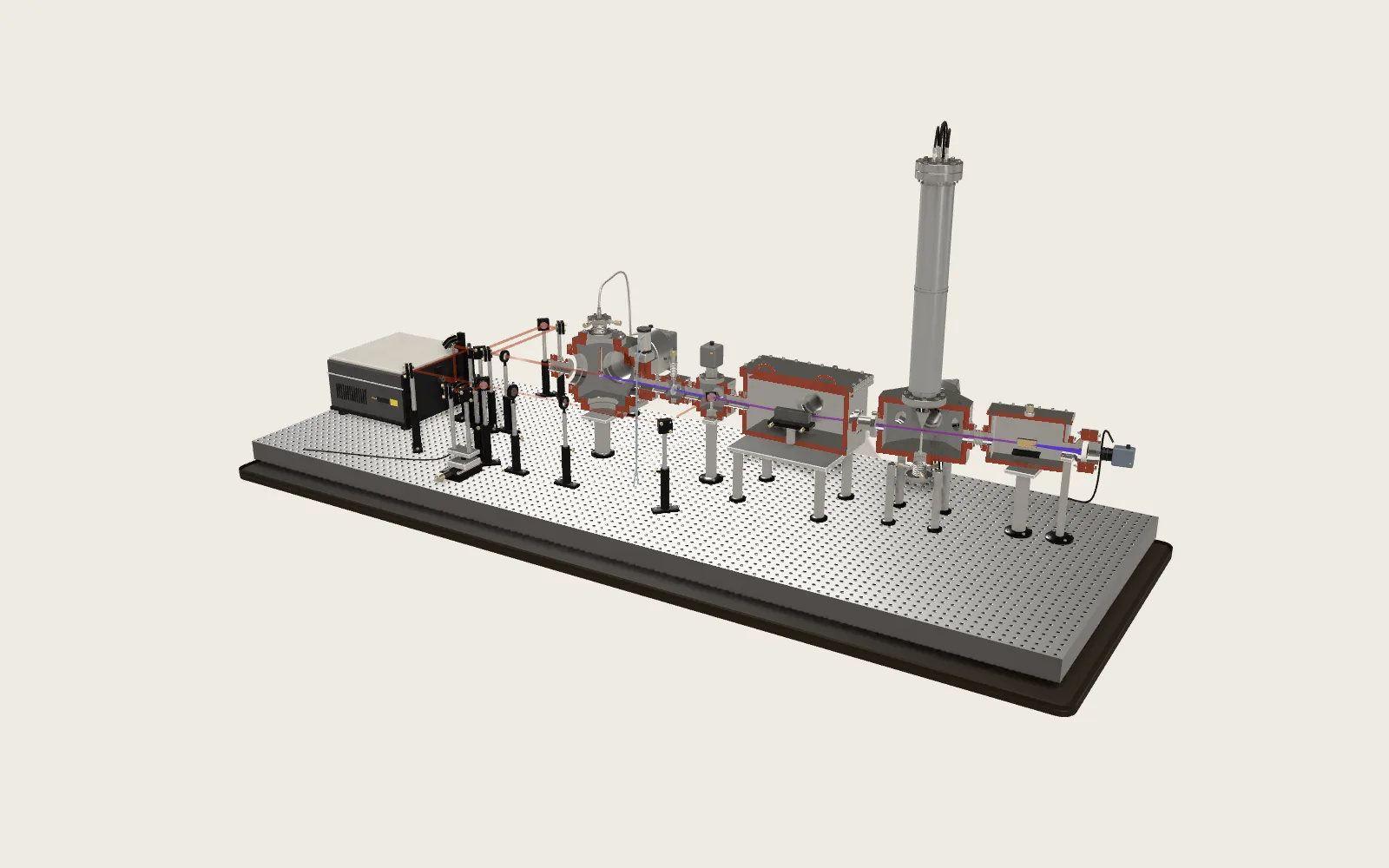 Plate F34Attosecond Light PulsesAn intense infrared laser is fired into a noble gas; electrons in the gas are pulled out and slammed back, and every half cycle of the light they give off a flash of extreme ultraviolet a few hundred attoseconds long. The 2023 Nobel Prize in Physics went to the experimental methods that make these flashes.
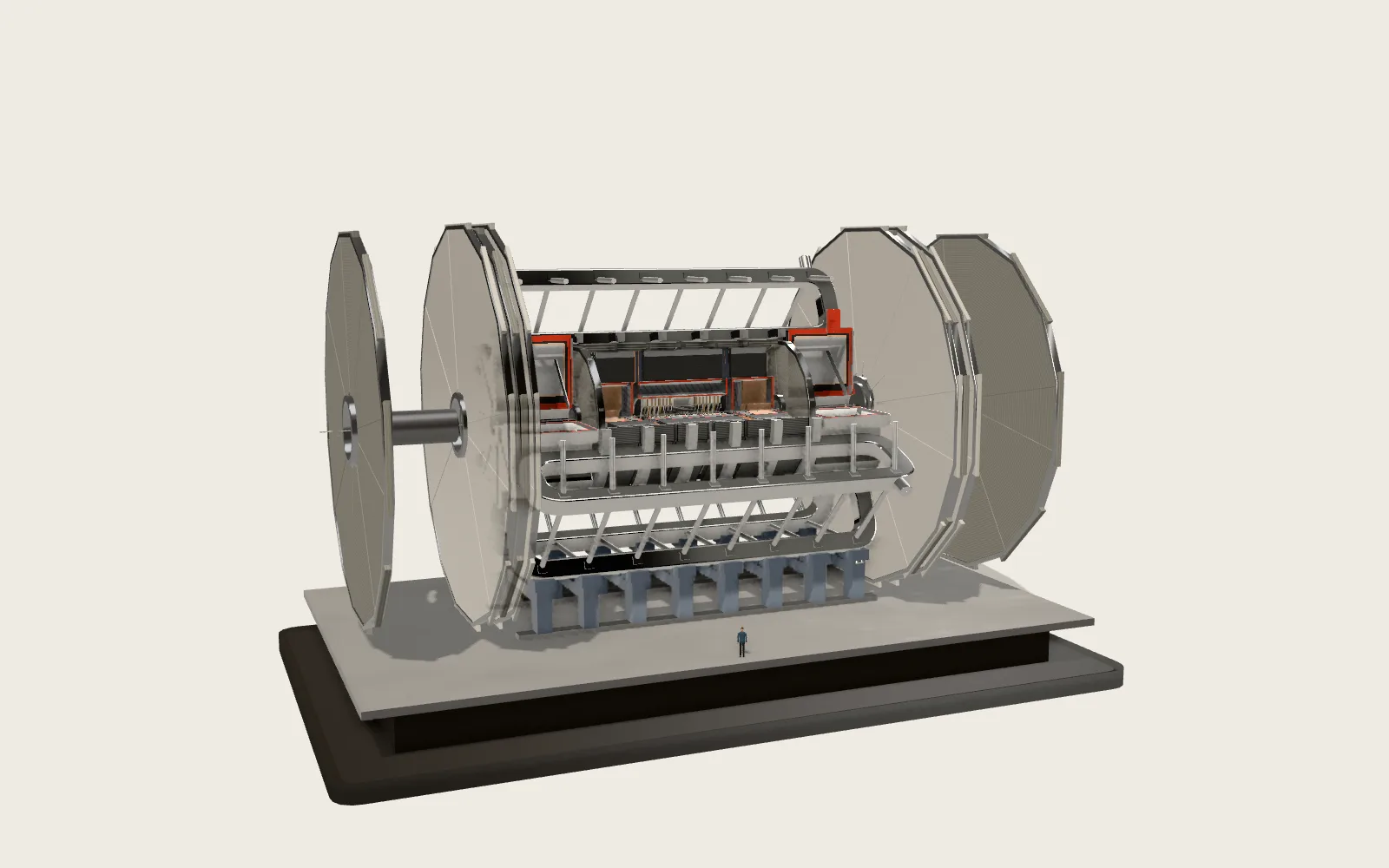 Plate F28ATLAS and the Higgs BosonThe Large Hadron Collider smashes protons head-on, and the energy of the collision becomes new particles. A Higgs boson decays as soon as it is made; ATLAS records the photons and leptons it leaves and works its mass back out.
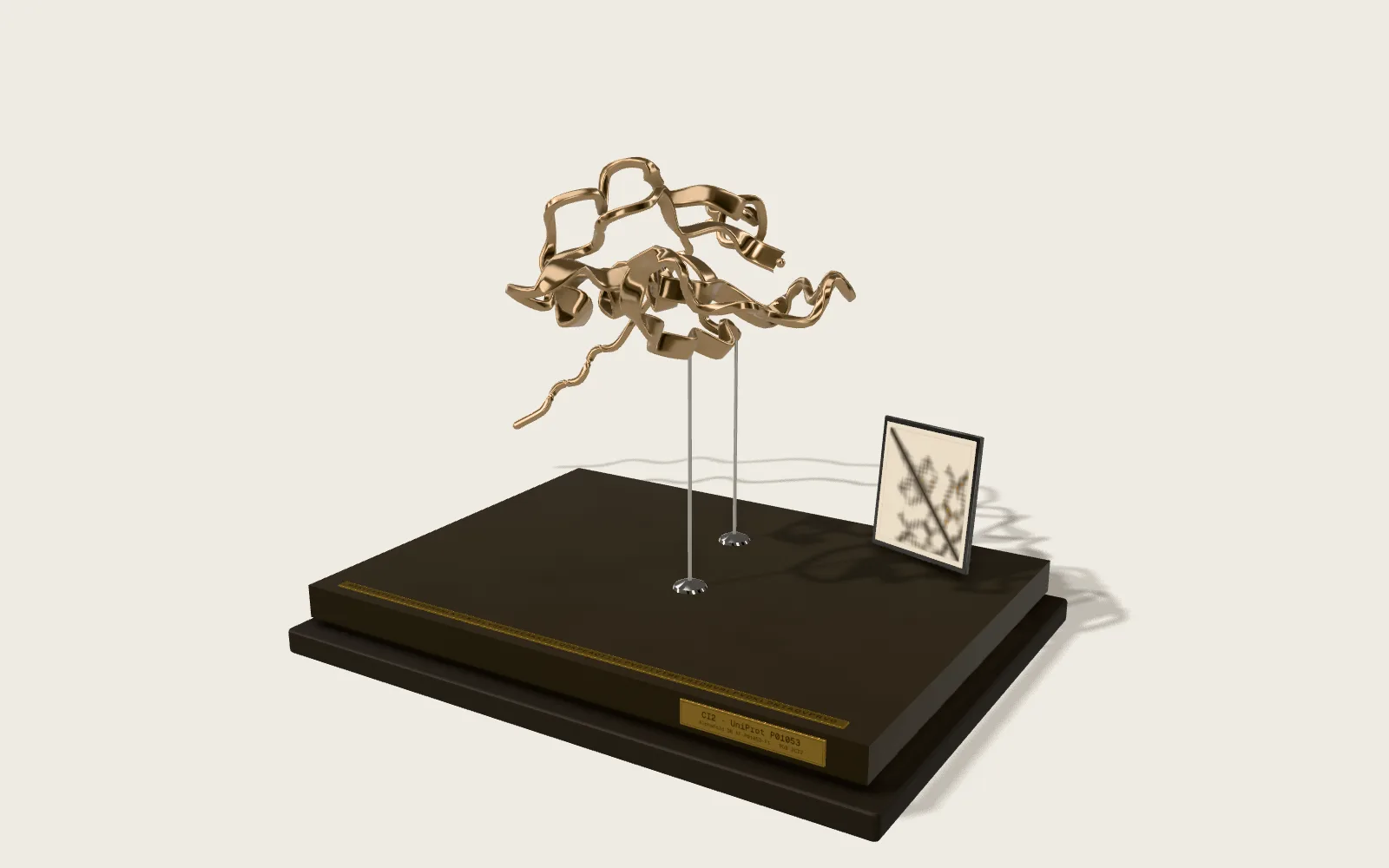 Plate F19AlphaFold: A Protein’s Shape from Its SequenceA bronze ribbon model of a barley protein: 84 amino acids folded as AlphaFold predicts them, beside an enamel plate with its distance map, and the crystal structure that can be set inside it.