ATLAS and the Higgs Boson
In a 27 km ring two beams of protons collide head-on. The energy becomes new particles, most of which decay at once. ATLAS records the debris, and in it found the Higgs boson.
Scroll
Weighed to 0.09%
In 2023 the ATLAS Collaboration, using data from two runs, put the mass of the Higgs boson at 125.11 ± 0.11 GeV, a precision of 0.09%. The GeV is the usual unit of mass in particle physics; a proton is about 0.94 GeV.
Nobody has ever seen the particle itself. The Standard Model predicts it lives about 1.6 × 10⁻²² s, less time than light needs to cross 50 femtometres. A detector records what it decays into, two photons, say, or four leptons, and works its mass back out from their energies and directions.
125.11 ± 0.11 GeV (ATLAS, 2023) · lifetime about 1.6 × 10⁻²² s (Standard Model)
A 27-Kilometre Ring
The Large Hadron Collider (LHC) lies underground near Geneva, 26,659 metres round. Two beams of protons travel in opposite directions in two pipes side by side, going round 11,245 times a second.
They are bent by 1,232 superconducting dipole magnets, each 15 m long, designed for 8.33 tesla. The magnets sit in superfluid helium at 1.9 K, colder than the 2.7 K of space. Since 5 July 2022 each beam has carried 6.8 TeV, so the protons collide at 13.6 TeV. Superconducting coils are also on the plate “Tokamak”.
Circumference 26,659 m · 1,232 dipoles · 1.9 K · 6.8 TeV per beam
Energy Into Mass
A proton is made of quarks and gluons. When two protons collide, two of these actually meet, carrying part of the protons’ energy. That energy can become particles that were not there before; by E = mc², the more energy, the heavier the particles it can make.
Most heavy particles decay at once. What reaches the detector is electrons, photons, muons, sprays of hadrons, and neutrinos. Add up the energies and momenta of the decay products and work out their “invariant mass”: however fast the parent was flying, it comes out as the parent’s mass.
m²c⁴ = (ΣE)² − |Σp c|²: the invariant mass of the products is the mass of the parent
Forty Million a Second
The protons fly in bunches 25 ns apart, about 7.5 m. At the centre of ATLAS the bunches cross 40 million times a second; in the third run, from 2022, each crossing brings on average up to about 60 proton collisions.
All of it cannot be kept. The first-level trigger is hardware: it decides within 2.5 µs and keeps at most 100,000 crossings a second. The second level is a computer farm; in the third run it writes about 3,000 a second on average, in 2012 about 400. The rest are lost. In CERN’s words, a Higgs boson is made about once in a billion collisions.
40 million a second → 100,000 a second (within 2.5 µs) → about 3,000 a second written (Run 3)
Cut Open: 7,000 Tonnes
ATLAS is a cylinder lying on its side, 46 m long and 25 m across by ATLAS’s public figures, and it weighs about 7,000 tonnes. It stands in a cavern about 100 m underground. This model is about 1 : 40; the figure on the floor is 1.75 m tall.
From the centre outwards, layer within layer: round the beam pipe, the inner detector inside a superconducting solenoid; then the liquid-argon electromagnetic calorimeter and the hadronic calorimeter of steel and scintillating tiles; outermost, eight toroid coils with the muon chambers hung between them. About 3,000 km of cable carry about 100 million readout channels out.
46 × 25 m · 7,000 t · model about 1 : 40 · feet, struts and chamber layout schematic
Tracks in Two Tesla
The inner detector fills a cylinder 1.15 m in radius and 7 m long. Its innermost layer is silicon pixels, only about 3.3 cm from the beam, each 50 × 250 µm; then silicon strips; then about 300,000 straw tubes 4 mm across. A charged particle leaves one point in each layer.
The solenoid makes a 2-tesla field, which bends a charged particle’s path into an arc. The radius is the transverse momentum divided by 0.3 times the field: a 1 GeV particle curves with a radius of about 1.7 m; one of 50 GeV is nearly straight. How much it bends gives its momentum.
Radius R = p_T / (0.3 B): at B = 2 T, 1 GeV gives about 1.7 m
Stopping Particles
An electron or a photon that hits lead turns into a growing spray of weaker electrons and photons, an electromagnetic shower. ATLAS’s electromagnetic calorimeter is lead folded like an accordion, in liquid argon at about −184 °C, at least 22 radiation lengths deep; the shower stops in it. The charge collected is proportional to the particle’s energy.
Hadrons such as protons, neutrons and pions get further. The tile calorimeter outside uses steel plates as the absorber with hundreds of thousands of plastic scintillating tiles between them, 64 wedges to a barrel. Hadrons shower in it, the tiles glow, and about 9,500 photomultipliers turn the light into signals. At about 2,900 tonnes it is the heaviest part of ATLAS.
Electromagnetic: lead + liquid argon, accordion · hadronic: steel + tiles, 64 wedges
Magnets Full of Air
Hardly anything stops a muon; it passes through the calorimeters. The muon spectrometer outside measures it. The eight barrel toroid coils are each 25.3 m long and together 20.1 m across; at 20.5 kA they store 1.08 GJ. At each end sits an end-cap toroid.
Between the coils there is air, not iron, so a passing muon is scattered very little. The field runs round the beam, so it bends muons along the beam’s direction. Three layers of chambers, at radii of about 5, 7.5 and 10 m, measure the bend with drift tubes 3 cm across; the wheels at the ends are about 25 m in diameter.
Barrel toroid: 8 coils · 25.3 m · 20.1 m across · about 0.5 T where the muons fly
Where Each One Stops
Each kind of particle leaves its own trace. An electron leaves a track and stops in the electromagnetic calorimeter; a photon, with no charge, leaves no track and stops there too; quarks and gluons turn into a spray of hadrons called a jet, a few tracks with most of the energy in the tile calorimeter; a muon leaves a track, passes all the calorimeters and leaves a few more points in the muon chambers.
A neutrino leaves nothing. Across the beam the total momentum before the collision is zero, so the momenta seen after it should also add up to zero. What is missing, the missing transverse momentum, was carried off by what cannot be seen.
Electron · photon · muon · jet · neutrino, and the layer each one stops in
4 July 2012
On this day ATLAS and CMS each reported at a seminar at CERN a new particle near 125 GeV. ATLAS, with 4.8 fb⁻¹ of 7 TeV data from 2011 and 5.8 fb⁻¹ at 8 TeV from 2012, found a mass of 126.0 GeV and a local significance of 5.9 σ; CMS found 125.3 GeV and 5.0 σ.
The signal came mainly from two decays. Two photons: between 100 and 160 GeV ATLAS selected 59,039 photon pairs, of which about 190 were expected from a Higgs boson, and they piled up into a small bump near 126.5 GeV. Four leptons: 13 events between 120 and 130 GeV, where background alone predicted about 4.9. A local 5.9 σ means that background alone would throw up so large a bump with a probability of about 1.7 × 10⁻⁹.
ATLAS 5.9 σ (γγ 4.5 σ · 4ℓ 3.6 σ · WW 2.8 σ) · CMS 5.0 σ
The 2013 Nobel Prize
The 2013 Nobel Prize in Physics went to François Englert and Peter W. Higgs “for the theoretical discovery of a mechanism that contributes to our understanding of the origin of mass of subatomic particles, and which recently was confirmed through the discovery of the predicted fundamental particle, by the ATLAS and CMS experiments at CERN’s Large Hadron Collider”. In 1964 Englert, with the late Robert Brout, and Higgs proposed the theory independently.
The prize was for the mechanism; the experiments confirmed the particle. The Higgs field gives mass to the W and Z bosons and to fundamental particles such as electrons and quarks, but it is not where all mass comes from. The three quarks in a proton add up to only about 1% of its mass; almost all the rest is the energy of the strong interaction binding quarks and gluons together. Nor did the theory predict how heavy the Higgs boson itself is.
1964 theory · 2008 LHC start · 2010 7 TeV collisions · 2012 discovery · 2013 prize
Taken Apart
The beam pipe, the inner detector, the solenoid, the liquid-argon calorimeter, the tile calorimeter, the eight barrel coils, the muon chambers, the end-cap calorimeters, the end-cap toroids, the muon wheels and the shielding, one by one.
Point at a part and it lifts out alone, the rest fading; at rest, every part is named.
Event by Event
The lever sets how fast data arrive. Each event’s invariant mass drops into a bin: above, the mass of two photons; below, of four leptons. No event says whether it is background or signal, and the page does not know either.
Every so often the page fits the two histograms together: a smooth curve for the background, a narrow peak at 125.1 GeV for the signal, and it compares how well “a peak” and “no peak” describe the data to give a local significance. It is a simulation, generated from the event counts and background shapes published in 2012; it uses two channels and no categories, cruder than ATLAS’s analysis, so at 10.6 fb⁻¹ it often stays below 5 σ.
Try thisPush the lever to full and watch the local significance when the data reach 10.6 fb⁻¹, the amount of the 2012 discovery. Start again: is the number the same?
What the model leaves out
The model follows the sizes in the ATLAS detector paper (2008), at about 1 : 40: the inner detector, the solenoid, the liquid-argon and tile calorimeters, the barrel and end-cap toroids, three stations of muon chambers and the wheels at the ends are in the right places; the feet, the struts between the coils, the service turrets and the layout of the chambers and of the wheels’ sectors are schematic, not engineering drawings. The middle and outer muon chambers that sit on the eight coils are left out; in the wide views cut along the beam the other middle and outer chambers are taken off too and the wheels at the ends stay whole, so the eight coils and their struts show. The length is ATLAS’s public 46 m; the collaboration’s detector papers give 44 m. The New Small Wheels of the third run are not drawn separately. The bunches in the beams are drawn far thicker than they are; their 7.5 m spacing is to scale. The accordion, the tiles and the drift tubes in the sections are patterns at their real spacing, fading to an average colour where they are too fine to see. The events are made by the page: tracks bend only inside the solenoid and run straight beyond it; showers are blocks in the calorimeters whose length stands for their energy; the bend of muons along the beam in the toroid field is drawn only in the small figure of “Magnets Full of Air”, thirty times larger than it is. The laboratory’s simulation: the diphoton background follows the paper’s count of candidates (59,039 in 10.6 fb⁻¹) and a smoothly falling spectrum; the signal is the paper’s roughly 190 expected events times the signal strength ATLAS measured in this channel, 1.8, with a mass resolution of 1.6 GeV; the four-lepton background is about 4.9 events within 120–130 GeV and the signal about 5.3 events times 1.2, and the size of the single Z-boson peak at 91 GeV is illustrative. The fit uses the same family of curves for the background as the generator (ATLAS used a fourth-order Bernstein polynomial for this spectrum), fixes the mass at 125.1 GeV, and computes the significance from the likelihood ratio q₀ as Z = √q₀.
Common misreadings
5 σ does not mean “99.99997% sure the particle exists”. It means that background alone would fluctuate into so large a bump with a probability of about one in 3.5 million. That is the “local” significance, at one mass; allowing for having looked across a wide range of masses, ATLAS’s global significance in 2012 was 5.1 σ. The bump’s width comes from the detector’s resolution, about 1.6 GeV; the particle itself is only about 4 MeV wide. The Higgs boson is not a “God particle” and does not give everything its mass: most of your weight is protons and neutrons, whose mass is mostly the energy of the strong interaction. The LHC’s collisions are safe: cosmic rays have hit the Earth at higher energies for billions of years, and a panel of experts reviewed the risks for CERN and found none.
Common questions · 5
- What is the mass of the Higgs boson?
In 2023 the ATLAS Collaboration, using data from two runs, put the mass of the Higgs boson at 125.11 ± 0.11 GeV, a precision of 0.09%.
01Weighed to 0.09% ↑- Why can’t the Higgs boson itself be seen?
The Standard Model predicts it lives about 1.6 × 10⁻²² s, less time than light needs to cross 50 femtometres.
01Weighed to 0.09% ↑- How does a detector notice a neutrino?
Across the beam the total momentum before the collision is zero, so the momenta seen after it should also add up to zero.
09Where Each One Stops ↑- How sure was the 2012 Higgs discovery?
A local 5.9 σ means that background alone would throw up so large a bump with a probability of about 1.7 × 10⁻⁹.
104 July 2012 ↑- Does the proton get its mass from the Higgs field?
The three quarks in a proton add up to only about 1% of its mass; almost all the rest is the energy of the strong interaction binding quarks and gluons together.
11The 2013 Nobel Prize ↑
Sources
- ATLAS Collaboration (2012): Observation of a new particle in the search for the Standard Model Higgs boson with the ATLAS detector at the LHC, Phys. Lett. B 716, 1 (4.8 + 5.8 fb⁻¹; 126.0 ± 0.4 ± 0.4 GeV; 5.9 σ, p₀ = 1.7 × 10⁻⁹; γγ 4.5 σ, 4ℓ 3.6 σ, WW 2.8 σ; 23,788 + 35,251 photon pairs, expected signal 79.6 + 110.5; σ_CB 1.6 GeV; 13 events in the 4ℓ window; global 5.1 σ)
- CMS Collaboration (2012): Observation of a new boson at a mass of 125 GeV with the CMS experiment at the LHC, Phys. Lett. B 716, 30 (125.3 ± 0.4 ± 0.5 GeV, 5.0 σ)
- ATLAS Collaboration (2008): The ATLAS Experiment at the CERN Large Hadron Collider, JINST 3, S08003 (sizes of the subdetectors, magnet parameters, performance goals)
- ATLAS Collaboration (2024): The ATLAS experiment at the CERN Large Hadron Collider: a description of the detector configuration for LHC Run 3, JINST 19, P05063 (IBL at 33.4 mm; up to about 60 collisions per crossing in Run 3; about 3 kHz recorded)
- L. Evans, P. Bryant (2008): LHC Machine, JINST 3, S08001 (dipoles 8.33 T, apertures 194 mm apart; tunnel 45 to 170 m underground)
- ATLAS Collaboration (2023): Combined measurement of the Higgs boson mass, Phys. Rev. Lett. 131, 251802 (125.11 ± 0.11 GeV, 0.09% precision)
- ATLAS Collaboration (2017): Performance of the ATLAS trigger system in 2015, Eur. Phys. J. C 77, 317 (first level 100 kHz; about 400 Hz recorded in 2012)
- ATLAS Collaboration (2024): The ATLAS trigger system for LHC Run 3 and trigger performance in 2022, JINST 19, P06029 (decision within 2.5 µs; about 3 kHz)
- CERN: The Large Hadron Collider (26,659 m, 11,245 turns a second, 6.8 / 13.6 TeV, bunches 25 ns apart, safety)
- CERN: Pulling together: superconducting electromagnets (1,232 dipoles, 15 m each)
- CERN: Cryogenics: low temperatures, high performance (1.9 K, superfluid helium)
- CERN: How did we discover the Higgs boson? (a Higgs boson about once in a billion collisions)
- CERN press release, 4 July 2012
- CERN: the third run starts, 5 July 2022
- ATLAS: The ATLAS detector (46 × 25 m, 7,000 t, 100 m underground)
- ATLAS: Magnet System (the solenoid, the barrel and end-cap toroids)
- ATLAS: Calorimeter (liquid argon at −184 °C; about 420,000 tiles, 9,500 photomultipliers; about 2,900 t)
- ATLAS: Trigger and Data Acquisition (up to 1.7 billion collisions a second)
- Nobel Prize: 2013 physics press release (Englert, Higgs)
- Nobel Committee for Physics: 2013 scientific background
- F. Englert, R. Brout (1964): Broken Symmetry and the Mass of Gauge Vector Mesons, PRL 13, 321
- P. W. Higgs (1964): Broken Symmetries and the Masses of Gauge Bosons, PRL 13, 508
- Particle Data Group (2025): Status of Higgs Boson Physics (SM width 4.1 MeV; branching ratios)
- Particle Data Group (2025): quark masses (u about 2.16 MeV, d about 4.70 MeV)
- Y.-B. Yang et al. (2018): Proton Mass Decomposition from the QCD Energy Momentum Tensor, PRL 121, 212001
- J. Ellis et al. (2008): Review of the Safety of LHC Collisions (the LHC Safety Assessment Group)
Data
The model follows the ATLAS detector paper (JINST 3 S08003) for the sizes and places of the inner detector, the solenoid, the calorimeters, the toroids and the muon stations; the feet, the struts between the coils, the turrets, the chambers’ layout and the wheels’ sectors are schematic. It is not built from engineering drawings. The histograms in the laboratory, the events in the detector and the significance are computed by this page from a simulation shaped after the published numbers (ATLAS, Phys. Lett. B 716 (2012) 1); they are not ATLAS data. Material presets, parts and the softbox studio of the site’s model kit are ported from AirsupHQ/machine-skill (MIT, © 2026 Air Supply Technologies Inc.).
The text, pictures and models on this page are licensed CC BY-NC 4.0: free to use and adapt for teaching and other non-commercial purposes, with credit to world.lapla.si. Third-party material listed above keeps its own licence.
Cite this plate
Laplace’s Mini World, Plate F28, “ATLAS and the Higgs Boson”, https://world.lapla.si/en/lhc/, CC BY-NC 4.0, updated 2026-10-21.
Follow the question
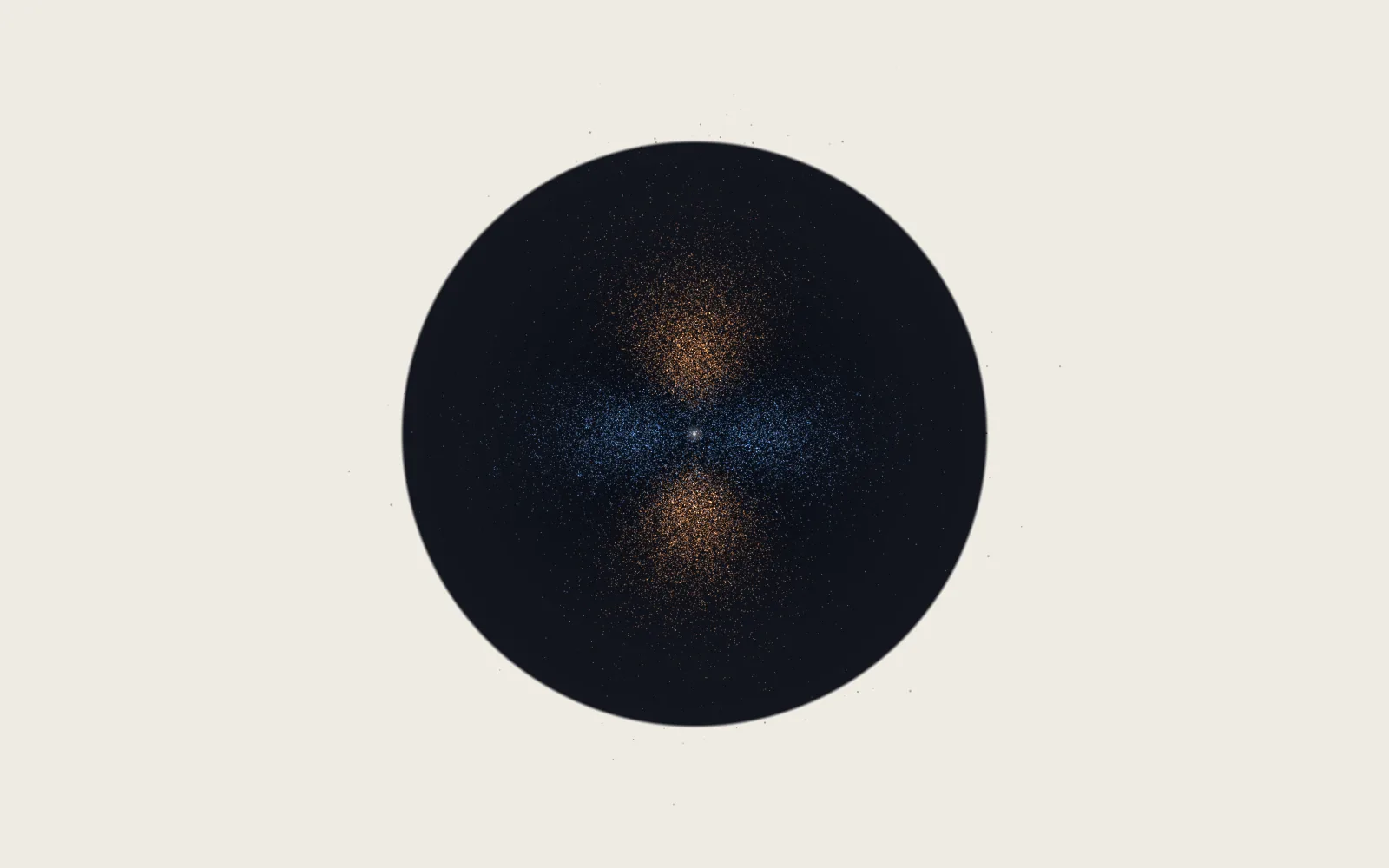 Plate 36Where Is the Electron?Textbooks often draw electrons as little balls circling the nucleus. In fact an electron has no orbit. It is more like a cloud: all we can say is where it is likely to be.
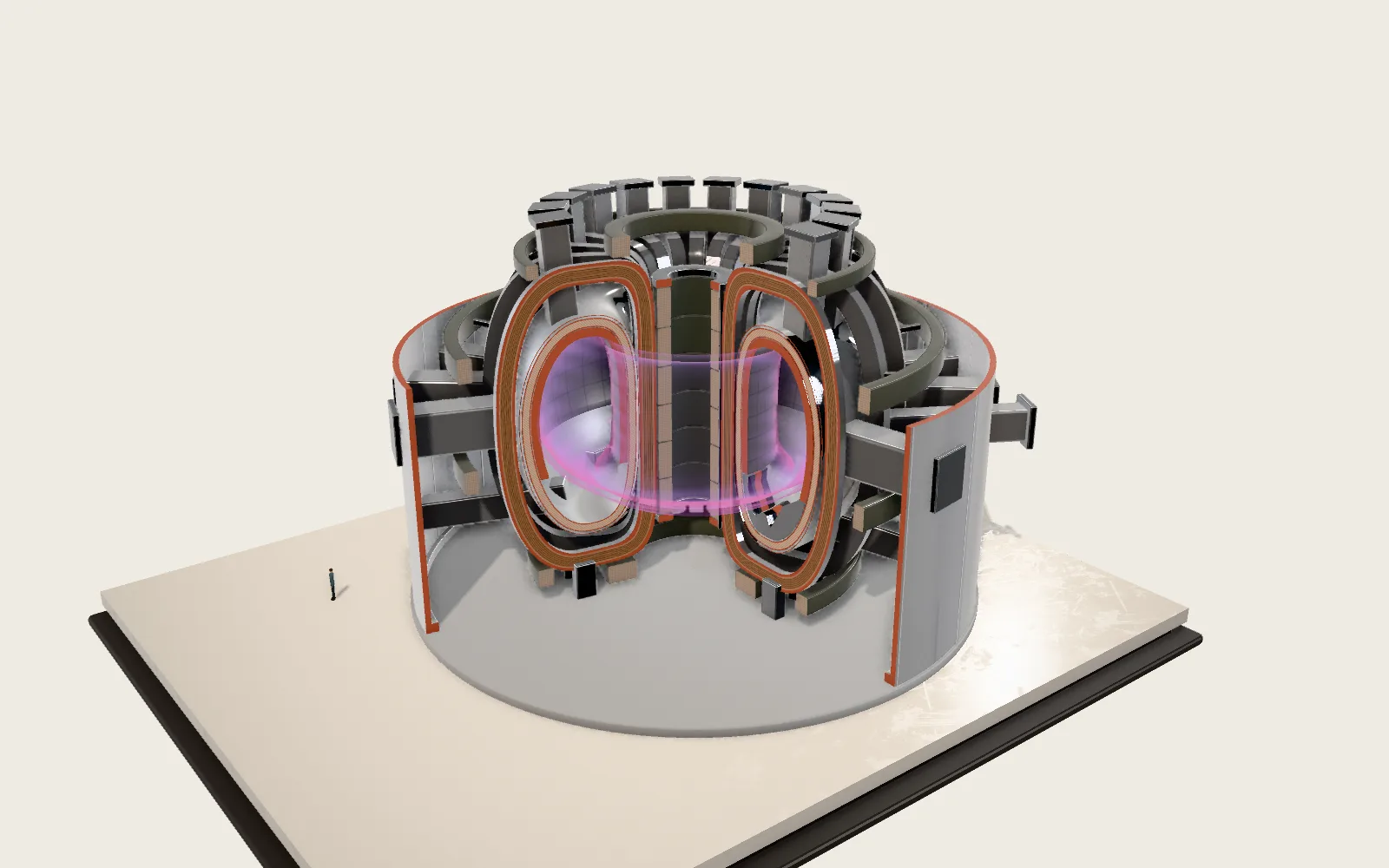 Plate F06Tokamak Fusion ReactorA tokamak like ITER: eighteen D-shaped superconducting coils round a ring-shaped vacuum vessel, inside which a deuterium–tritium plasma at about 150 million degrees hangs in a magnetic field.