Five-Axis Machining Centre
Jet-engine blisks, turbocharger impellers, artificial joints and moulds are all complex curved surfaces, and in many places a cutter can only reach in at a slant. A five-axis machining centre tilts and turns the part so the cutter always meets it at a good angle. In the model, the machine is cutting an impeller from an aluminium billet 210 mm across.
Scroll
Thousandths of a Millimetre
On the plinth are two parts made on five-axis machines: a compressor impeller and a blisk. The blades are thin and curved, and every point has to match the surface in the drawing.
Makers specify the positioning accuracy of these machines at about 3 to 8 µm, a few thousandths of a millimetre; repeatability is finer still. A human hair is about 70 µm across.
Positioning accuracy about 3–8 µm (makers’ figures, to differing standards)
Five Axes
Three straight axes, X, Y and Z, move the spindle: left and right, back and forth, up and down. The other two are rotary axes, both on the table side: the cradle tilts about A, and the round table turns about C.
This layout is called a trunnion, or table-table, machine; some makers call the tilting axis B. The cradle commonly tilts from −120° to +30°, some as far as ±130°, and the table turns all the way round. The spindle always points straight down; it is the part that changes its angle.
X Y Z move the spindle · A tilts the cradle · C turns the table
Why Five
An impeller’s blades lean, and they overhang one another. A three-axis machine can only bring the cutter straight down: it can’t reach under the blades, and it can’t turn the cutter to follow a curved surface.
A five-axis machine tilts and turns the part so the cutter goes into the channel along the blades. The cutter can then be short: at the same thickness, a shorter cutter bends less and chatters less, and cuts a truer surface.
Red: a vertical cutter would hit the blades
The Tip Stays on the Path
When A and C turn, every point on the part moves away. The control works out at the same time how far X, Y and Z must make up, so the tool tip stays on its path. This is called tool-centre-point control, often written RTCP or TCPM.
The line is the toolpath, the route the tip takes over the part. All five axis readings change together: five-axis simultaneous machining.
The path turns with the part · all five axes interpolated together
Tip and Flank
Finishing can be done two ways. Point milling sweeps the surface row by row with the tip of a ball-nose cutter; it can make any shape, and suits free-form surfaces such as the hub. Flank milling lays the side of the cutter against the blade and sweeps a whole wall in one pass; it is faster and leaves a better finish, but the blade has to be designed as a ruled surface.
Both need five axes: the cutter’s direction has to keep changing as it moves.
Point milling: the tip touches · flank milling: the side touches
Cut Open: the Spindle
The spindle is itself a motor: the stator is fixed in the housing and the rotor sits on the shaft, with no belt or gears. Sets of angular-contact ball bearings at the front take the cutting forces. Common spindles run at 12,000 to 20,000 rpm; high-speed ones reach about 42,000.
The holder fits an HSK interface: a short hollow taper of 1:10. A stack of disc springs pulls the drawbar up, and the gripper pulls the holder in from inside, so the taper and the face both seat. To change tools, a hydraulic cylinder pushes the drawbar down and the holder comes free.
HSK holder · 1:10 taper · taper and face in contact together
Scales and Heat
How far a servo motor has turned is not how far the table has moved: the ballscrew grows as it warms. Precision machines carry a linear scale beside each straight axis that reads the position directly: a good glass scale is true to ±3 µm over a metre and resolves steps of 1 nm.
Steel grows by about 11.5 µm per metre for each degree it warms. A fast spindle makes heat and, uncorrected, can grow by tens of micrometres. Machines carry the heat away with circulating coolant and correct the position from temperature sensors. Most machines of this kind drive their slides with ballscrews, at rapids of about 60 m/min; some use linear motors with no screw at all, at about 1 g.
Steel: about 11.5 µm per metre per degree · a spindle 6 K warmer grows about 21 µm over 30 cm (estimate)
Tool Changer, Probe and Coolant
The magazine on board holds 30 to 60 tools, and add-on stores hold hundreds. A change takes a few seconds: the spindle sets the old tool down in its empty pocket, the magazine turns the next one under it, and the spindle comes down and clamps it.
Before cutting, the spindle picks up a probe. When the stylus’s ruby ball touches the part, the probe sends a signal, the control records the position and works out exactly where the part sits. While cutting, coolant sprays from the nozzles onto the tip, or through the spindle and the tool itself, commonly at 40 or 80 bar, to carry off heat and chips; the guarding and glass door keep both inside.
Probe repeatability about 1 µm (makers’ figure)
From a Solid Block
The impeller starts as a solid bar of aluminium. First its outline is cut, then the channels one by one, and last the hub and blades are finished. For this impeller about three quarters of the metal turns to chips.
Jet-engine blisks are made the same way: blades and disk are one piece of titanium or nickel alloy, milled from a solid block; three quarters of the material or more is cut away, over tens of hours per part. Orthopaedic implants, prostheses and the cavities of moulds are often machined on five-axis machines too.
The model’s toolpath is greatly simplified and played faster
Taken Apart
The machine is made of a few large parts: the cast-iron bed and side walls, the bridge (Y), the saddle (X), the ram and spindle (Z), the cradle (A) and table (C), the tool magazine, and the guarding with its control panel. A machine of this size weighs about 7 to 14 tonnes.
Each part moves apart; whichever one the pointer rests on is lifted out and named.
Spindle Speed
At a fixed chip thickness per tooth, feed rate = spindle speed × number of teeth × feed per tooth. The faster the spindle, the faster the feed, and the sooner a channel is done.
Try thisRaise the spindle from 12,000 to 24,000 rpm at the same feed per tooth: what happens to the feed rate?
What the model leaves out
This is a generic trunnion five-axis machine, not any maker’s design; the proportions and the placing of the guides and screws are drawn to read clearly. The impeller is drawn 200 mm across, with nine main blades and no splitter blades. The toolpath is greatly simplified: a real impeller takes thousands of passes and often hours of roughing and finishing; here one cycle takes under three minutes. The spindle is drawn turning very slowly, and the chips and coolant are only suggested. The thermal growth figures are estimates from steel’s expansion coefficient, not any machine’s.
Some common misreadings
“Five-axis” means five motion axes that can be interpolated together, not five cutters or five spindles. Positioning accuracy and repeatability are different things, and makers measure them to different standards (ISO 230-2, VDI/DGQ 3441, JIS and others), so the figures can’t be compared directly. A machine’s accuracy is not the part’s accuracy either: tool wear, cutting forces, heat and clamping all affect the final size.
Sources
- Hermle: C 42 GEN2 technical data (travels, ±130° swivel, spindle speeds, 42 pockets and 4.5 s chip to chip, 40/80 bar coolant, ISO 230-2 positioning uncertainty ≤ 0.006 mm, about 13.5 t)
- Hermle: C 42 brochure, 2016 (10,000–42,000 rpm spindles, VDI/DGQ 3441 positioning 0.008 mm, direct measuring)
- Makino: DA300 (A axis +30° to −120°, C 360°, 20,000 rpm HSK-A63, tool-centre-point control)
- Makino: D500 (A +30/−120, 12,000–30,000 rpm spindles)
- Mazak: VARIAXIS i series catalogue (A −120° to +30°, i-600 positioning about 3 µm as tested)
- Mazak: accuracy technology (cutting-edge position held against speed and temperature)
- DMG MORI: DMU 50 3rd generation (swivel axis called B, linear scales in all axes, cooled motor spindle and screw nuts, 40 bar coolant)
- DMG MORI: DMU 65 monoBLOCK (4 µm positioning as standard, multi-sensor compensation, up to 30,000 rpm)
- Matsuura: MAM72-35V (thermal displacement compensation)
- HEIDENHAIN: Linear encoders for NC machine tools (accuracy grades ±3 / ±5 µm per metre, 0.001 µm measuring step)
- HEIDENHAIN: Accuracy of feed axes (ballscrew growth; negligible drift with a linear scale)
- HEIDENHAIN: Machining accuracy of machine tools (1 K gives up to 10 µm over 1 m)
- HEIDENHAIN: TNC options (TCPM: linear axes compensate the tilting axes)
- Siemens: SINUMERIK five-axis programming (TRAORI, compensating movements)
- Kaye & Laby (NPL): thermal expansion coefficients (steel, cast iron, aluminium, titanium)
- Yuksel, Budak et al. (2021): thermal growth of a high-speed spindle, MM Science Journal (up to about 88 µm in Z)
- CTE Magazine: DMC 60 H linear (linear drives, about 1 g, up to 100 m/min)
- BIG DAISHOWA: HSK 101 (hollow 1:10 taper, taper and face contact)
- ISCAR: HSK DIN 69893 / ISO 12164-1 data (HSK-A63 flange 63 mm)
- OTT-JAKOB patent US7393165 (disc-spring drawbar, hydraulic release)
- SKF: super-precision hybrid angular-contact bearings for spindles
- Renishaw: OMP40-2 data sheet (1.00 µm 2σ unidirectional repeatability; set-up and inspection)
- OPEN MIND: hyperMILL impeller and blisk machining (point and flank milling)
- Siemens NX: tilting the tool axis to use the shortest tool
- AEROREPORT (MTU): titanium blisks milled on a five-axis machine in about 40–60 hours
- SNECMA patent US20110016715A1 (blisk milling removes up to 75 % of the material or more)
- Hermle: applications (mould insert, bone plate, impeller mould)
- DMG MORI: medical (five-axis machining of implants and prostheses)
- Sandvik Coromant: milling formulas (vf = fz × n × z, vc = π × D × n / 1000)
- US EPA: particulate matter basics (a hair about 70 µm across)
Follow the question
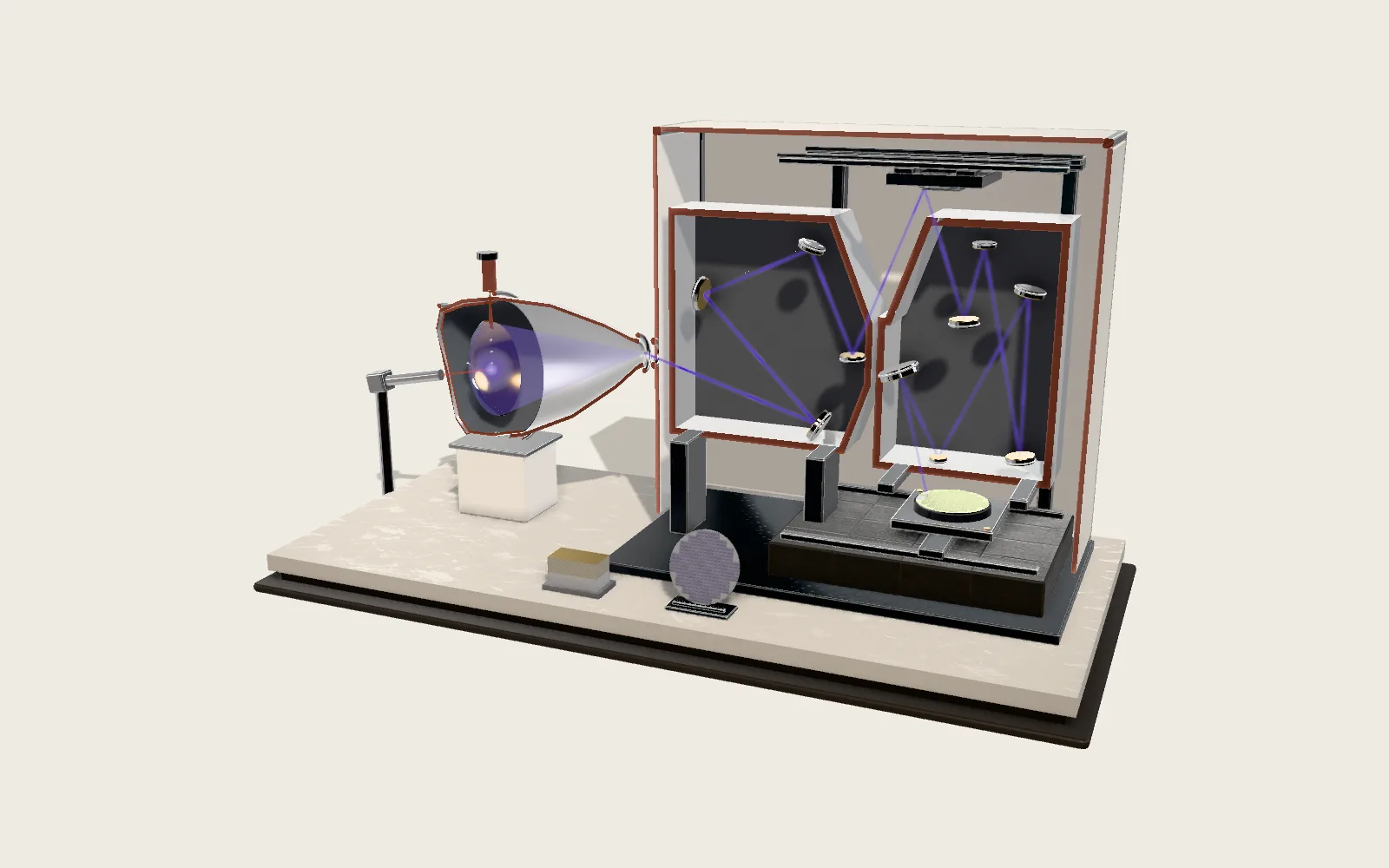 Plate F01EUV Lithography MachineLight 13.5 nm long prints a chip’s circuits on silicon, four times smaller than the mask. It comes from tin droplets turned to plasma, and travels only by mirrors.
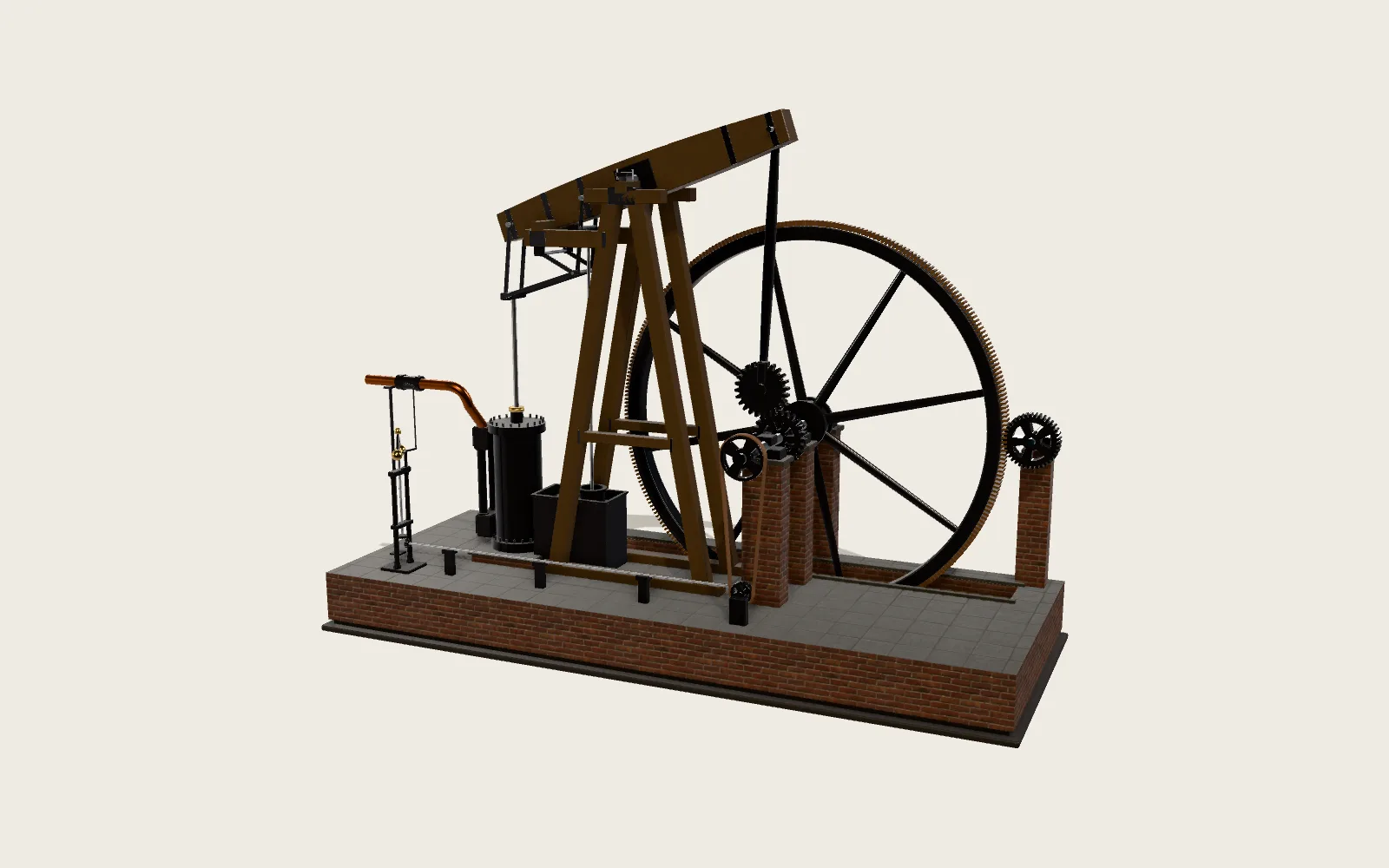 Plate C01Watt’s Steam EngineAn iron vessel standing in cold water saved most of the coal; two spinning balls taught the engine its own pace. Built in Birmingham in 1788, it stands at rest in London today.