Watt’s Steam Engine
James Watt did not invent the steam engine. Half a century before him, engines were already pumping water from English mines, but at every stroke they chilled their own cylinder and then had to warm it again. Watt gave cold and heat each a place of its own, and the same coal did twice the work; twenty years on, he and his partner were building engines that drove whole factories. This one, built in 1788, is the oldest rotative steam engine in the world to survive essentially unaltered.
Scroll
Between Cold and Hot
From 1712, Thomas Newcomen’s engines stood beside English mines, pumping. The cylinder filled with steam; a spray of cold water followed; the steam shrank to a few drops, the cylinder was left nearly empty, and the weight of the air outside pressed the piston down and worked the pumps below.
The trouble lay in that same spray. It condensed the steam, and it chilled the iron walls. The next charge of steam had first to warm the iron again, and much of it turned to water on the cold metal before it did any work. Cold, then hot, stroke after stroke: the coal went with it, shovel by shovel.
Suppose this cylinder worked Newcomen’s way: cold water sprayed inside, the wall chilled and warmed again
A Separate Vessel
In the winter of 1763 the University of Glasgow asked its instrument maker, James Watt, to mend a teaching model of a Newcomen engine. Its hunger for steam astonished him, and the cold spray was to blame. On a Sunday walk across Glasgow Green in May 1765 the answer came: the steam need not condense in the cylinder at all. Let it pass into another vessel.
That vessel is the condenser. It stands in a cistern of cold water and is always cold; the cylinder, wrapped in a jacket of steam, is always hot. The condenser turns steam to water and leaves a vacuum, which draws the steam out of the cylinder; beside it an air pump carries off the water and whatever air creeps in. For the same work, Watt’s engine burned less than half the coal of Newcomen’s.
The cylinder stays hot, the condenser stays cold · between them, one pipe and a valve
Pushing Both Ways
Newcomen’s piston worked only on its way down; the weight of the pump rods hauled it back up. In 1782 Watt let the steam press on each face in turn. Steam enters above while the space below opens to the condenser, and the piston is driven down; at the bottom the valves change over, steam enters below, the space above opens to the condenser, and the piston is driven up.
In the opened cylinder, the warm colour is steam just let in; the cool colour, the side the condenser has emptied. Watt’s steam was barely stronger than the air outside. Much of what drove the piston was the emptiness on its other side.
Warm: steam · cool: the vacuum open to the condenser
A Straight Line out of an Arc
A piston that pushes as well as pulls brought a new difficulty. Older engines hung the piston rod from the arched end of the beam by a chain, and a chain can pull but never push. The end of the beam travels on an arc; the piston rod must slide straight in and out of the cylinder, or it will wear its seal away.
In 1784 Watt answered with a few jointed iron bars: a link hanging from the beam, a radius rod pinned to the frame, and a parallelogram. The thin line traces the arc of the beam’s end; the thick line, the path of the piston rod’s top, which over the four-foot stroke strays less than a centimetre from straight. Late in life he told his son it was the invention he was proudest of.
Arc: the end of the beam · line: the top of the piston rod
Sun and Planet
To drive a factory’s machines, back-and-forth had to become turning. A crank was the ready answer, but in 1780 James Pickard had patented the crank and connecting rod. Watt’s employee William Murdoch found another way, patented in Watt’s name in 1781: a gear wheel, the planet, fixed to the foot of the connecting rod. It never spins on its own axle; it travels around the sun wheel on the flywheel shaft and carries the sun round with it.
The two wheels are the same size, so for each lap of the planet the sun turns twice. For every rise and fall of the piston the sixteen-foot flywheel turns twice: one full turn for each stroke. Its heavy cast-iron rim smooths a push that swells and fades within every stroke into an even turning.
One lap of the planet · two turns of the sun and the flywheel
The Flyball Governor
An engine driving 43 polishing machines never knows a steady load: here a few machines stop, there a few start. When the load lightens, the engine runs faster and faster. In 1788 Boulton and Watt borrowed something from the windmills: two balls hung from a spindle the engine spins. Faster, and the balls swing out, lifting a collar that, through a lever, closes the throttle valve in the steam pipe; slower, and they fall, and the valve opens.
Each ball settles where the slanting pull of its arm both holds up its weight and keeps it circling the spindle: cos α = g / (ω²ℓ), with ω the speed of spin and ℓ the length of the arm. When every polishing machine stops, the balls fly out and the valve closes; when they all start again, the balls drop and it opens. Yet the speed never quite returns: with less load the engine settles a little faster. That is the nature of this kind of governor.
The faster the spin, the wider the balls, the narrower the valve
Taken Apart
The frame is English oak, pulled tight with wrought-iron straps and bolts, and the beam is timber too. Cylinder, gears and flywheel are cast iron; 304 wooden teeth set into the flywheel’s rim drive the shaft to the polishing shop; the governor’s balls and the valve fittings are brass. The bed is brick.
Taken apart, each piece goes its own way: the beam rises, the flywheel draws back, the cylinder steps aside. Whichever piece the pointer rests on is lifted out and named.
Cut Open
Teaching models in museums are often cut away by a quarter to show what lies within. Here the cylinder, the condenser cistern and the throttle valve are opened. The piston rises and falls while steam comes and goes at either end; in the condenser a jet of cold water breaks into mist, and steam that touches it turns to water; the air pump rises and falls with the beam, drawing off water and air.
The pressure in the condenser is a tenth of the atmosphere’s or less. Steam a little above atmospheric pressure on one face of the piston, a near-vacuum on the other: that small difference drives the piston, and the whole engine.
Cut open: cylinder · condenser and air pump · throttle valve
What It Changed
The Lap engine drove the machines that polished buttons and buckles at Matthew Boulton’s Soho Manufactory for seventy years. By 1800, when the partnership of Boulton and Watt ended, they had built 451 engines, 268 of them rotative. A factory no longer had to crouch by a river for its power; it could rise wherever the coal and the workers were.
To tell buyers how many horses an engine would replace, Watt set one horsepower at 33,000 foot-pounds a minute, about 745.7 watts. This engine was rated at 10 horsepower, about 7.5 kilowatts. In 1882 William Siemens proposed naming the unit of power after him; the watt is now the SI unit, printed on every light bulb. In 1868 James Clerk Maxwell asked, in a paper on governors, why they sometimes hunt back and forth; it is counted as the beginning of control theory.
1 horsepower = 33,000 foot-pounds per minute ≈ 745.7 watts
At the Regulator
One turn of the handle and steam floods the cylinder; the beam nods and the great wheel turns. Stop a few polishing machines and the balls open a little; start them all and the balls fall back. Without the governor, the first lightening of the load sends the engine running, with no hand on the reins.
Try thisTake the governor off and stop every polishing machine: how fast does the flywheel run? And with the governor back on?
What the model leaves out
The cylinder, stroke and flywheel are to the real engine’s measurements (18¾ in bore, 4 ft stroke, 16 ft flywheel). The beam’s length, the heights, the parallel motion’s lever ratio, and the governor’s arms and gearing have no published measurements and are estimated in proportion. The valve gear (the plug rod on the beam and its tappets) is not drawn: the valves are taken to change over instantly at the ends of the stroke, with steam admitted for the whole stroke, leaving out the expansive working Watt added later. The push uses a mean effective pressure of 10 pounds per square inch, and the flywheel’s mass is an estimate. The boiler is out of the picture. The chapter on Newcomen’s method imagines this engine’s cylinder condensing his way, for comparison; it is not a real Newcomen engine.
Some common misreadings
Watt did not invent the steam engine; he improved Newcomen’s, which had been at work for half a century. Nor did his engines drive the piston with high-pressure steam: his steam was only a little above atmospheric pressure, and much of the push came from the condenser’s vacuum. High-pressure engines waited for Trevithick and others, around 1800. A flyball governor doesn’t hold the speed exactly either: with less load, the engine settles a little faster. As for whether this was “the first engine with a governor”: the Science Museum says so, but older engines in Sydney (the Whitbread engine, 1785) and Edinburgh (1786) carry governors too, the Whitbread one fitted in the 1790s, so here it is called one of the first.
Sources
- Science Museum Group: Rotative steam engine by Boulton and Watt, 1788 (1861-46)
- David Hulse: The Lap Engine (flywheel, wooden teeth, oak frame)
- Powerhouse Collection, Sydney: Boulton and Watt rotative steam engine (Whitbread, 1785)
- ASME Landmark 111: Boulton & Watt rotative steam engine
- University of Glasgow: James Watt and the University
- J. C. Maxwell (1868): On Governors, Proceedings of the Royal Society
- NIST Special Publication 811: horsepower to watts
- BIPM: The International System of Units (SI Brochure)
Follow the question
 Plate 32Why Mountain Water Isn’t Hot EnoughAt the top of Everest, water boils at about 70°C — too cool to hard-boil an egg, however long you wait. The temperature water boils at depends on how much air is pressing down on it.
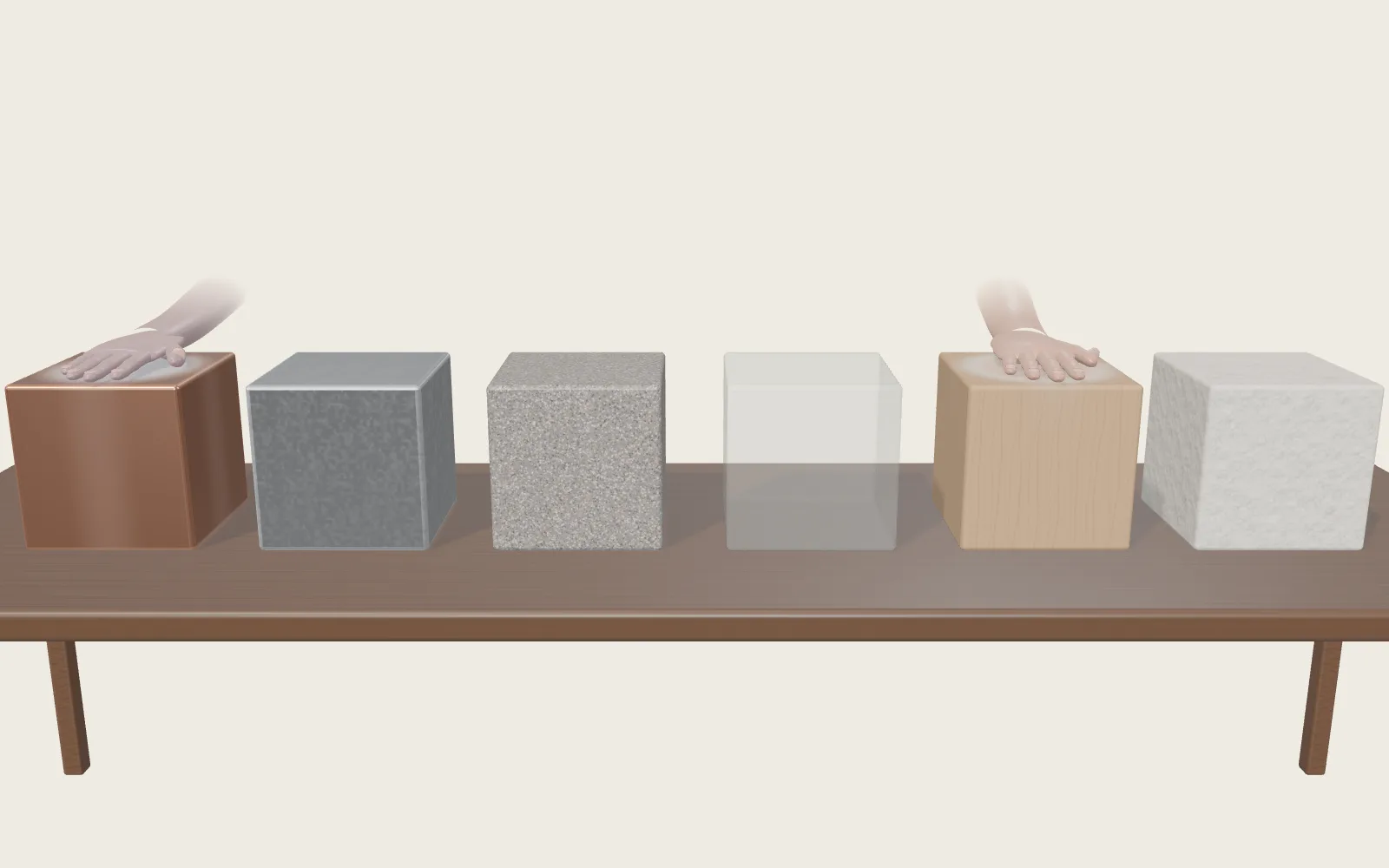 Plate 31Why Metal Feels ColdA metal spoon and a wooden spoon left in the same room are exactly the same temperature, yet the metal one feels much colder. What your hand feels is how fast heat leaves it.