The SLR Camera
SLR stands for single-lens reflex. The same lens is used to frame and to take the picture: a mirror sends the lens’s light to the viewfinder, and at the moment of exposure it swings up and the light falls on the film. The model follows the Olympus OM-1 of 1972, a fully mechanical 35 mm film SLR.
Scroll
What You See, What You Get
On a rangefinder or viewfinder camera, the finder window sits beside the lens. What the window shows is not quite what the lens records, and the nearer the subject, the bigger the difference. This is parallax.
The window can’t show where the lens is focused either, and it doesn’t change when a longer or wider lens goes on. The SLR’s answer is to look through the taking lens itself.
Red frame: what the lens records · dashed frame: what a window beside it sees (at 0.45 m)
A Mirror at 45°
Behind the lens a mirror stands at 45° and reflects the light up to the focusing screen. The screen is as far from the mirror as the film is, so the image on the screen is as sharp as the one on the film.
The lens forms an inverted image: upside down and reversed left to right. The mirror turns it the right way up on the screen, but it is still reversed left to right.
Lens → 45° mirror → focusing screen
The Roof Pentaprism
Above the screen sits a roof pentaprism. The light first meets the “roof” on top and reflects once off each of its two faces, then once more off the silvered front face, and leaves through the back towards the eyepiece.
Three reflections in the prism and one at the mirror make four. An even number of reflections never turns the image into a mirror image, and the roof swaps left and right back. Through the eyepiece the image is upright and the right way round.
Roof twice + front face once · upright through the eyepiece
Pressing the Release
While you frame, the aperture stays wide open and the screen is bright. Press the release: the aperture closes down to its setting, the mirror swings up and the finder goes dark, the shutter opens and closes, the mirror drops back and the aperture opens again.
The mirror returns by itself; this is the instant-return mirror. The OM-1’s mirror has an air damper to soften the shock as it moves. The whole sequence takes less than a tenth of a second; here it is slowed down.
Aperture closes → mirror up → shutter → mirror down → aperture opens
Two Curtains
The OM-1 has a cloth focal-plane shutter just in front of the film. Two opaque cloth curtains cross the 24 × 36 mm frame sideways: the first uncovers it, the second follows and covers it again.
At slow speeds the second curtain sets off only after the first has arrived, so the whole frame stands open for a while. At fast speeds it sets off early, and only a slit between the two crosses the film. The narrower the slit, the faster the speed, but every part of the film is lit for the same time.
Shutter speeds 1 s to 1/1000 s · slowed down
Flash Sync
A flash lasts a few thousandths of a second. It fires when the first curtain arrives, and lights only what is open at that moment.
At 1/60 s or slower, the whole frame is open then, and all of it is lit. At faster speeds there is only a slit, and the picture shows one lit band. That is why the OM-1 syncs with flash at 1/60 s.
1/60 s: all of the frame lit · 1/250 s: one band
Winding On
After each picture, the advance lever. The OM-1’s lever swings 150° and does several jobs in one stroke: it winds the film on one frame, moves the frame counter, cocks the shutter, and sets the mirror and automatic aperture for the next shot.
135 film has 8 perforations per frame, 4.75 mm apart, so each frame is 38 mm: 36 mm of picture and 2 mm between frames. While cocking, the two curtains go back overlapped, so no light reaches the film.
One frame = 8 perforations × 4.75 mm = 38 mm
Taken Apart
An SLR comes apart into a few assemblies: the lens, the mirror box, the finder (screen, pentaprism, eyepiece), the focal-plane shutter, the film transport, and the body around them. The OM-1 body is 136 mm wide, 83 mm high and 50 mm deep and weighs 490 g; in 1972 it was the smallest and lightest 35 mm SLR.
The assemblies separate; whichever one the pointer rests on is lifted out and named.
Cut Open: One Light Path
Cut along the lens axis, the light’s whole route shows: through the lens, folded up by the mirror, imaged on the focusing screen, three reflections in the pentaprism, and out of the eyepiece.
The OM mount is 46 mm from the film. The mirror lives in that space, and swings up flat beneath the screen.
Section: lens · mirror box · pentaprism · shutter · film
What It Changed
What the eyepiece shows is what the lens records. Telephoto, wide-angle or macro, any lens frames itself, with no separate finder to fit. Interchangeable lenses, finders and focusing screens, and motor drives grew into whole systems.
The Nikon F of 1959 was the model of the system SLR. At the 1964 Tokyo Olympics it replaced the large-format press camera as the reporters’ main tool, and it was everywhere in the coverage of the Vietnam War. For decades after, the SLR was the standard camera of professional photography.
1936 Kine Exakta · 1949 Contax S · 1959 Nikon F · 1972 OM-1
At the Shutter
The speed dial runs from 1 s to 1/1000 s. Each press of the release lifts the mirror, runs the two curtains, drops the mirror, and the lever winds the film on a frame. With the flash on, only 1/60 s and slower light the whole frame.
Try thisAt 1/1000 s, how wide is the gap between the curtains? And at 1/60 s?
What the model leaves out
The outside dimensions, the mount distance and the shutter speeds follow the OM-1’s published figures; the sizes and places of the parts inside are drawn in proportion. The lens’s six elements sketch a double-Gauss layout, not this lens’s actual design. The OM-1’s pentaprism has a curved lower face and no separate condenser; here it is drawn flat. Olympus doesn’t publish how long the curtains take to cross the frame: it must be under 1/60 s, and the model takes 15 ms, which makes the slit about 2.4 mm at 1/1000 s; real curtains also speed up as they go, so the slit varies a little. The release, the curtains and the winding are all slowed down. The meter, self-timer and mirror lock-up are not drawn. The beam shows the light from one point of the scene.
Some common misreadings
At fast speeds the shutter doesn’t “open faster”: the curtains travel at the same speed, and what changes is the gap between them. Every part of the film gets exactly the set exposure time. The finder image isn’t put right by the mirror alone: the mirror turns it the right way up, and the roof of the pentaprism sets left and right. Which SLR first had an eye-level pentaprism is disputed: the Contax S and the Rectaflex of 1949 are usually named, and the Hungarian Duflex came earlier. The instant-return mirror is usually credited to the Asahiflex IIb of 1954, which had no pentaprism yet.
Sources
- Olympus museum: OM-1 (on sale July 1972 as the M-1, renamed 1973; the smallest and lightest 35 mm SLR; air damper)
- Olympus museum (Japanese): OM-1
- Olympus OM-1 instructions (scan): speeds, 1/60 s flash sync, 150° advance, automatic diaphragm
- Olympus: lecture by the designer, Yoshihisa Maitani
- SMPTE ST 139: 35 mm film, KS perforations, 4.75 mm pitch
- Alan Wood: the OM mount’s 46.0 mm register
- Nikon: the history of the Nikon F
- J. Greivenkamp, University of Arizona OPTI 502: mirrors and prisms (roof pentaprism, three reflections)
- Focal-plane shutter (citing Goldberg, Camera Technology, 1992)
- Single-lens reflex camera (Kine Exakta, Contax S, Rectaflex)
- Instant return mirror (Asahiflex IIb, 1954)
- Kemény: Jenő Dulovits and the Duflex (Hungarian Academy of Sciences)
Follow the question
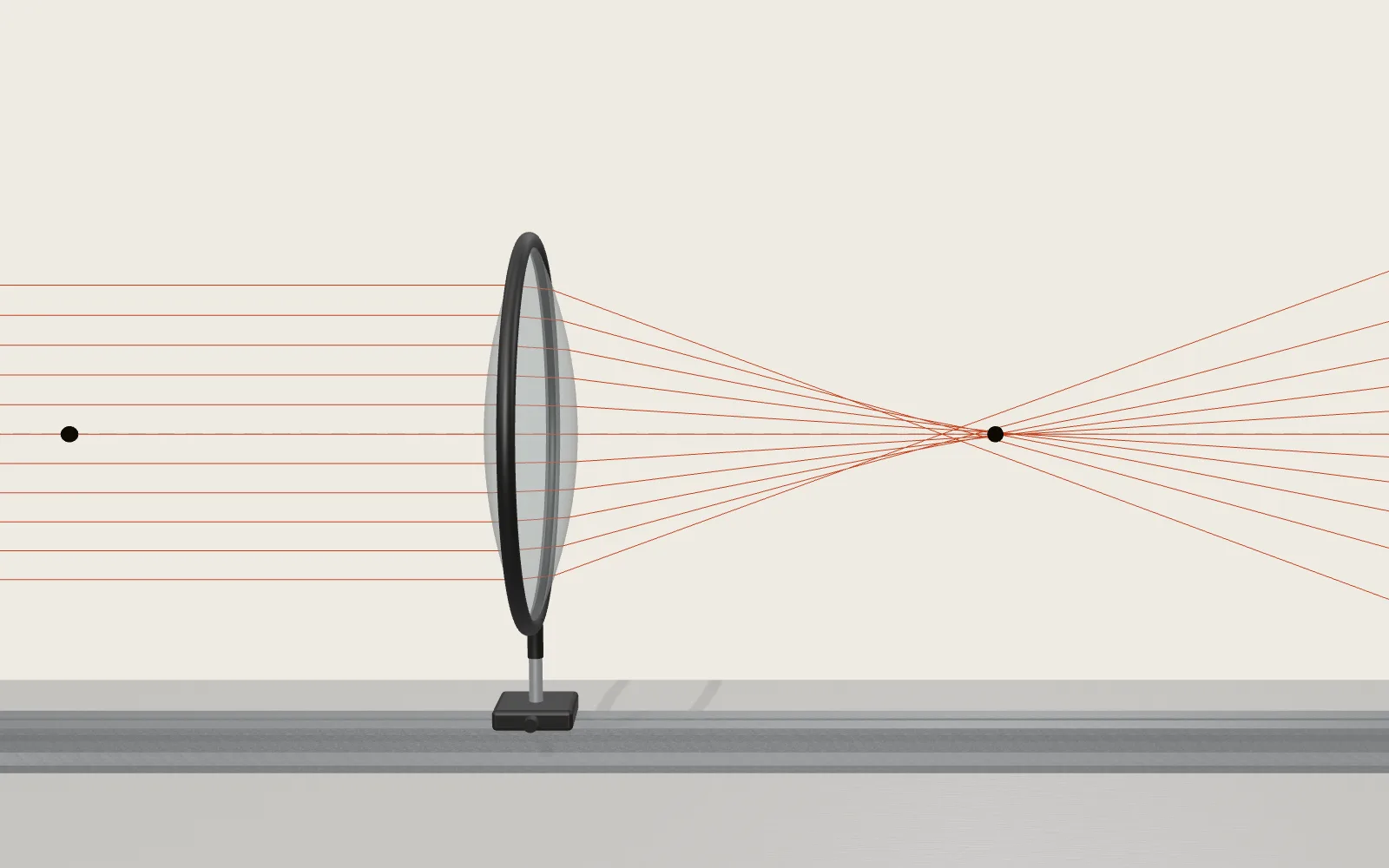 Plate 29A Curved Piece of GlassLight bends a little as it passes from air into glass. Shape the glass into a curve and light passing through every part of it can meet at one point — which is how magnifying glasses, cameras and your eyes work.
 Plate 07Why a Rainbow Is RoundIt does not hang anywhere in the sky. It is a ring of light 42 degrees around the shadow of your own head.