Tokamak Fusion Reactor
A tokamak holds a plasma hotter than a hundred million degrees in a ring-shaped vacuum vessel with magnetic fields, so that deuterium and tritium fuse. This is a cutaway model of one, in the proportions of ITER, under construction in France.
Chapters · 14
Scroll
150 Million Degrees
The centre of ITER’s plasma is to reach about 150 million °C. The core of the Sun is about 15 million: this is ten times hotter.
In the unit plasma physicists use, that is about 13 keV. At this temperature atoms have long lost their electrons; nuclei and electrons fly about separately.
About 150 million °C ≈ 13 keV · the Sun’s core about 15 million °C
17.6 MeV
The fuel is two isotopes of hydrogen: deuterium (a proton and a neutron) and tritium (a proton and two neutrons). They fuse into a helium nucleus, an alpha particle, and a neutron, releasing 17.6 MeV.
Momentum conservation sets the split: the light neutron takes about four fifths, 14.1 MeV; the alpha takes 3.5 MeV.
The alpha is charged: the field keeps it in the plasma, where it hands its energy to the fuel around it. The neutron has no charge: it flies straight out and stops in the blanket, as heat.
D + T → ⁴He (3.5 MeV) + n (14.1 MeV)
Density, Temperature, Time
The Sun’s gravity squeezes its core to about 150 grams per cubic centimetre, and it burns slowly for billions of years. A machine on Earth has neither that density nor that time, so it must go much hotter.
Whether a plasma can keep itself burning depends on a product of three numbers: density n, temperature T and energy confinement time τE. For D–T, ignition needs roughly n·T·τE ≥ 3 × 10²¹ keV·s/m³.
ITER is designed for about 10²⁰ particles per cubic metre, about a quarter of a million times thinner than air, about 10 keV, and a confinement time of about 3 to 4 seconds.
n·T·τE ≥ 3 × 10²¹ keV·s·m⁻³ (D–T, near 14 keV)
Round the Field Lines
A charged particle in a magnetic field circles a field line while sliding along it: a helix. The radius is r = mv⊥/(qB); the frequency ω = qB/m.
In ITER’s 5.3 tesla a 10 keV deuteron circles with a radius of about 4 mm, some 40 million times a second; an electron’s radius is only about 0.06 mm.
Across the field a particle cannot go far; along it nothing stops it. A straight solenoid is open at both ends, and the particles leak out along the field lines.
r = mv⊥ / (qB) · ω = qB / m · radii enlarged many times here
Bent into a Ring, Still Drifting
Bend the solenoid into a ring and the field lines close on themselves: no ends.
But in the ring the field is stronger on the inside than the outside, and the lines are curved. On each turn a particle’s circle is wider on the outside than the inside, so it drifts slowly up or down: ions one way, electrons the other.
The charges separate and make an electric field from top to bottom. Together with the magnetic field it pushes ions and electrons alike towards the outside of the ring, into the wall.
Toroidal field alone: ions and electrons part vertically, then both drift outwards
Twisting the Field
The answer is a large current through the plasma itself: 15 million amperes in ITER’s design. The current makes its own field, around the cross-section: the poloidal field.
Toroidal plus poloidal makes the field lines helical: they go round the ring and round the cross-section at once. Following them, a particle spends time above and below, its drift cancels out, and it stays inside.
How many times a line goes round the long way for once round the short way is the safety factor q. Near ITER’s edge q is about 3. More current twists the lines tighter and makes q smaller.
Toroidal + poloidal field = helical lines · ITER q95 ≈ 3 (15 MA)
Cut Open: Layer within Layer
From the inside out: the plasma, the blanket, the double-walled vacuum vessel, the silvered thermal shield, the eighteen D-shaped toroidal-field coils; standing in the middle, the central solenoid; outside, six poloidal-field coils; and round it all, the cryostat.
ITER’s vacuum vessel is 19.4 m across and 11.4 m high, about 5,200 tonnes; the cryostat 29.4 m across and 29 m high. The whole tokamak weighs about 23,000 tonnes. The figure by the base is 1.75 m tall.
Vessel 19.4 × 11.4 m · cryostat 29.4 × 29 m · about 23,000 t
Coils at −269 °C
The eighteen toroidal-field coils are wound from niobium–tin superconductor, each 17 m tall and 9 m wide, with a peak field of 11.8 tesla and about 41 gigajoules of magnetic energy between them. The cut shows the turns of conductor inside each steel case.
The central solenoid is six modules stacked, also niobium–tin, at 13 tesla. Changing its current induces a current in the plasma, like the primary of a transformer with the plasma as its secondary. The six poloidal-field coils are niobium–titanium, the largest 24 m across; they shape the plasma and hold it in place.
Every superconducting coil is cooled by supercritical helium at about 4 K (−269 °C). An MRI scanner’s main magnet is the same kind of technology, much smaller.
18 toroidal-field coils · Nb₃Sn · 11.8 T · central solenoid 13 T · about 4 K
The Edge You Can See
In photographs the plasma glows pink-violet. The light comes mostly from the cooler edge, where there are still hydrogen atoms to be struck and lit: the red Hα line is strongest, and with the blue and violet lines it looks pink.
The core is too hot: its atoms are fully ionised and give off almost no visible light, mainly X-rays. So in the model the light is only at the edge and towards the bottom.
Visible light from the cooler edge · the core almost invisible
Blanket and Divertor
Lining the vessel are 440 blanket modules, each about 1 × 1.5 m and up to 4.6 tonnes. They stop neutrons and shield the vessel and coils behind. Since 2023 ITER’s first wall is to be tungsten instead of beryllium.
In a future power plant the blanket would make tritium from neutrons and lithium. ITER’s blanket only shields; breeding is tested in a few test modules.
At the bottom is the divertor: 54 tungsten-armoured cassettes. Particles from the plasma’s edge are led here along the field lines, and the targets must take a steady 10 MW per square metre. ITER compares that with ten times the heat on a spacecraft re-entering the atmosphere. The throat of a rocket nozzle sees more still, about 130 to 160 MW per square metre, but the divertor must take its load in 400-second pulses, over and over, under neutron bombardment.
Blanket 440 modules · divertor 54 cassettes · targets 10 MW/m² (steady)
Heating
The plasma current heats the plasma, but the hotter it gets the lower its resistance, and that heating runs out. To reach 150 million degrees, heat must come from outside.
Neutral beams: in the design, deuterium ions are accelerated to about 1 MeV, neutralised into atoms so they can cross the field, and fired in; in the plasma they are ionised again and give up their energy in collisions. ITER has two, of 16.5 MW each.
Radio waves: ion cyclotron heating at 40 to 55 MHz matches a deuteron’s gyrofrequency of about 40 MHz in 5.3 tesla; electron cyclotron heating at 170 GHz, where electrons turn at about 28 GHz per tesla.
Neutral beams 2 × 16.5 MW · ion cyclotron 40–55 MHz · electron cyclotron 170 GHz
Where Things Stand
The gain Q is fusion power divided by the heating power put into the plasma. Q = 1 is scientific breakeven. ITER aims at Q ≥ 10: 500 MW of fusion power from 50 MW of heating, for 400 seconds.
Europe’s JET reached a 16 MW peak in 1997, with Q about 0.6. In its last deuterium–tritium campaign, in autumn 2023, one pulse released 69 MJ in about 5 seconds from 0.2 mg of fuel: the energy record. JET stopped operating at the end of 2023.
In 2024 ITER published a new baseline: research operation from 2034, full magnetic energy in 2036, deuterium–tritium operation from 2039. By July 2026 six of the vacuum vessel’s nine sector modules were in the pit.
Engineering gain is a different thing: electricity out minus electricity in, divided by electricity in. ITER makes no electricity. America’s NIF, which uses lasers, released 8.6 MJ in 2025, over four times the laser energy on the target, but its laser draws 300 to 400 MJ from the grid.
Q = P_fusion / P_heating · ITER aims at Q ≥ 10 · JET 69 MJ (2023)
Taken Apart
The parts come apart: the central solenoid rises, the poloidal-field coils, the vessel and the blanket lift in turn, the divertor stays at the bottom, and the toroidal-field coils open out.
Whichever part the pointer rests on is lifted out and named.
Plasma Current
More current makes a stronger poloidal field, twists the lines tighter and makes q smaller. With q too small the plasma kinks and goes unstable, so the current has a limit too.
Try thisHalve the plasma current from 15 MA to 7.5 MA: what does the safety factor q become, and how many times round the long way does a field line go for each time round the short way?
What the model leaves out
This is a model of the principle in ITER’s proportions. The layers’ thicknesses, the number and placing of the ports and the number of turns shown in the coil sections are drawn so the structure reads; the upper half of the cryostat and its lid are left off, and only the duct of the neutral beam injector is shown (the injector itself, some 20 m long, stands beyond the model). The plasma’s light is drawn as a glowing edge, its colour indicative. The field lines are drawn on a smooth flux surface in straight-field-line angles, advancing 2π/q per turn. The orbits are computed live with the Boris method, but the gyroradius is enlarged many times, which makes the drift much faster too; a real 10 keV deuteron circles within a few millimetres. Electrons are only described, not drawn. The D–T reaction is a sketch; nucleons are not to scale.
Some common misreadings
A hundred and fifty million degrees does not make the machine hot: the plasma is extremely thin and holds little heat, and the superconducting coils outside stay at −269 °C. A fusion plasma cannot run away and explode: disturb the conditions and it goes out, and only a few grams of fuel are in the vessel at any time. Q above 1 is not electricity: Q compares only what goes into and out of the plasma, not what the heating systems, magnets and cryogenics draw. The divertor’s heat flux is often said to exceed the Sun’s surface; it does not: the Sun’s surface gives off about 63 MW per square metre, the divertor’s steady load is 10. The field does not push particles into the middle; it lets them move only along the lines, and without the poloidal field they would still drift into the wall.
Sources
- ITER Engineering Basis Handbook, vol. 1, ch. 4 (2026): the 17.6 MeV split, the triple product, the definition of Q, the blanket
- ITER: Facts & Figures (150 million °C, the Sun’s core 15 million °C, 23,000 tonnes)
- NASA: Sun facts (core temperature and density)
- S. E. Wurzel and S. C. Hsu (2022): Progress toward fusion energy breakeven and gain as measured against the Lawson criterion, Phys. Plasmas
- NIST CODATA: fundamental constants and nuclear masses
- PPPL SULI lecture (2021): single-particle motion, drifts in a toroidal field
- Lehigh University ME 362 lecture: drifts, E × B and the safety factor
- ITER design parameters (κ95 1.70, δ95 0.33, q95 3.0), reproduced in a University of Warwick lecture
- A. J. Creely et al. (2020): Overview of the SPARC tokamak, J. Plasma Phys. (the Uckan formula for q95)
- ITER: magnets (toroidal field, central solenoid, poloidal field)
- ITER: vacuum vessel
- ITER: blanket (tungsten first wall)
- ITER: divertor (54 cassettes, 10 MW/m², the re-entry comparison)
- ITER: cryostat
- ITER: external heating systems
- ITER: tritium breeding and test blanket modules
- ITER Newsline (2018): the plasma’s light-emitting regions are the coolest, at its edge
- NASA TP-2694 (1987): Space Shuttle main engine throat heat flux of about 163 MW/m²
- ITER (3 July 2024): summary of the new baseline press conference
- ITER (Nov 2024): the 35th Council endorses the approach of the new baseline
- ITER (29 July 2026): two-thirds of the tokamak core now in place
- EUROfusion: JET’s final deuterium–tritium experiments, 69.26 MJ
- JET-P(98)70: 16.1 MW peak fusion power in 1997
- LLNL: NIF achieves ignition (3.15 MJ in 2022, 8.6 MJ in 2025)
- LLNL: NIF draws 300–400 MJ from the grid
Follow the question
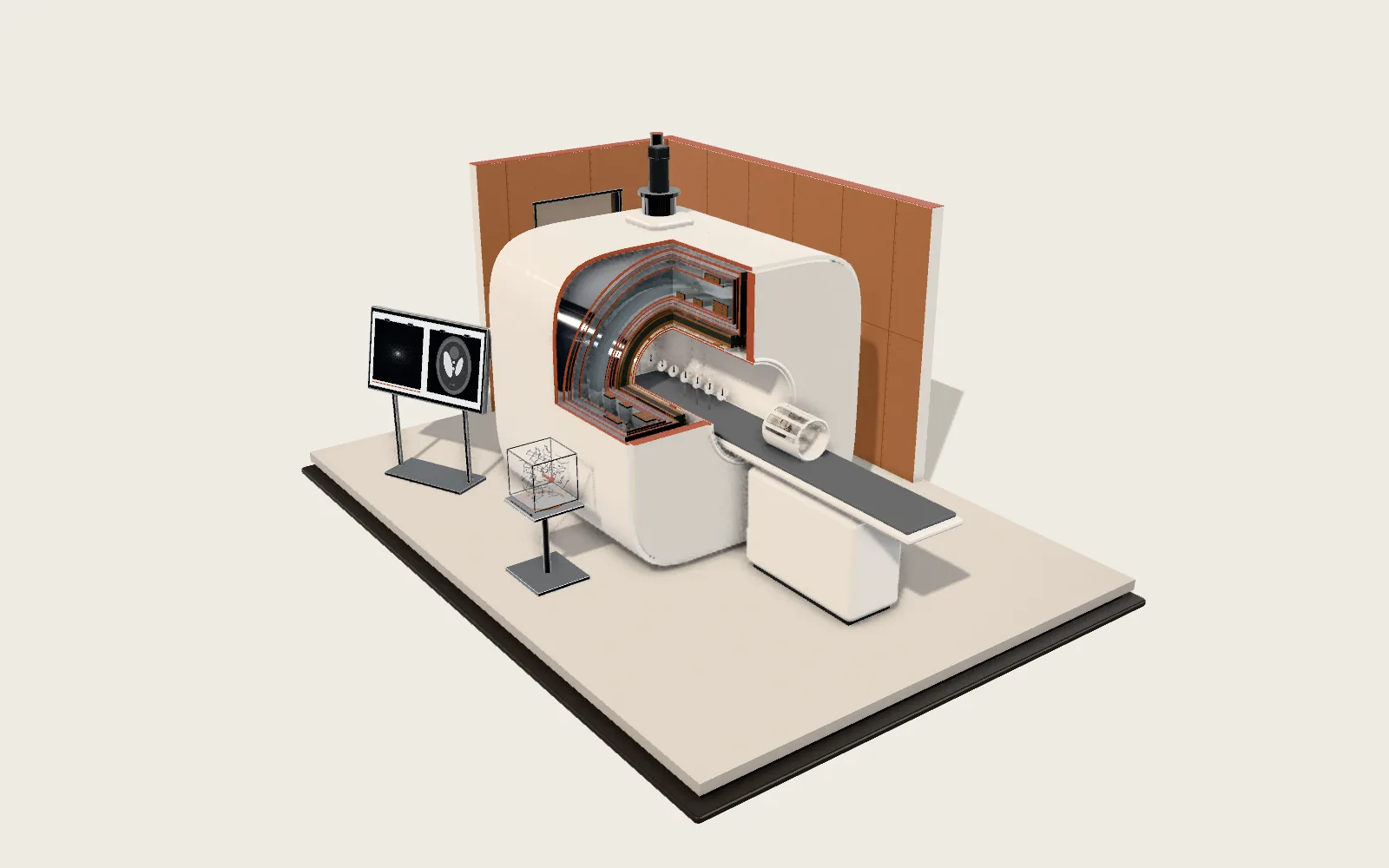 Plate F03MRI ScannerA clinical MRI scanner: a superconducting magnet, gradient coils and RF coils, one inside another. Hydrogen nuclei precess in the field; their signal fills k-space, and a Fourier transform turns it into an image.
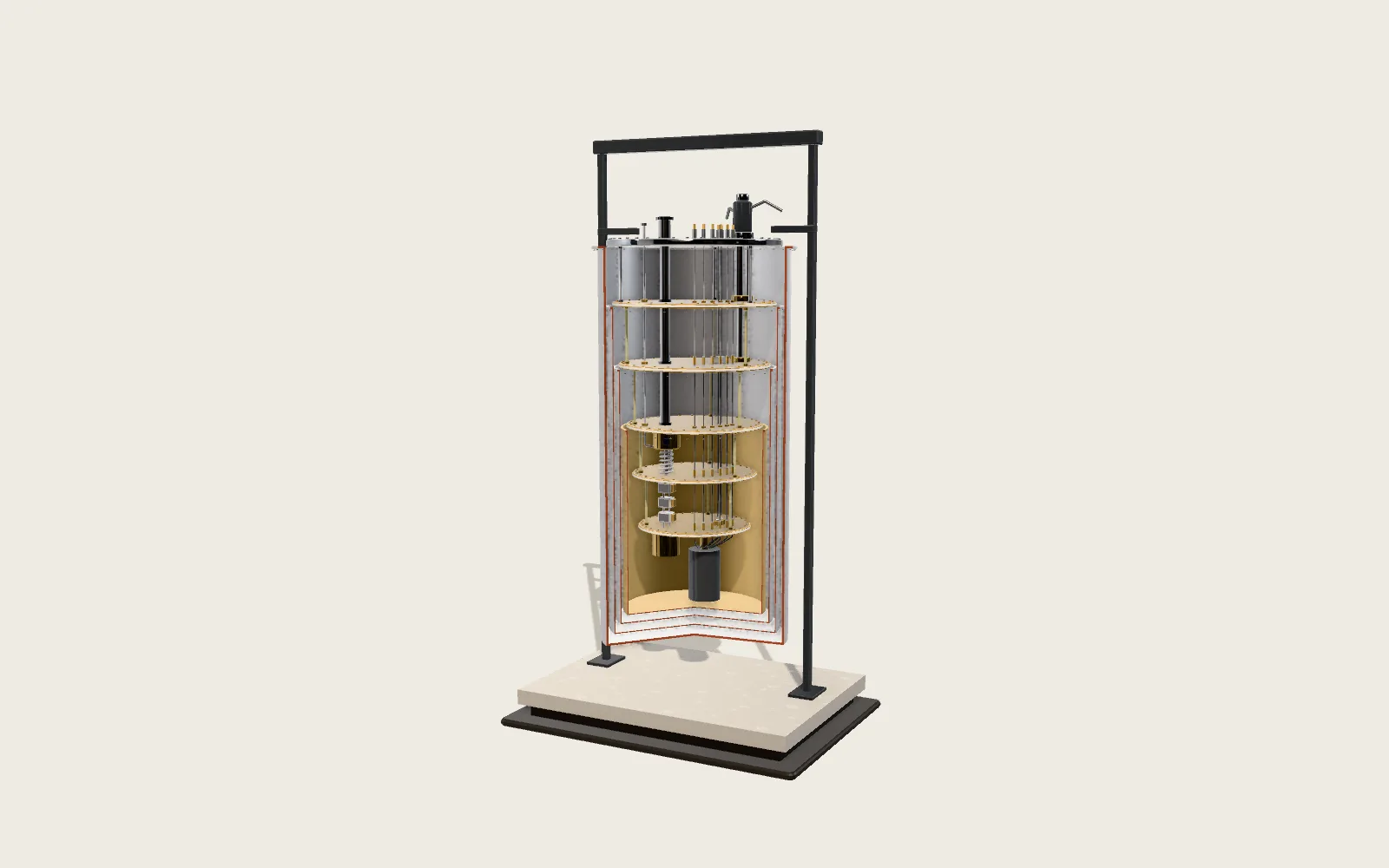 Plate F05The Dilution RefrigeratorA superconducting quantum computer hangs from a gold-plated “chandelier”. Each stage is colder than the one above; the last is about 10 mK, hundreds of times colder than space.