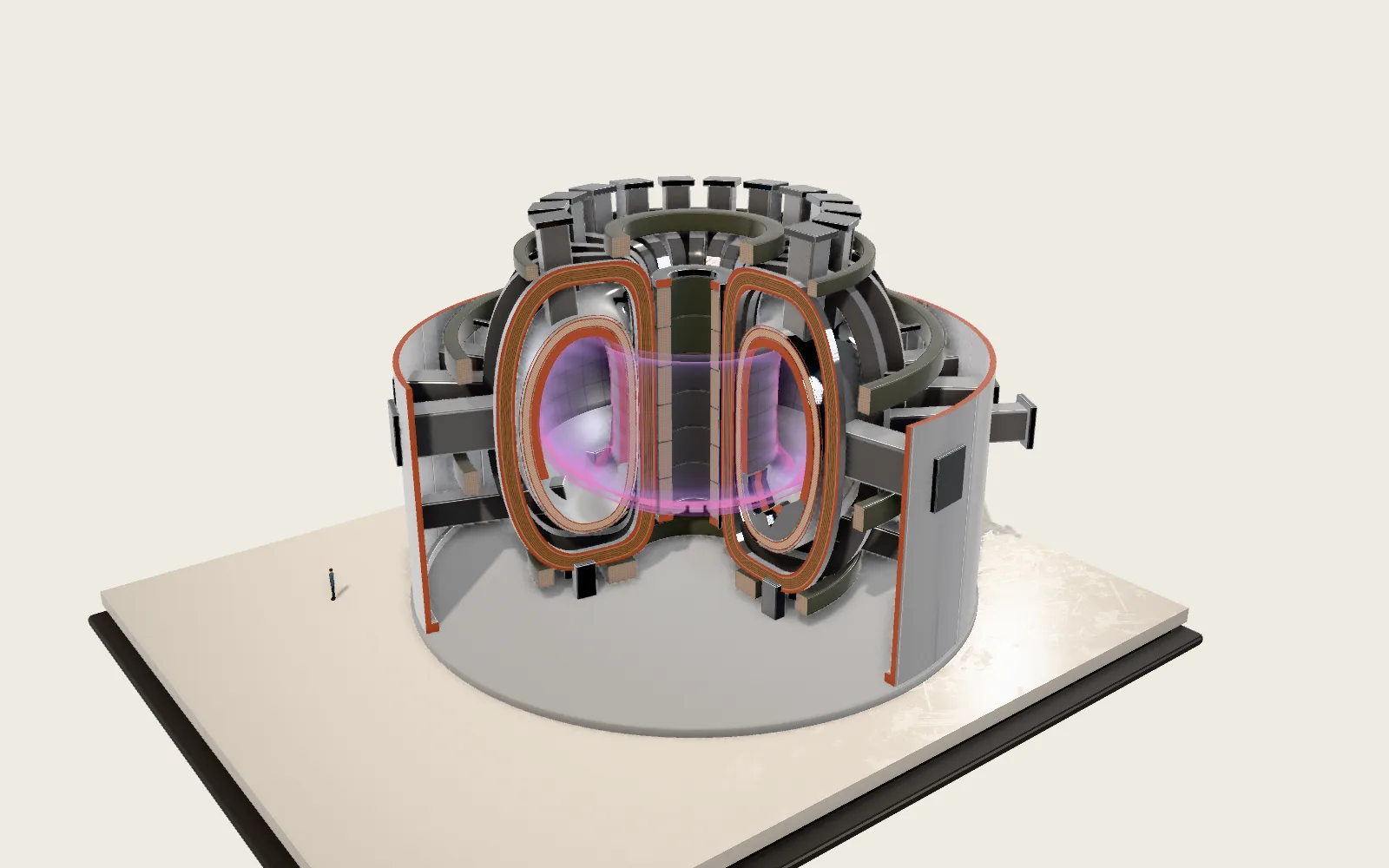
The Dilution Refrigerator
Superconducting qubits only work close to absolute zero. The machine that takes them there is a dilution refrigerator: its upper stages are cooled by a pulse-tube cooler, the last stretch by a mixture of helium-3 and helium-4.
Scroll
Ten Millikelvin
The lowest plate is the mixing chamber plate. It runs below 10 mK, a hundredth of a degree above absolute zero. The quantum processor hangs beneath it in a shielded can.
The cosmic microwave background is 2.725 K. This is two to three hundred times colder.
Mixing chamber ≤ 10 mK · cosmic background 2.725 K
Why So Cold
A superconducting qubit is a superconducting circuit, so first it must be cold enough to superconduct. The harder demand comes from heat: thermal energy is about kT, and the gap between the qubit’s two levels is hf. At 5 GHz, hf/k ≈ 0.24 K.
kT must be far below hf, or heat kicks the qubit into its upper level. At 4 K it would spend almost half its time excited; at 20 mK the chance of a thermal excitation is about six in a million; at 10 mK, about four in a hundred billion.
hf/k = 0.24 K (5 GHz) · excitation ≈ e^(−hf/kT)
Cut Open: Stage by Stage
Outside is the vacuum can; inside it, nested radiation shields, each hanging from a plate. The plates are gold-plated copper, which conducts heat well; between them run thin fibreglass rods, which conduct it badly.
From the top: the room-temperature plate, about 40 K, about 3 K, the still at about 0.8 K, the cold plate at about 0.1 K, and the mixing chamber at about 0.01 K. The upper two are usually called the 50 K and 4 K plates; they run somewhat colder.
300 K → about 40 K → about 3 K → about 0.8 K → about 0.1 K → ≤ 0.01 K
The Pulse Tube: Down to 4 K
The first two stages are cooled by a pulse-tube cooler. A compressor drives helium gas back and forth through the tubes, compressing and expanding it, which carries heat upward. Nothing moves inside at low temperature.
Fridges like this are called “dry”: no liquid helium is poured in. A typical pulse tube removes 1 to 2 W at 4.2 K.
First stage about 40 K · second about 3 K · 1–2 W at 4.2 K
Helium-3 Floats on Helium-4
Further down, the work is done by helium’s two isotopes. Below 0.87 K a mixture of helium-3 and helium-4 separates into two layers: nearly pure helium-3 on top, a dilute phase of mostly helium-4 below.
Even close to absolute zero the dilute phase still holds about 6.5 % helium-3. In the mixing chamber, helium-3 atoms cross the boundary from the upper layer into the dilute phase, and like a liquid evaporating into a gas, they take up heat. That step is the cooling.
Separates below 0.87 K · dilute phase about 6.5 % helium-3
Round the Loop
The dilute phase runs up through heat exchangers to the still. At about 0.8 K, helium-3 evaporates far more readily than helium-4, so more than nine tenths of the gas pumped off is helium-3. As it is pumped away, more helium-3 crosses the boundary in the mixing chamber to replace it.
At room temperature the helium-3 is compressed and sent back down the condensing line: cooled by the pulse tube, liquefied, then through a chain of heat exchangers, where the cold outgoing liquid cools it, into the top of the mixing chamber again. A typical flow is under a millimole a second.
Still pumped → compressed → condensed → heat exchangers → mixing chamber
Lines That Shed Heat
The microwave signals that drive the qubits come down from room temperature. The lines would carry room-temperature thermal noise down with them: at 6 GHz, 300 K means about a thousand thermal photons in each mode.
So each drive line has a 20 dB attenuator at 4 K, at the cold plate and at the mixing chamber. Each one removes 99 % of the noise from above and adds a little of its own stage’s. At the mixing chamber about two thousandths of a photon is left. Readout signals going up pass isolators at the mixing chamber, then a HEMT amplifier on the 4 K plate.
20 + 20 + 20 dB · thermal photons about 1,000 → about 0.002
Taken Apart
The vacuum can and the radiation shields come off downwards, and the plates show. A cooldown starts with pumping out the can; from room temperature to base takes about a day on common systems.
Whichever stage the pointer rests on is lifted out and named.
Cooldown
The lever is time, from switch-on to base. For most of the first day the pulse tube slowly cools the upper stages; once they are near 4 K the mixture condenses and starts to circulate, and the lower three stages fall to base within a few hours.
Try thisWarm the mixing chamber from 10 mK to 50 mK: how many times likelier is a 5 GHz qubit to be thermally excited?
What the model leaves out
This is a model of the principle, not of any maker’s design. The still, the heat exchangers, the mixing chamber and the processor can are drawn larger than life, and the spacing of the plates and the number and placing of the lines are chosen so the structure reads clearly. Real heat exchangers come as a continuous exchanger and step exchangers filled with sintered silver powder; only their outsides are drawn. The shape of the cooldown curve is schematic; only “about a day” and each stage’s final temperature come from the sources. Helium-3 atoms are drawn as beads, not to number or speed. The flow impedance in the condensing line is not drawn.
Some common misreadings
The mixing chamber does not cool by a liquid evaporating into a vacuum. When helium-3 passes from the concentrated phase into the dilute one its enthalpy rises, and the heat for that is taken from its surroundings; the helium-4 is only an inert background. Because the helium-3 in the dilute phase does not fall to zero at low temperature, the cooling power falls only as the square of the temperature, while pumping on helium-3 vapour loses cooling power exponentially; that is why dilution reaches a few millikelvin. The plates are named 50 K and 4 K but usually run colder. 10 mK is the mixing chamber’s temperature; the measured “effective temperature” of a qubit is often higher, about 35 to 50 mK, set by residual radiation and noise.
Sources
- S. Krinner et al. (2019): Engineering cryogenic setups for 100-qubit scale superconducting circuit systems, EPJ Quantum Technology (measured stage temperatures, 19 µW at 20 mK, 20/0/20/20 dB attenuation, isolators and amplifiers, line materials)
- F. Pobell: Matter and Methods at Low Temperatures (ch. 7: ³He/⁴He mixtures, phase separation, cooling power Q̇ = ṅ(95T² − 11T²))
- University of Oxford, Physics: how a dilution refrigerator works (0.87 K, 6.6 %, mixing chamber and still)
- Heidelberg University, low-temperature physics lectures: dilution refrigeration (still about 0.7 K, vapour over nine tenths ³He)
- Bluefors: LD series (base 10 mK, 12–14 µW at 20 mK, cooldown about 24 h)
- Bluefors: XLD series (500 mm mixing chamber plate, over 14–30 µW at 20 mK)
- Bluefors: pulse-tube cryocoolers and the PT420 capacity curve (about 2 W at 4.2 K)
- Oxford Instruments: ProteoxLX (base below 7 mK, over 25 µW at 20 mK)
- Bluefors: the KIDE cryogenic platform (a large platform of several dilution units)
- IBM: the Goldeneye cryogenic concept system
- Google: behind the scenes at the Google Quantum AI lab (the dilution refrigerator, “colder than outer space”)
- X. Y. Jin et al. (2015): Thermal and residual excited-state population in a 3D transmon qubit, PRL 114, 240501 (effective temperature about 35 mK)
- NASA LAMBDA: COBE/FIRAS (cosmic microwave background 2.725 K)
- NIST: fundamental physical constants (h, k)
Follow the question
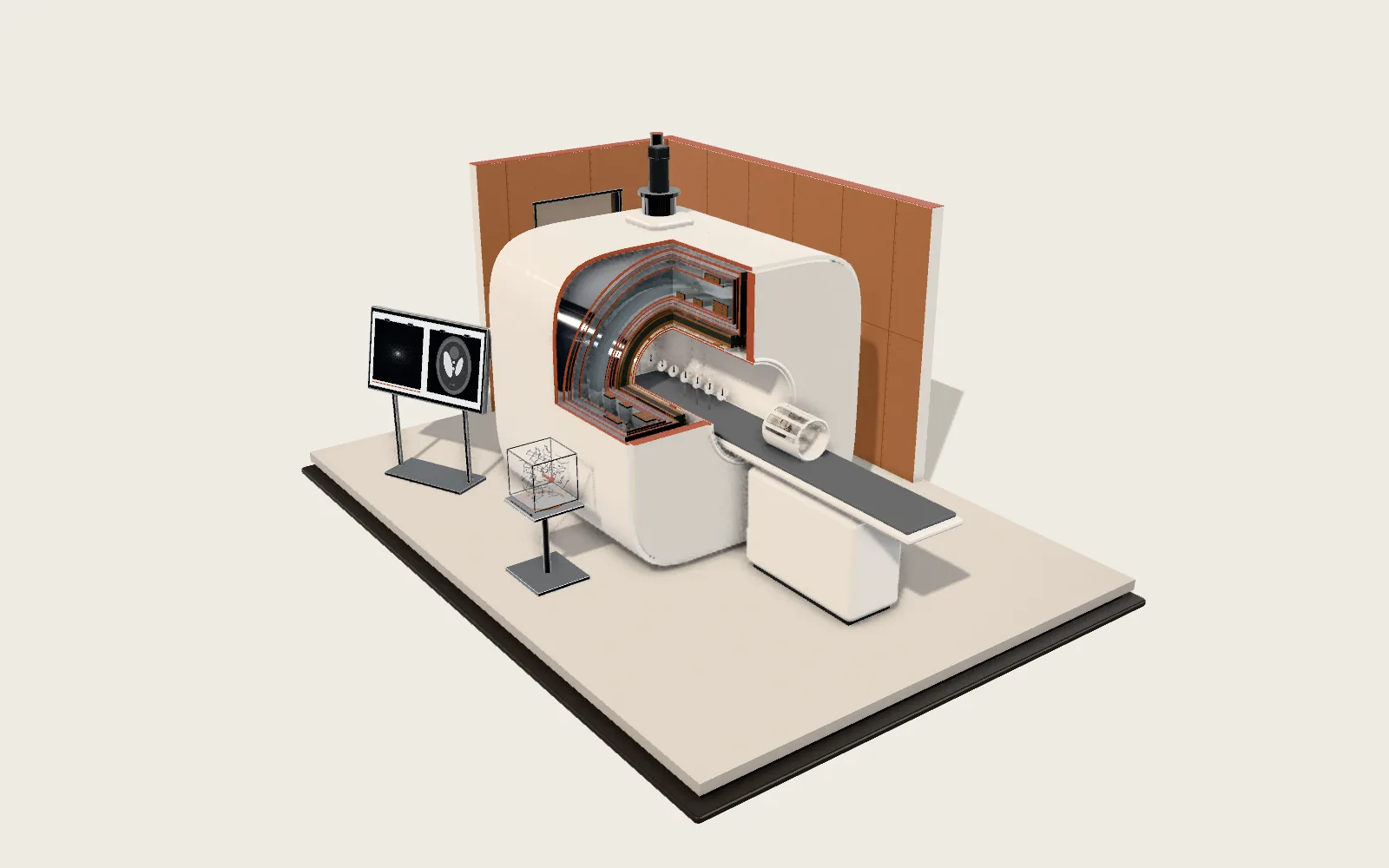 Plate F03MRI ScannerA clinical MRI scanner: a superconducting magnet, gradient coils and RF coils, one inside another. Hydrogen nuclei precess in the field; their signal fills k-space, and a Fourier transform turns it into an image.
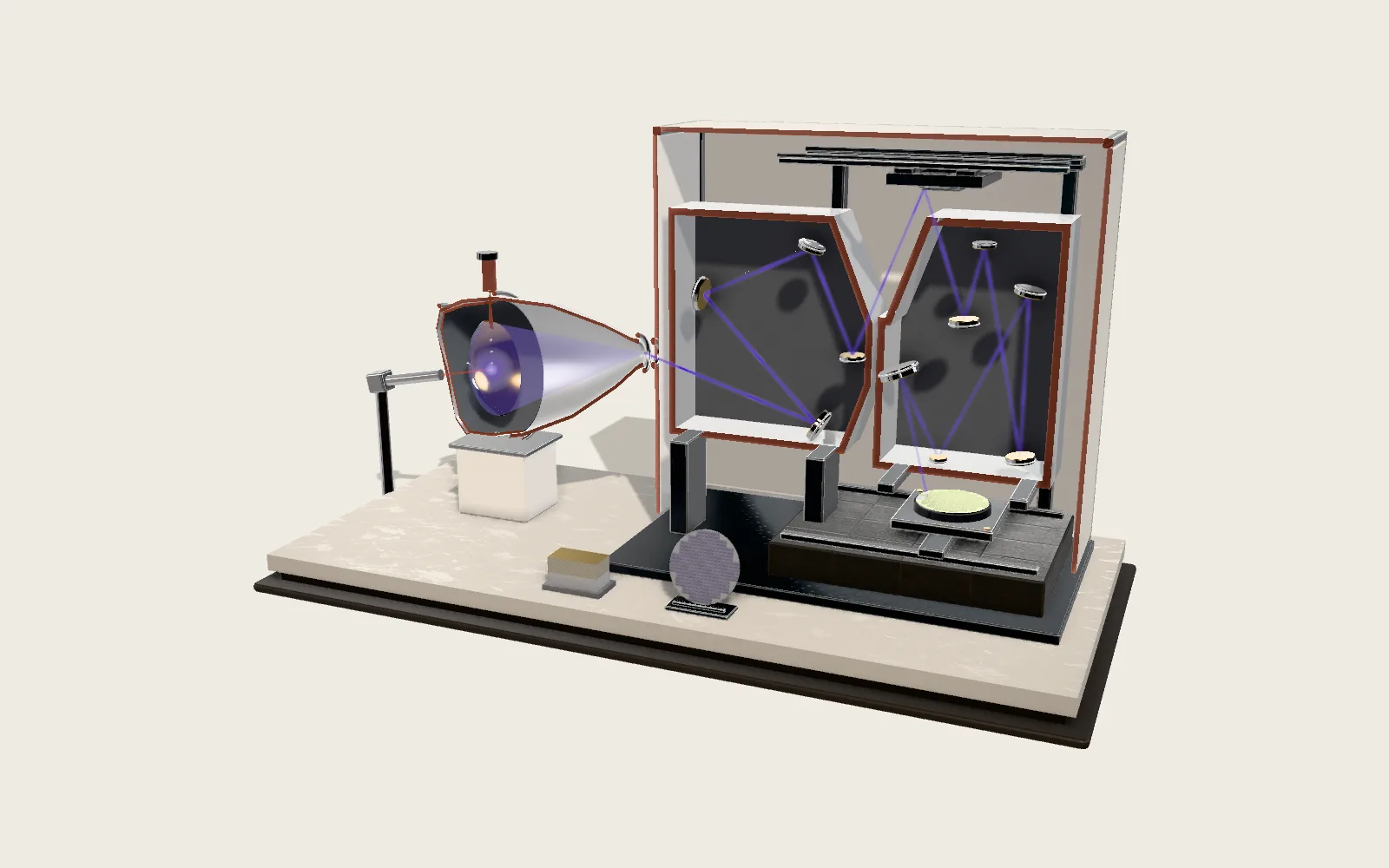 Plate F01EUV Lithography MachineLight 13.5 nm long prints a chip’s circuits on silicon, four times smaller than the mask. It comes from tin droplets turned to plasma, and travels only by mirrors.