The Wankel Rotary Engine
In a piston engine the pistons stop and reverse dozens of times a second. The rotary engine does away with that: a three-sided rotor on an eccentric shaft runs round a bore shaped as an epitrochoid, and the three chambers between rotor and bore take turns to draw in, compress, burn and expel. The model is built to the dimensions of Mazda’s 13B: R 105 mm, e 15 mm, 80 mm wide, two rotors.
Scroll
An Engine That Doesn’t Reciprocate
A four-stroke engine’s pistons stop at the top and bottom of every stroke and reverse; the crankshaft, rods, cams and valves all serve that back and forth. Felix Wankel (1902–1988) wanted an engine that only turned.
On 1 February 1957 his first engine at NSU, the DKM 54, started on the test bench. In that engine both the housing and the rotor turned. NSU’s development department then held the housing still and mounted the rotor on an eccentric shaft. Every rotary engine since has taken that form.
1 February 1957: the DKM 54 first runs · then a fixed housing and an eccentric shaft
An Epitrochoid
The rotor’s three apexes sit R from its centre; the centre moves on a circle of radius e round the shaft’s axis while the rotor turns at a third of the speed. The curve the apexes trace is an epitrochoid: x = e cos 3α + R cos α, y = e sin 3α + R sin α. The bore is machined to it.
On Mazda’s 13B, R is 105 mm and e is 15 mm, so the bore is 240 mm long and 180 mm across, an oval pinched at the waist. R/e is 7: the smaller the ratio, the tighter the waist and the higher the compression, and the harder the apex seals’ job.
x = e cos 3α + R cos α · y = e sin 3α + R sin α · R 105 · e 15 · b 80 mm
Three to Two
On one side of the rotor is a ring of internal teeth with a pitch radius of 3e. It runs round an external gear fixed to the side housing, pitch radius 2e. Their centres are exactly e apart: the eccentric shaft’s throw.
For every turn of the eccentric shaft, the rotor rolls round the fixed gear and turns only a third of a turn itself. These gears carry no power; they keep the phase, so that all three apexes stay on the bore. The gas pushes on the rotor, and the rotor passes the force to the shaft through the journal it rides on.
Internal gear 3e = 45 mm · fixed gear 2e = 30 mm · 3 shaft turns, 1 rotor turn
Three Chambers, Four Strokes at Once
The rotor divides the bore into three chambers. As the rotor goes round once, each chamber grows twice and shrinks twice: intake, compression, power, exhaust. Each stroke takes 270 degrees of the eccentric shaft.
The three chambers are a third of a turn apart, so one of them is always on its power stroke. A rotor fires three times per turn of its own, once per turn of the shaft. Each chamber’s largest and smallest volumes differ by 3√3·e·R·b: 654 cc on the 13B, which Mazda writes as 654 cc × 2.
Fresh charge · compression · combustion · exhaust
No Valves
The rotor opens and closes its own ports. Ports in the side housings are side ports, covered and uncovered by the rotor’s flat side; ports in the bore are peripheral ports, swept by the apex seals.
A peripheral port is straight and large and breathes well at high revs, but intake and exhaust stay open together for longer, and the engine runs roughly at low speed. Mazda’s road 13B took its intake through side ports and exhausted through the periphery; the Renesis of 2003 moved the exhaust to the sides as well, and the overlap disappeared. The 787B that won Le Mans in 1991 used peripheral intake and exhaust.
The Apex Seals
Between two chambers there is only a thin steel strip at the apex. Springs and centrifugal force hold it against the bore; it touches along one line and sweeps the whole bore every turn. On the 13B at 9,000 rpm the apex slides at up to about 47 metres a second.
The bore curves, so the angle between the seal and the bore’s normal keeps changing, up to arcsin(3e/R): ±25.4 degrees on the 13B. The seal’s tip has to be rounded. Early seals chattered and left waves in the bore, which Mazda called “devil’s claw marks”. Mazda’s first production rotary used seals of carbon impregnated with aluminium; later ones were cast iron, running on a hard chrome bore.
Seal lean = arcsin(3e/R) = ±25.4° · at 9,000 rpm the apex slides at up to about 47 m/s
A Long, Thin Combustion Chamber
At its smallest the chamber is a curved slot about 190 mm long and on average only a few millimetres deep. Its ratio of surface to volume is about 1.7 times that of a flat-topped cylinder 80 mm across (the bore of the engine in the four-stroke plate) at the same compression ratio. Mixture against the cold walls does not burn through and the flame does not catch up with the trailing end, so unburnt hydrocarbons are high and so is the heat lost.
Mazda put two spark plugs on every rotor, leading and trailing; the trailing plug lights the mixture left behind. In February 1973, the RX-3 and RX-4 with thermal reactors met the 1975 standards in US EPA testing; after the oil crisis that year, Mazda set out to cut the rotary’s fuel use by 40 percent.
At its smallest: about 190 mm long, 5 mm deep on average · surface/volume about 1.7× a flat-topped cylinder at the same ratio
Taken Apart
Front to back: pulley and front cover, front side housing, front rotor housing, intermediate housing, rear rotor housing, rear side housing, tied together by a dozen long tension bolts. The rotor housings are cast aluminium with a chrome-plated bore and coolant passages round it; the side housings are cast iron, with the intake ports on their inner faces.
The two rotors share one eccentric shaft, their journals half a turn apart so that they balance. Each rotor carries three apex seals, six corner seals and six side seals.
Cut Along the Shaft
Cut along the eccentric shaft: the two rotors sit one high and one low, half a turn apart; the journals in their bores are 15 mm off the axis, and beside each the small fixed gear meshes inside the larger ring. Apart from the seals moving in their slots, everything in the engine turns.
Small and Strong
Every rotor makes a power stroke on every turn of the eccentric shaft, as often as a two-stroke. So racing rules counted a rotary at 1.8 times its size: the 787B’s four-rotor R26B is 654 cc × 4, rated at 4,708.8 cc.
The R26B made 700 PS at 9,000 rpm. In June 1991, the number 55 787B won the Le Mans 24 Hours after 362 laps: the first win for a Japanese maker, and the only one for a rotary engine. The rules then changed; that year was the last time rotary racing cars entered Le Mans.
R26B: 654 cc × 4 · 700 PS at 9,000 rpm · Le Mans 1991, 362 laps
What It Changed
NSU showed the world’s first production car with a Wankel engine, the Wankel Spider, in 1963, and built 2,375. Its Ro 80 of 1967 had a two-rotor engine (2 × 497 cc, 115 PS), was Car of the Year 1968, and was built until April 1977: 37,374 cars.
Mazda began with the Cosmo Sport in 1967 and kept going until the RX-8 ended in 2012, building more than two million rotary cars. In 2023 the rotary came back in another role: in the MX-30 R-EV, an 830 cc single-rotor engine does not drive the wheels; it turns a generator.
1957 DKM 54 · 1963 NSU Spider · 1967 Ro 80, Cosmo Sport · 1991 Le Mans · 2012 last RX-8 · 2023 8C generator
Turn the Shaft
Push the lever to run the eccentric shaft, or drag the scale to stop it at any angle. The curves are the volume and pressure of one chamber of the front rotor. Change the ports to see when they open and close and how much they overlap; add apex-seal wear and the compression falls away.
Try thisDrop the shaft from 7,000 to 250 rpm with the same worn apex seals: does the compression pressure fall further or less? Why?
What the model leaves out
The bore is a pure epitrochoid (R 105, e 15). Real bores are the parallel curve about 2 mm outside it (the radius of the apex seal’s tip), and Mazda’s 105 mm already includes that. The rotor’s flanks are the inner envelope of the curve less a 0.15 mm clearance, cut back 2.5 mm at the apexes so the seals stand proud; the recess’s shape is ours, its depth (about 8 mm) set to give the 13B-REW’s compression ratio of 9.0. The tooth counts (51 in the rotor, 34 on the fixed gear) are the model’s; only the 3 : 2 ratio is certain. Wall thickness, coolant passages, bolts, outline, plumbing and stand are ours, and so are the places of the three port layouts, set so their timing comes out near common figures: the angles on the page are the model’s, not Mazda’s specifications. The pressure curve comes from a simple gas model: constant ratio of specific heats, heat released along a Wiebe curve, ports and leakage as orifices, no heat lost to the walls. It shows trends, not a measurement of any engine. The model turns far slower than a real engine.
Some common misreadings
The rotor is not a Reuleaux triangle: its flanks are the inner envelope of the bore curve, slimmer than the Reuleaux triangle on the same apexes, with a recess in each. All three faces of a rotor work; “654 cc” is the working volume of one face. Counted by power strokes per turn of the shaft, one rotor matches a 1.3-litre four-stroke, which is why racing rules applied a factor. The phasing gears carry no power: the drive passes through the rotor’s journal to the shaft. Nor is a rotary entirely free of reciprocating parts: the apex seals move in and out of their slots all the time.
Sources
- Audi: the NSU Wankel Spider (the DKM 54 first ran at NSU on 1 February 1957; the Spider shown in 1963, 2,375 built)
- Audi museum mobile: 60 years of the NSU/Wankel engine (2017)
- Audi Tradition: NSU Ro 80 (2 × 497 cm³, 85 kW / 115 PS, Car of the Year 1968)
- Audi: NSU Ro 80 (37,374 built, the last in April 1977)
- German Patent and Trade Mark Office, inventors’ gallery: Felix Wankel (1902–1988)
- JSME Mechanical Engineering Heritage No. 5: Mazda 10A rotary engine (Cosmo Sport, 110 PS at 7,000 rpm, two plugs per rotor, aluminium-impregnated carbon seals)
- Mazda centennial virtual museum: the 1967 Cosmo Sport; RX-3 and RX-4 meet the 1975 standards in US EPA testing, February 1973
- Mazda centennial virtual museum: project “Phoenix”, the aim of 40 percent better rotary fuel economy
- Mazda: R26B (654 cc × 4, rated 4,708.8 cc, 700 PS at 9,000 rpm; 13B production ended with the RX-8 in 2012)
- Mazda: 787B (number 55, 362 laps, about 4,923 km)
- Mazda: 30 years since Le Mans (peripheral intake and exhaust ports)
- Mazda newsroom: first Japanese winner, the only rotary-powered overall win
- Mazda centennial: 1991 the final year for rotary racing cars at Le Mans
- Inside Mazda: more than two million rotary-engined vehicles (2023)
- Mazda UK media pack: the e-Skyactiv R-EV’s 8C (830 cc single rotor, 120 mm rotor radius, 76 mm wide)
- Mazda training manual, Rotary Engine Theory: the rotor housing (aluminium alloy, hard chrome-molybdenum plating)
- The same manual: leading and trailing spark plugs
- Burley et al., Sources of hydrocarbon emissions in rotary engines (SAE 780419, 1978)
- Bayer et al., Rotary combustion engine hydrocarbon source studies (SAE 780965, 1978)
- Racing Beat: Mazda apex seal materials and thicknesses over the years (a tuner’s notes)
The text, pictures and models on this page are licensed CC BY-NC 4.0: free to use and adapt for teaching and other non-commercial purposes, with credit to world.lapla.si. Third-party material listed above keeps its own licence.
Follow the question
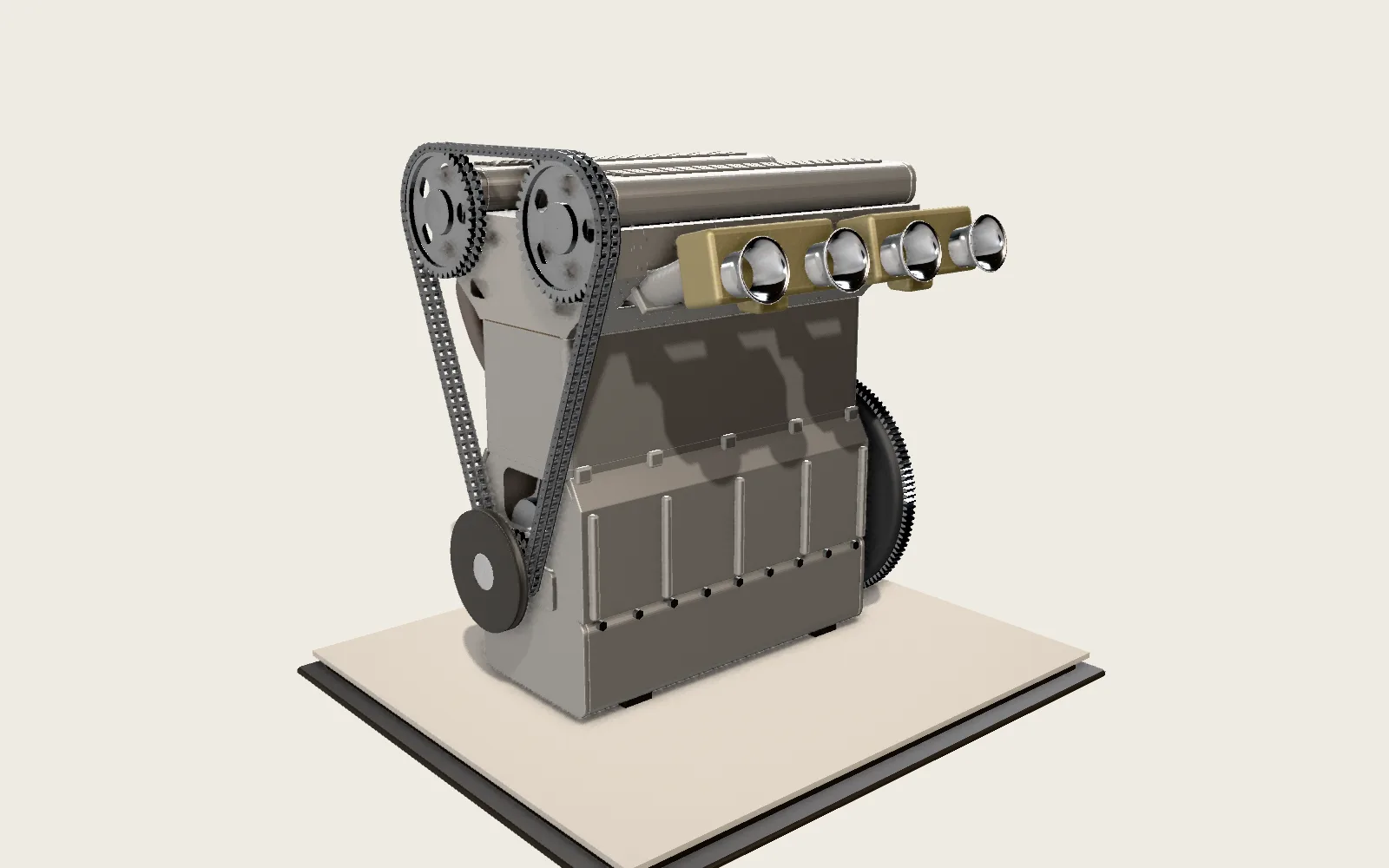 Plate C04The Four-Stroke EngineThe fuel burns inside the cylinder. The piston makes four strokes and the crank turns twice; in one of them, the burning gas drives the piston down.
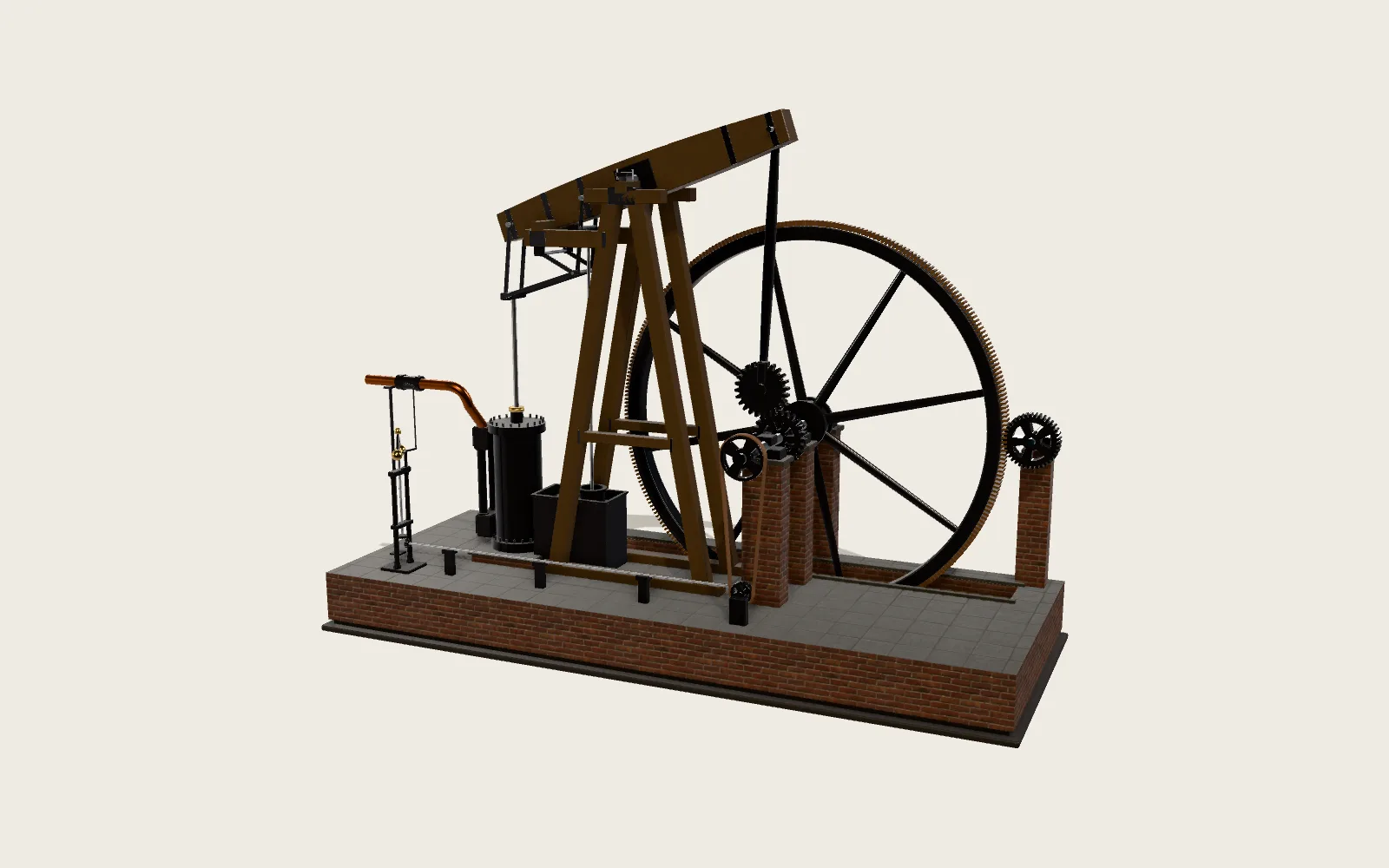 Plate C01Watt’s Steam EngineAn iron vessel standing in cold water saved most of the coal; two spinning balls taught the engine its own pace. Built in Birmingham in 1788, it stands at rest in London today.
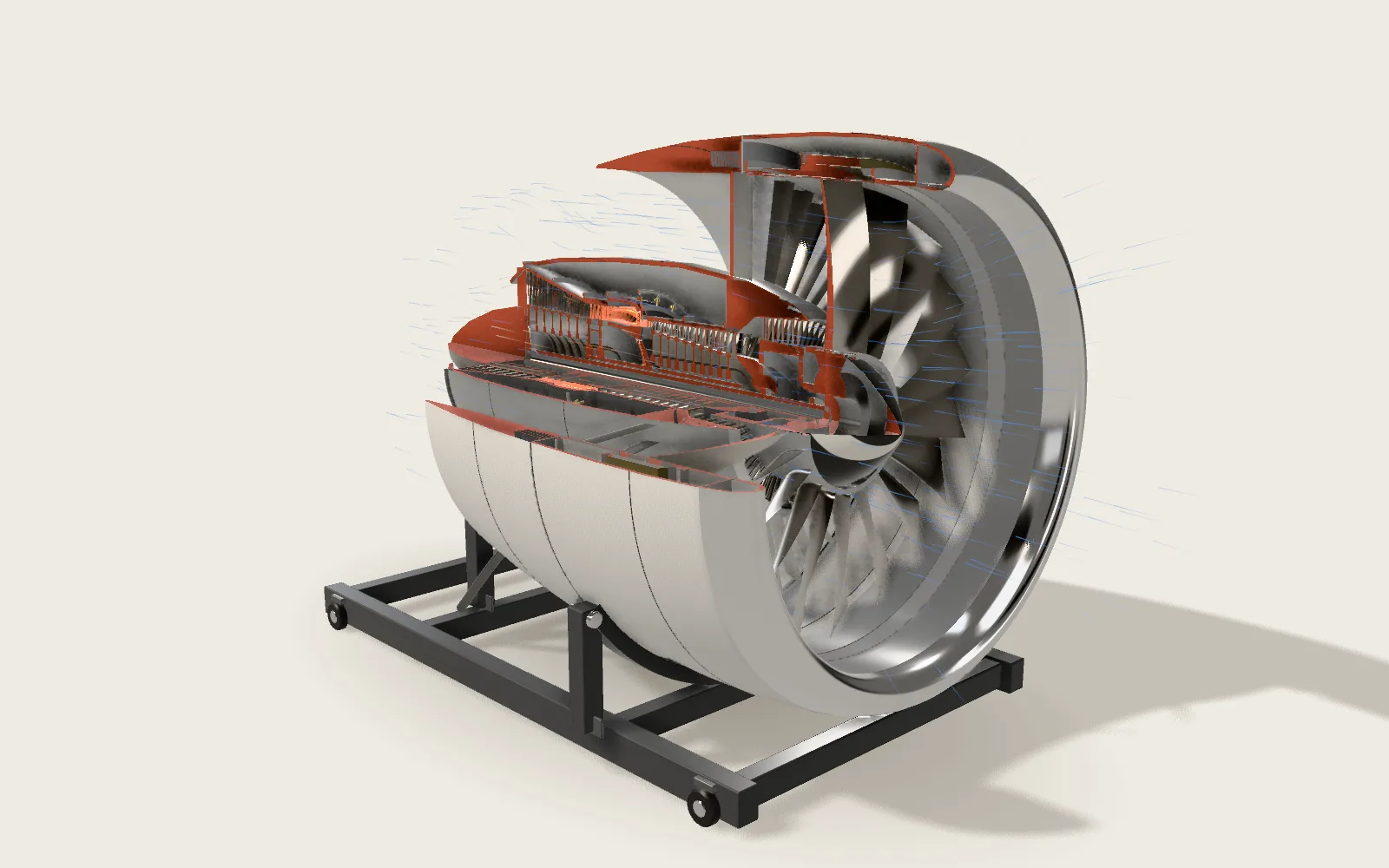 Plate F07Turbofan EngineA high-bypass turbofan of the kind under a widebody’s wing, a quarter cut away: fan, ten-stage high-pressure compressor, annular combustor, two turbines. At take-off it swallows about 1.2 tonnes of air a second.