The Four-Stroke Engine
A petrol engine burns its fuel inside the cylinder, with no boiler. In every two round trips of the piston it draws in, compresses, burns and pushes out its charge, and only one of those strokes is driven by the gas. The model follows the 1968 Alfa Romeo 1750, an inline four with two overhead camshafts: an aluminium block, cast-iron liners and a forged-steel crankshaft.
Scroll
Fire Inside the Cylinder
A steam engine burns coal under a boiler and sends the steam to its cylinder. The boiler is big and heavy, and it takes a long time to raise steam. If the fuel burned inside the cylinder, the engine could be far smaller and start at once.
In 1860 Étienne Lenoir built the first gas engine to sell, but it fired the gas as it drew it in, without compressing it, and turned about 4% of the fuel’s energy into work. In 1876 Nicolaus Otto compressed the charge before lighting it, in a cycle of four strokes. In 1886 Karl Benz drove his three-wheeled motor car with a single-cylinder four-stroke.
1860 Lenoir: no compression, about 4% · 1876 Otto: compression, four strokes · 1886 Benz’s motor car
Four Strokes
Intake: the piston goes down with the inlet valve open and draws in the mixture. Compression: both valves shut, the piston comes up and squeezes the mixture to a ninth of its volume.
Power: just before the top the spark plug fires, the pressure leaps and drives the piston down. Exhaust: the exhaust valve opens and the piston comes up, pushing the burnt gas out. Four strokes, two turns of the crank.
The ideal Otto cycle: two adiabats, heat in at once at the top, out at once at the bottom · compression 9:1 · the real loop has rounded corners
Camshafts at Half Speed
Each cylinder’s inlet and exhaust valves open once in every two turns of the crank. So the camshafts, driven by the chain, turn at exactly half crank speed: their sprockets have twice the teeth of the crank’s.
The valves don’t open and shut exactly at the top and bottom. The inlet opens before the top and closes after the bottom, so the moving air keeps filling the cylinder; the exhaust opens before the bottom. Around the top, both are open for a little while: the valve overlap.
Inlet: opens 12° before the top, closes 48° after the bottom · exhaust: opens 48° before the bottom, closes 12° after the top · 24° of overlap
Crank and Connecting Rod
The connecting rod turns the piston’s to-and-fro into the crank’s rotation. The piston doesn’t follow a sine wave: at 90° of crank it is already past half its stroke, because the rod is leaning. It moves faster near the top than near the bottom.
Counterweights on the crank balance the throws and the rods’ big ends. The heavy flywheel at the back stores energy in the power stroke and gives it back through the other three, so the crank turns evenly.
Crank radius 44.25 mm · rod 152 mm · at 90° the piston is 50.8 mm down, more than half the stroke
Four Cylinders, 1-3-4-2
A single cylinder gives one push in two turns, and its torque swings from large to negative. Four cylinders half a turn apart, firing 1-3-4-2, give a power stroke in every half turn.
The throws of cylinders 1 and 4 point the same way; those of 2 and 3 point the other way. The torque of all four swings, relative to its mean, about a quarter as much as one cylinder’s.
Thin lines: each cylinder’s gas torque · thick line: the four together · piston and rod inertia left out
Compression and Efficiency
The ideal Otto cycle’s efficiency depends only on the compression ratio r: η = 1 − r^(1−γ), with γ about 1.4 for air. At 10:1 that is about 60%. A real petrol engine delivers 25% to 40% of its fuel’s energy at the crankshaft; most of the rest leaves in the exhaust and the cooling water.
The ratio can’t rise for ever. The harder the squeeze, the hotter the unburnt mixture, and it can light by itself before the flame reaches it, setting the pressure ringing: knock. The higher a fuel’s octane number, the better it resists knock.
Ideal efficiency rises with compression, more and more slowly · real efficiency 25%–40%
Taken Apart
The head on top holds the two camshafts, eight valves and their springs, and the spark plugs. The block in the middle is cast aluminium, with four cast-iron liners standing in the cooling water.
Below is the crank train: four pistons, four rods and a forged-steel crankshaft in five main bearings. The timing chain is at the front, the flywheel at the back, the sump at the bottom.
One Cylinder, Cut Open
Cut through the middle of cylinder 1: the inlet and exhaust ports on either side, the two valves facing each other at 80°, the hemispherical chamber with the spark plug at its top. The colour in the cylinder is the gas of the stroke under way.
Fresh mixture · compressed · burning · exhaust
What It Changed
The four-stroke made the car an everyday thing and took aircraft off the ground: the Wright brothers’ 1903 Flyer had a four-cylinder petrol engine of about 12 hp. Until the jet engine, aircraft flew on piston engines, and most small aircraft still do.
Now electric motors are taking over some of the engine’s work. In 2024 more than one in five new cars sold worldwide was electric, plug-in hybrids included. An electric motor turns its energy into motion far more efficiently; a kilogram of petrol stores far more energy than a kilogram of battery. How long the two share the road differs from place to place.
1876 Otto · 1886 Benz · 1903 the Wright Flyer · 2024 electric cars more than a fifth of new sales
Throttle in Hand
Open the throttle and the inlet pressure rises, the torque grows and the speed climbs to a new balance. The model is shown slowed down; the readout is the real speed. Stroke by stroke, the crank moves half a turn at a time.
Try thisOpen the throttle twice as far: does the engine run twice as fast? And the power?
What the model leaves out
Bore, stroke, capacity, compression ratio, valve angle and materials follow the published figures for the Alfa Romeo 1750; the rod length (152 mm), the bore spacing, the valve timing (inlet 12°/48°, exhaust 48°/12°), the valve lift (9.5 mm) and the spark advance are typical values chosen for the model, not this engine’s factory settings. The pressure–volume diagram is the air-standard ideal Otto cycle: heat added at once at the top and removed at once at the bottom, with a fixed amount of heat; a real loop is rounded at all four corners, burning takes tens of degrees of crank, and the peak pressure is lower. The torque chart counts gas pressure only, not the inertia of the pistons and rods. In the laboratory, the full-throttle torque curve passes through the published peak torque (186 N·m at 3,000 rpm) and peak power (122 PS at 5,500 rpm); its shape in between is illustrative, and the engine drives a load that rises with the square of speed, so each throttle setting has a steady speed. The model is shown slowed down 30 times. The carburettors are simplified; the distributor, water pump and oil pump are not drawn.
Some common misreadings
Four strokes are not four turns of the crank but four strokes of the piston, in two turns. The plug fires before the top because the flame takes time to cross the chamber, so the faster the engine, the earlier the spark. The ideal 60% is not a figure an engine can reach: it ignores heat loss, friction, burning time and pumping. Knock is not another word for an early spark: it is the end of the mixture lighting by itself before the flame gets there, though too early a spark makes it likelier. The four-stroke principle was first patented by Alphonse Beau de Rochas in France in 1862; Otto built the first practical engine in 1876. The firing order 1-3-4-2 is the most common for an inline four; 1-2-4-3 works too.
Sources
- Alfa Romeo Twin Cam engine (from 1954; aluminium block, wet cast-iron liners, hemispherical chambers, two valves at 80°, double-row timing chain, forged-steel crank in five main bearings)
- Alfa Romeo 105/115 Series coupés: the 1750 engine, 1,779 cc, 80 × 88.5 mm, 122 PS at 5,500 rpm, 186 N·m at 3,000 rpm
- 1750 GT Veloce specifications (compression 9.0:1)
- Otto engine (Lenoir’s 1860 engine at about 4%; Otto’s compressed-charge engine of 9 May 1876)
- Benz Patent-Motorwagen (patent applied for 29 January 1886; 954 cc single-cylinder four-stroke)
- Smithsonian National Air and Space Museum: 1903 Wright Flyer (four-cylinder, 12 hp petrol engine)
- Otto cycle (ideal efficiency 1 − r^(1−γ))
- Engine efficiency (road cars about 20%–40%; typical compression 9:1 to 10:1)
- Toyota: Dynamic Force engine, 40% thermal efficiency (2016)
- Mazda: SKYACTIV-G, a mass-production petrol engine at 14.0:1; higher compression raises the risk of knock
- Engine knocking
- Firing order (inline four: 1-3-4-2 or 1-2-4-3)
- IEA Global EV Outlook 2025: electric cars more than 20% of new car sales in 2024
Follow the question
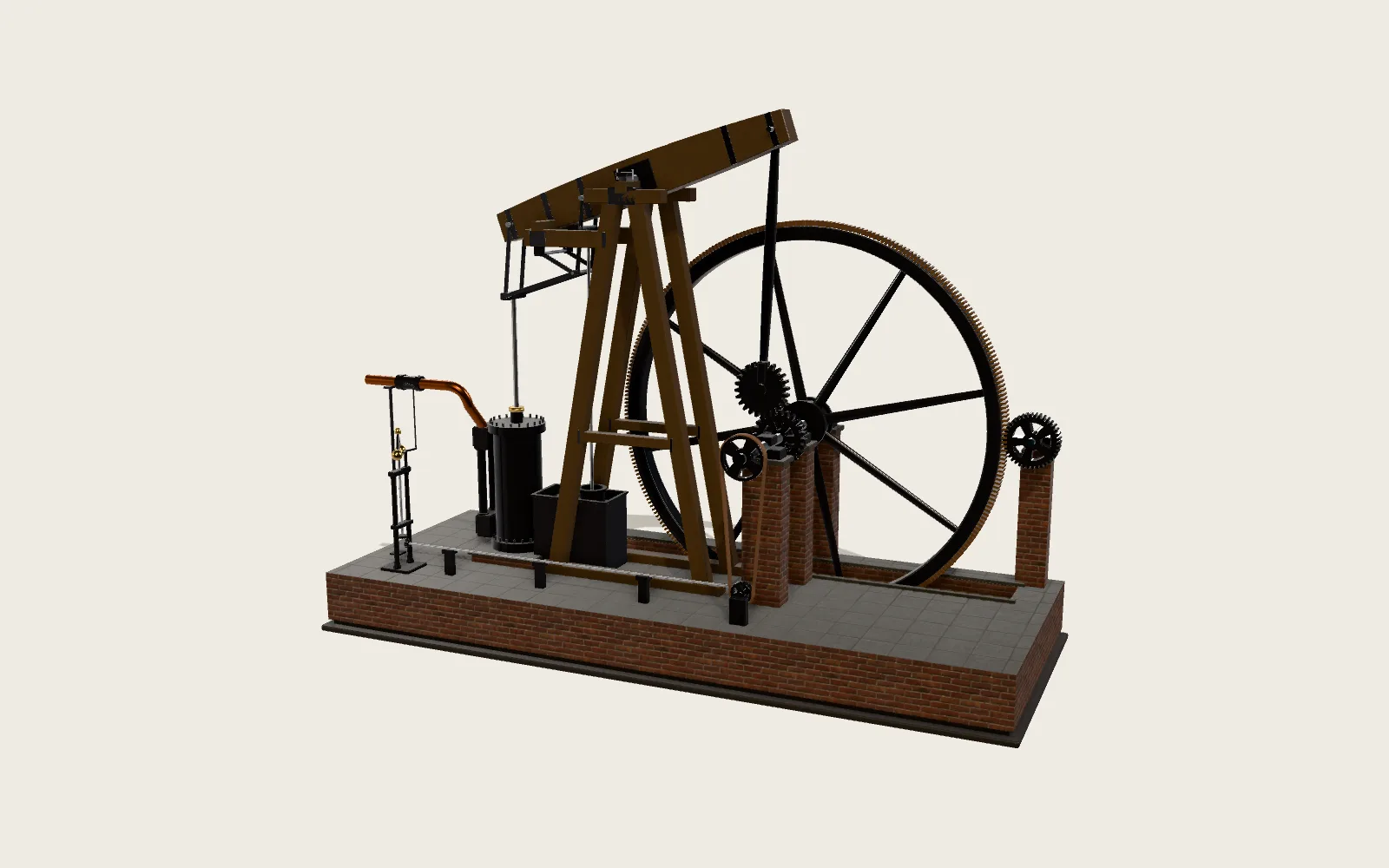 Plate C01Watt’s Steam EngineAn iron vessel standing in cold water saved most of the coal; two spinning balls taught the engine its own pace. Built in Birmingham in 1788, it stands at rest in London today.
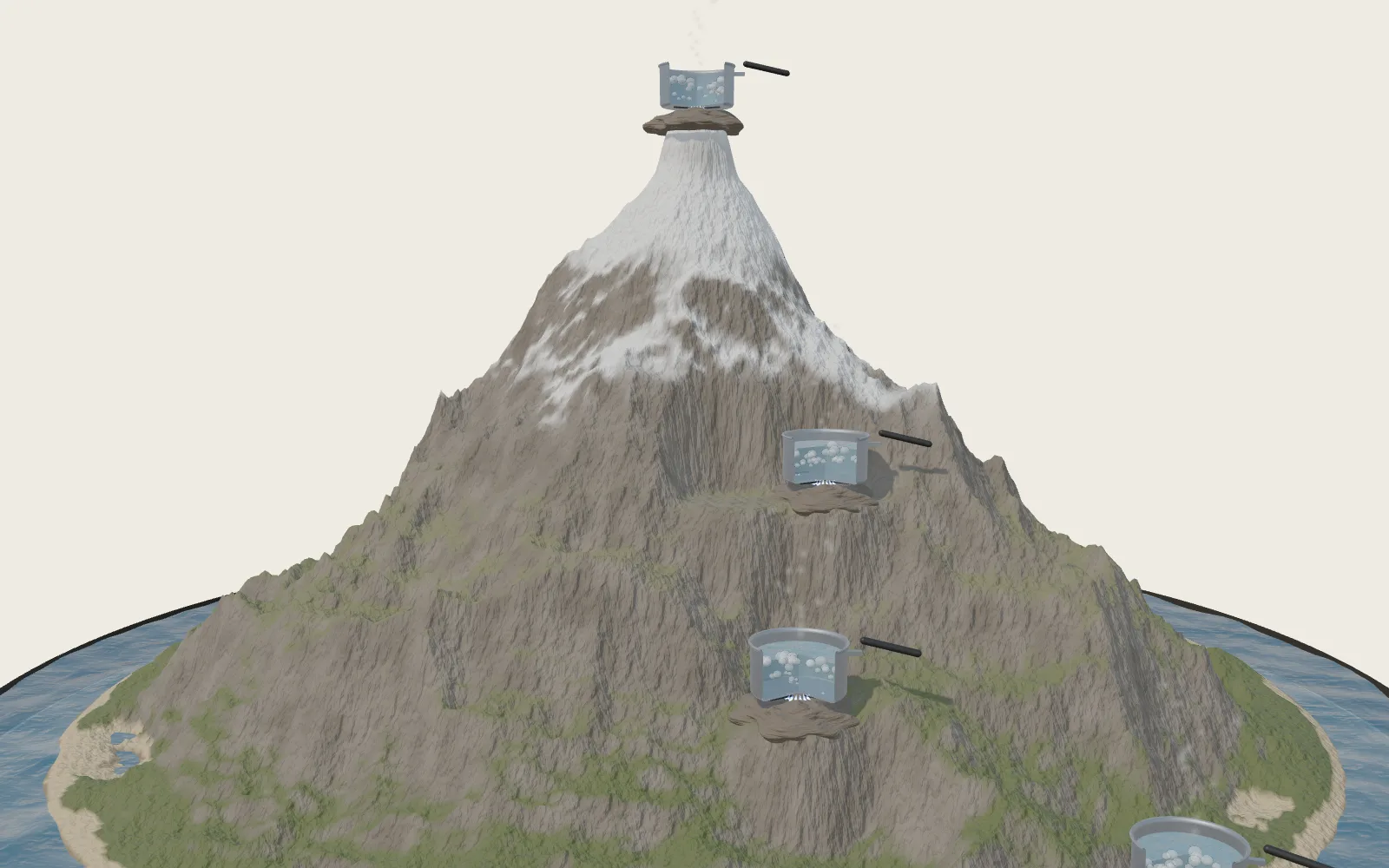 Plate 32Why Mountain Water Isn’t Hot EnoughAt the top of Everest, water boils at about 70°C — too cool to hard-boil an egg, however long you wait. The temperature water boils at depends on how much air is pressing down on it.