The Typewriter
Handwriting is slow, and every hand is different. The typewriter cast each letter as a piece of type and printed it at the touch of a key, the same size and just as clear every time. The model is a frontstrike machine of the kind of the Underwood No. 5, made from 1900: a black enamelled cast frame, glass-topped keys, and forty-two nickelled typebars in a half circle, striking the front of a rubber platen. Type on it with your own keyboard.
Scroll
The Trouble with Handwriting
In the offices of the nineteenth century, letters, contracts and accounts were written by hand. A writer managed somewhere between a dozen and thirty words a minute, every hand looked different, and every copy had to be written out again.
On a typewriter every letter comes from the same piece of metal type: the same size, the same spacing, equally clear whoever types it. Trained typists soon left handwriting far behind: at a contest in Cincinnati in 1888 the winner reached nearly a hundred words a minute, both from dictation and copying.
The First Typewriter on Sale
In 1868 Christopher Latham Sholes, Carlos Glidden and Samuel W. Soule of Milwaukee received two typewriter patents: No. 79,265 on 23 June and No. 79,868 on 14 July. The machine was rebuilt again and again in a local machine shop.
In March 1873 E. Remington & Sons agreed to make it, and it went on sale in 1874 at $125; about five thousand were sold. It typed capitals only, and its typebars struck the underside of the platen, so the typist could not see the line without lifting the carriage. The Remington No. 2 of 1878 added a shift, and lower case.
Why the Keyboard Says QWERTY
Sholes’s keyboard changed many times over a few years. His patent drawing of 1878 is already close to today’s, except that M sits at the end of the middle row, C and X are swapped, and there are no 1 and 0 (typists used the lower-case l and the capital O). The layout we know settled only around 1882.
The familiar story says the keys were scrambled to slow typists down so the typebars would not jam. Nothing documents the slowing down. A study from Kyoto University in 2011 finds the layout grew step by step: the first users were telegraph operators taking down Morse, and their needs, changes at the factory and patent manoeuvres all left their marks. Keeping typebars apart may have played a part, yet ER, one of the commonest pairs, sits almost side by side in the basket.
Above: the keyboard in the patent drawing of 1878 (US 207,559) · Below: today’s
One Keystroke, Slowed Down
Press a key and its key lever turns down about a pivot at the back, pulling a link. The link turns a sublever, a small bellcrank, which pulls the typebar’s heel through a second link. The typebar swings up about its pivot in the segment, through the type guide, and its type strikes the front of the platen through the ribbon.
Every typebar’s pivot is the same distance from the printing point, so all forty-two, from either side of the basket, land on the same spot. Each piece of type carries two characters, lower case below and capital above. The bar falls back onto its felt pad under its own weight and a spring. Here it is slowed 25 times.
A Carriage That Moves One Space at a Time
A steel drawband runs from the carriage to a mainspring drum at the back of the machine, and the spring pulls the carriage to the left all the time. The escapement holds it back: a rack under the carriage turns a pinion, and on the pinion’s shaft is the star wheel.
Two dogs on a rocker take turns holding the star wheel, a rigid dog and a loose dog. As the typebar nears the platen its heel pushes the universal bar and the rocker tips: the loose dog lets the tooth go, and the wheel turns a little until the rigid dog stops it. As the key comes up the rocker tips back, the rigid dog moves away, and the wheel turns on until the next tooth rests on the loose dog. Together that is one tooth, one letter: pica type sets ten letters to the inch, 2.54 mm each.
Capitals, the Bell and a New Line
The Underwood shifts the carriage: hold the shift key and the whole carriage, platen and all, rises a little, so the capital on top of each piece of type meets the line. The typebars and the segment stay where they are.
Seven spaces before the margin, a stop on the carriage rings a small bell to warn the typist; at the margin the keys lock. A pull on the return lever at the left first turns the platen one line (six lines to the inch, 4.23 mm), then pushes the carriage back to the left.
Taken Apart
At the top is the carriage: the platen and its knobs, the paper table, the paper bail, the scale, the return lever and the rack underneath. Below it are the two ribbon spools and the vibrator that guides the ribbon.
Inside the frame are the keys and key levers at the front, a row of sublevers and links in the middle, and above them the segment and its forty-two typebars. At the back are the escapement, the mainspring drum and its drawband, and the bell at the right.
One Key, Cut Open
The frame cut open along one key: the key, the key lever and its pivot at the back, the link pulling up, the sublever, a second link, the typebar’s heel, and the bar swinging all the way to the front of the platen. The key travels about 15 mm; the type runs along an arc of more than a hundred.
What It Changed
By 1900 most business letters and records were typed. The text was even and quick to read, and with carbon paper one typing made several copies. The office changed: how it looked, who worked in it, and how the work was organised.
Typing became a new occupation, mostly for women. The US census counted 154 stenographers and typists in 1870, seven of them women; 112,000 in 1900, about three quarters women; and 811,000 in 1930, 96 per cent women. And the QWERTY keyboard passed from the typewriter to teleprinters, computers and phones, where it still is.
Stenographers and typists in the US census: how many (bars) and the share who were women (figures). 1880 is an estimate
Type a Few Lines
Type with your keyboard; shift gives capitals, Return pulls the return lever, Backspace moves the carriage back a space. On a phone, tap “Type” to bring up the keyboard, or tap the keys on the model. Sound is off until you turn it on.
Try thisThe bell rings near the end of a line. How many spaces are left before the margin?
What the model leaves out
The model follows frontstrike machines of the kind of the Underwood No. 5, with sizes estimated to scale; the frame’s shape, the decals and the lettering on the keys are invented, with no maker’s name. The forty-two keys are laid out as on machines of the time, with a few symbol keys of the model’s own choosing; many machines then had no figure 1. The segment’s radius, the typebars’ length and the linkage’s proportions are the model’s, chosen so every bar lands on one point and every key goes down 15 mm; real linkages differ in shape. A keystroke is timed as a brisk tap, and the slow chapter runs 25 times slower. In the cut chapters the one key’s chain is picked out in a brass colour and the other keys’ linkages fade; on the real machine they are nickelled or blackened steel. The tabulator, the ribbon reverse, the ribbon colour selector, the margin stops’ setting, the feed rolls and what lies under the paper table are not shown. The type on the paper is Special Elite, a modern face after worn typewriter type, not Underwood’s own. The sounds are synthesised.
Some common misreadings
Nothing documents that QWERTY was designed to slow typists down; the layout was changed step by step over years, and why is still argued. The first machine made in numbers, the Sholes and Glidden, could not type lower case and did not show what it typed; visible writing came with frontstrike machines. No one person invented the typewriter: many writing machines came before it, and Sholes worked with a team. What a shift moves differs: the Remington No. 2 moved the platen, the Underwood lifts the carriage, and many later machines move the segment.
Sources
- US Patent 79,265 (23 June 1868, Sholes, Glidden and Soule, Milwaukee)
- US Patent 79,868 (14 July 1868)
- US Patent 207,559 (27 August 1878, Sholes): a near-QWERTY keyboard
- Smithsonian National Museum of American History: the patent model of 1868
- Smithsonian National Museum of American History: Sholes and Glidden typewriter (on sale 1874 at $125, capitals only; the 1878 model typed both cases)
- ASME Landmark 249: the Sholes and Glidden Type-Writer (Kleinsteuber’s shop, the contract of 1 March 1873, blind upstrike, uniform text and carbon copies, women at work)
- Early Office Museum: early typewriters (sold 1874–78, about 5,000)
- Koichi Yasuoka and Motoko Yasuoka, “On the Prehistory of QWERTY”, ZINBUN 42 (2011), Kyoto University
- Smithsonian Magazine (2013): Fact or fiction? The legend of the QWERTY keyboard
- Smithsonian National Museum of American History: Underwood typewriter (Franz X. Wagner’s visible typewriter)
- Richard Polt: Underwood No. 5 (frontstrike, U-shaped segment, 84 characters, made from 1900)
- Science Museum Group: Underwood typewriter No. 5
- US National Park Service: the Underwood No. 5 typewriter
- US Army TM 10-601, Underwood Typewriter Maintenance and Repair (1955): carriage shift, escapement (rigid dog, loose dog, universal bar), mainspring drum and drawband, keys locked seven spaces after the bell, pica ten letters to the inch
- US Census Bureau, Edwards (1943): Comparative occupation statistics, 1870–1940 (stenographers and typists, tables 8 and 10)
- Margery Davies, Woman’s Place Is at the Typewriter, chapter 4 (Temple University Press)
- Early Office Museum: gender in the office (women among typists, 1870–1930)
- QWERTY People Archive (Kyoto University): reports of the Cincinnati typing contest of 1888
- Pitch: pica at ten letters to the inch, six lines to the inch
- The type on the paper: Special Elite by Astigmatic (Brian J. Bonislawsky), Apache License 2.0, unmodified
Follow the question
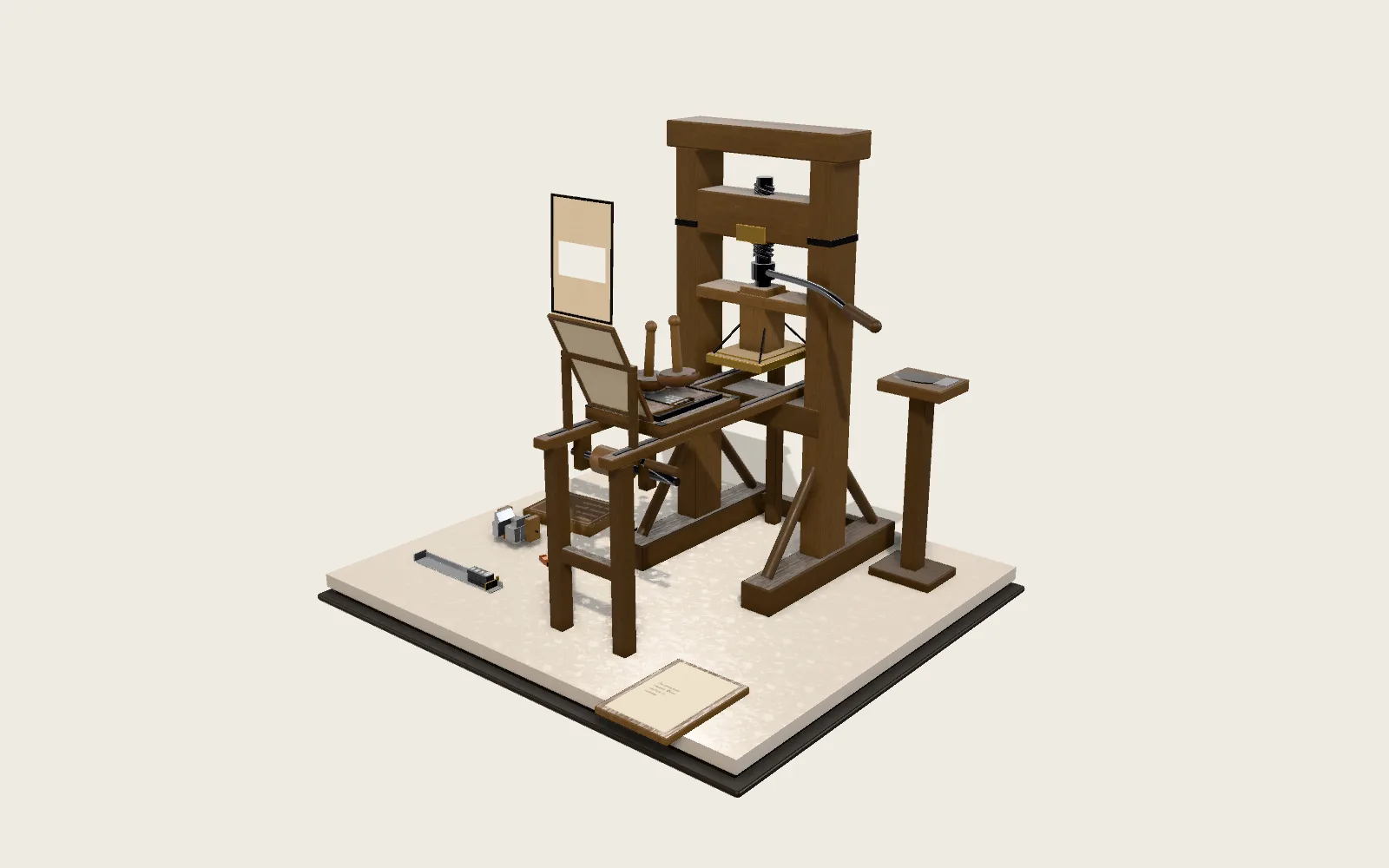 Plate C05The Printing PressMetal letters set into a page, inked, covered with paper, one pull of the bar: a printed page. Mainz, about 1450.
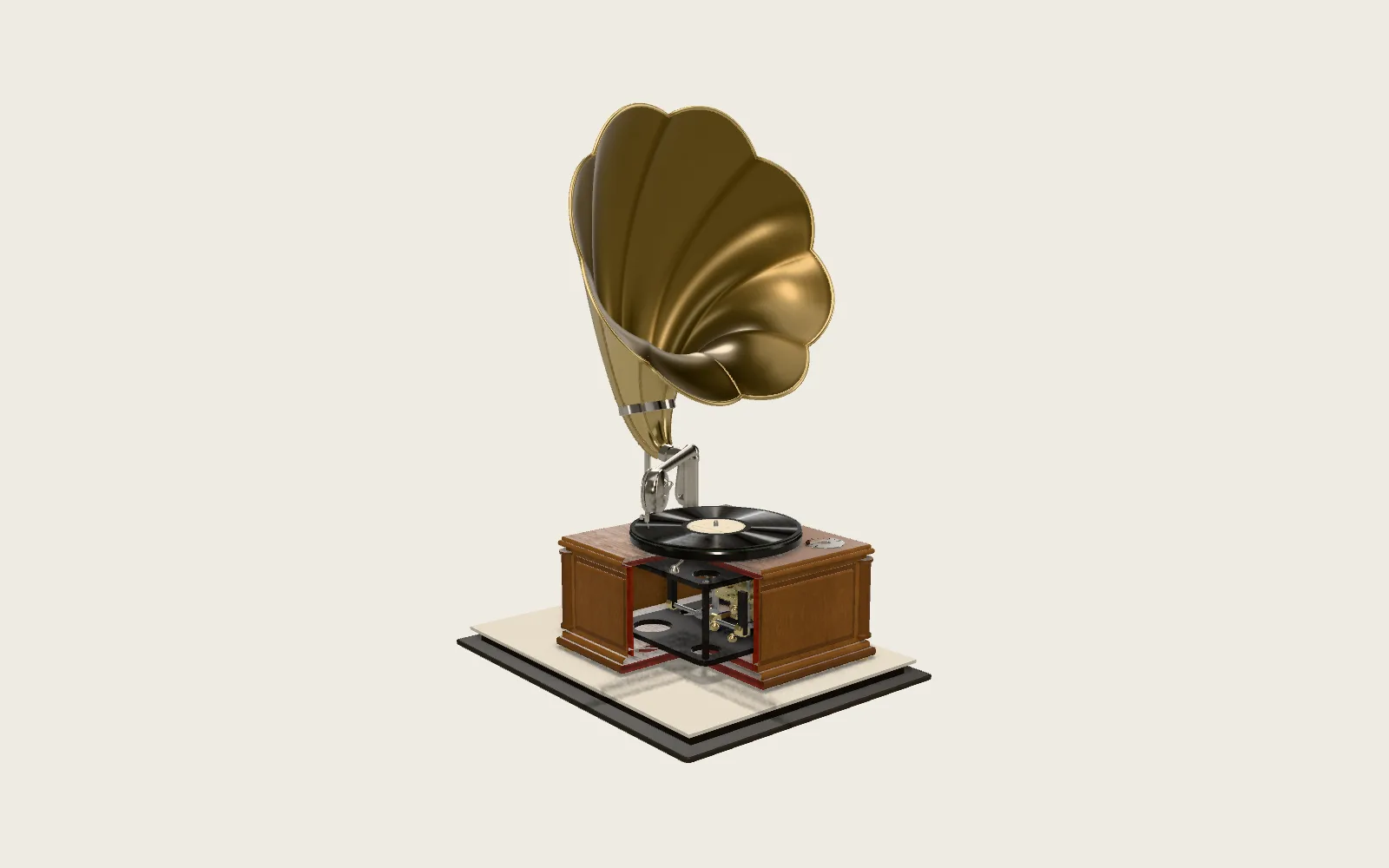 Plate C06The Phonograph and the GramophoneSound pushes a needle that cuts wiggles into a groove; a needle running back along the wiggles brings the sound back. The whole machine runs without electricity.