The Phonograph and the Gramophone
Before 1877, no one had heard recorded sound. The phonograph cut the vibrations of sound into a fine groove, then let a steel needle run along it and shake a thin diaphragm. The model is a wind-up table gramophone: an oak cabinet, a 78 rpm shellac disc, a soundbox with a mica diaphragm and a brass petal horn.
Scroll
Sound Was Gone As Soon As It Was Made
Words could be written down and scenes drawn, but a sound vanished the moment it was made. In 1857 Édouard-Léon Scott de Martinville patented the phonautograph in France: sound moved a membrane, and a bristle on it traced a wavy line on soot-blackened paper.
It could record but not play back; Scott wanted to see sound. In 2008 researchers played back one of his 1860 tracings, the folk song “Au clair de la lune”, from scanned images. It was first heard as a woman’s voice; a year later they found it had been played twice too fast, and it is now thought to be Scott himself.
How the phonautograph recorded: a line on blackened paper swinging with the sound (illustration; the line is computed from this page’s chord)
A Cylinder of Tinfoil
In 1877 Thomas Edison had the needle press dents instead of drawing a line, then follow the dents back. In early December the machinist John Kruesi built the first one. A crank turns a long shaft with a screw thread, ten turns to the inch, and the cylinder on it is wrapped in tinfoil.
Speak into the mouthpiece and the diaphragm drives the needle in and out, pressing dents of varying depth into the foil: a hill-and-dale groove. A second diaphragm’s needle follows the dents and plays them back. The patent was filed on 24 December 1877 and granted on 19 February 1878. The foil lasted only a few playings.
Left: the tinfoil phonograph of 1877 (illustrative model). The shaft’s thread moves the cylinder 2.54 mm along at each turn
A Flat Disc
In 1887 Emile Berliner changed two things. The shape: a flat disc instead of a cylinder. The cut: the needle swings from side to side instead of pressing in, so the groove keeps the same depth and wiggles sideways. His first patent was granted on 8 November 1887.
He traced the sound on a zinc disc coated with beeswax, then etched the trace into a groove with acid. The zinc master was electroplated into a negative that stamped one copy after another: hard rubber at first, shellac from 1895. A cylinder had to be recorded one at a time; a disc could be printed. The record industry began there.
One sound cut two ways, in magnified section: hill-and-dale (Edison) changes the depth, lateral (Berliner) changes the sideways position
The Needle in the Groove
The disc turns 78 times a minute. With the needle 10 cm from the centre, the groove runs under it at about 0.8 metres a second. The groove spirals in from the rim; a side of a 10-inch disc plays about three minutes.
A 78’s groove is far wider than an LP’s, yet a human hair is thinner still. The needle’s tip, 65 to 90 micrometres in radius, rides on the groove’s two walls. Steel needles were meant to be used once, a new one for every side: the shellac is filled with mineral powder that wears the point.
A Chord Cut into the Groove
The block on the right is a piece of groove magnified 200 times in every direction. The middle turn carries a C major chord (C4, E4, G4) computed at true scale: a largest swing of 30 micrometres in a groove about 0.15 mm wide. Six centimetres from the centre, one wavelength of C4 is only 1.9 mm long.
The groove barely bends; to the eye it is a straight line. All of the sound is in those bends: closer bends, a higher note; larger bends, a louder one. The trace below and its sound are computed straight from the groove’s shape, muted until asked for.
The sideways position of the groove’s centre line at true scale (across: distance along the groove)
The Soundbox
The needle is clamped in the lower end of the needle bar. The bar pivots at the bottom edge of the soundbox, and its upper end holds the centre of a mica diaphragm. As the groove pushes the needle sideways, the bar rocks about its pivot and pushes and pulls the diaphragm.
The diaphragm sits between two rubber gaskets and moves back and forth like a small piston on the air inside the soundbox. Its movements are tens of micrometres; the model magnifies them to make them visible.
The Horn
The diaphragm is a few centimetres across; facing the open air directly, it can barely move it. The horn widens slowly from a narrow throat to a broad bell, turning the diaphragm’s small, forceful motion step by step into a large, gentle motion of the air, and passing it into the room. It works like a transformer for air.
The sound leaves the soundbox, runs through the tone arm and the elbow into the horn. There is not one wire on the way. Even after records began to be made with microphones in 1925, a wind-up gramophone played them without electricity.
The horn’s bore along its length: the bell’s area is a few hundred times the throat’s
Spring and Governor
Inside the cabinet is a coiled spring. The crank winds it through a ratchet, and the spring drives the turntable through gears. Fully wound it pushes hard; nearly run down it pushes little. Yet the disc must keep one speed, or the pitch would wander.
A worm on the turntable spindle drives a fast shaft carrying three small balls on flat springs. The faster it turns, the further the balls fly out, pulling a disc along the shaft against a leather pad that brakes away the extra speed. This is a centrifugal governor, the same idea as on Watt’s steam engine.
From fully wound to run down: the speed keeps close to 78 rpm until the last of the spring is spent (model values)
Taken Apart
At the top are the horn and its crane, the tone arm and the soundbox. The soundbox comes apart into its back, case, rubber gaskets, mica diaphragm, front ring, needle bar and needle.
In the middle are the disc and turntable. In the cabinet is the motor: the cast frame, the spring barrel, the intermediate gear, the turntable spindle, the governor and the winding shaft, with the crank coming out of the right side.
The Sound’s Path, Cut Open
Cut along the path the sound takes: the needle, the needle bar, the mica diaphragm, the soundbox’s outlet, the tone arm widening as it goes, the elbow into the horn’s throat, and the horn opening all the way to the bell.
What It Changed
For the first time, music could be bought and taken home. Berliner began selling discs in the United States in 1894, which the Library of Congress calls the true beginning of the enormous record industry. In 1904 Victor released Enrico Caruso’s first American recordings, and he became the recording industry’s first superstar.
For the first time, voices could be kept: Johannes Brahms at the piano in 1889 and Florence Nightingale speaking in 1890 survive to this day. The long-playing record arrived in 1948 and the 45 in 1949; through the 1950s the 78 left the stage.
1857 phonautograph · 1877 tinfoil phonograph · 1887 disc · 1894 discs on sale · 1925 microphone recording · 1948 LP
Crank in Hand
The crank winds the spring; with the brake off, the turntable rises to the speed the governor is set for. The speed lever moves the leather pad: the further away the pad, the wider the balls must fly to reach it, and the faster the turntable runs. The governor’s shaft is shown slowed down; the readout is the real speed.
Try thisThe looser the spring, the weaker its push. Why does the turntable keep to 78 rpm?
What the model leaves out
The gramophone follows the wind-up table machines of the 1910s and 1920s; the cabinet’s and horn’s sizes follow the Smithsonian’s Victor machine and horn, while the petals, the label and the absence of a maker are invented. In the enlarged groove, the swing (30 micrometres), the groove spacing (0.3 mm) and the cut (each note’s swing inversely proportional to its frequency, so every note moves the needle at the same speed) are the model’s choices; real 78s varied from maker to maker and were standardised only in the 1940s. The sound of the enlarged groove is computed from its shape alone: the needle runs along the groove and the soundbox follows its sideways speed; the soundbox’s and the horn’s own colouring are not simulated. The motor’s and governor’s numbers (torques, gear ratios, 360 turns of the turntable from a full wind, the balls and their springs) are typical values chosen for the model, not any one machine’s. The diaphragm’s and needle bar’s vibration and the sound in the horn are magnified and slowed down. The motor’s layout is schematic.
Some common misreadings
Edison did not think of recording sound from nothing: Scott had written sound down as a line in 1857, though it could not be played. Early discs did not all run at 78: Berliner’s ran at about 70–72 rpm and early Victors at about 75–76, and speeds settled more or less on 78 only around 1925. The horn creates no energy; it passes the soundbox’s vibration into the air more effectively, and all the energy comes from the groove pushing the needle, and in the end from the spring. The centrifugal governor is a brake, not an accelerator: however hard the spring pushes, it only rubs away the extra speed. The 2008 playback computed the sound from scanned images; the phonautograph itself never played a sound.
Sources
- Library of Congress: Emile Berliner and the gramophone (etched zinc, lateral cut, patent of 8 November 1887, the United States Gramophone Company of 1894, shellac from 1895, about 78 rpm)
- Library of Congress: History of the cylinder phonograph (tinfoil, hill-and-dale, built by Kruesi, patent filed 24 December 1877, issued 19 February 1878)
- Library of Congress: A recorded sound timeline (1857 phonautograph, 2008 playback, Caruso 1904, electrical recording 1925, the 45 in 1949)
- Library of Congress National Recording Registry: Scott’s phonautograms (c. 1853–1861)
- Library of Congress: Acoustical recording (steel needle, soundbox, tone arm; about 100–2,500 Hz)
- Library of Congress blog: the first long-playing disc (June 1948)
- Thomas A. Edison Papers (Rutgers): Inventing sound recording (a shaft with ten threads to the inch; built by Kruesi in early December)
- US Patent 200,521: Edison, phonograph or speaking machine
- US Patent 372,786: Berliner, gramophone (a groove of even depth)
- US Patent 842,042: a centrifugal governor sliding a disc against a felt pad
- First Sounds: Scott and the playback of “Au clair de la lune” (1860)
- NPR (2009): Reconsidering earliest-known recording (played twice too fast; the singer thought to be Scott)
- Discography of American Historical Recordings (UCSB): turntable speeds (Berliners at 70–72 rpm; more or less 78 rpm after about 1925)
- Discography of American Historical Recordings (UCSB): sizes and playing times (10-inch about three minutes)
- National Film and Sound Archive of Australia: shellac disc (10 or 12 inches, three to four minutes a side, 70–90 rpm)
- University of Illinois PSAP: what discs are made of (shellac, clay, slate, limestone, carbon black)
- Smithsonian National Museum of American History: Victor horn (66.7 × 47.6 cm)
- Smithsonian National Museum of American History: Victor talking machine (about 19 × 35 × 35 cm)
- City of London Phonograph and Gramophone Society: speed regulating, 78 stylus sizes (2.5–4 thousandths of an inch), steel needles used once
- Stanford CCRMA: Brahms at the piano, 1889
- Wellcome Collection: Florence Nightingale, 1890
Follow the question
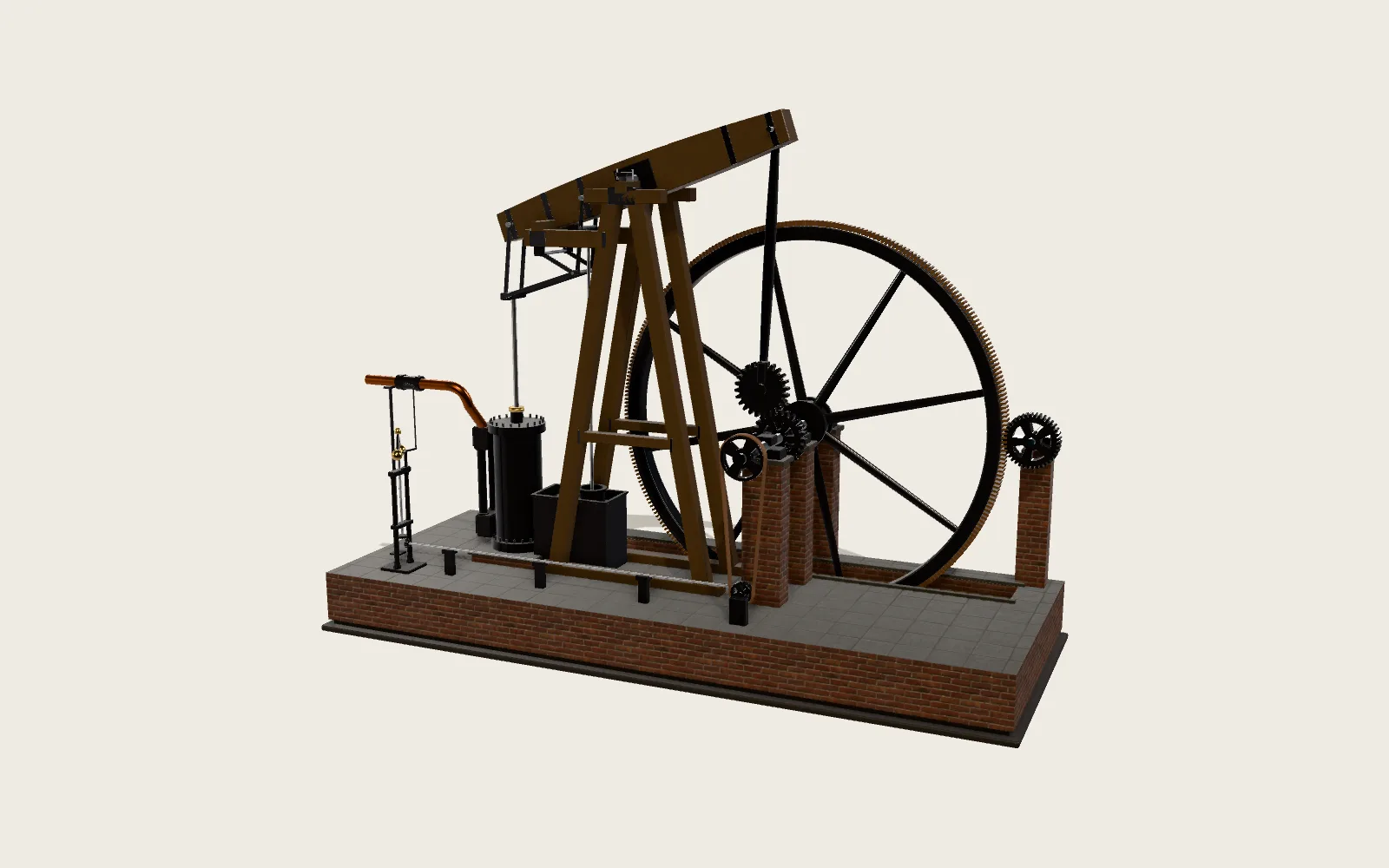 Plate C01Watt’s Steam EngineAn iron vessel standing in cold water saved most of the coal; two spinning balls taught the engine its own pace. Built in Birmingham in 1788, it stands at rest in London today.
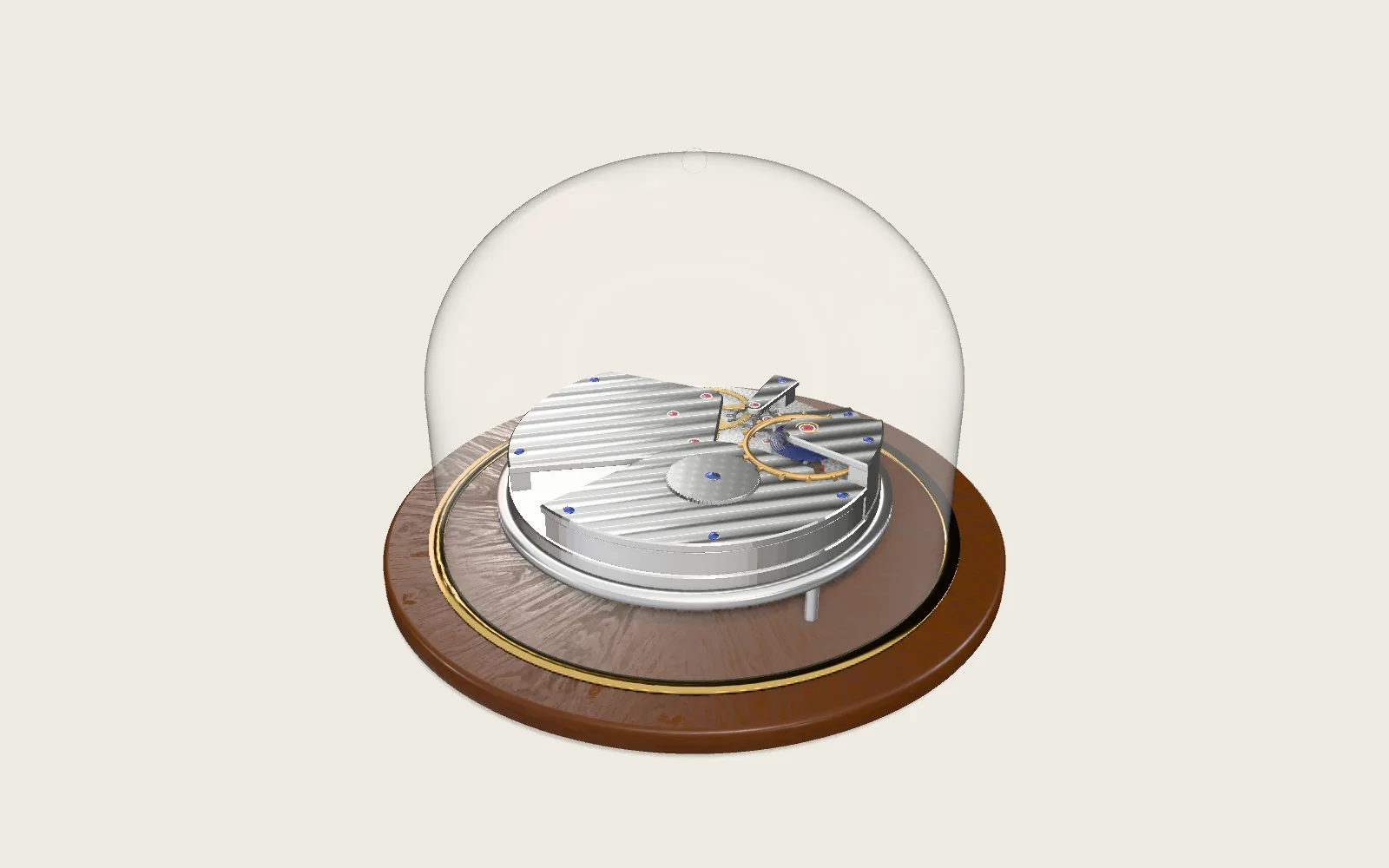 Plate C03The EscapementA spring or a falling weight, let go, gives up its energy all at once. The escapement lets it out in equal small steps, one per beat, timed by something that swings back and forth.