The Printing Press
Around 1450 in Mainz, Johannes Gutenberg put several things together into one method: a hand mould that could change its width, type cast from a lead–tin alloy, oil-based ink, and a screw press. The letters could be taken apart and set again, and a page could be printed hundreds of times. The model follows the wooden hand press as later pictures show it; the tools for casting and setting type are on the bench beside it.
Scroll
How a Book Was Made
Before 1450, books in Europe were copied by hand, one at a time. A scribe’s mistake was copied again by the next.
Woodblock printing was long established in China: the Diamond Sutra in the British Library, printed in 868, is the oldest dated printed book to survive. A woodblock carries a whole page cut in one piece of wood, and one wrong character means patching or recutting the block. In the Qingli years (1041–1048), Bi Sheng made single characters of clay, fired them hard and set them in a frame to print, as Shen Kuo recorded. In Korea, books were printed from metal type: the Jikji, printed at Heungdeok Temple in Cheongju in 1377, is the oldest surviving book printed with movable metal type.
Left: a woodblock, a whole page in one piece of wood · right: movable type, one piece per letter
Gutenberg’s Method
A letter is cut, reversed, on the end of a steel bar: the punch. Struck into a softer block of copper, it leaves a sunken letter: the matrix. The matrix goes in the bottom of the hand mould, the two halves close, molten metal is poured in, and it sets in seconds.
The two halves of the hand mould slide sideways: narrow for an i, wide for an m. The body and the height stay the same, so every letter stands the same height and they set into a level page. The metal is mostly lead, with tin and antimony; it melts low and sets fast, and the antimony expands a little as it sets, so the letters come out sharp. The ink is oil-based, linseed oil boiled to a varnish and mixed with lampblack, so it holds on metal.
Punch (steel) → matrix (copper) → hand mould · the tools on the bench are 2.5 times life size
Set Backwards
The compositor holds a composing stick in the left hand and takes letters one by one from the case with the right, setting them in a line. Seen from the faces, the line is backwards: it runs right to left, and each letter is reversed.
In printing, the paper lies face down on the type and is turned over to be read, which swaps left and right once more. Set backwards on the type, it reads the right way on the page.
Top: the faces in the composing stick · bottom: how it prints
Locking Up and Inking
The set lines are moved, line by line, onto a flat stone to make a page. Wooden strips go round it, wooden wedges squeeze it tight, and the whole page is locked in an iron frame, so it can be moved without falling apart. The locked page is the forme.
Ink goes on with two leather ink balls, stuffed with wool or horsehair, on wooden handles. The pressman first spreads the ink on the ink block, then beats the faces of the type with the balls, so each letter takes a thin coat.
Iron chase · wooden strips and wedges · two leather ink balls
One Pull
A dampened sheet goes on the tympan, placed on its points; the frisket, a frame with windows cut in it, folds down to mask what should not print; then the tympan folds down onto the forme. A turn of the rounce runs the carriage along its rails under the platen.
The pressman pulls the bar, the screw turns, and the brass platen presses down on the sheet. The platen moves only a short way, and the thread turns the pull of an arm into a great pressure. The bar goes back, the carriage runs out, the tympan opens and the printed sheet comes off.
Ink → sheet → frisket → tympan → run in → pull → run out → take off
Taken Apart
The frame is oak: two cheeks, a cap on top, feet below. The head between the cheeks holds a brass nut, and the iron screw turns in it. The foot of the screw sits in a square hose, and the platen hangs from the hose. The rails run out of the frame, and the carriage and tympan travel on them.
Taken apart, whichever piece the pointer rests on is lifted out and named.
Cut Open: Casting a Letter
Cut open, the hand mould has a narrow upright slot in its middle, the copper matrix at the bottom and a mouth at the top. Poured metal fills the slot first and leaves a stub in the mouth.
Once it has set, the halves part, the letter comes out and the stub, the jet, is broken off. Dressed, it is a piece of type. Change the matrix and the same mould casts the next letter.
Cut open: the two halves · slot · copper matrix · mouth · 2.5 times life size
Forty-Two Lines
Gutenberg’s best-known book is a Latin Bible, finished before 1455. Each page has two columns, most of them 42 lines long, hence the name “42-line Bible”; the first pages have 40. It runs to 1,282 pages in two volumes.
According to the Gutenberg-Museum in Mainz, about 180 copies were printed, about 150 on paper and 30 on vellum. To make it look like a manuscript, 290 different characters were cast, including ligatures and abbreviations. About 20 people worked on it in the workshop. 49 copies survive today. Before it, the workshop printed Latin grammars and indulgences; one indulgence, dated 22 October 1454, is the earliest precisely dated print in Europe.
About 180 copies · 42 lines a column · 290 characters · 49 survive
What It Changed
Printing spread across Europe within a few decades. By 1500, more than two hundred towns had a printing shop. The Incunabula Short Title Catalogue (ISTC) records about 30,000 editions printed from movable type before 1501.
Every copy from the same setting has the same pages and the same words. Readers could cite a page and a line, and a mistake corrected once was correct in every later copy. One book could reach many cities at once: in 1517 Luther’s theses were reprinted in several cities within weeks. In 1543 Copernicus’s On the Revolutions was printed in Nuremberg, in about 400 to 500 copies.
Around 1450: Mainz · 1500: more than two hundred towns · about 30,000 editions
At the Bar
Once the carriage is in, the bar can be pulled. The deeper the pull, the harder the impression and the blacker the letters. Let go and the carriage runs out, the sheet comes off, and the next one follows.
Try thisPull the bar only halfway: how does the page come out? And with a full pull?
What the model leaves out
No press from Gutenberg’s workshop survives, and the earliest picture of a press is a woodcut in a Dance of Death printed at Lyon in 1499. Gutenberg’s press was adapted from the screw press used for wine. The model follows the later “common press”: the tympan, frisket and running carriage belong to it, and carriages that ran in for two pulls appeared around 1472. Dimensions are estimated in proportion. The forme does not carry a page of the 42-line Bible but the first verse of Genesis in the Latin of the Vulgate, set in UnifrakturMaguntia, a modern Fraktur rather than the Bible’s textura, and much larger than the Bible’s type (a body of about 7 mm) so it can be read. Drying, folding and binding the sheets are not shown.
Some common misreadings
Gutenberg did not invent movable type, nor metal type: Bi Sheng in China and the craftsmen of Goryeo Korea came before him. What he made was a whole method for printing books in quantity and at speed: an adjustable hand mould, an alloy suited to casting, oil-based ink and a screw press. His exact alloy is not recorded; lead, tin and antimony is the make-up of later type metal. Some researchers, from small differences between letters, argue that his earliest type may not have been cast from fixed copper matrices; by the 1470s, punch, copper matrix and hand mould were the standard method. The figure of about 180 copies comes from Piccolomini’s letter of 12 March 1455, which also mentions 158; estimates of the paper and vellum copies differ, and the Library of Congress gives 145 and 35.
Sources
- Gutenberg-Museum Mainz: The 42-line Bible (about 180 copies, 150 paper and 30 parchment; 290 characters; 1,282 pages; about 20 workers; 49 survive)
- Gutenberg-Museum Mainz: Gutenberg’s invention (punch, matrix, hand mould, alloy, press)
- Library of Congress: Gutenberg Bible (vellum)
- Library of Congress: its Gutenberg Bible, one of three perfect vellum copies
- Bibliothèque nationale de France: Jikji, printed with metal type at Heungdeok Temple, Cheongju, 1377
- British Library: The Diamond Sutra, 868
- Bi Sheng and clay movable type (Shen Kuo, Dream Pool Essays)
- Cahill et al. (1984): Gutenberg’s inks and papers, proton milliprobe analysis, Archaeometry
- Princeton University Library: the first picture of a printing press (Lyon, 1499)
- Incunabula Short Title Catalogue (ISTC), British Library / CERL
- The spread of printing (towns with a press before 1500)
- Gutenberg’s casting method and the work of Agüera y Arcas and Needham
- Typeface on the page: UnifrakturMaguntia by j. ‘mach’ wust and Peter Wiegel, SIL Open Font License 1.1 (OFL), unmodified. A modern Fraktur after a Mainz Fraktur of 1901, not the 42-line Bible’s type
- SIL Open Font License 1.1, full text
Follow the question
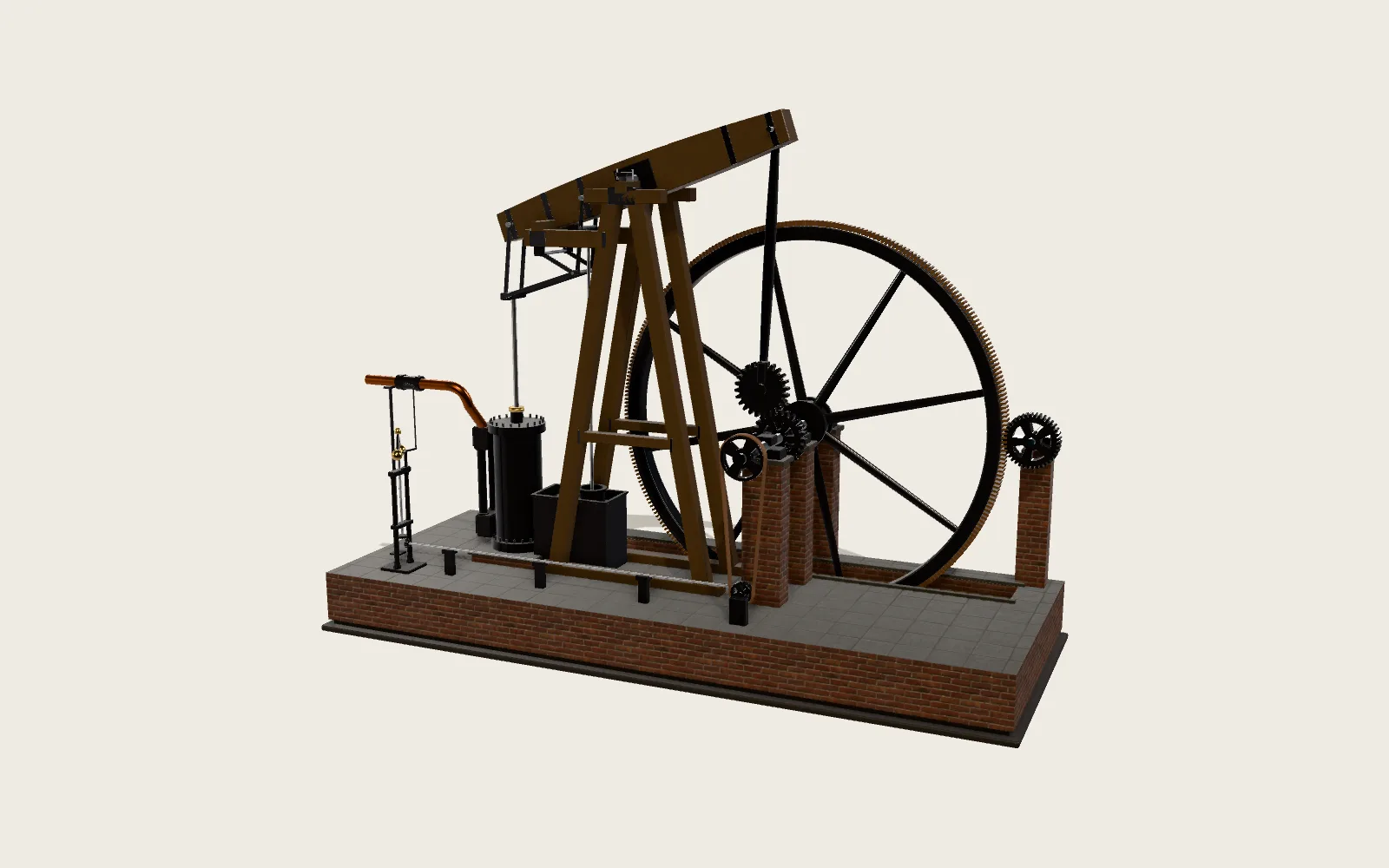 Plate C01Watt’s Steam EngineAn iron vessel standing in cold water saved most of the coal; two spinning balls taught the engine its own pace. Built in Birmingham in 1788, it stands at rest in London today.
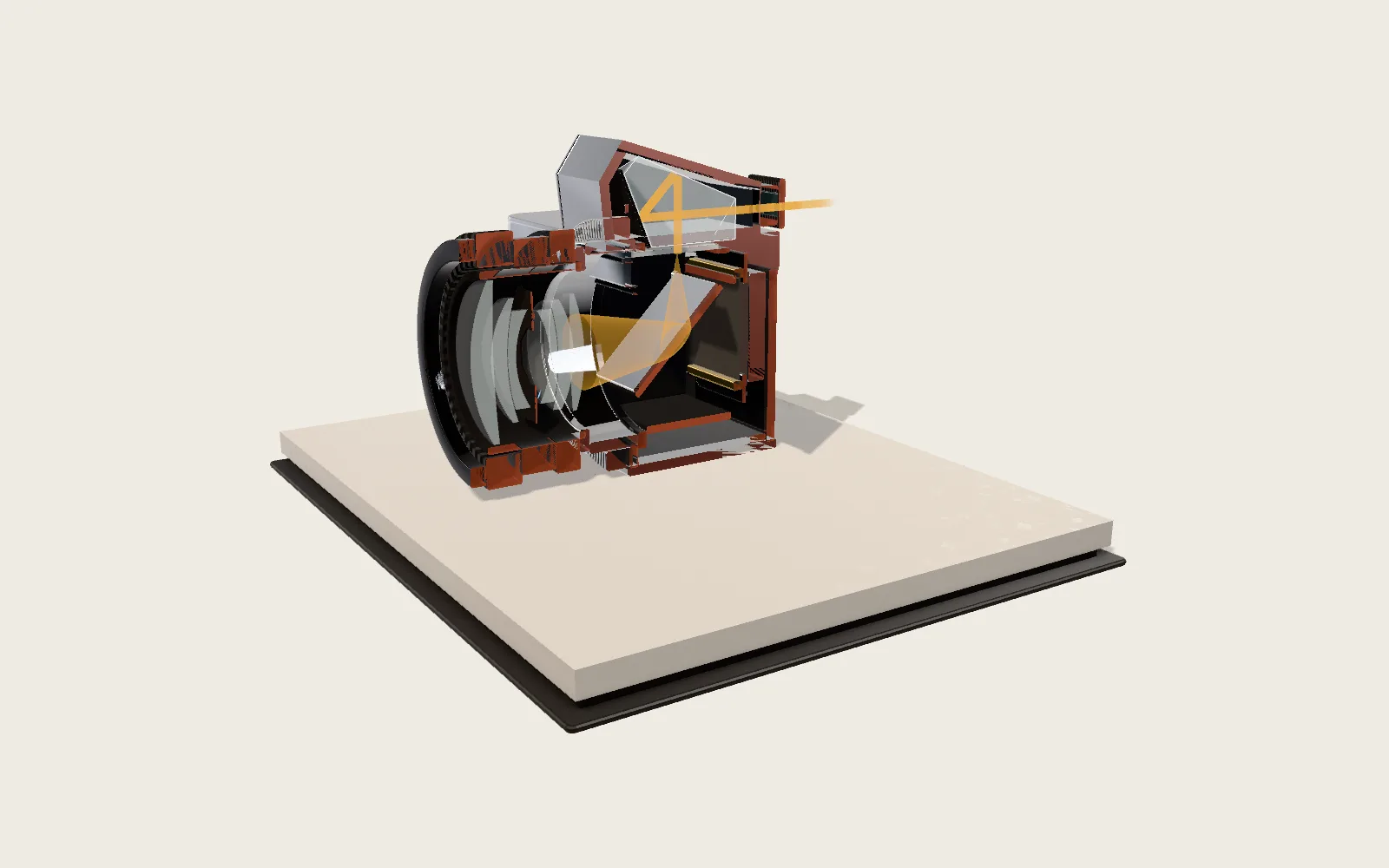 Plate C02The SLR CameraWhile you frame, a mirror behind the lens sends the light up into a prism. Press the release and the mirror lifts; two cloth curtains cross the film one after the other.