The Stellarator
Fifty twisted superconducting coils make the magnetic cage, with no large plasma current. In 2023 the largest held a plasma for eight minutes.
Scroll
Eight Minutes of Plasma
A stellarator holds a very hot hydrogen plasma in a twisted magnetic field made entirely by the coils around it. Wendelstein 7-X (W7-X) in Greifswald, Germany, is the largest stellarator in the world: 16 m across, 725 tonnes, first switched on on 10 December 2015.
On 15 February 2023 it held a plasma for eight minutes (480 s), with 1.3 GJ of energy put in and taken out. On 22 May 2025 it held a high value of the fusion triple product for 43 seconds: for discharges longer than 30 seconds, on a par with the best tokamaks (shared with JET). The same campaign reached 1.8 GJ of energy turnover. It runs on hydrogen, uses no tritium and makes no fusion energy.
480 s · 1.3 GJ (2023) · triple product held 43 s (2025) · 1.8 GJ
One Part in 100,000
A stellarator’s field comes entirely from its coils, so it can be checked before there is any plasma. In 2015 the team sent a beam of electrons along a field line in the evacuated vessel and swept a thin rod coated with a fluorescent powder through the cross-section: the electrons went round the same field line many times, leaving a bright spot each time they crossed the rod, and the spots drew nested magnetic surfaces.
The result, published in 2016: the field differs from the calculated one by less than one part in 100,000; a field line followed for 100 m stays within a millimetre. It needed coils built to tolerances of about ±1 mm. The small error measured came mainly from the planar coils’ placement and shape, and five external trim coils can cancel it.
Error < 1 in 100,000 · 1 mm in 100 m · coil tolerance about ±1 mm
A Twist Made by Coils
Charged particles circle along magnetic field lines. Bend the lines into a plain ring and the field is weaker on the outside: ions drift up, electrons down, the separated charges set up an electric field, and that pushes both out to the wall. The cure is to make each line wind round the cross-section as it goes round the ring: a particle drifts away on the upper half and back on the lower, and on average stays on its magnetic surface.
How many times a line goes round the cross-section for each time round the ring is the rotational transform, ι. A tokamak makes it with a large current in the plasma, driven by a transformer, so it runs in pulses, and current-driven instabilities can end in disruptions. A stellarator makes it with the shape of its coils alone: no large plasma current, no transformer, and it can run continuously. In W7-X’s standard configuration ι rises from about 0.85 at the centre to about 0.98 at the edge.
ι = turns round the cross-section per turn round the ring · about 0.85 → 0.98
From Bean to Triangle
Seen from above, the plasma ring of W7-X is a rounded pentagon: the machine is made of five nearly identical modules, and its field repeats every 72°. The magnetic axis is no flat circle either, but a spiral that rises and falls.
The cross-section changes all the way round: at a corner of the pentagon (φ = 0°) it is an upright bean, half a period on (φ = 36°) a flat triangle, and half a period later a bean again. Its long axis turns half a turn every period, and that, with the twist of the axis, gives the rotational transform.
5 periods · bean (0°) → triangle (36°) → bean (72°)
Fifty Coils, Five Shapes
The field comes from 50 twisted, non-planar superconducting coils, each about 3.5 m high, 2.5 m wide and 6 tonnes. Each module has ten, in pairs of the same shape mounted upside down, so there are only five shapes in all. Each coil has 108 turns of niobium-titanium cable: superconducting filaments in copper wires, braided into a cable inside an aluminium sheath, with liquid helium flowing through the gaps to cool it to about 4 K (−269 °C). In the full-system test of 2015 all coils together reached 12.8 kA.
Twenty planar coils (two types, 36 turns each) sit over them to adjust the field: they add or remove toroidal field and move ι up or down as a whole. Each coil type has its own power supply, seven circuits in all. In operation the field on the axis is 2.5 T; the design allows up to 3 T.
50 non-planar coils · 5 shapes · 20 planar coils · about 4 K · 12.8 kA
A Shape That Was Calculated
Early stellarators confined their field lines but not their particles: many particle orbits drifted out. The field of W7-X was calculated first. A theory group searched the possible configurations for more than ten years for one that met seven conditions at once, among them a field little disturbed by the plasma’s pressure, low heat losses, a very small bootstrap current, well-confined fast particles and modular coils that can be built. The calculation needed the supercomputers of the 1980s; the coils’ odd shapes are its result.
A paper in 2021 tested it. In a high-performance discharge of 2018 these “neoclassical” losses were about 30 % of the heating power; the same plasma in a less optimised stellarator would, by calculation, have lost more than all of its heating power, which is impossible. What remains is mostly lost to turbulence.
Seven conditions · 1980s supercomputers · neoclassical losses about 30 % (2021)
Cut Open: Cold and Vacuum
Cut open, it is shells within shells. Outermost is the 16 m outer vessel, the cryostat, pumped to a vacuum that insulates; the copper-coloured layer is the thermal shield. The coils and the ring-shaped central support that holds them are cooled to superconducting temperature together, a cold mass of 425 tonnes, by a 7,000 W helium refrigerator. The cut coils show their copper-coloured windings.
Inside the coils is the stainless-steel plasma vessel: 20 sections, twisted to follow the plasma, 35 tonnes, pumped to an ultra-high vacuum below 10⁻⁸ mbar. 254 port tubes pass between the cold coils to the outer wall, for diagnostics, fuelling and heating.
16 m across · cold mass 425 t · about 4 K · 254 ports · < 10⁻⁸ mbar
The Island Divertor
Heat and particles always leak to the edge of a plasma. At the edge of W7-X the field forms a chain of magnetic islands by itself: in the standard configuration ι is exactly 1 there, and the cross-section shows five islands (5/5). The target plates of ten divertor units, two per module, cut into those islands; heat and particles follow the islands onto the plates, where they are neutralised and pumped away. Unlike a tokamak, it needs no extra magnets to divert the edge.
In 2015–16 there were five graphite limiters, in 2017–18 an uncooled graphite test divertor. Since 2022 it has had a water-cooled divertor of carbon-fibre-reinforced carbon, designed for 10 MW per square metre, so far shown at 6 MW per square metre. The water pipes that cool the inner wall are 6.8 km long, in 657 separate circuits.
5/5 islands · 10 divertor units · water-cooled · 10 MW/m² (design)
Heated by Microwaves
The plasma is heated by waves and beams sent in from outside, not by an induced current. The main heating is electron cyclotron resonance: gyrotrons make 140 GHz microwaves, about 2 mm long, twice the frequency at which electrons circle in a 2.5 T field. Each gyrotron gives about 1 MW, the newest 1.3 MW, and eleven are installed. They stand in another building; the beams travel about 60 m through the air from one cooled copper mirror to the next and enter the plasma through a port.
Neutral-beam injection fires 55 keV hydrogen atoms into the plasma, up to 7 MW; ion cyclotron heating adds up to 1.5 MW. Fuel comes as pellets of frozen hydrogen: in the record discharge of 2025, about 90 went in over 43 seconds.
140 GHz · about 2 mm · about 60 m by mirrors · neutral beams up to 7 MW
Costs and Limits
It makes no power: it runs on hydrogen, not tritium, and was never meant to. The eight-minute discharge averaged 2.7 MW of heating; the design goal is 10 MW for 30 minutes, 18 GJ. Discharges longer than five minutes have run into overheated components and scorched sealing rings on vacuum valves. The stellarator record for the triple product, 1.126 × 10²⁰ keV·s·m⁻³ in 2024, is about 3.8 % of a power plant’s threshold (3 × 10²¹); the plasma pressure has reached almost 3 % of the magnetic pressure, where a power plant needs 4–5 %.
The investment from 1995 to 2021 was 460 million euros; with the Greifswald institute’s buildings, staff and running costs, 1.44 billion. Assembly took nine years and more than a million working hours. Most of its losses now are to turbulence. Its plasma is 30 cubic metres; ITER’s is 830. New companies, among them Proxima Fusion and Gauss Fusion in Germany, are designing stellarator power plants based on it.
2.7 MW of 10 · 480 s of 30 min · triple product about 3.8 % of the threshold
Taken Apart
The outer vessel with its ports, the 50 non-planar coils, the 20 planar coils, the plasma vessel, the divertor, the plasma and the neutral-beam injector, lifted apart layer by layer.
Rest the pointer on one (tap it on a phone) and it lifts on its own with its name; the rest fade.
Turn the Planar Coils
The lever sets the current in the 20 planar coils, per turn, as 0 to −70.6 % of the non-planar coils’. Each setting is the vacuum field this page computed from the shapes of all 70 coils: the figure is the Poincaré plot in the bean-shaped cross-section, a dot each time a field line crosses it; the readouts are ι at the centre and at the edge.
The more negative the current, the higher ι as a whole. In the standard configuration (0) ι runs from 0.86 to 0.98 and the edge has five islands; at −70.6 % (the current ratio of the high-iota configuration in the experiments of 2018) ι runs from 1.02 to 1.20 and the edge has four islands (5/4). In the settings between, the five islands of ι = 1 move inside the plasma. The experiments of 2018 measured 0.854 → 0.984 and 1.012 → 1.210.
Try thisMove the planar coils from the standard setting to high iota: how many islands does the edge show in the cross-section before and after? In the settings between, where do the ι = 1 islands go?
What the model leaves out
The model is at 1:16. The centre lines of the non-planar and planar coils come from a single-filament model of W7-X’s coils; the casings’ cross-sections, the support blocks between coils and the wall thicknesses are schematic. The outer vessel is drawn as a ring of round cross-section; the real one is more complex. Only a few dozen ports are drawn (the machine has 254), placed where they clear the coils. Heating shows one microwave line and one neutral-beam box; the gyrotrons and their building are not in the model, and the line is cut at the plinth’s edge. The divertor’s target plates are rows of tiles in a schematic place. The plasma’s pink glow, the field lines and the two beams in the heating chapter are drawings: a real plasma is almost invisible, and neither field lines nor microwaves can be seen. The surfaces and lines are computed by this page from the coils (vacuum, no plasma pressure, single-filament coils); in the laboratory the two planar coil types carry the same current, and the model’s surfaces stay those of the standard configuration while only the field lines’ twist follows the readout. The dots in the bean and triangle cross-sections are this page’s computed Poincaré plots, not photographs from the experiment.
Common misconceptions
“There is no current in a stellarator” is wrong: its coils carry thousands of amperes; what it lacks is a tokamak’s large, transformer-driven plasma current. The plasma still drives a small bootstrap current of its own, measured below a few kiloamperes in W7-X and at times cancelled with microwave current drive. “No disruptions” means none driven by a current, not no instabilities: discharges can end in a radiative collapse, and MHD activity appears when ι crosses 1. The 1.3 and 1.8 GJ are heating energy put in and taken out, not fusion energy produced. A “world record” needs its qualifier: those of 2017–18 and 2024 are stellarator records; that of 2025 is the triple product in discharges longer than 30 seconds, shared with JET, while tokamaks still lead for short ones. The longest discharge is 480 s, not 30 minutes. W7-X is the largest stellarator, not the largest fusion device. Hundred-million-degree figures are electron temperatures; the ions have reached about 40 million degrees. 3 T is the design field; experiments use 2.5 T. The 50 coils come in only five shapes. The supercomputers that designed it were those of the 1980s. The plasma does not touch nothing: its edge is led onto the divertor on purpose, and that is where it is hottest.
Common questions · 4
- How exactly was the magnetic field of W7-X built?
The result, published in 2016: the field differs from the calculated one by less than one part in 100,000; a field line followed for 100 m stays within a millimetre.
02One Part in 100,000 ↑- How is a stellarator different from a tokamak?
A stellarator makes it with the shape of its coils alone: no large plasma current, no transformer, and it can run continuously.
03A Twist Made by Coils ↑- How many coil shapes does W7-X have?
Each module has ten, in pairs of the same shape mounted upside down, so there are only five shapes in all.
05Fifty Coils, Five Shapes ↑- Where do the islands at the edge of W7-X come from?
At the edge of W7-X the field forms a chain of magnetic islands by itself: in the standard configuration ι is exactly 1 there, and the cross-section shows five islands (5/5).
08The Island Divertor ↑
Sources
- IPP: Wendelstein 7-X (largest stellarator; investment €460 million, €1.44 billion with the institute; 50 non-planar superconducting coils)
- IPP: Introduction – the Wendelstein 7-X stellarator (major radius 5.5 m, minor 0.53 m, 30 m³, 3 T; no tritium)
- IPP: W7-X Concept planning (pentagon; spiral axis; triangular to bean-shaped cross-sections; seven conditions; 1980s supercomputers)
- IPP: W7-X Technology (five modules, five coil types; 20 planar coils; ring support; 16 m cryostat; 20-section plasma vessel; 7,000 W, 425 t)
- IPP: W7-X Milestones (first plasma 10 Dec 2015; 8 minutes, 1.3 GJ on 15 Feb 2023; triple product on 22 May 2025)
- IPP: Stellarator (no longitudinal net current in the plasma, no transformer, continuous operation; more than ten years of searching)
- IPP: Magnet coils (about 3.5 m high, 6 t; NbTi strands in copper, aluminium sheath, helium at 4 K)
- IPP: Plasma vessel (below 10⁻⁸ mbar; high-grade steel)
- IPP: Plasma boundary (divertor; no extra magnets; ten target areas; water-cooled, 10 MW/m², carbon-fibre-reinforced carbon)
- IPP: Magnetic confinement (a purely ring-shaped field weakens outwards and pushes particles to the wall; the lines must be twisted)
- IPP: Tokamak (plasma current induced by a transformer, hence pulsed)
- IPP: Microwave heating – ECRH (main heating; 140 GHz, about 2 mm, 2.5 T; about 60 m, copper mirrors)
- IPP: Neutral Beam Injection (two injector boxes; hydrogen at 55 keV, 7 MW)
- IPP: Ion Cyclotron Resonance Heating (25–38 MHz)
- IPP: Wendelstein 7-X fusion device, fact sheet (16 m across, 5 m high, 725 t; 254 ports; Spitzer 1951)
- IPP (2006): Plasma vessel for Wendelstein 7-X ready (20 sectors, 35 t)
- IPP (2013): Last steel seam on Wendelstein 7-X closed (the 254th port)
- IPP (2015): Magnet tests on Wendelstein 7-X successfully completed (all coils together to 12.8 kA)
- IPP (2015): The first plasma (nine years of construction, over a million assembly hours; helium)
- IPP (2016): Upgrading after successful first round of experiments (about 6,000 carbon tiles)
- IPP (2016): Magnetic field of Wendelstein 7-X exact to a hundred-thousandth (1 mm in 100 m)
- IPP (2021): The Wendelstein 7-X concept proves its efficiency (neoclassical losses about 30 %; more than the heating power in less optimised fields)
- IPP (2022): Wendelstein 7-X on the verge of new peak performance (6.8 km of pipes, 657 circuits; NBI 7 MW; ICRH 1.5 MW)
- IPP (2023): Power plasma with gigajoule energy turnover generated for eight minutes (1.3 GJ, 480 s, 2.7 MW average)
- IPP (2024): Wendelstein 7-X starts new experimental campaign
- IPP (3 June 2025, updated 30 June): Wendelstein 7-X sets new performance records (43 s; joint with JET; 1.8 GJ in 360 s; almost 3 %; about 90 pellets)
- IPP (2025): Ten years of Wendelstein 7-X (Proxima Fusion, Gauss Fusion)
- IPP (2026): HiPMiB (eleven gyrotrons, 0.6–1.3 MW; 12 positions; 28 GHz per tesla; overheating in pulses over five minutes)
- Pedersen et al. (2016): Confirmation of the topology of the Wendelstein 7-X magnetic field to better than 1:100,000, Nature Commun. 7, 13493 (electron beam and fluorescent rod; ±1 mm; error mainly from the planar coils; trim coils)
- Klinger et al. (2019): Overview of first Wendelstein 7-X high-performance operation, Nucl. Fusion 59, 112004 (high iota, low shear; five graphite limiters; island divertor)
- Geiger et al. (2020): Confinement and equilibrium with internal islands in a configuration scan with respect to iota in W7-X, IAEA FEC 2020 (Table 1: standard ι 0.854 → 0.984, high iota 1.012 → 1.210; a power supply per coil type)
- Beidler et al. (2021): Demonstration of reduced neoclassical energy transport in Wendelstein 7-X, Nature 596, 221
- Grulke et al. (2024): Overview of the first Wendelstein 7-X long pulse campaign with fully water-cooled plasma facing components, Nucl. Fusion 64, 112002 (10 MW/m² design, 6 MW/m² shown; 480 s)
- Grulke et al. (2026): Overview of Wendelstein 7-X high-performance operation, Nucl. Fusion 66, 116003 (triple product 1.126 × 10²⁰ keV·s·m⁻³; ⟨β⟩ = 2.8 %; plasma current below 3 kA)
- Davies et al. (2025): Characterisation of X- and O-points in Wendelstein 7-X with respect to coil currents, arXiv 2511.15641 (5/5, 5/4, 5/6 island chains; planar coils move ι; 108 / 36 turns)
- Risse et al. (2017): The magnet system of Wendelstein 7-X stellarator in operation (108 turns non-planar, 36 planar)
- Imbert-Gérard, Paul, Wright (2020): An Introduction to Stellarators, arXiv 1908.05360 (drifts in a toroidal field; rotational transform; disruptions)
- ITER: Facts & Figures (830 m³ of plasma)
- simsopt (MIT licence): the W7-X single-filament coil set (from which this page computes the field, ι and the Poincaré plots)
Data
The coils are swept along the single-filament coil set of Wendelstein 7-X in simsopt (MIT licence, © 2023 Simsopt contributors; the shapes from the coil file coils.w7x_v001 by J. Geiger, IPP). The flux surfaces, the rotational transform, the Poincaré plots and the laboratory’s eight settings are computed by this page from those coils, in vacuum. The model follows what IPP publishes about the machine (five modules, 50 non-planar and 20 planar coils, the plasma vessel, the cryostat, ports, ten divertor units, microwave and neutral-beam heating); it is no plan of the machine, and what it simplifies is listed in the notes. Material presets, parts and the softbox studio of the site’s model kit are ported from AirsupHQ/machine-skill (MIT, © 2026 Air Supply Technologies Inc.).
The text, pictures and models on this page are licensed CC BY-NC 4.0: free to use and adapt for teaching and other non-commercial purposes, with credit to world.lapla.si. Third-party material listed above keeps its own licence.
Cite this plate
Laplace’s Mini World, Plate F46, “The Stellarator”, https://world.lapla.si/en/stellarator/, CC BY-NC 4.0, updated 2026-10-25.
Follow the question
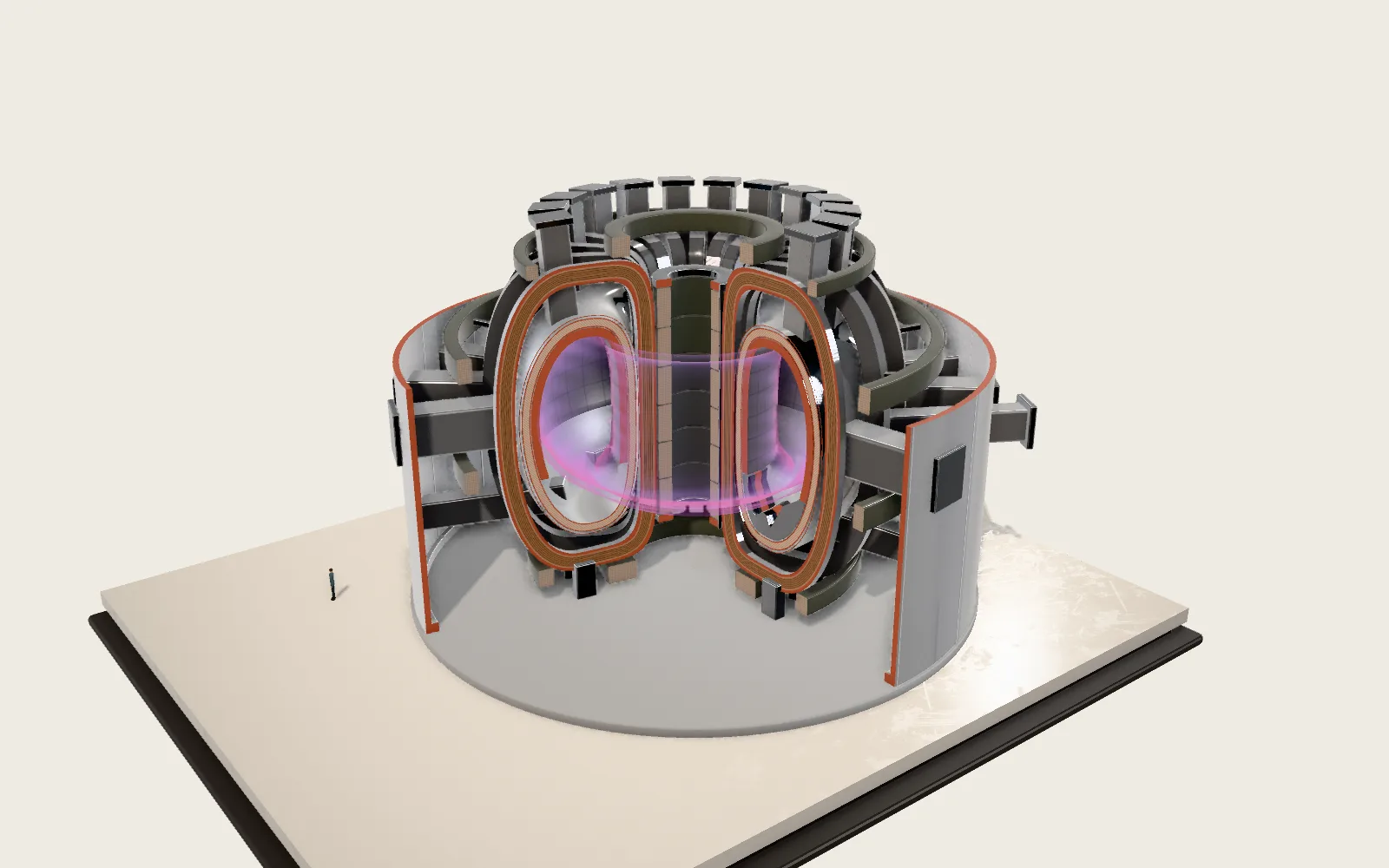 Plate F06Tokamak Fusion ReactorA tokamak like ITER: eighteen D-shaped superconducting coils round a ring-shaped vacuum vessel, inside which a deuterium–tritium plasma at about 150 million degrees hangs in a magnetic field.
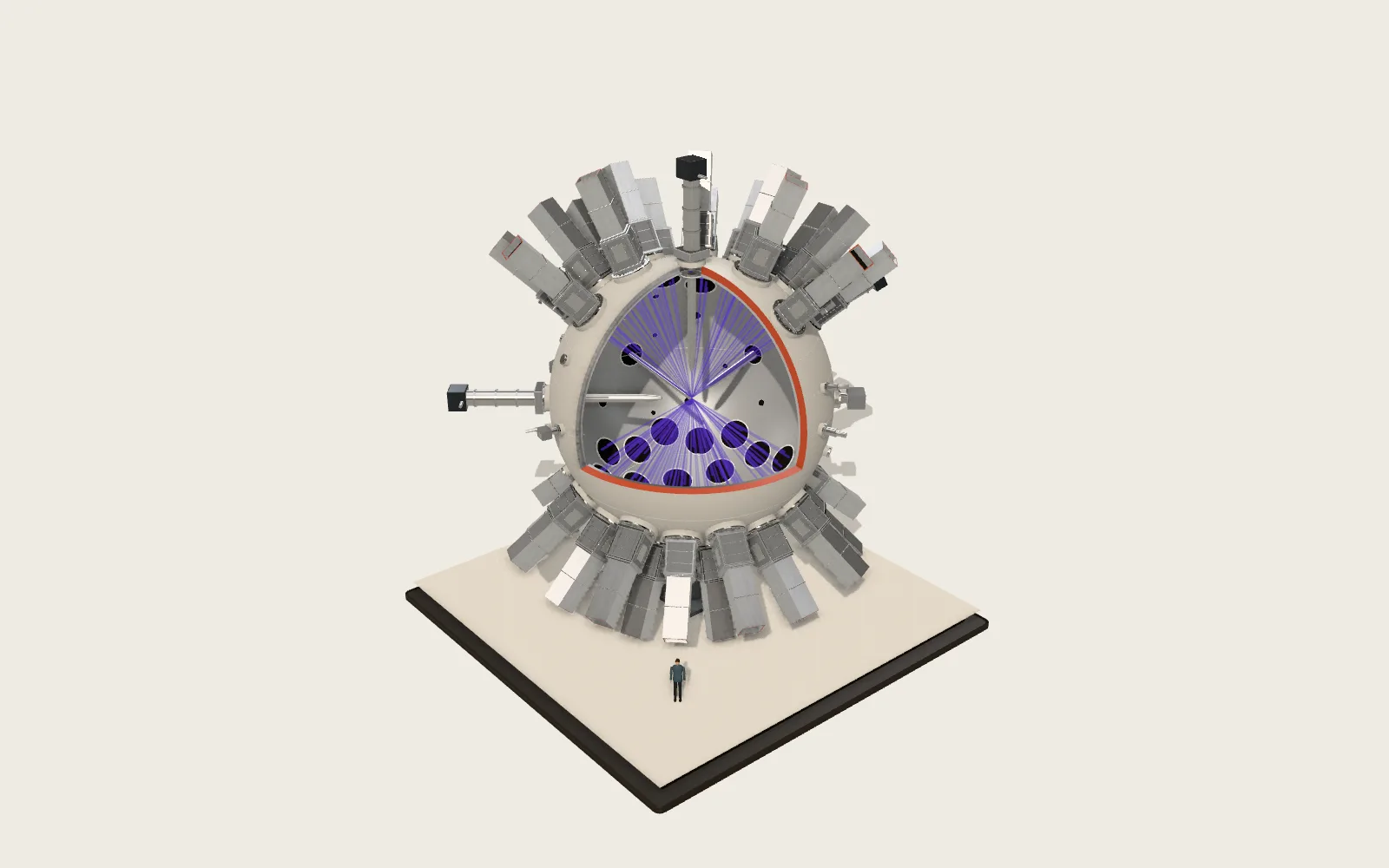 Plate F32Laser Fusion IgnitionThe National Ignition Facility heats a small gold can with 192 laser beams; the X-rays inside squeeze a fuel capsule smaller than a peppercorn until it fuses. On 5 December 2022 the fusion energy released was larger, for the first time, than the laser energy that reached the target.
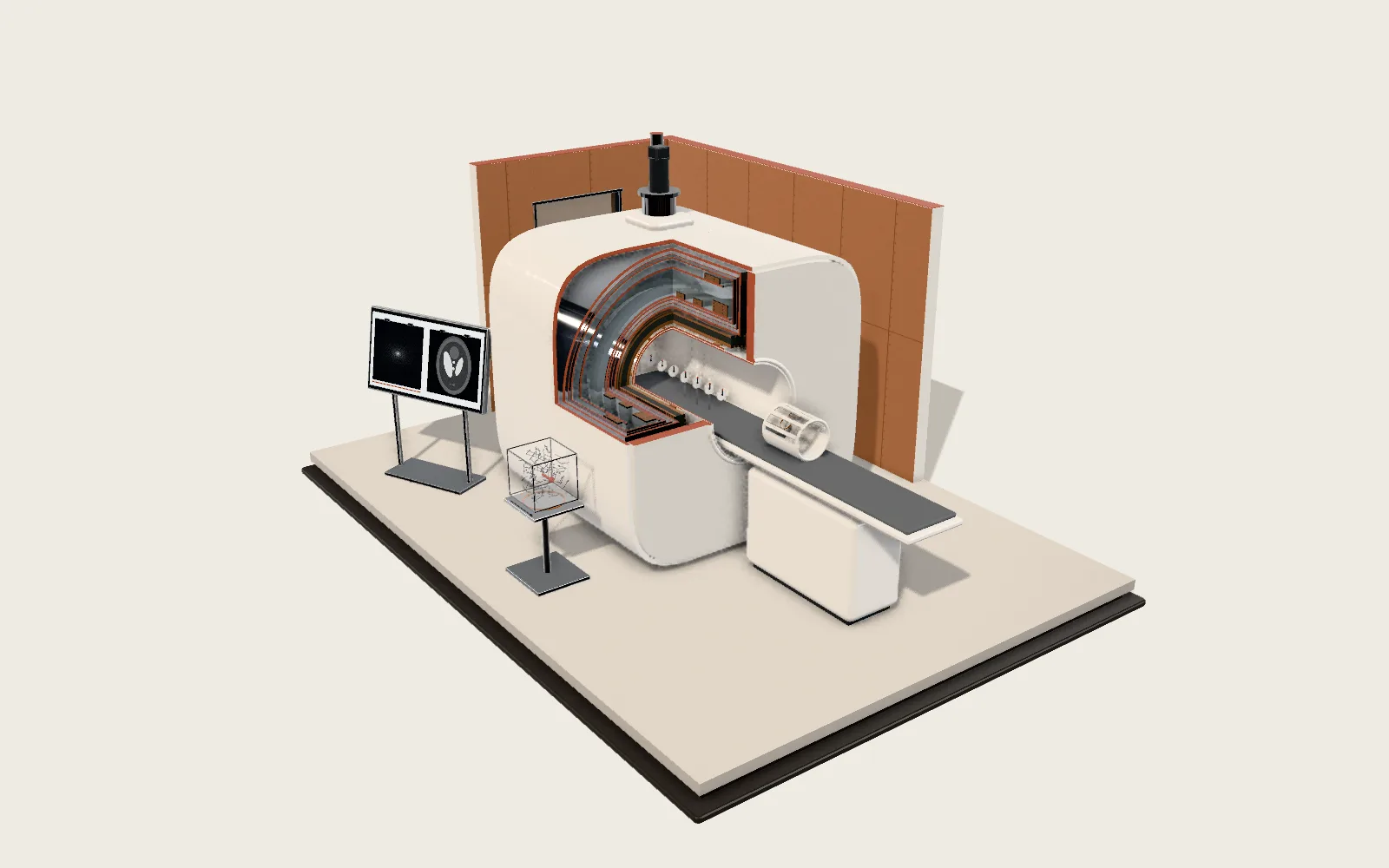 Plate F03MRI ScannerA clinical MRI scanner: a superconducting magnet, gradient coils and RF coils, one inside another. Hydrogen nuclei precess in the field; their signal fills k-space, and a Fourier transform turns it into an image.