Laser Fusion Ignition
Laser fusion squeezes and lights its fuel within a few nanoseconds, so it burns before it can fly apart. Here are the target chamber of the National Ignition Facility (NIF) at 1 : 8 and its target at 100 : 1.
Chapters · 14
- 01More Out Than In
- 02Counting From the Grid
- 03Inward Like a Rocket
- 04Light Into X-rays
- 05A Hot Spot That Heats Itself
- 06Cut Open: Ten Metres
- 07192 Beams in Four Cones
- 08Amplified a Quadrillion Times
- 09Infrared to Ultraviolet
- 10A Small Gold Can
- 11Smaller Than a Peppercorn
- 12Ten More Since
- 13Taken Apart
- 14Nanosecond by Nanosecond
Scroll
More Out Than In
At 1:03 a.m. on 5 December 2022, NIF delivered 2.05 MJ of ultraviolet laser light to its target and measured 3.15 MJ of fusion energy. For the first time the fusion energy released was larger than the laser energy delivered to the target: a target gain of about 1.5. The peer-reviewed paper gives 3.1 ± 0.16 MJ.
The shot released about 1.1 × 10¹⁸ neutrons, one from each deuterium–tritium fusion. In 1997 the US National Academy of Sciences defined ignition as a gain greater than one, and this is the definition NIF uses. A shot on 8 August 2021 had already reached ignition in the sense of the Lawson criterion, releasing about 1.3 MJ, but its gain was still below one.
Laser 2.05 MJ → fusion 3.15 MJ · target gain about 1.5 · 5 December 2022
Counting From the Grid
The 2.05 MJ is only the laser light that reached the target. For the shot, NIF first stored about 400 MJ of electrical energy in 3,840 capacitors over 60 seconds, then released it in 400 microseconds into 7,680 flashlamps. The flashlamps pump the amplifiers, which make about 4 MJ of infrared light; turned into ultraviolet, about 2 MJ is left. The capsule absorbs about 258 kJ, and about 19.4 kJ goes into the fuel itself.
Those 400 MJ or so all come from the grid: some 200 times the laser energy delivered to the target. The 3.15 MJ released was less than one hundredth of it. NIF fires about 400 shots a year. A power plant would light about ten targets a second, and even a test facility with zero net electric demand would need a target gain approaching 15.
Capacitors ≈ 400 MJ → laser 2.05 MJ → fuel 19.4 kJ → fusion 3.15 MJ · under 1% of the grid’s share
Inward Like a Rocket
The capsule is a hollow ball of diamond with a layer of frozen deuterium–tritium on its inside. The X-rays heat the outer layer of the diamond into a plasma that streams outwards, and the recoil drives the rest of the shell inwards, like a rocket’s exhaust. Most of the diamond is burnt away on the way.
In a few nanoseconds the shell reaches 380 to 400 km a second and squeezes the cold fuel to 1,000 to 2,000 times its density. The radius and speed in the figure come from the page’s thin-shell model: it works by the rocket principle, with a few constants set so that it matches the speed, the timing and the size given in the papers. A tokamak holds a thin fuel with magnetic fields for a long time; here the fuel holds together only by its own inertia, for tens of picoseconds, which is why this is called inertial confinement.
Implosion speed 380–400 km/s · fuel compressed 1,000–2,000 times (N221204) · the page’s model peaks at about 384 km/s
Light Into X-rays
The laser does not shine on the capsule directly. The beams enter a small gold can, the hohlraum, through holes at its top and bottom. They strike its inner wall and heat it to about 300 electronvolts, more than three million degrees. The hot wall gives off X-rays that fill the can and bathe the capsule fairly evenly from every side.
For N221204 the hohlraum was 6.4 mm across and 11.24 mm long, with a wall of depleted uranium lined with gold and 0.3 mg of helium in each cubic centimetre; for the 2021 design its laser entrance holes had been narrowed from 3.65 to 3.1 mm. The inner cones’ light lands near its waist, the outer cones’ near its ends. Offsetting the two sets of beams in wavelength (by 2.75 ångströms on this shot) moves energy from one set to the other where they cross, which evens out the squeeze.
Hohlraum 6.4 × 11.24 mm · about 300 eV (313 eV at peak on N221204) · capsule absorbs about 258 kJ
A Hot Spot That Heats Itself
About 9.5 ns after the laser starts, the shell stops and squeezes the centre into a hot spot a few tens of micrometres across: about 13 keV, or 150 million degrees, at a pressure of about 600 billion atmospheres. Deuterium and tritium fuse there, each fusion giving off a 14.1 MeV neutron and a 3.5 MeV alpha particle.
The neutrons nearly all escape, but the alpha particles cannot go far: the hot spot’s areal density, about 0.44 g per square centimetre, is more than an alpha particle’s range at 10 keV, about 0.3. The alphas leave their energy in the hot spot, which gets hotter and burns faster. In shots from late 2020 to early 2021 this self-heating first exceeded the work done by the compression: a burning plasma. On the December 2022 shot the burn lasted about 75 picoseconds and used up about 4.3% of the fuel.
Hot spot 13.1 keV · 608 Gbar · areal density 0.44 g/cm² · burn about 75 ps · 4.3% burnt (N221204)
Cut Open: Ten Metres
The target chamber is an aluminium sphere 10 m across, assembled from 10 cm aluminium panels and weighing 287,000 pounds, about 130 tonnes. It is covered with 0.3 m of concrete laced with boron to absorb the neutrons from fusion. It was lifted into place on 17 June 1999; during a shot its inside is a vacuum.
Each of the 48 beam ports carries a final optics assembly. Three diagnostic instrument manipulators bring instruments close to the centre from the top and the waist, and a seven-metre positioner holds the target at the centre and keeps it at about 18 K. The model is 1 : 8, with a wedge on this side cut away from the top to just below the equator; the figure is 1.75 m tall.
10 m across · 10 cm aluminium · 0.3 m borated concrete · about 130 t · model 1 : 8
192 Beams in Four Cones
The 192 beams travel in groups of four, entering the chamber through 48 ports: 24 groups from the upper half, 24 from the lower. The ports lie on four cones at 23.5°, 30°, 44.5° and 50° from the vertical: the first two are the inner cones, 64 beams; the other two the outer cones, 128 beams.
Each beam travels about 1,500 m from where it is made to the target. On the December 2022 shot the beams arrived within 30 picoseconds of each other and were pointed to within 50 micrometres. Ultraviolet light is invisible; the page draws it violet, and leaves out the beams of the wedge that is cut away.
48 groups of 4 · inner cones 23.5° / 30° · outer cones 44.5° / 50°
Amplified a Quadrillion Times
Every shot starts in the master oscillator, a fibre laser that makes pulses of only a few nanojoules; the shape of the pulse is set here. Forty-eight preamplifier modules raise it to about a joule per beam and send it into two laser bays, each 122 m long.
The amplifiers hold 3,072 slabs of neodymium-doped phosphate glass, 16 for each beam, pumped by 7,680 flashlamps. A plasma-electrode Pockels cell acts as an optical switch, sending the light four times through the main amplifier and then twice through the power amplifier. Each beam comes out with more than 20 kJ, amplified more than a quadrillion times in all. Mirrors in the switchyards then send the beams to the upper and lower halves of the chamber.
A few nJ → about 1 J a beam → more than 20 kJ a beam (1053 nm) · 3,072 glass slabs · 7,680 flashlamps · gain over 10¹⁵
Infrared to Ultraviolet
The amplifiers give infrared light at 1053 nm. In the final optics assemblies on the chamber, a first crystal of KDP turns about two thirds of it into green light at 527 nm, and a second crystal of DKDP combines that green with the rest of the infrared into ultraviolet at 351 nm.
The design’s peak conversion efficiency is 85%, but a shaped pulse has long stretches at low power, which convert poorly: over a shot about 4 MJ of infrared becomes about 2 MJ of ultraviolet. In the hohlraum ultraviolet light makes fewer hot electrons, which would heat the fuel too early. After the crystals comes a slightly wedged focusing lens, 7.7 m in focal length, which sets the leftover infrared and green aside from the focus; last is a debris shield.
1053 nm → 527 nm → 351 nm · KDP + DKDP · about 4 MJ infrared → 2 MJ ultraviolet a shot · 48 assemblies
A Small Gold Can
Here the target is drawn 100 times its size. Each laser entrance hole of the hohlraum is closed by a thin film that keeps the helium in. The hohlraum sits in an aluminium thermal–mechanical package with silicon heat sinks; the cryogenic positioner cools it to about 18 K and holds it there to within a thousandth of a degree.
The capsule hangs at the hohlraum’s centre between two Formvar films 45 nm thick, known as the tent. A fill tube 2 µm across runs into the capsule from the side; the deuterium–tritium is filled through it.
Model 100 : 1 · hohlraum 6.4 × 11.24 mm · about 18 K · tent films 45 nm · fill tube 2 μm
Smaller Than a Peppercorn
The capsule’s shell is nanocrystalline diamond, also called high-density carbon: 1,050 µm in inner radius, about 85 µm thick, weighing 4.25 mg. Buried in it is a layer 15 µm thick with about 0.6% of its atoms tungsten, which blocks X-rays that would heat the fuel too early.
On the shell’s inside is a layer of frozen deuterium–tritium 64.5 µm thick, 220 µg in all, with deuterium–tritium vapour in the middle. The ice is kept at about 18 K, a little below the triple point of deuterium–tritium, about 19.8 K. The shell must be smooth to nearly a nanometre; the shells of 2022 had ten times fewer surface pits and inner voids than those of 2021.
Diamond shell about 85 μm · tungsten-doped layer 15 μm · DT ice 64.5 μm (220 μg) · about 18 K
Ten More Since
By June 2026 NIF had reached ignition 11 times. On 30 July 2023 the same 2.05 MJ of laser light gave 3.88 MJ; from October 2023 the laser energy on ignition targets went up to 2.2 MJ. On 7 April 2025, 2.08 MJ gave 8.6 MJ, a target gain of 4.13 and the record so far. The latest was on 20 June 2026: 7.9 MJ, a gain of about 3.8.
In April 2026 a project to raise the laser’s energy from 2.2 to 2.6 MJ passed its conceptual design approval. Every one of these gains counts the laser light delivered to the target, not the losses between the grid and the laser.
11 ignitions (to June 2026) · record 8.6 MJ from 2.08 MJ, gain 4.13 (7 April 2025)
Taken Apart
The final optics and their beam tubes slide out along their own ports, the diagnostic manipulators and the target positioner back along their axes; the aluminium sphere and the column stay.
Point at a part and it lifts out alone, the rest fading; at rest, every part is named.
Nanosecond by Nanosecond
The lever is time, counted from the start of the laser pulse, to about 11 ns. The readouts are the laser’s power at that moment, the inner radius of the fuel, the shell’s speed and the stage the shot is in.
First comes the low-power foot, as a few shocks cross the shell and the ice; then the main pulse, about 440 TW, which drives the shell inwards. After the laser stops the shell coasts on for about 0.8 ns; when it stops, a hot spot forms at the centre and ignites, and tens of picoseconds later the fuel flies apart. The curve comes from the page’s thin-shell model.
Try thisTake the lever to about 9.53 ns: how small does the fuel’s inner radius get, and how fast is the shell moving at that moment, and why?
What the model leaves out
The chamber follows the sizes Lawrence Livermore National Laboratory publishes, at 1 : 8: a 10 m aluminium sphere, 10 cm of aluminium, 0.3 m of concrete, and 48 beam ports on four cones. The ports’ azimuths within each cone are drawn evenly spaced and the lower half is turned by 22.5°, unlike the real port table; the diagnostic ports’ places and sizes, the outer shapes of the final optics, the manipulators and the positioner are schematic; the beam tubes are cut at the model’s edge and drawn straight out (the real ones turn in from mirrors in the switchyards); the column under the chamber is schematic, as the real chamber is held by the target bay’s structure. The beams are drawn as slim violet rods aimed at the centres of the entrance holes; those of the wedge that is cut away appear only in the target. The target is 100 : 1: the hohlraum’s wall is really only tens of micrometres thick and is drawn thicker; the fill tube is drawn about 15 times too wide, the tent films are made visible, and the silicon heat sinks follow a 2007 description of the design in outline only. The implosion curve is a thin-shell model: the ablation pressure drives the shell inwards while the rocket equation takes mass away, and the gas in the middle, squeezed adiabatically, stops it. The pressure goes as the laser’s power to the 1.81th power, 0.25 ns late, and a few constants are set so that the shell peaks at about 384 km/s and stops at 40 µm at 9.53 ns, matching the papers’ implosion speed, bang time and hot-spot size. It leaves out shocks, the transport of radiation and fluid instabilities; the rebound after the stop comes from the model gas’s springiness and only stands for the fuel flying apart. The laser pulse’s shape is schematic; only its total of 2.05 MJ and its 440 TW peak follow the paper. The fuel’s compression is drawn as the radius to the power 2.25, about 1,350 times when the shell stops, inside the papers’ 1,000 to 2,000. In the hot-spot figure the ratio of the alpha particles’ range to the hot spot’s radius is the page’s arithmetic from the two areal densities, 0.3 and 0.44.
Common misconceptions
Ignition here means a target gain above one: more fusion energy than the laser energy delivered to the target, not a net output from the facility. Each NIF shot takes about 400 MJ from the grid, some 200 times the laser energy; the fusion energy released is under a hundredth of that, and none of it makes electricity. Nor is 3.15 MJ a great deal of energy: about what a 2 kW kettle uses in 26 minutes. The laser does not shine on the fuel: in this indirect drive the laser heats the hohlraum, and the hohlraum’s X-rays squeeze the capsule. Ultraviolet and infrared light are invisible; the colours on the page are drawn. A tokamak’s Q compares fusion power with heating power and is not the same quantity as this target gain, so the two cannot be compared directly. Nor can the fusion run away: each shot holds only about 0.2 mg of fuel, and the burn is over in about 75 picoseconds.
Common questions · 5
- When did NIF first get more fusion energy out than laser energy in?
At 1:03 a.m. on 5 December 2022, NIF delivered 2.05 MJ of ultraviolet laser light to its target and measured 3.15 MJ of fusion energy.
01More Out Than In ↑- How much electricity does one NIF shot use?
For the shot, NIF first stored about 400 MJ of electrical energy in 3,840 capacitors over 60 seconds, then released it in 400 microseconds into 7,680 flashlamps.
02Counting From the Grid ↑- Why does laser fusion use a hohlraum?
The hot wall gives off X-rays that fill the can and bathe the capsule fairly evenly from every side.
04Light Into X-rays ↑- How hot is the hot spot in laser fusion?
About 9.5 ns after the laser starts, the shell stops and squeezes the centre into a hot spot a few tens of micrometres across: about 13 keV, or 150 million degrees, at a pressure of about 600 billion atmospheres.
05A Hot Spot That Heats Itself ↑- What is NIF’s fusion energy record?
On 7 April 2025, 2.08 MJ gave 8.6 MJ, a target gain of 4.13 and the record so far.
12Ten More Since ↑
Sources
- Lawrence Livermore National Laboratory (LLNL): Achieving Fusion Ignition (dates, laser energies, yields and gains of the 11 ignition shots)
- US Department of Energy: press release of December 2022 (2.05 MJ → 3.15 MJ)
- LLNL: Star Power (1:03 a.m., 5 December 2022)
- LLNL: Laser Focused (30 ps and 50 µm; a pulse of about 8 ns)
- H. Abu-Shawareb et al. (2024): Achievement of Target Gain Larger than Unity in an Inertial Fusion Experiment, PRL 132, 065102 (3.1 ± 0.16 MJ, gain 1.5; 440 TW; 1.12 × 10¹⁸ neutrons; hohlraum 6.4 × 11.24 mm, gold-lined depleted uranium, 0.3 mg/cc He, 3.1 mm holes; diamond shell 4.25 mg, tungsten-doped layer, ice 64.5 μm and 220 μg; 45 nm tent, 2 μm fill tube; 380–400 km/s, compression 1,000–2,000; Table I: 13.1 keV, 608 Gbar, 0.44 g/cm², 75 ps, 4.33% burnt, 0.78 ns coast; the National Academy’s definition of ignition)
- O. A. Hurricane et al. (2024): Energy Principles of Scientific Breakeven in an Inertial Fusion Experiment, PRL 132, 065103 (capsule absorbs 258 kJ, fuel 19.4 kJ)
- A. L. Kritcher et al. (2024): Design of the first fusion experiment to achieve target energy gain G > 1, PRE 109, 025204 (1050 μm inner radius, about 85 μm thick; bang time 9.53 ns; 2.75 Å wavelength offset)
- A. Pak et al. (2024): Observations and properties of the first laboratory fusion experiment to exceed a target gain of unity, PRE 109, 025203
- H. Abu-Shawareb et al. (2022): Lawson Criterion for Ignition Exceeded in an Inertial Fusion Experiment, PRL 129, 075001 (8 August 2021)
- A. B. Zylstra et al. (2022): Burning plasma achieved in inertial fusion, Nature 601, 542
- J. D. Lindl et al. (2004): The physics basis for ignition using indirect-drive targets on the National Ignition Facility, Phys. Plasmas 11, 339 (alpha range about 0.3 g/cm²)
- LLNL: Target Chamber (10 m, 10 cm aluminium, 0.3 m borated concrete, 7 m positioners, about 18 K)
- LLNL: Chamber Geometry (48 ports, four cone angles, inner and outer cones)
- LLNL: Power Conditioning System (about 400 MJ, 3,840 capacitors, 60 s, 400 µs)
- LLNL: How NIF Works (about 1,500 m; amplified over a quadrillion times; 4 MJ infrared → 2 MJ ultraviolet)
- LLNL: Amplifiers (3,072 glass slabs, 16 a beam; 7,680 flashlamps; 1053 nm)
- LLNL: Injection Laser System (fibre master oscillator, a few nJ; 48 preamplifier modules)
- LLNL: Beam Transport (four passes of the main amplifier, two of the power amplifier; 122 m laser bays; switchyards)
- LLNL: Final Optics (48 assemblies; the first crystal converts two thirds; 351 nm)
- LLNL: Rapid-Growth Crystals (KDP and DKDP)
- LLNL: Target Fabrication (smooth to nearly 1 nm)
- LLNL: Building NIF (287,000 pounds; lifted in on 17 June 1999)
- LLNL: Efficiency Improvements (about 400 shots a year)
- LLNL: FAQ (smaller than a peppercorn)
- NIF User Guide (three diagnostic instrument manipulators; over 20 kJ a beam; 7.7 m wedged lens)
- Spaeth et al., LLNL (2016): National Ignition Facility Laser System Performance, Fusion Sci. Technol. (about 400 MJ from the utility line; under 8 hours between shots)
- LLNL: IFE-STAR (about ten times a second for a plant; gain approaching 15 for a test facility with zero net electric demand)
- LLNL: news of April 2026 (the 2.2 → 2.6 MJ upgrade)
- Atherton et al., LLNL (1999): frequency conversion on NIF (KDP and DKDP; ultraviolet makes fewer hot electrons)
- LLNL (1998): the frequency converter (85% peak efficiency)
- LLNL (2007): The Ignition Target for the NIF (aluminium thermal–mechanical package with silicon heat sinks)
- Fusion Science and Technology: the triple point of DT, about 19.8 K
- R. E. Olson et al. (2011): Ablation Rate and Implosion Velocity in ICF Capsules at the NIF, APS Division of Plasma Physics abstract (90–96% of the ablator removed by peak velocity)
Data
The chamber model follows the sizes Lawrence Livermore National Laboratory publishes (a 10 m sphere of 10 cm aluminium under 0.3 m of borated concrete, 48 beam ports on cones at 23.5°, 30°, 44.5° and 50°); the azimuths within each cone, the diagnostic ports, the outer shapes of the optics, manipulators and positioner, the cut beam tubes and the column are schematic. The target follows shot N221204 as described in Phys. Rev. Lett. 132, 065102 (2024) and Phys. Rev. E 109, 025204 (2024). Shot energies are LLNL’s (lmf.llnl.gov, “Achieving Fusion Ignition”); the energy flow inside the target is from O. A. Hurricane et al., Phys. Rev. Lett. 132, 065103 (2024). The implosion curve is the page’s own thin-shell model, tuned to the published speed, bang time and hot-spot size; it is not a simulation by the NIF team. Material presets, parts and the softbox studio of the site’s model kit are ported from AirsupHQ/machine-skill (MIT, © 2026 Air Supply Technologies Inc.).
The text, pictures and models on this page are licensed CC BY-NC 4.0: free to use and adapt for teaching and other non-commercial purposes, with credit to world.lapla.si. Third-party material listed above keeps its own licence.
Cite this plate
Laplace’s Mini World, Plate F32, “Laser Fusion Ignition”, https://world.lapla.si/en/nif/, CC BY-NC 4.0, updated 2026-10-21.
Follow the question
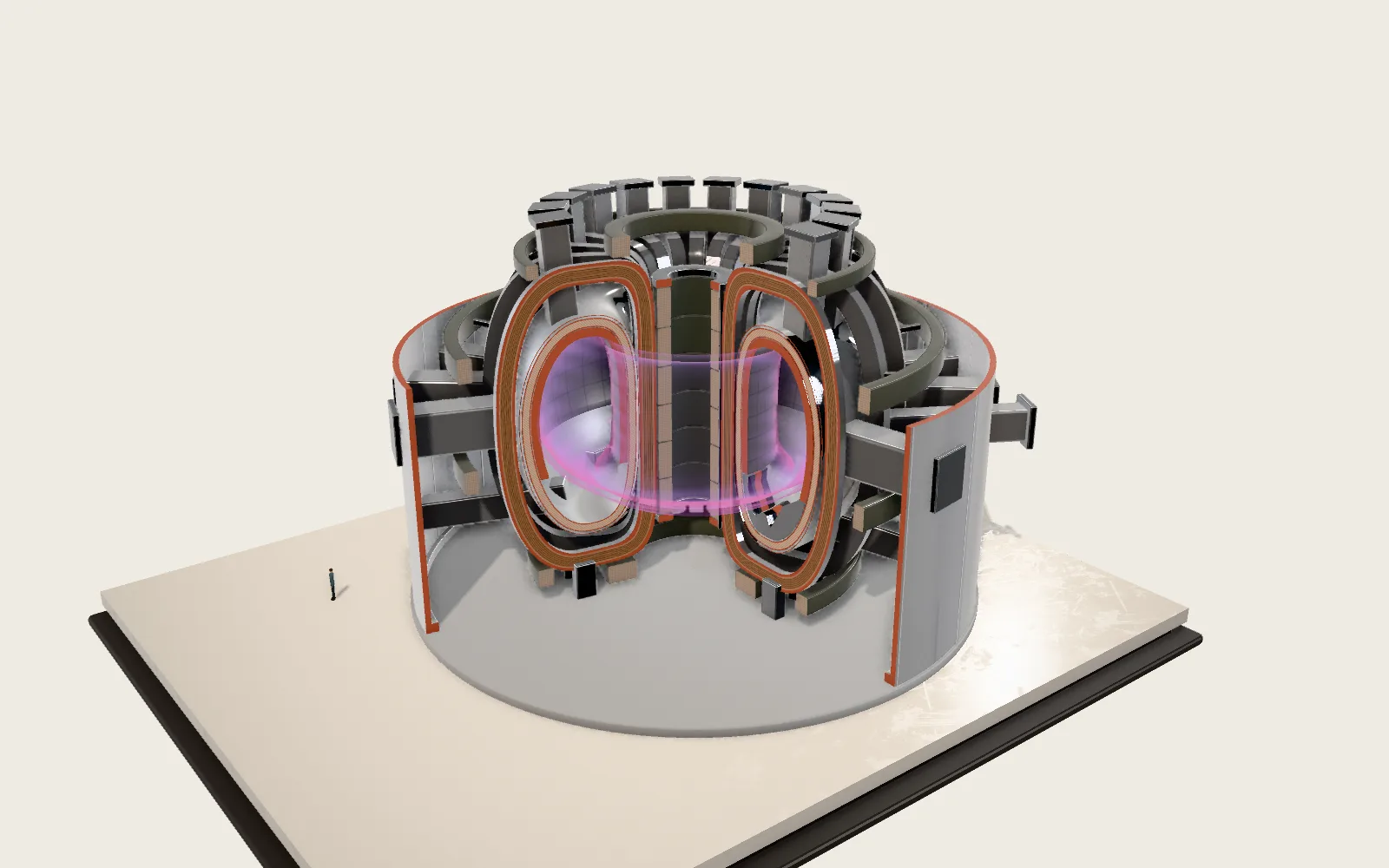 Plate F06Tokamak Fusion ReactorA tokamak like ITER: eighteen D-shaped superconducting coils round a ring-shaped vacuum vessel, inside which a deuterium–tritium plasma at about 150 million degrees hangs in a magnetic field.
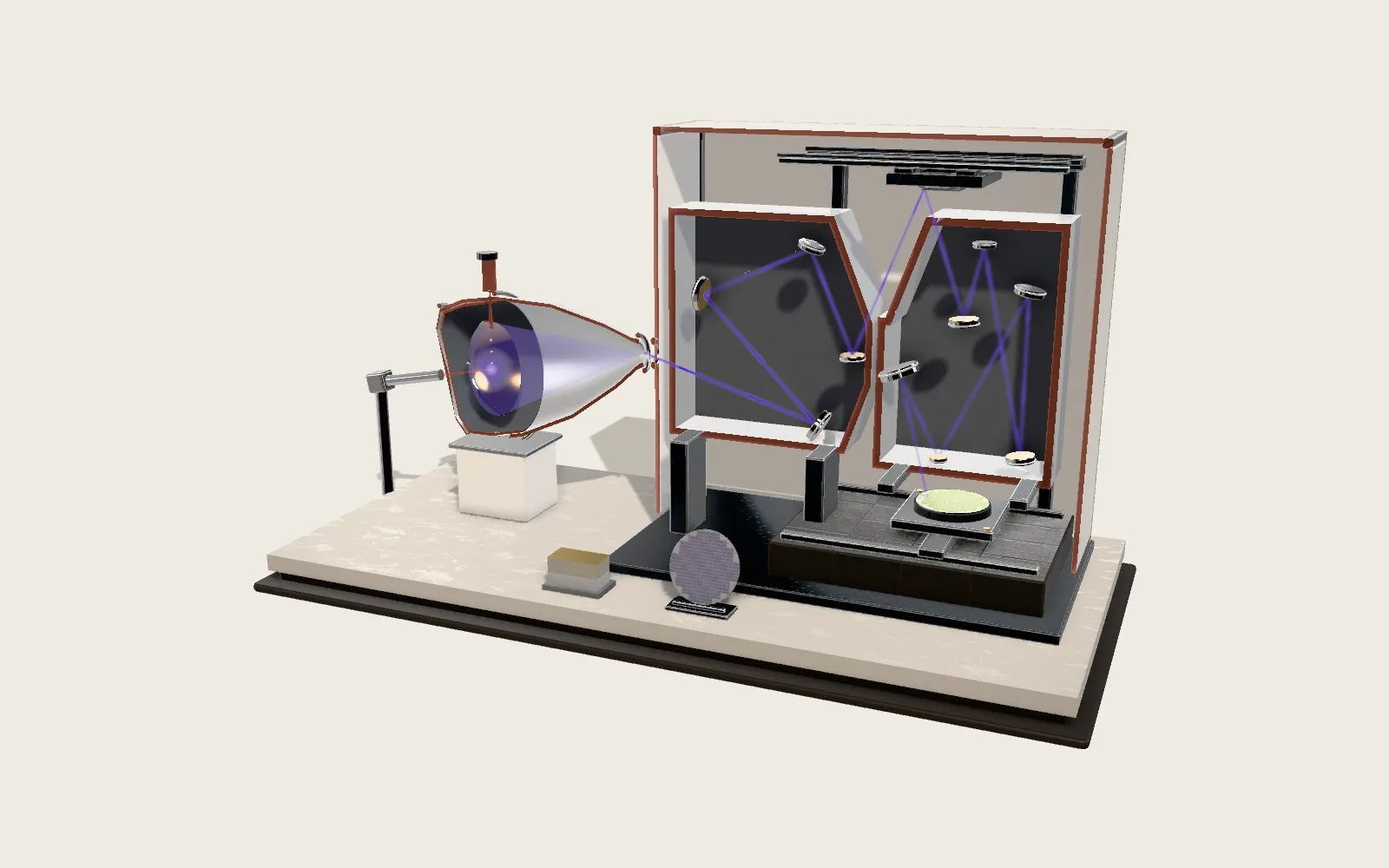 Plate F01EUV Lithography MachineLight 13.5 nm long prints a chip’s circuits on silicon, four times smaller than the mask. It comes from tin droplets turned to plasma, and travels only by mirrors.