Watt’s Steam Engine
An iron vessel standing in cold water saved most of the coal; two spinning balls taught the engine its own pace. Built in Birmingham in 1788, it stands at rest in London today.
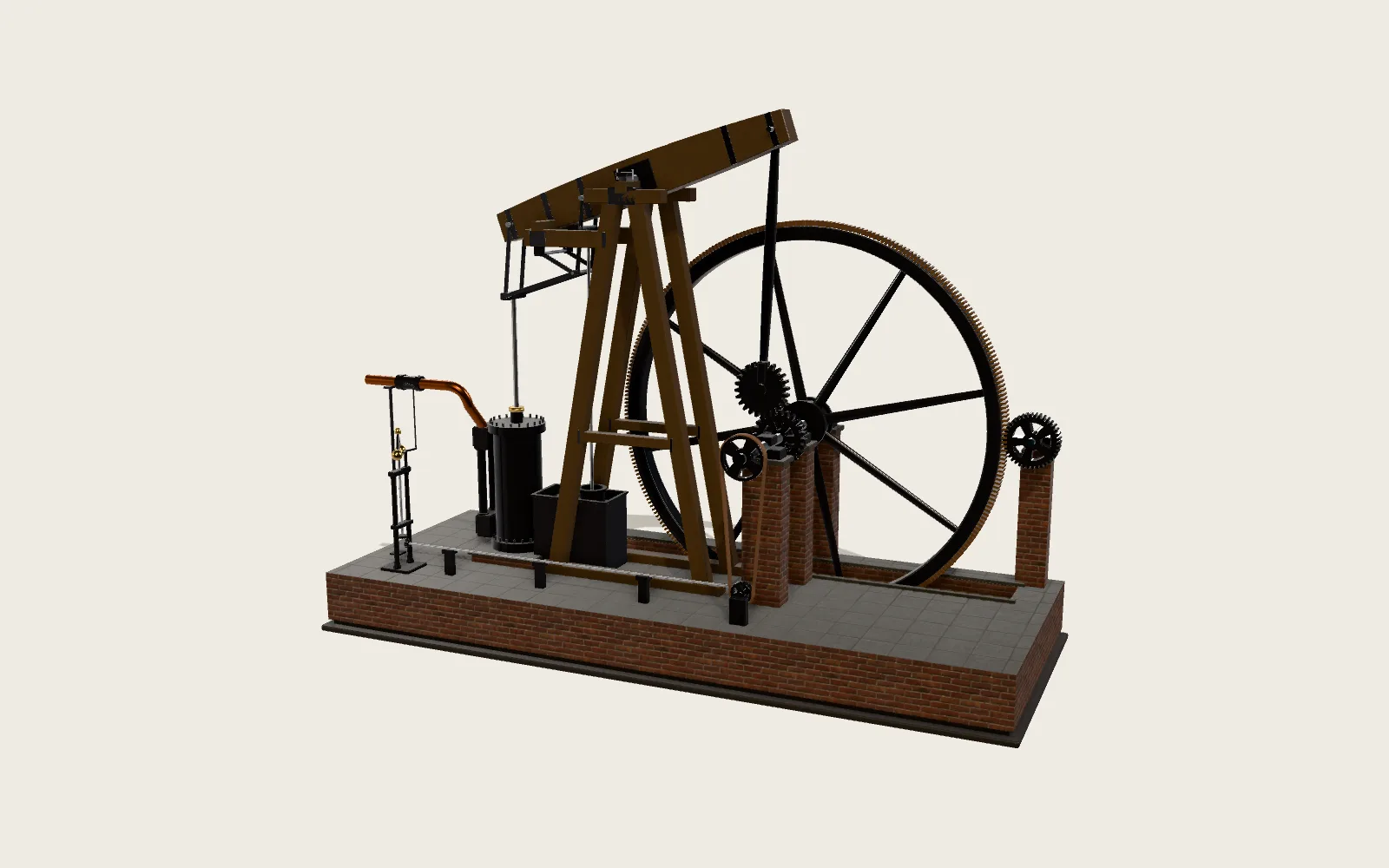
- Who it’s for
- Ages 11 to 16. Knowing that heat turns water to steam, and cold turns steam back to water, is enough.
- Time
- 15 or 40 minutes
- You need
- A computer online and a projector; tablets help for the hands-on part
CC BY-NC 4.0Teachers may copy, adapt and print this page and the plate for class, with credit to world.lapla.si.
01Learning goals
- Say what Watt changed: the steam condenses in a separate vessel, so the cylinder stays hot and the condenser stays cold, and the same work takes less than half the coal.
- Explain what drives the piston: steam only a little above atmospheric pressure on one side, a near-vacuum made by the condenser on the other.
- Describe how the flyball governor keeps the pace by itself, and why it cannot hold the speed exactly.
0215 minutes
To open or close a lesson: you project and talk it through.
- 0–3 min
Project “Between Cold and Hot”: Newcomen’s engine chills its own cylinder at every stroke and warms it again. Ask: where does the coal go?
Chapter 01Between Cold and Hot→ - 3–6 min
“A Separate Vessel”: the condenser stands in cold water and stays cold; the cylinder, in its steam jacket, stays hot.
Chapter 02A Separate Vessel→ - 6–9 min
“Pushing Both Ways”: in the opened cylinder, warm is steam just let in, cool is the side the condenser has emptied.
Chapter 03Pushing Both Ways→ - 9–13 min
“The Flyball Governor”: the chapter’s button reads “Stop every polishing machine” or “Start every polishing machine”. Stop them all and watch the balls fly out and the valve close; press again to start them all and watch the balls drop and the valve open.
Chapter 06The Flyball Governor→ - 13–15 min
“What It Changed”: factories no longer needed a river, and the watt became the unit of power.
Chapter 09What It Changed→
0340 minutes
A whole lesson, with time for students to work the model and talk.
- 0–4 min
Open with a question: where does a steam engine get its strength? Then project “Between Cold and Hot” and watch the wall chill and warm.
Chapter 01Between Cold and Hot→ - 4–9 min
“A Separate Vessel”: the idea came to Watt on a walk across Glasgow Green in May 1765. Students explain why the condenser must stay cold and the cylinder hot.
Chapter 02A Separate Vessel→ - 9–14 min
“Pushing Both Ways”: steam presses on each face in turn. Stress that Watt’s steam was barely stronger than the air outside; much of the push came from the vacuum.
Chapter 03Pushing Both Ways→ - 14–18 min
“A Straight Line out of an Arc”: the end of the beam moves on an arc, but the piston rod must move in a line. Compare the thin and thick lines.
Chapter 04A Straight Line out of an Arc→ - 18–22 min
“Sun and Planet”: for each lap of the planet, the sun and the flywheel turn twice. Have students count.
Chapter 05Sun and Planet→ - 22–28 min
“The Flyball Governor”: use the chapter’s button to stop and restart every polishing machine, and watch the balls and the valve.
Chapter 06The Flyball Governor→ - 28–36 min
Hands-on: follow the steps below to compare the engine’s speed with and without the governor.
Chapter 10At the Regulator→ - 36–40 min
“What It Changed”: 451 engines by 1800; one horsepower is about 745.7 watts, and this engine was rated at 10 horsepower.
Chapter 09What It Changed→
04Questions to ask
Why did Newcomen’s engine burn so much coal?
A good answerAt every stroke it sprayed cold water into the cylinder. The spray condensed the steam but also chilled the iron walls, so the next charge of steam had to warm the iron again, and much of it turned to water before doing any work.
How did Watt’s condenser save coal?
A good answerThe steam condenses in another vessel standing in cold water, while the cylinder, in its steam jacket, stays hot and never has to be warmed again. For the same work, Watt’s engine burned less than half the coal.
Is the piston driven by high-pressure steam?
A good answerNo. Watt’s steam was only a little above atmospheric pressure, and the other side of the piston was open to the condenser, a near-vacuum. That small difference in pressure drives the piston, and much of it comes from the vacuum.
Every polishing machine stops at once. What does the engine do with its governor? Without it?
A good answerWith the governor, the engine speeds up, the balls swing out and close the throttle valve, and it settles a little faster than before: to keep the valve further closed the balls must stand further out, and they only do that at a higher speed. Without it, the engine keeps speeding up, with nothing to rein it in.
Older engines hung the piston rod from a chain. Why did Watt need the parallel motion?
A good answerHis piston pushed as well as pulled, and a chain can only pull. The end of the beam moves on an arc, but the rod must go straight in and out of the cylinder; the parallel motion keeps the top of the rod within a centimetre of a straight line over the four-foot stroke.
05Hands-on
What happens without the governor?
- Go to the last chapter, “At the Regulator”. Push the “Steam valve” to “Open” and leave “Polishing machines running” at 43. When the flywheel has settled, write down “Flywheel” and “Throttle valve”.
- Drag “Polishing machines running” to 0. Watch the balls and the valve, and when the speed has settled, write the readings down again.
- Bring the machines back to 43 and turn “Governor” off (the throttle opens fully, so the speed rises a little). Once it has settled, drag the machines to 0, wait a minute or two, and watch “Flywheel”.
- Turn the governor back on and move the machines up and down a few times. Watch the balls swing out and drop.
Look forWith the governor, a lighter load opens the balls and closes the valve, and the engine settles only a little faster, never quite back where it was. Without it, the speed climbs and climbs, and only levels off a minute or two later at more than twice the governed speed.
06Common misconceptions
The ideaJames Watt invented the steam engine.
What the plate showsHe improved Newcomen’s, which had already been at work for half a century.
The ideaWatt’s engines drove the piston with high-pressure steam.
What the plate showsHis steam was only a little above atmospheric pressure, and much of the push came from the condenser’s vacuum. High-pressure engines came with Trevithick and others, around 1800.
The ideaA flyball governor holds the speed exactly.
What the plate showsWith less load, the engine settles a little faster. That is the nature of this kind of governor.
07Sources
The plate’s own. Every fact on this page comes from the plate and these sources.
- Science Museum Group: Rotative steam engine by Boulton and Watt, 1788 (1861-46)
- David Hulse: The Lap Engine (flywheel, wooden teeth, oak frame)
- Powerhouse Collection, Sydney: Boulton and Watt rotative steam engine (Whitbread, 1785)
- ASME Landmark 111: Boulton & Watt rotative steam engine
- University of Glasgow: James Watt and the University
- J. C. Maxwell (1868): On Governors, Proceedings of the Royal Society
- NIST Special Publication 811: horsepower to watts
- BIPM: The International System of Units (SI Brochure)
08Use it in class
This page and the plate’s text, pictures and models are licensed CC BY-NC 4.0. You may copy, print and adapt them, hand them out to students and share them with colleagues, as long as you credit world.lapla.si (Laplace’s Mini World).
They may not be sold or used for other commercial purposes. Third-party data and pictures listed on the plate keep their own licences.
The licence in full (CC BY-NC 4.0) ↗