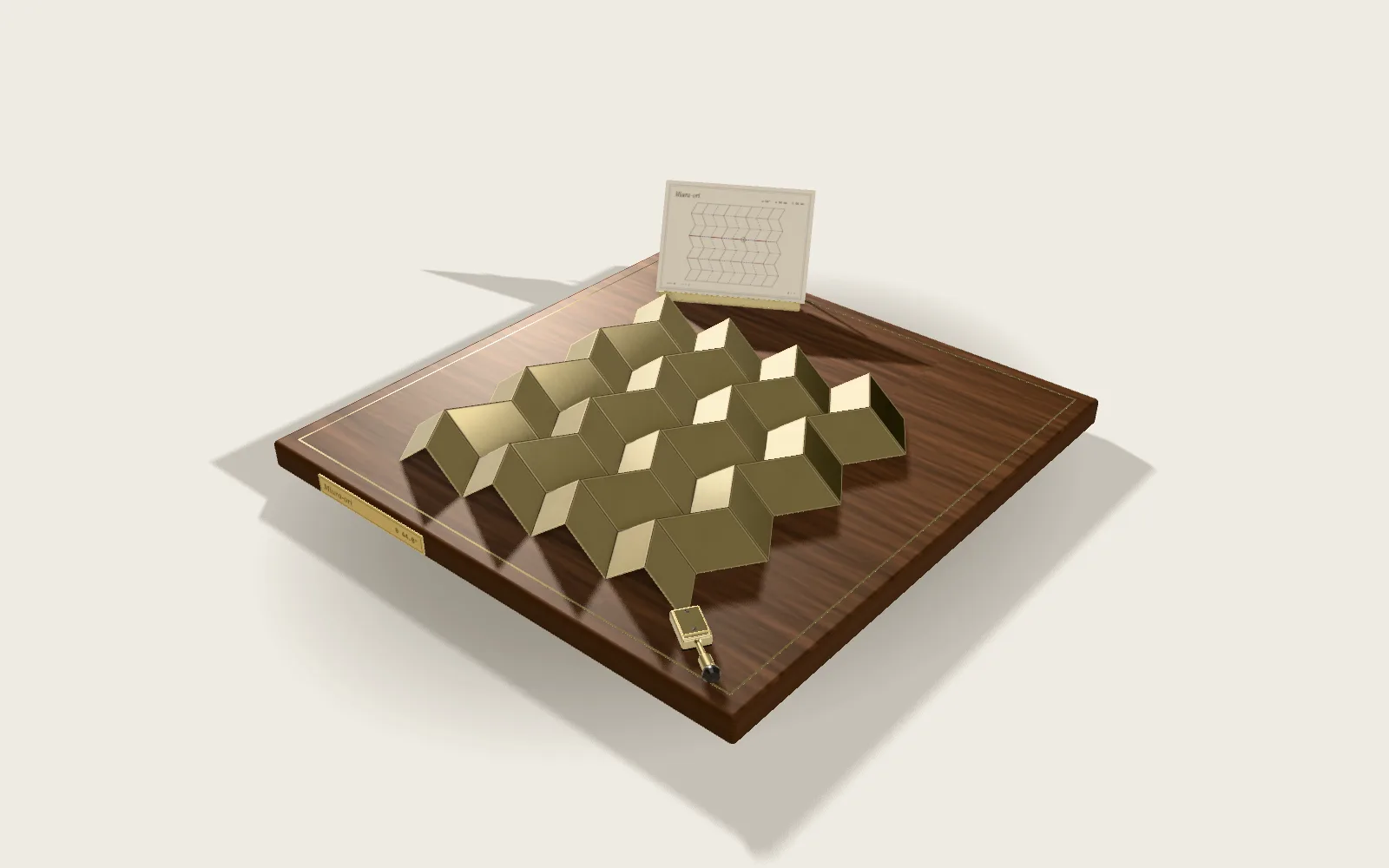
A Matrix Moves the Whole Plane
A 2 × 2 matrix moves the whole plane at once: grid lines stay straight, parallel and evenly spaced, and the origin stays put. The matrix’s two columns are where the basis arrows î and ĵ land. The unit square becomes a parallelogram, and the factor by which its area grows is the determinant.
Scroll
A Grid and Two Arrows
The brass base is engraved with a fixed grid, and the glass with the same grid. Two brass arms reach out from the origin: the red one is î, pointing to (1, 0); the green one is ĵ, pointing to (0, 1).
There are endless ways to move the grid on the glass. Linear maps are the tidiest kind: every grid line stays a straight line, parallel lines stay parallel, the spacing stays even, and the origin doesn’t move.
The grid may be turned, slanted, stretched, even flipped over; as long as those rules hold, it is a linear map. The grid on the base never moves, for comparison.
Two Columns, Two Landing Points
Where î lands and where ĵ lands settle the whole map. Write the two landing points side by side as columns and you have the map’s matrix: the first column is where î lands, (a, c); the second is where ĵ lands, (b, d).
Every other vector follows. The vector v = (x, y) is x lots of î plus y lots of ĵ; after the map it is x lots of the new î plus y lots of the new ĵ: v′ = x·(a, c) + y·(b, d) = (ax + by, cx + dy). That is the rule for multiplying a matrix by a vector.
The steel needle points at v = (−1, 1.5). Whatever the grid does, it does too, staying on the same crossing of the moved grid.
Turn, Shear, Stretch, Flip
A turn of 60°: the columns are (0.5, 0.87) and (−0.87, 0.5). Every length and every angle stays the same.
A shear: the columns are (1, 0) and (1, 1). î stays, ĵ leans over to (1, 1); the horizontal lines stay where they are, and the vertical ones all lean by the same slope.
A stretch: the columns are (1.5, 0) and (0, 0.6). Across, everything grows to 1.5 times; up and down, it shrinks to 0.6. The two axes keep their directions.
A flip: the columns are (1, 0) and (0, −1), turning the plane over across the horizontal axis. Going continuously from no change to the flip, there is always a moment when the grid is squashed onto a line: within the plane there is no way over without it.
One Map, Then Another
A shear followed by a quarter turn is again a linear map, with a matrix of its own. Its columns are where î and ĵ end up after both steps: (0, 1) and (−1, 1).
That combined matrix is the product of the two, written R·S: the S on the right is done first and the R on the left second, the same habit as f(g(x)), where g comes first.
The order can’t be swapped. Turn first and shear second, and the columns are (1, 1) and (−1, 0): the square ends up somewhere else, so R·S ≠ S·R. But (A·B)·C always equals A·(B·C): three steps done in the same order give the same result wherever the brackets go.
How Much Area Grows
The unit square spanned by î and ĵ has area 1. After the map it is the parallelogram spanned by the two columns.
Every area in the plane changes by the same factor: each small cell becomes the same parallelogram, and any shape can be built from small cells. That factor is the determinant. With columns (a, c) and (b, d) it equals ad − bc.
Stretch across to twice the width and the area becomes 2; a shear slants the square, and the area is still 1. The reading on the brass plate is the area measured from the coordinates of the parallelogram’s four corners, not worked out from the formula.
Do two maps in a row and areas grow first by det(A), then by det(B), so det(B·A) = det(B)·det(A).
Flipped and Flattened
A determinant can be negative. Going from î round to ĵ is anticlockwise to begin with; if it is clockwise after the map, the plane has in effect been turned over, and the determinant takes a minus sign. Its size is still the factor for areas. The small arrow in the square keeps track of the turn.
A determinant can also be 0: the two columns lie on one line, the square is squashed into a segment, and the whole plane is squashed onto a line.
A squashed plane can’t be restored: many different points have landed on the same point, and there is no telling where one came from, so the matrix has no inverse. Whenever the determinant isn’t 0, the inverse exists.
Arrows That Keep Their Line
In a map most vectors turn off the line they were on. A few don’t: they are only stretched, shrunk or reversed, and stay on their own line. Such vectors are eigenvectors, and the factor they are stretched by is the eigenvalue.
The matrix with columns (1.5, 0.5) and (0.5, 1.5) stretches every vector along (1, 1) to twice its length and leaves those along (1, −1) as they are: the eigenvalues are 2 and 1. The two lines that light up on the glass during the map are those two directions.
A shear has only one such line, the horizontal axis; a quarter turn has none, since every vector is turned away. Where there are two eigen-lines, the map seen along them is simply a stretch in each of two directions.
The Bench
The tips of the two brass arms î and ĵ and the tip of the steel needle v can be dragged. The readouts give the matrix, the determinant (the measured area beside ad − bc), where v lands, and the eigenvalues and eigenvectors, or a note when there are no real ones. Buttons set the table back to a few common maps; with Snap on, the tips stop at whole multiples of half a cell.
Try thisPut the tip of î at (2, 1) and the tip of ĵ at (−1, −0.5). What is the determinant, and what becomes of the plane?
What the model leaves out
Real glass doesn’t bend. In the model the glass sheet itself stays still; the grid engraved on it moves as the matrix says, and is drawn only inside the window of the base. Mathematically the grid goes on for ever. The brass arms telescope, their length set by the matrix, and the steel needle under each tip marks the vector’s exact point. One cell of the model is 70 mm, and the window runs from −3 to 3 cells. Only 2 × 2 matrices of the plane are shown; a 3 × 3 matrix of space turns the unit cube into a parallelepiped, and its determinant is the factor for volumes.
Easy to misread
A product of matrices reads from right to left: B·A means A first, then B. A negative determinant isn’t a “negative area”; it is the factor for areas together with a flip. With a determinant of 0 the plane hasn’t vanished; it has been squashed onto a line (or a point). An eigenvector means every vector on a whole line, not one particular arrow; a rotation (other than by 0° or 180°) has no real eigenvectors. A shift isn’t a linear map, because it moves the origin.
Sources
- MacTutor History of Mathematics, Matrices and determinants
- Arthur Cayley (1858), A memoir on the theory of matrices, Philosophical Transactions of the Royal Society 148: 17–37
- 3Blue1Brown, Essence of linear algebra (series)
Data
Reading a matrix as a motion of the plane (its columns as where the basis arrows land, the determinant as the change in area, eigenvectors as arrows that keep their line) follows Grant Sanderson’s series Essence of Linear Algebra (3Blue1Brown). The videos are under Watch next. Seki Takakazu (1683) and Gottfried Wilhelm Leibniz (1693) used determinants to solve equations. Augustin-Louis Cauchy gave the word its modern sense in 1812 and proved that the determinant of a product is the product of the determinants; Jacques Binet read a proof at the same meeting. James Joseph Sylvester introduced the word “matrix” in 1850, and Arthur Cayley’s memoir of 1858 multiplied matrices as the composition of linear transformations. The transform table is our own model.
Watch next
The player comes from YouTube and loads only when you press play.
Follow the question
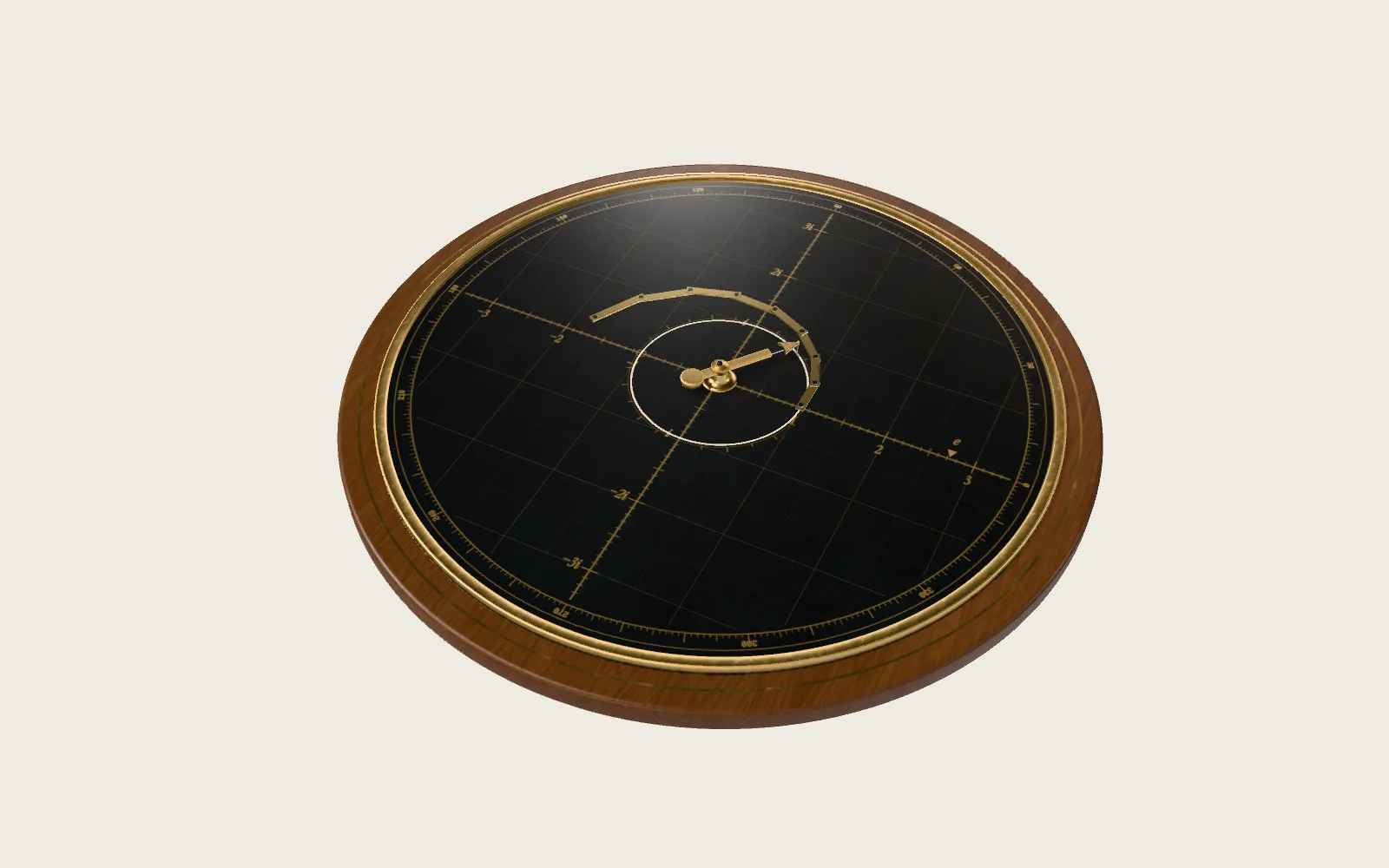 Plate M06Half a Turn Is e to the iπeⁱᵗ is a point walking round the unit circle at a steady pace, its velocity always i times its position. After time π it is at −1.
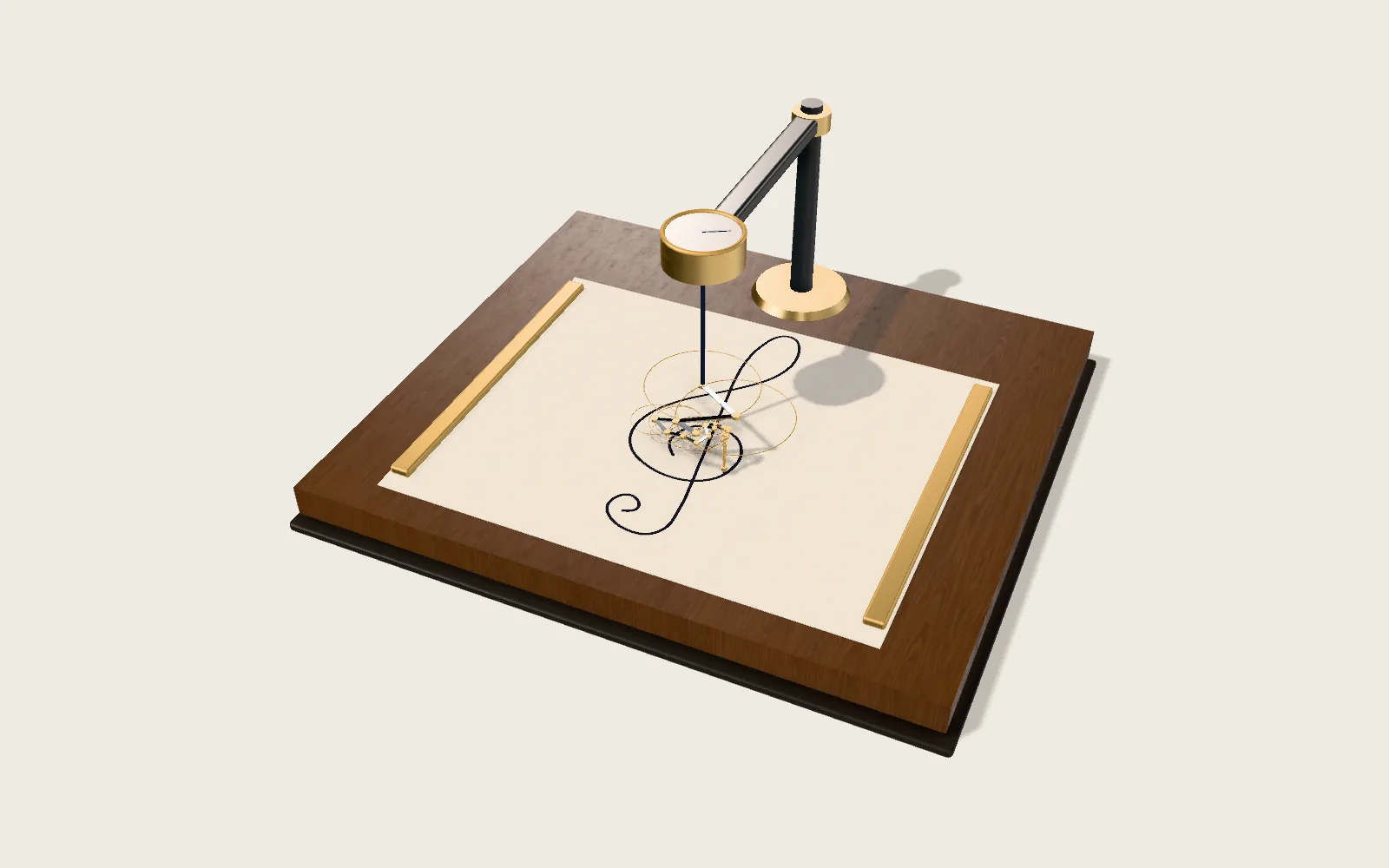 Plate M03Any Closed Line, Drawn by Turning CirclesA chain of arrows, head to tail, each turning at a whole-number speed: the last tip can draw any closed line.