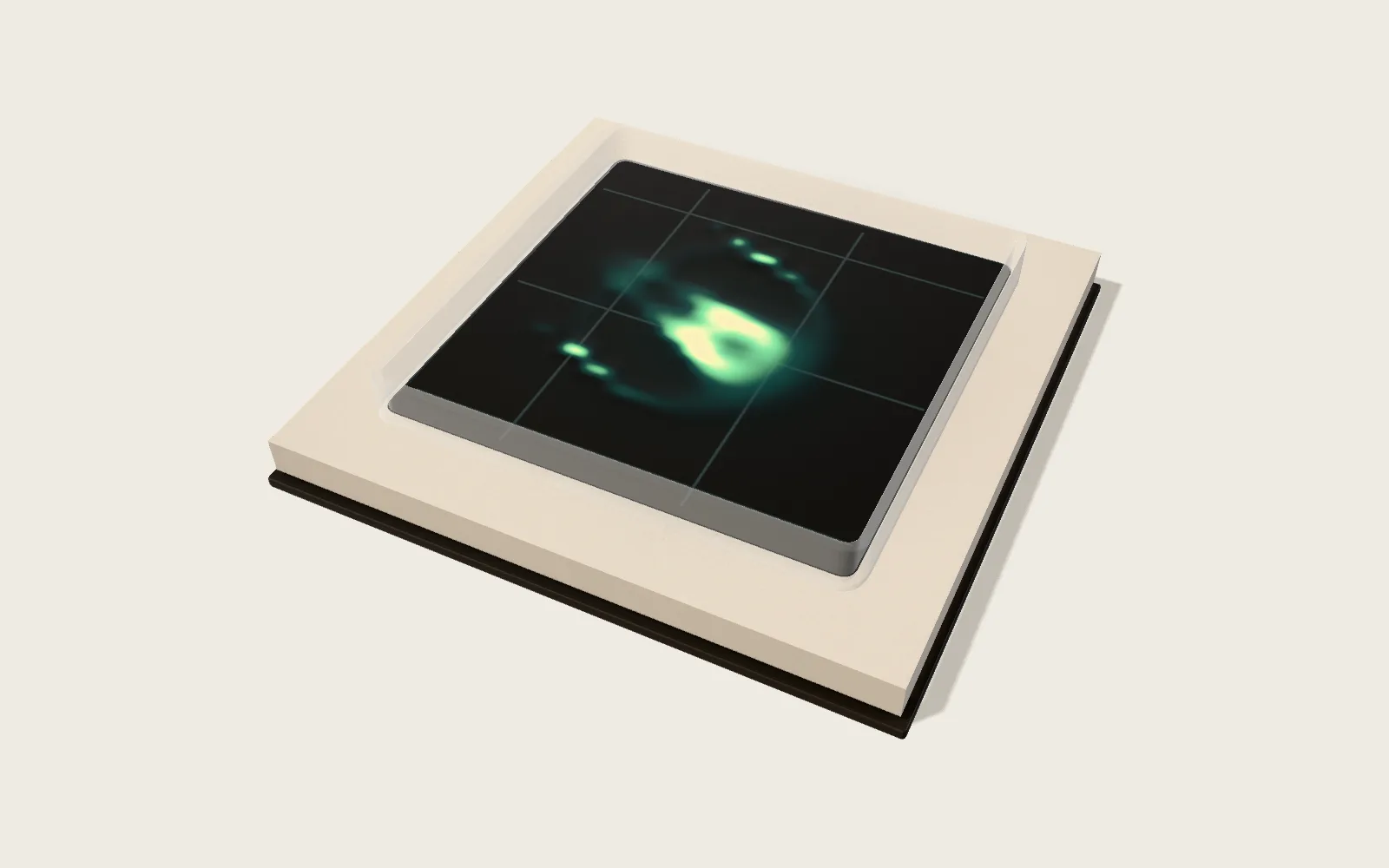
A Fold That Opens in One Pull
A sheet is folded along a pattern of parallelograms. Pull one corner and the whole sheet opens together; push it back and it closes together. No panel bends; each only turns about its creases. The shape of the whole sheet is set by a single angle.
Scroll
Pull a Corner, Open It All
The model is a thin sheet of brushed brass: 8 × 7 parallelograms, about 42 × 35 cm when flat. It sits on a walnut plinth, pinned at one vertex near the middle, with a brass handle at one corner.
As the handle moves out, the whole sheet flattens and grows at once; pushed back, it steepens and shrinks at once. No panel moves first and none moves later.
This is the Miura fold (Miura-ori), proposed around 1970 in Japanese space research to pack large membranes and solar panels into a small volume.
Straight One Way, Zig-Zag the Other
Opened out, the sheet is all the same parallelogram, with sides of 50 mm and 56 mm meeting at 64°.
Across, the creases are straight lines. Lengthwise, they are zig-zags, one segment leaning right and the next leaning left.
Creases come in two kinds: a mountain fold rises, a valley fold sinks. Every zig-zag line is one kind from end to end, mountains and valleys in turn. Along every straight line, mountain and valley alternate segment by segment. The card shows the pattern: red for mountains, blue for valleys.
Panels Stay Flat; Only the Creases Turn
While it folds, every parallelogram stays flat, with the same sides and the same angles. Only the creases move: two neighbouring panels turn about the crease between them.
This is rigid folding, so it needs no paper: hinged metal plates fold just the same. The model is brass.
Few patterns fold rigidly. Draw a crease pattern at random and the paper usually has to bend to fold it. The Miura fold doesn’t.
Two Counts at One Vertex
At every vertex four creases meet, splitting the sheet round it into four angles: 64°, 116°, 116°, 64°.
Take every other angle and each pair adds to 180°: 64° + 116° = 180°. This is Kawasaki’s theorem: for a vertex to fold completely flat, alternate angles must each add to 180°.
Now count the creases: three mountains and one valley, or three valleys and one mountain. Mountains minus valleys is always +2 or −2. This is Maekawa’s theorem, another condition for folding flat.
Halfway through the fold both counts stay the same: the angles are measured on the paper, which folding doesn’t change, and no crease switches between mountain and valley.
One Angle Sets Every Crease
Call the angle between each panel and the base θ. At θ = 0 the sheet is flat; at θ = 90° it is pressed into a flat stack.
At a zig-zag crease one panel tilts up by θ and the other down by θ, so the crease is folded by 2θ. The straight creases fold less, by an angle ρ with tan(ρ/2) = cos 64° × tan θ.
Given θ, every vertex can be written down: the height H = a·sin θ·sin α, the length per panel L = a·√(1 − sin²θ·sin²α), and two more like them. So the whole sheet has one degree of freedom. The handle changes θ, and everything else follows.
Longer One Way, Longer the Other
Stretch a rubber band and it gets thinner. Most materials behave this way: longer in one direction, narrower in the other.
The Miura fold does the opposite. Pull it open along the straight creases and it opens along the zig-zags as well; push one side in and the other comes in too. In engineering terms, its in-plane Poisson’s ratio is negative.
The ratio is −tan²α·cos²θ, below zero over the whole fold. It comes from the geometry alone, not from the material.
Maps, Solar Arrays, Sandwich Panels
A map folded this way opens in one move when two opposite corners are pulled, and closes along the same creases when they are pushed back.
Japan’s Space Flyer Unit, launched on 18 March 1995, carried a two-dimensional solar array folded this way as an experiment, to test opening and closing it in orbit.
Folded sheets of this kind between two thin skins make light, stiff sandwich panels. The negative Poisson’s ratio has also made it a subject of research on “metamaterials”, whose properties come mostly from how they are folded rather than what they are made of.
The Bench
The lever sets how far the whole sheet is folded; the corner with the handle can also be dragged. Sliders change the panels’ acute angle and their two sides, and the pattern on the card follows. The readouts give the fold angle, the folds of the two kinds of crease, the sheet’s size, its Poisson’s ratio, and the Kawasaki and Maekawa counts at the marked vertex.
Try thisChange the panels’ acute angle from 64° to 80° and pull the sheet open by the same amount. Does it open more or less the other way?
What the model leaves out
The model treats the sheet as having no thickness, the panels as perfectly stiff and the creases as ideal hinges. Real plates have thickness, and folded deep its panels collide; real Miura folds use softer creases or leave gaps between panels. The model’s fold angle is kept between about 4° and 82°. Perfectly flat, the sheet has some extra freedom to bend a little, which is why a real fold always starts from a slightly folded state.
Easy to misread
Kawasaki’s and Maekawa’s theorems say whether one vertex can fold completely flat, and they are necessary conditions. A pattern whose every vertex passes may still not fold flat as a whole, let alone fold rigidly; the Miura fold does both because of its special geometry. Mountain and valley depend on the side you look from: turn the sheet over and they swap. The negative Poisson’s ratio is about stretching within the sheet; bend a Miura sheet out of its plane and it curves into a saddle, where the Poisson’s ratio is positive.
Sources
- Mark Schenk and Simon D. Guest (2013), Geometry of Miura-folded metamaterials, PNAS 110(9): 3276–3281
- Z. Y. Wei et al. (2013), Geometric mechanics of periodic pleated origami, Physical Review Letters 110: 215501
- Koryo Miura (1969), Proposition of pseudo-cylindrical concave polyhedral shells, Report of the Institute of Space and Aeronautical Science, University of Tokyo 34(9): 141–163
- Koryo Miura (1985), Method of packaging and deployment of large membranes in space, ISAS Report 618
- ISAS / JAXA, Space Flyer Unit (SFU)
- Miura and Natori (1985), 2-D array experiment on board a Space Flyer Unit, Space Solar Power Review 5(4): 345
- Thomas Hull, The combinatorics of flat folds: a survey
Data
The fold is Kōryō Miura’s (三浦公亮), worked out at the Institute of Space and Aeronautical Science of the University of Tokyo (now ISAS, JAXA). His report of 1969 proposed the folded parallelogram surface; his report of 1985 described it for packing large membranes in space. With Michihiro Natori he planned the two-dimensional array experiment flown on the Space Flyer Unit (launched 18 March 1995). The vertex rules carry the names of Toshikazu Kawasaki (also found independently by Jacques Justin) and Jun Maekawa (first published by Kunihiko Kasahara and Toshie Takahama in 1987). Thomas Hull’s survey of flat folds states and proves both. The closed-form fold (H, S, L, V) and the in-plane Poisson’s ratio −tan²α cos²θ are from Mark Schenk and Simon Guest (2013); the opposite signs in plane and out of plane are also shown by Z. Y. Wei, Z. V. Guo, L. Dudte, H. Y. Liang and L. Mahadevan (2013). The folded sheet, the walnut plinth, the brass handle and the pattern card are our own model.
Follow the question
 Plate F09The Webb Space TelescopeEighteen gold-coated segments make one 6.5 m mirror, and five layers of film keep the Sun’s heat off it. It was launched folded and unfolded itself in space over two weeks.
 Plate M05Why a Slanted Cut Through a Cone Is an EllipseSlice a cone at a slant and the cut is the same curve two pins and a string draw. Two spheres prove it.