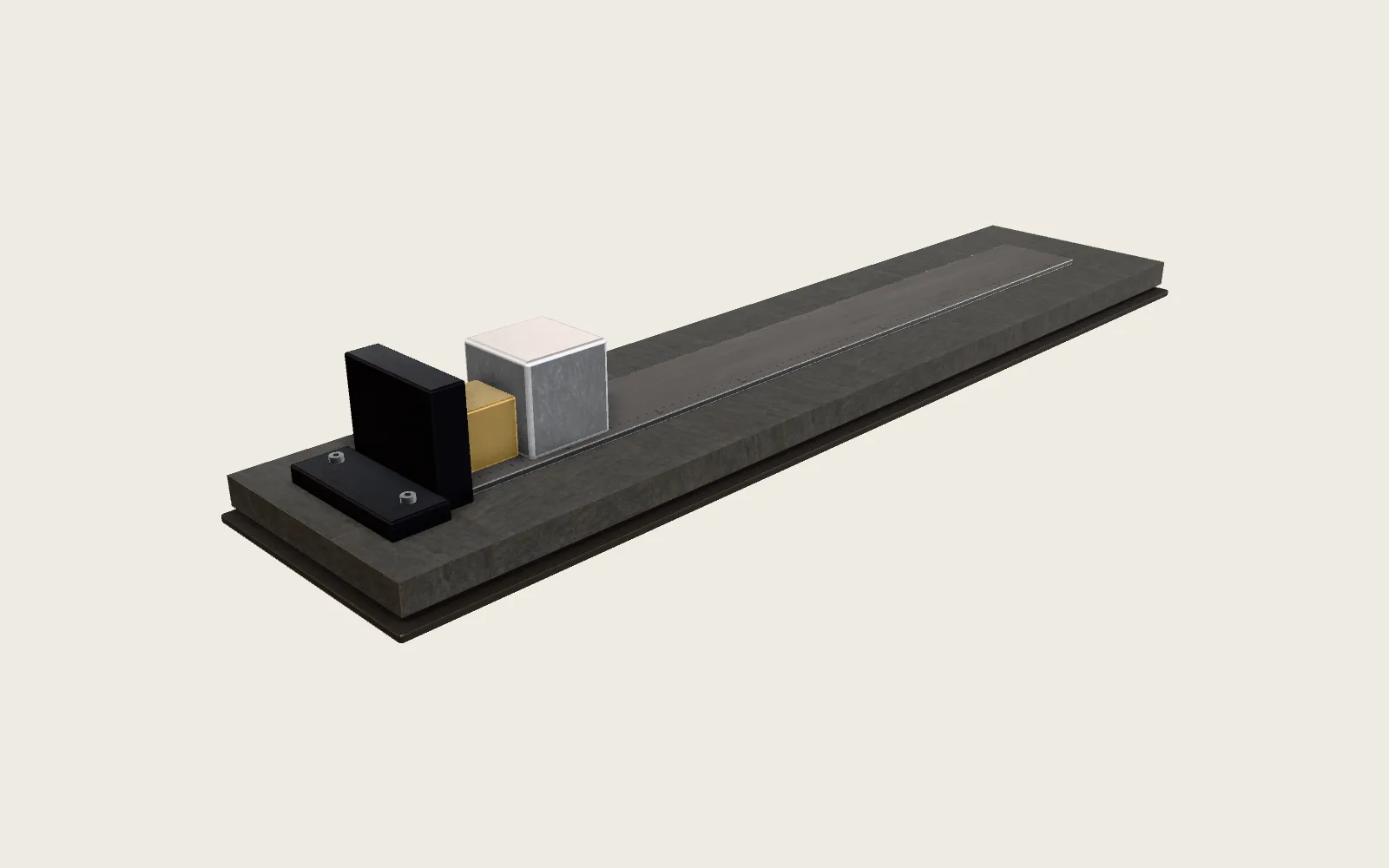
Life from a Smooth Rule
A sheet of squares, three rules, and patterns crawl across the page: the Game of Life, 1970. Let the squares, the ticks and the life-or-death run smooth, and out of the dish swims something no one has drawn: it glides, it heals, and it comes in species.
Scroll
The Game of Life
In 1970 the mathematician John Conway made a game with no players. Every square is alive or dead. At each generation all of them count their eight neighbours at once: a dead square with exactly three comes to life; a live one with two or three lives on; the rest fall silent.
That is the whole of the rule, and still it makes surprising things. Five squares called a glider slip one square diagonally every four generations, as if crawling. It has no legs and nothing pushes it: the squares only live and die by the rule, and the same shape surfaces again one step along.
Smoothing It Out
In the Game of Life everything comes whole: a square is dead or alive, its neighbours are the ring that touches it, and time leaps a generation at a time. What if all three were melted? Each square now holds a number between 0 and 1, like ink of any depth; the neighbourhood widens into a ring 13 squares in radius, heaviest along its middle; a generation is cut into ten small steps, each changing things a little. This continuous version is called Lenia, from the Latin lenis, “smooth”.
The golden halo in the dish is one square’s neighbourhood. Averaging the squares beneath it, by weight, gives a single number, U: how full the surroundings are. Every square has such a ring, thousands of them overlapping.
The Growth Curve
With U in hand, each square consults a curve: thicken, or thin? The curve is a small bell-shaped hill. Near μ the square grows; far from it, whether the surroundings are too empty or too crowded, it fades. σ is the width of the hill. The whole law of this world is one ring and one curve.
The dish now shows not the shading but the change: gold where the field is growing, blue where it fades. Growth at the front, fading at the back, and the whole pattern flows forward. Nothing travels; the shape is rebuilt, a little further on, step after step.
Orbium
In the world where μ = 0.15 and σ = 0.015 lives a small thing with a round body and a crescent tail. It glides at an even pace, covering its own length about every thirty steps, and given time it rises by itself out of a scatter of random blots. Its name is Orbium unicaudatus, the one-tailed orb.
The one in the dish is made from the published data: the pattern, the radius, μ and σ, not a number changed. No one drew its shape, and no line of code says “swim forward”. The rule says only how each square regards its neighbours; body, tail and heading surface from thousands of squares pulling on one another.
A Narrow Law
What if the law shifted a hair? Below is the growth curve, and beside it a map, μ across and σ up, in which every square is an Orbium we set down in that world to see what became of it. Teal: still swimming. Pale: fallen apart. Red: swollen to fill the world. The black dot is the law in the dish now; wherever the dot comes to rest, that is the law the Orbium must live under.
The ground it can live on is a thin slanting band. Too narrow a curve, and squares seldom meet the crowding that lets them grow; the Orbium fades away. Too wide, and everything grows; it bursts and floods the dish. The two deaths are called evaporation and explosion. The slant holds one thing more: as μ rises, σ must widen with it, or the Orbium cannot survive.
The Wound
A touch on the dish takes a small bite out of it. Bitten at the edge, it grows the piece back within seconds, recovers its shape and swims on. No rule says “repair”: what fills the gap is the same growth curve.
It is not deathless. The same bite taken from the dense middle of its body, and the whole Orbium comes apart. Many creatures in this world are remarkably hardy, recovering from deformation and collision; the Orbium is small, and a wound in the wrong place is beyond mending. The larger Paraptera survives the same bite here.
A Field Guide
The Orbium was only the beginning. Change the number of rings, the radius and the curve, and more than 400 species have turned up in this world, in 18 families, sorted and named as a naturalist would. The dish shows a few in turn, each from the catalogue: Gyrorbium, swimming in circles; the shield-shaped Scutium; Paraptera with its broad wings; Hydrogeminium, sensing its neighbours through three rings; and Kronium, through two.
Their forms could hardly differ more, yet the rule is one and the same; only those few numbers change. A creature’s symmetry foretells its motion: the symmetric all round keep still, those with a twist turn in place, and only those with a left and a right, but a different front and back, travel on.
Is It Alive?
These creatures have no cells and take no food, and by 2019 none had yet been found that copies itself. Each is a table of numbers, rewritten again and again by one formula. Yet they have clear edges, hold their shape, move, and mend their wounds. Much of what life looks like, it seems, needs no chemistry, only many simple parts pulling on one another by the same local rule. This is called self-organisation.
In 2020 the rule was carried into several channels, several kernels and higher dimensions, and self-replication appeared there, and “virtual eukaryotes” with a division of labour inside. How these patterns hold themselves together at all is still not well understood. It is the question artificial life keeps asking: is being alive a property of the stuff, or of how it is arranged?
The Bench
Six species, two dials, one dish. Time runs fast or slow; a touch on the dish is a wound, and whether it heals is the creature’s own affair.
Try thisWith σ narrowed to 0.012, how long does the Orbium last? And widened to 0.025?
What the model leaves out
This is discrete Lenia as defined in its reference code: 96 × 96 squares, the Orbium’s ring 13 squares in radius, 10 steps per unit of time, and the same ring shape and growth curve, computed square by square on your graphics card. The world’s edges are joined: whatever leaves on the right comes back on the left, as on the surface of a doughnut, which is the usual practice for such simulations. The dish follows the creature like a microscope stage and shows part of the world; the grid lines move with the world. The same species have also been studied on much finer grids, with rings over a hundred squares across. Each square of the map is a run of 60 units of time from the original Orbium pattern in a small 64 × 64 world; near the edges of the band, a different start or a longer run could end differently. The glass dish and the gel are only display: Lenia is mathematics, not chemistry.
A common misreading
An Orbium is not an animation that someone drew and set moving, and there is nothing in the rule about bodies, tails or headings; it is a pattern the rule keeps in being. Nor is it alive: it does not eat, grow up or evolve. Calling them species is borrowed language, a way to describe and compare them, not a claim that they live.
Sources
- Bert Wang-Chak Chan (2019), Lenia — Biology of Artificial Life, Complex Systems 28(3): 251–286, arXiv:1812.05433
- Bert Wang-Chak Chan (2020), Lenia and Expanded Universe, ALIFE 2020 Conference Proceedings, 221–229, arXiv:2005.03742
- Bert Wang-Chak Chan, Lenia home page (papers, videos and related work)
- Chakazul/Lenia (Bert Wang-Chak Chan, MIT licence): the reference code LeniaND.py and the species data animals.json
- Gardner (1970), Mathematical Games: John Conway’s new solitaire game “life”, Scientific American 223(4): 120–123
- Stephan Rafler (2011), a similar rule reached independently: Generalization of Conway’s “Game of Life” to a continuous domain — SmoothLife, arXiv:1111.1567
Data
Lenia was created by Bert Wang-Chak Chan (chakazul.github.io/lenia.html). Species patterns and parameters: Python/animals.json in github.com/Chakazul/Lenia (MIT licence, © 2018 Bert Chan); the rule follows his reference code, Python/LeniaND.py. SmoothLife (Stephan Rafler, 2011) reached a similar continuous rule independently.
Watch next
-
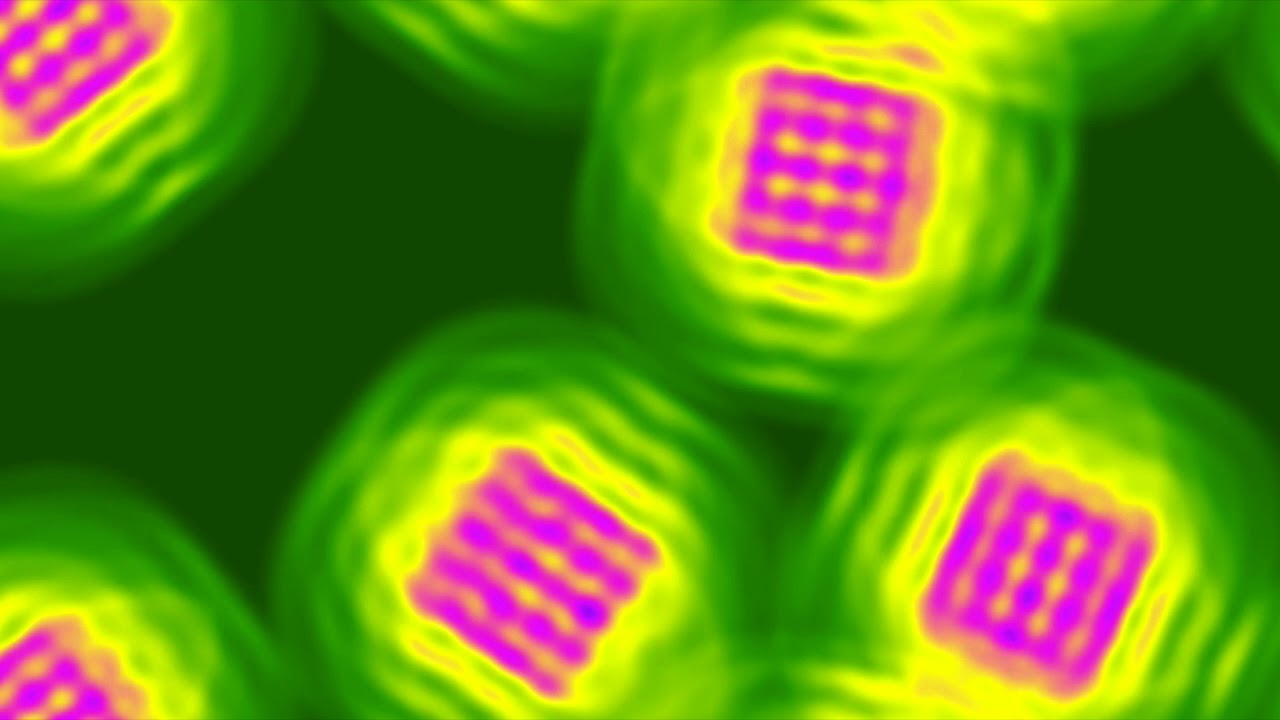
Lenia - Mathematical Life Forms Watch on YouTube ↗ -
Bert Wang-Chak Chan - Alife 2020 Contributed Talk Watch on YouTube ↗
The player comes from YouTube and loads only when you press play.
Follow the question
 Plate 16Where Spots and Stripes Come FromA leopard’s spots and a fish’s stripes may come from the same simple recipe: two ingredients, one fast and one slow.
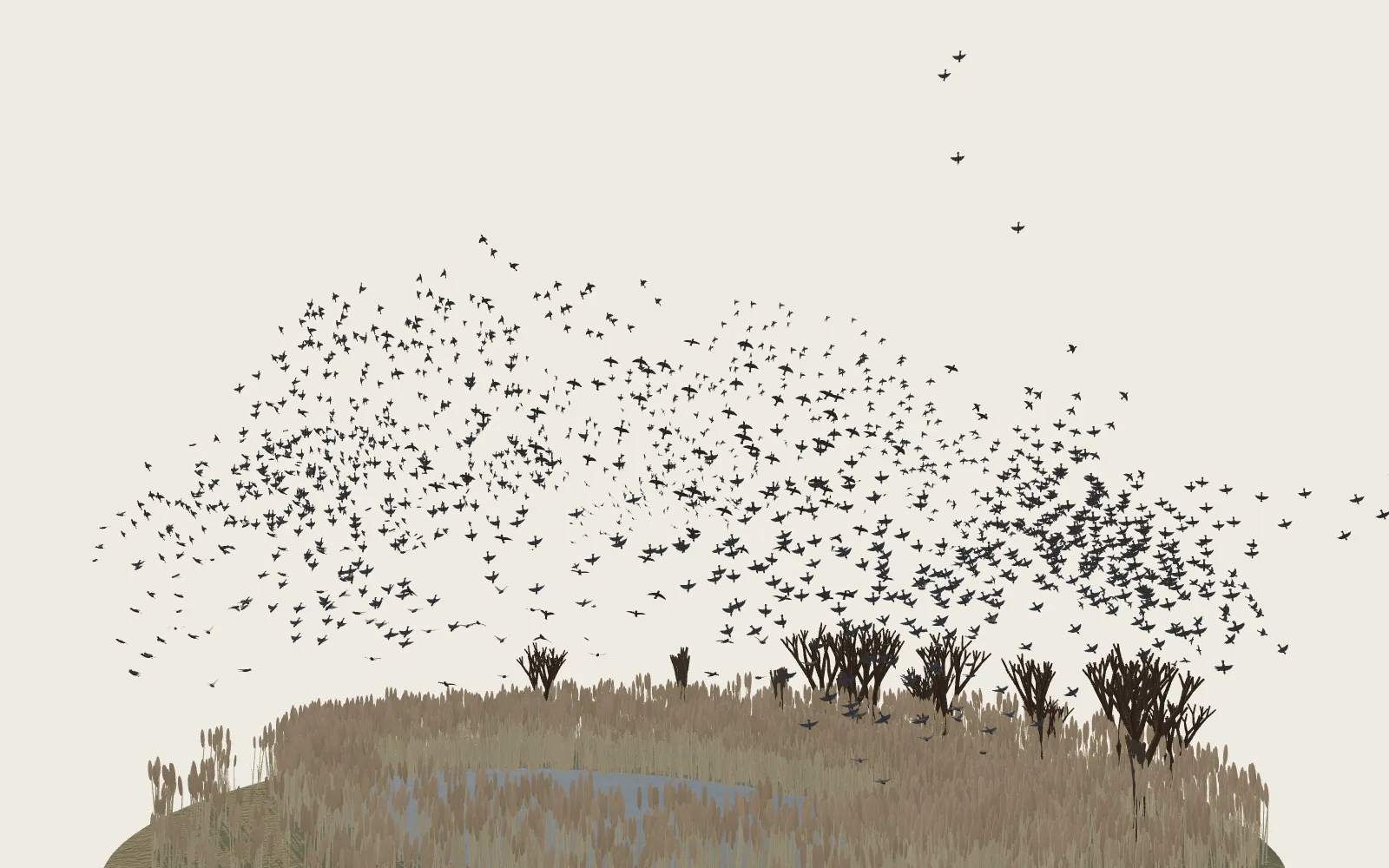 Plate 09No Bird in ChargeThousands of starlings turn together at dusk like a shape-shifting cloud of smoke. No one is giving orders.