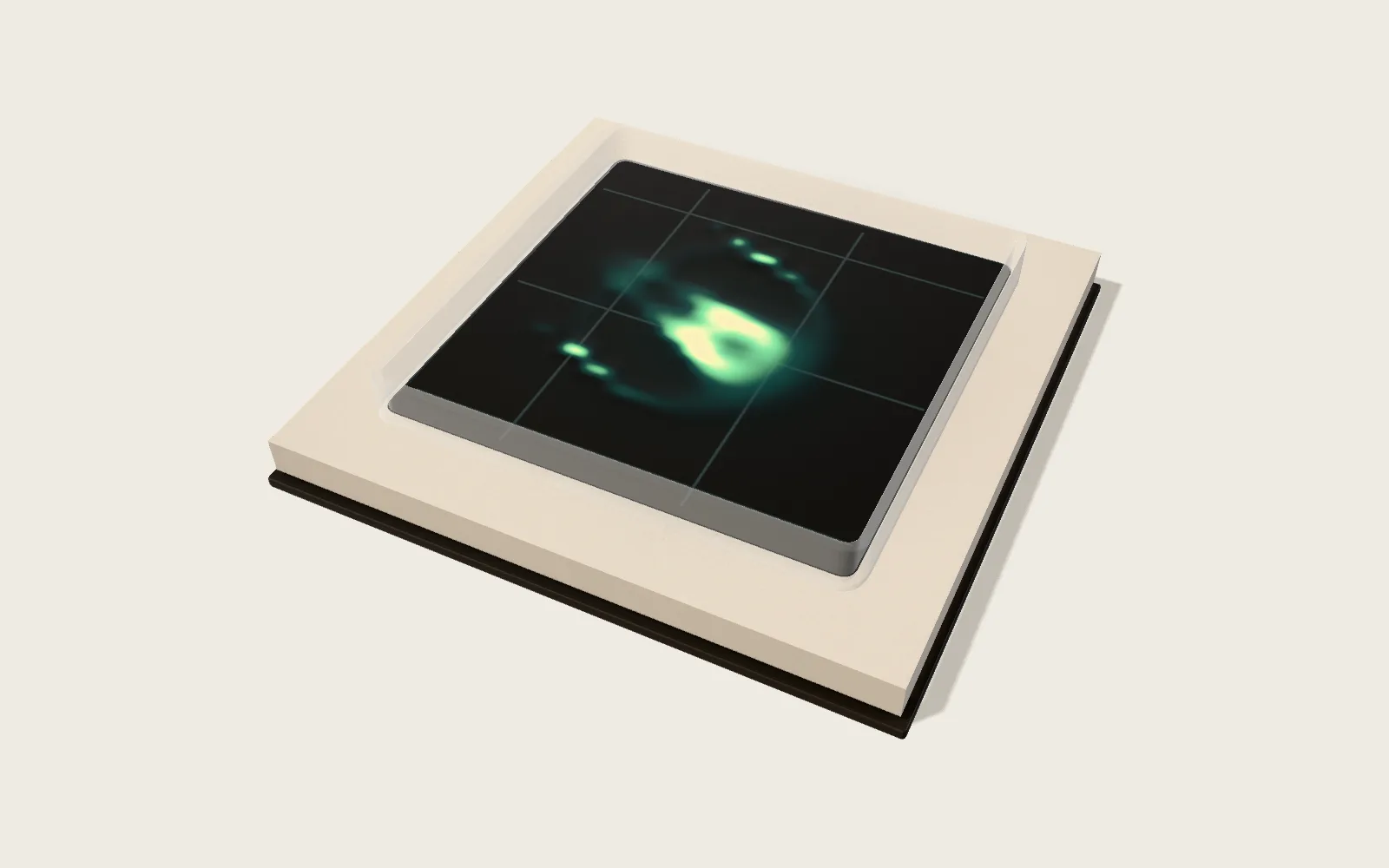
Why a Slanted Cut Through a Cone Is an Ellipse
Cut a cone with a slanted plane and the edge of the cut is a closed curve. Two pins and a string draw an ellipse. They are the same curve: drop two spheres into the cone, and the points where they touch the cut are the ellipse’s foci.
Scroll
Four Cuts
A level plane cuts a cone in a circle. Tilt the plane and the circle stretches into an ellipse. Tilted until it runs parallel to one of the cone’s straight lines, the curve no longer closes: a parabola. Steeper still, a hyperbola.
The model’s glass cone stands on its tip, with a half-angle of 20°. The glass cut turns from 0° to 84°, and the four curves appear in turn. Together they are the conic sections.
A whole hyperbola has two branches; the second is on the other half of the cone, the one that would open upwards from the tip. The model has only one half, so it cuts only one branch.
Two Pins and a String
Another way to draw: put in two pins, tie the ends of a string that does not stretch to them, pull the string tight with a pen and go round. The pen’s distances to the two pins always add up to the string’s length.
The curve drawn this way is an ellipse, and the two pins are its foci. Its distances to the two foci have the same sum everywhere: that is what an ellipse is. Move the pins together and the ellipse rounds out; put them in one place and it is a circle.
The Same Curve?
The cut through the cone and the curve drawn with string look alike, but looking alike is not being the same. To show the cut is an ellipse, you need two points in the plane of the cut such that every point of the curve has the same sum of distances to them.
The cone has no pins and no string. Where those two points are cannot be seen from the cut itself. In 1822 the mathematician Germinal Pierre Dandelin gave a proof that needs almost no calculation.
Two Spheres
Put a sphere in the tip of the cone so that it rests against the cone’s inside and touches the cut from below. Above the cut, put a larger sphere that also rests against the inside and touches the cut from above.
Each sphere touches the cone all the way round, along a circle. Each touches the cut at a single point. Those two points, F₁ and F₂, are the foci of the ellipse.
In the model the small sphere stays in the tip and the glass cut leans on it. When the tilt changes, the large sphere changes size with it, always just touching both the cone and the cut.
Equal Tangents
From a point outside a sphere, every tangent line to the sphere has the same length, and the points of contact form a circle.
Take a point P on the curve. The segment PF₁ lies in the cut, and the cut touches the small sphere only at F₁, so PF₁ is a tangent to the small sphere. The cone’s straight line through P grazes the small sphere too, touching it at Q₁ on its circle of contact, so PQ₁ is a tangent as well. Hence PF₁ = PQ₁. In the same way, PF₂ = PQ₂.
So PF₁ + PF₂ = PQ₁ + PQ₂ = Q₁Q₂. Q₁Q₂ is the piece of the cone’s line between the two circles of contact, and it is the same length on every line of the cone. Wherever P goes, the sum stays the same, and the cut is the ellipse with foci F₁ and F₂.
One Sphere Left
When the cut leans until it runs parallel to a line of the cone, the sphere above it would have to be infinitely large to touch both the cone and the cut. There is no such sphere. Only the small one in the tip is left, with its focus F.
The level plane of the small sphere’s circle of contact meets the cut in a straight line, the directrix. Every point P of the curve is as far from F as it is from the directrix. That is what a parabola is.
The reason is again equal tangents: PF = PQ. PQ runs down the cone’s line from P to the plane of the circle, and PD runs down the cut from P to the same plane. Here the cut and the cone’s line have the same slope, so the two are equally long.
Ellipses and hyperbolas have directrices too, and for all of them PF divided by PD is the eccentricity, e = sin φ / cos α. φ is the cut’s tilt from the level and α the cone’s half-angle, measured from the axis. Below 1 it is an ellipse, at 1 a parabola, above 1 a hyperbola.
The Bench
On the bench the cut’s tilt runs from 0° to 46°, P can stop anywhere on the curve, and the cut can become a parabola. The readouts are PF₁, PF₂, their sum and the eccentricity; the chart below shows the eccentricity against the tilt.
Try thisAs the cut gets steeper, do the two foci move apart or together?
What the model leaves out
The model is a model of the idea: a glass cone 20.5 cm from tip to rim with a half-angle of 20°, two ivory porcelain spheres, small brass rings set in the glass at the foci, and fine waxed thread for the strings. A real cone goes on for ever; the model stops at its rim, so the steepest cut is 46°, beyond which the large sphere’s circle of contact would lie above the rim. The thickness of the glass and the thread is left out. Readouts are in centimetres at the model’s size, worked out from the exact formulas, not measured.
Two common misreadings
The cut is not egg-shaped. The cone is narrow at the bottom and wide at the top, so it is tempting to think the cut is fatter at one end; it is a true ellipse, with two axes of symmetry. Nor do the foci lie on the cone’s axis: apart from the circle of a level cut, both foci sit off the axis, and the point where the cut crosses the axis is not the centre of the ellipse. Also, Dandelin’s memoir deals with the foci; the first to prove the directrix property with a sphere may have been Pierce Morton, in print in 1830.
Sources
- G. P. Dandelin (1822), Mémoire sur quelques propriétés remarquables de la focale parabolique, Nouveaux mémoires de l’Académie royale des sciences et belles-lettres de Bruxelles 2: 171–200 (scan at the Biodiversity Heritage Library)
- Pierce Morton (1830), On the focus of a conic section, Transactions of the Cambridge Philosophical Society 3: 185–190
- Eric W. Weisstein, Dandelin Spheres, MathWorld
- J. J. O’Connor and E. F. Robertson, Germinal Pierre Dandelin, MacTutor History of Mathematics
- 3Blue1Brown, Dandelin spheres (lesson page)
Data
The two spheres are Germinal Pierre Dandelin’s, from his memoir to the Royal Academy in Brussels (1822). The focus–directrix argument with a sphere was published by Pierce Morton (1830). Grant Sanderson (3Blue1Brown) tells this proof in “Why slicing a cone gives an ellipse” (2018); the video is under Watch next. The glass cone, the spheres and the strings are our own model of the idea.
Follow the question
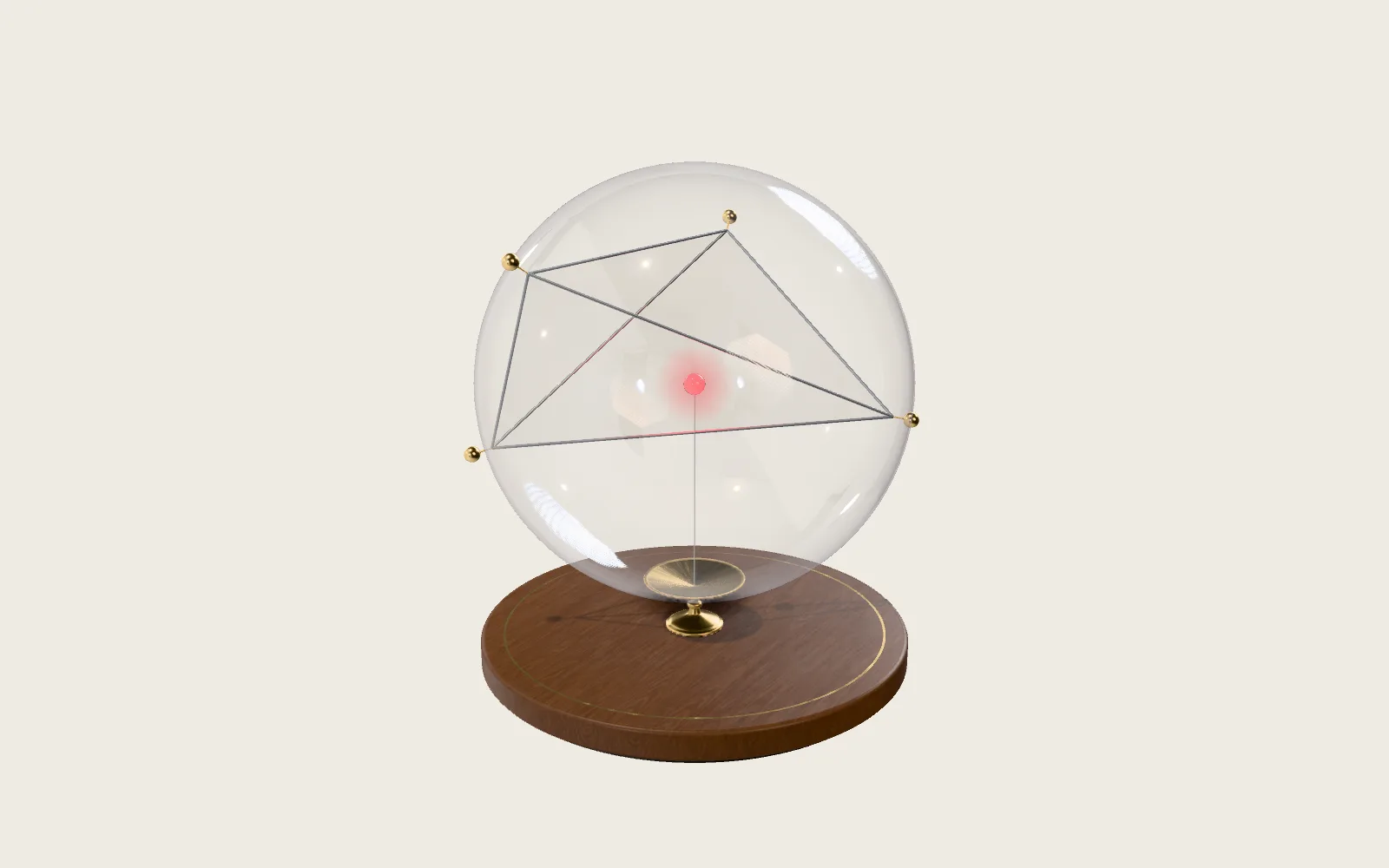 Plate M04One in Eight Random Tetrahedra Hold the CentreFour random points on a sphere make a tetrahedron that holds the centre one time in eight. Three points on a circle: one in four.
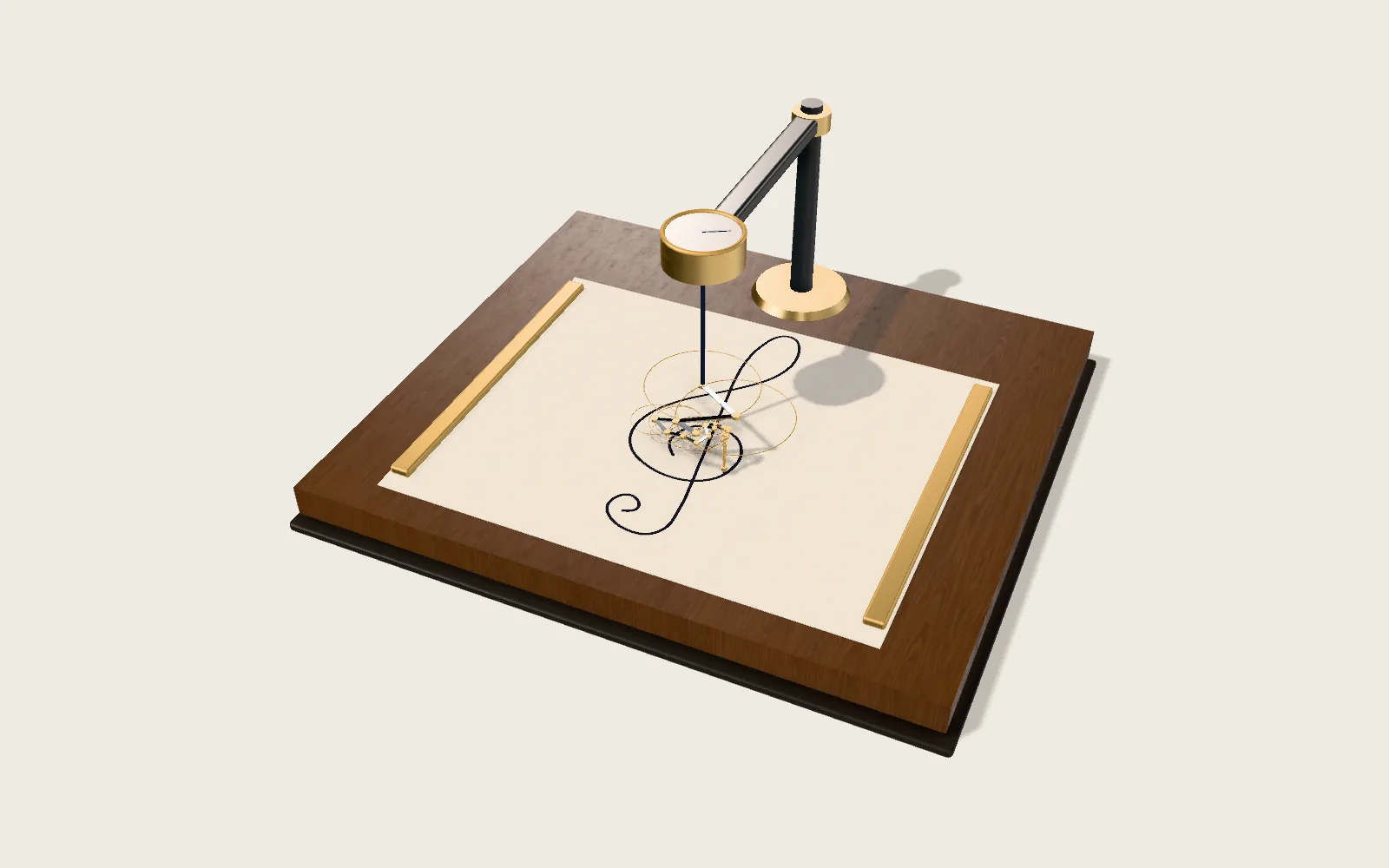 Plate M03Any Closed Line, Drawn by Turning CirclesA chain of arrows, head to tail, each turning at a whole-number speed: the last tip can draw any closed line.