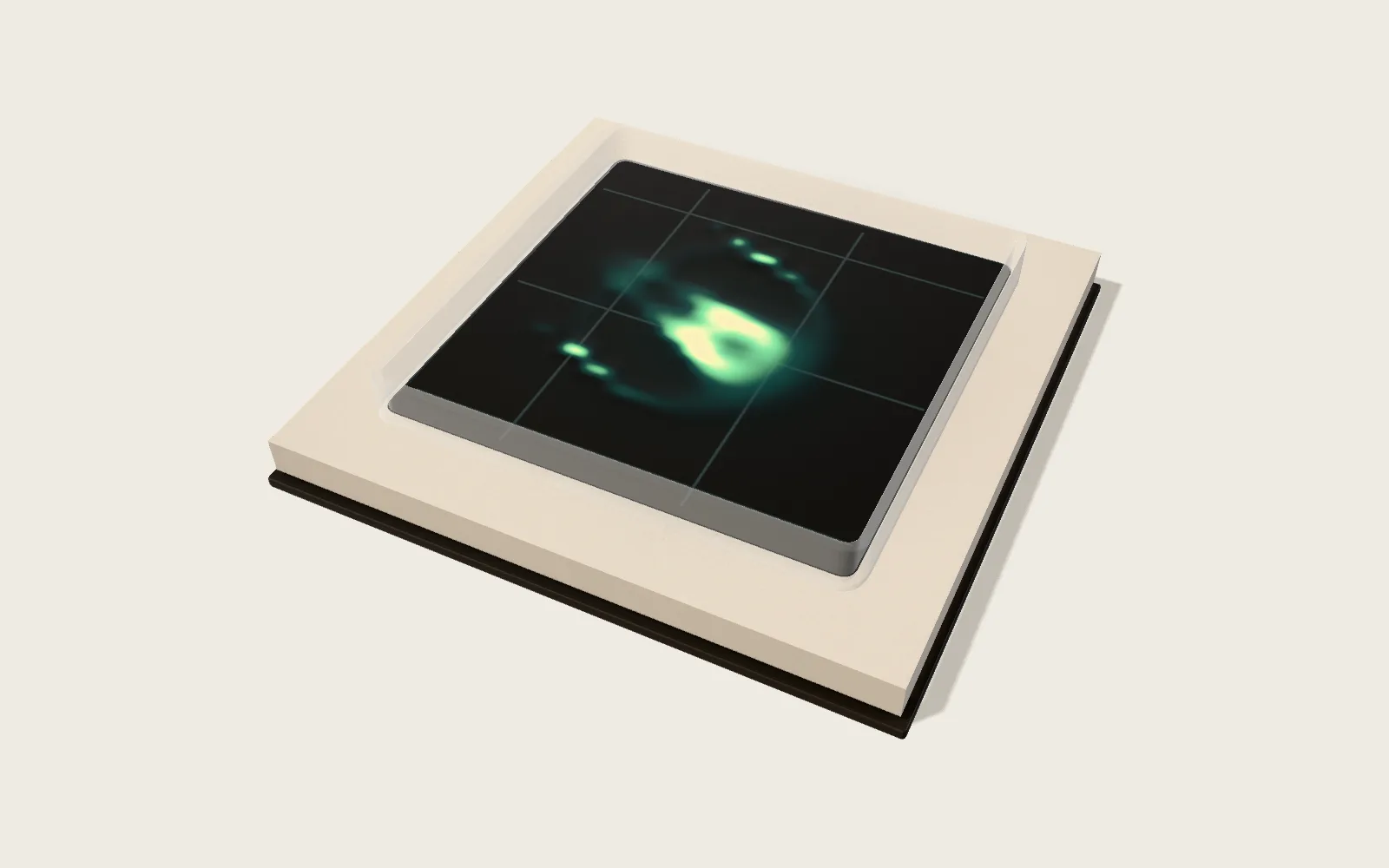
Any Closed Line, Drawn by Turning Circles
An arrow turning steadily about its foot draws a circle with its tip. Join many arrows head to tail, each turning at a different whole-number speed, and the last tip can draw a treble clef, or any other closed line. The length and starting angle of every arrow are worked out from the line itself.
Scroll
One Arrow
In the complex plane, eⁱᵗ is an arrow of length 1. Each time t grows by 2π it turns once round the origin, and its tip draws a circle.
Multiply by a complex number c and the arrow’s length becomes |c|, its starting direction the angle of c. e²ⁱᵗ turns twice as fast; e⁻ⁱᵗ turns the other way. Each arm of the machine is one such arrow: a length, a starting angle and a whole-number speed.
Two Arrows
The second arrow is mounted on the tip of the first. The first turns forwards at speed 1; the second, under a third as long, turns backwards at speed 2. The pen rides on the second tip and draws a triangle with rounded corners.
The pen’s position is the sum of the two arrows: c₁eⁱᵗ + c₋₂e⁻²ⁱᵗ. The triangle has three corners because the speeds differ by 3: each time the second arrow comes round to the same place relative to the first, the line bulges out into a corner.
Many Arrows
Here there are 128 arms, chained from longest to shortest, with speeds from ±1 and ±2 all the way to ±64, one arm for each whole number. The pen draws a treble clef.
A clef is written in one stroke, with a start and an end. A closed line has to come back to where it began, so the pen draws the stroke and then comes back along it. Broadly, the long arms turn slowly and set the outline; the short arms turn fast and add the small bends.
Where the Arrows Come From
To find the arrow with speed n, turn the whole line backwards: when the pen is at time t, turn that point back round the origin by the angle nt, which means multiplying it by e⁻ⁱⁿᵗ. The term with speed n stops turning; every other term still turns, now at speed m − n.
A point going steadily round a circle is, on average, at the centre. So when the turned-back points are averaged, every turning term averages to 0 and only the one that stopped is left. cₙ is the centre of mass of the turned-back line: cₙ = (1/2π)∫ z(t)e⁻ⁱⁿᵗ dt.
In practice the line is first sampled at 1024 points equally spaced along its length, and the integral becomes a sum divided by 1024: the discrete Fourier transform. With all 1024 terms, the tip passes through every sample exactly.
More Terms, Closer Fit
With the first 9 terms the clef is a lopsided tangle of loops, its farthest point off by more than a tenth of the clef’s height; with 129 terms, by less than 1.5%. The mean square of the error is exactly the sum of the squared lengths of the terms left out: Parseval’s theorem.
A square has sharp corners, and any finite number of terms draws them round, with fine ripples along the sides. Doubling the terms halves the largest error. A square only uses the speeds 1, −3, 5, −7, …, because a quarter turn brings it back onto itself.
If the line breaks, with the pen jumping from one place to another, things change: on either side of the jump the sum overshoots, by about 9% of the jump. More terms make the overshoot narrower, never lower. This is the Gibbs phenomenon; the figure shows a square wave.
It Began with Heat
Fourier was not studying drawings but heat. In December 1807 he read his memoir On the Propagation of Heat in Solid Bodies to the Institut in Paris, proposing that the temperature in a body can be written as a sum of sines and cosines. In 1822 he published The Analytical Theory of Heat.
On a ring, the heat equation makes each term fade on its own: the term with speed n shrinks as e^(−n²kt). The faster a term turns, the sooner it is gone, so the temperature grows smoother and smoother.
Read the star’s x coordinate as the temperature round a ring, and its y coordinate too, and let both spread: each arm shortens according to its speed. The points go first; the star becomes a rounded pentagon, then a circle. The machine draws one loop every so often.
The Bench
The paper takes a pen. On release, a straight line joins the end to the start, the machine works out every arrow afresh and draws the line again. The number of terms runs from 1 to 201.
Try thisDraw a square: how many terms before the corners look sharp?
What the model leaves out
The machine is a model of the idea: every arm’s length, starting angle and speed are set from the calculation, and the arms are stacked apart only so they can be seen; a real geared mechanism with 128 stages of any length would be hard to build. The line is sampled at 1024 points equally spaced along its length, and the discrete Fourier transform stands in for the integral, with straight lines between samples. The pen goes round the line at an even pace; a different pace (faster here, slower there) gives different coefficients but the same line. The heat chapter reads the drawing’s two coordinates as temperatures round a ring, with no real material or units.
Two common misreadings
The Gibbs phenomenon does not appear at every sharp corner. On an unbroken line, even with corners, the error goes to 0 as terms are added; the corners are only rounded. The overshoot of about 9% that never shrinks appears only where the line breaks. And adding terms never changes the ones already there: cₙ depends only on the line, so more terms only add more arrows. Fitting a polynomial is different: add one term and every earlier coefficient changes.
Sources
- Joseph Fourier (1822), Théorie analytique de la chaleur, Paris: Firmin Didot (scan at the Internet Archive)
- J. J. O’Connor and E. F. Robertson, Jean Baptiste Joseph Fourier, MacTutor History of Mathematics (the 1807 memoir and its reception)
- J. Willard Gibbs (1898), Fourier’s Series, Nature 59: 200
- J. Willard Gibbs (1899), Fourier’s Series, Nature 59: 606
- Edwin Hewitt and Robert E. Hewitt (1979), The Gibbs–Wilbraham phenomenon: An episode in Fourier analysis, Archive for History of Exact Sciences 21: 129–160
Data
Drawing with a chain of turning circles was brought to a wide audience by Grant Sanderson (3Blue1Brown) in 2019; his videos are under Watch next. The treble clef is our own centre-line trace; the machine is our own model of the idea.
Watch next
The player comes from YouTube and loads only when you press play.
Follow the question
 Plate M02Counting Clacks, Finding πTwo blocks and a wall, and a count of the collisions. Each time the large block gets 100 times heavier, the count gains another digit of π.
 Plate 15How Sound Crosses the AirSound is a push passed along through the air. The air doesn’t travel to you; the push does.