Any Closed Line, Drawn by Turning Circles
A chain of arrows, head to tail, each turning at a whole-number speed: the last tip can draw any closed line.
- Who it’s for
- Ages 15 to 18, best once students have met complex numbers. The drawing part alone works from about 13.
- Time
- 15 or 40 minutes
- You need
- A computer online and a projector; tablets help for the hands-on part
CC BY-NC 4.0Teachers may copy, adapt and print this page and the plate for class, with credit to world.lapla.si.
01Learning goals
- Match a turning arrow to a complex number: a length, a starting angle, a whole-number speed.
- Say where each term comes from: turn the whole line backwards by n and take the average; what is left is cₙ.
- Explain why more terms draw the line more closely, and know that where a line breaks the sum always overshoots by about 9% of the jump, narrower with more terms but never lower.
0215 minutes
To open or close a lesson: you project and talk it through.
- 0–2 min
Project “One Arrow”: eⁱᵗ turns once round and its tip draws a circle.
Chapter 01One Arrow→ - 2–5 min
“Two Arrows”: let students guess what the pen will draw before they watch. Ask: why three corners?
Chapter 02Two Arrows→ - 5–8 min
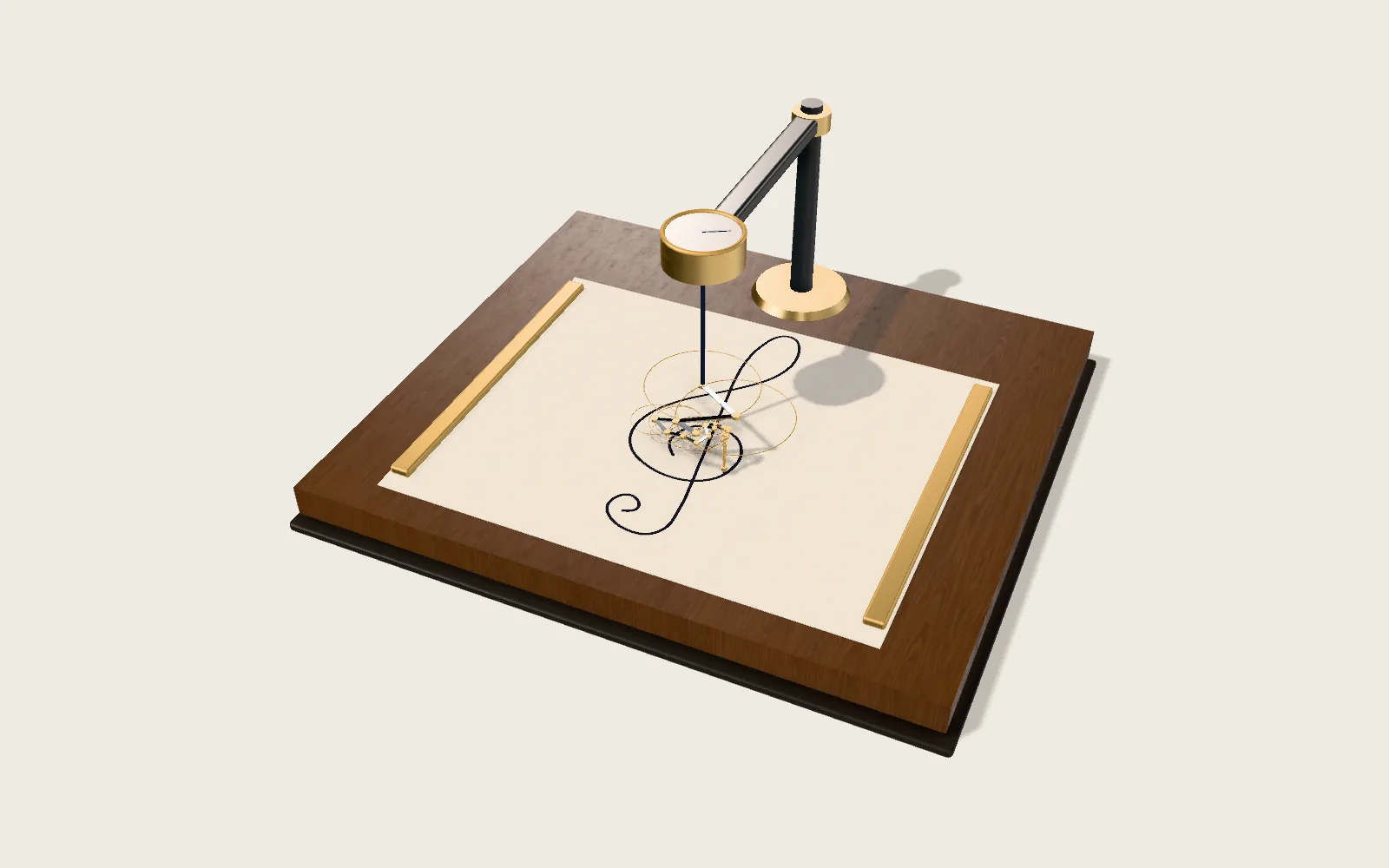
“Many Arrows”: 128 arms draw a treble clef. The long arms turn slowly and set the outline; the short arms turn fast and add the small bends.
Chapter 03Many Arrows→ - 8–12 min
“More Terms, Closer Fit”: with 9 terms the clef is a lopsided tangle; with 129, its farthest point is off by less than 1.5% of its height.
Chapter 05More Terms, Closer Fit→ - 12–15 min
At the bench, a student draws a line on the paper and the machine works out the arrows and draws it back.
Chapter 07The Bench→
0340 minutes
A whole lesson, with time for students to work the model and talk.
- 0–5 min
Recall multiplying complex numbers: times c, the length is multiplied by |c| and the direction turns by the angle of c, so c·eⁱᵗ has length |c| and starts at the angle of c. Then project “One Arrow”.
Chapter 01One Arrow→ - 5–10 min
“Two Arrows”: guess, then watch. The pen is the sum of the two arrows; talk through where the three corners come from.
Chapter 02Two Arrows→ - 10–15 min
“Many Arrows”: a clef is one stroke, and a closed line must come back to its start, so the pen draws the stroke and then comes back along it.
Chapter 03Many Arrows→ - 15–23 min
“Where the Arrows Come From”: use the animation to explain “turn back, then average”. Students say why every turning term averages to 0.
Chapter 04Where the Arrows Come From→ - 23–30 min
“More Terms, Closer Fit”: Parseval’s theorem and the Gibbs phenomenon. Ask: as terms are added, what is different between a square’s corner and a square wave’s jump?
Chapter 05More Terms, Closer Fit→ - 30–34 min
“It Began with Heat”: Fourier was studying heat. The faster a term turns, the sooner it fades, so the star loses its points and becomes a circle.
Chapter 06It Began with Heat→ - 34–40 min
Hands-on: follow the steps below to test “double the terms, halve the largest error” on the square.
Chapter 07The Bench→
04Questions to ask
The first arrow turns forwards at speed 1, the second backwards at speed 2. Why does the pen draw three corners?
A good answerThe speeds differ by 3. Each time the second arrow comes back round to the same place relative to the first, the line bulges out into a corner, so one loop has three.
How do you find the term with speed n?
A good answerTurn the whole line backwards: multiply each point by e⁻ⁱⁿᵗ. The term with speed n stops; every other term still turns. A point going steadily round a circle is on average at the centre, so the average leaves only the term that stopped: cₙ is the centre of mass of the turned-back line.
If you add more terms, do the arrows you already have change?
A good answerNo. cₙ depends only on the line, so more terms just add more arrows. Fitting a polynomial is different: add one term and every earlier coefficient changes.
As terms are added, how do a square’s corners differ from a square wave’s jumps?
A good answerThe square’s line never breaks, so the error goes to 0 and the corners only grow sharper; doubling the terms halves the largest error. A square wave breaks at each jump, and the sum overshoots on either side by about 9% of the jump. More terms make the overshoot narrower, never lower.
In the heat chapter, why does the star lose its points first and end as a circle?
A good answerThe term with speed n shrinks as e^(−n²kt), so the faster a term turns, the sooner it fades. The points are made by the fast terms, so they go first; the slowest term is left last, and it draws a circle.
05Hands-on
Double the terms, halve the error?
- Go to the last chapter, “The Bench”, and set “Drawing” to “Square”.
- Set “Terms” to 17, then 33, 65 and 129. Each time, let the pen finish a loop and write down “Largest error”.
- Work it out: each time the terms double, does the largest error roughly halve? Are the corners always round, only smaller?
- Switch to “Clef” and bring the terms slowly down from 129. Which details disappear first?
- Choose “Your own” and draw a line on the paper. Let go, watch the machine draw it back, then see what it looks like with very few terms.
Look forOn the square the largest error roughly halves each time the terms double, and the corners stay round, only smaller. As terms are taken away the small bends go first: they come from the short, fast arms.
06Common misconceptions
The ideaThe Gibbs phenomenon appears at every sharp corner.
What the plate showsOn an unbroken line, even with corners, the error goes to 0 as terms are added; the corners are only rounded. The overshoot of about 9% that never shrinks appears only where the line breaks.
The ideaAdding a term means working out every earlier coefficient again.
What the plate showscₙ depends only on the line, so more terms only add more arrows. That happens when fitting a polynomial, not here.
07Sources
The plate’s own. Every fact on this page comes from the plate and these sources.
- Joseph Fourier (1822), Théorie analytique de la chaleur, Paris: Firmin Didot (scan at the Internet Archive)
- J. J. O’Connor and E. F. Robertson, Jean Baptiste Joseph Fourier, MacTutor History of Mathematics (the 1807 memoir and its reception)
- J. Willard Gibbs (1898), Fourier’s Series, Nature 59: 200
- J. Willard Gibbs (1899), Fourier’s Series, Nature 59: 606
- Edwin Hewitt and Robert E. Hewitt (1979), The Gibbs–Wilbraham phenomenon: An episode in Fourier analysis, Archive for History of Exact Sciences 21: 129–160
08Use it in class
This page and the plate’s text, pictures and models are licensed CC BY-NC 4.0. You may copy, print and adapt them, hand them out to students and share them with colleagues, as long as you credit world.lapla.si (Laplace’s Mini World).
They may not be sold or used for other commercial purposes. Third-party data and pictures listed on the plate keep their own licences.
The licence in full (CC BY-NC 4.0) ↗