The Enigma Cipher Machine
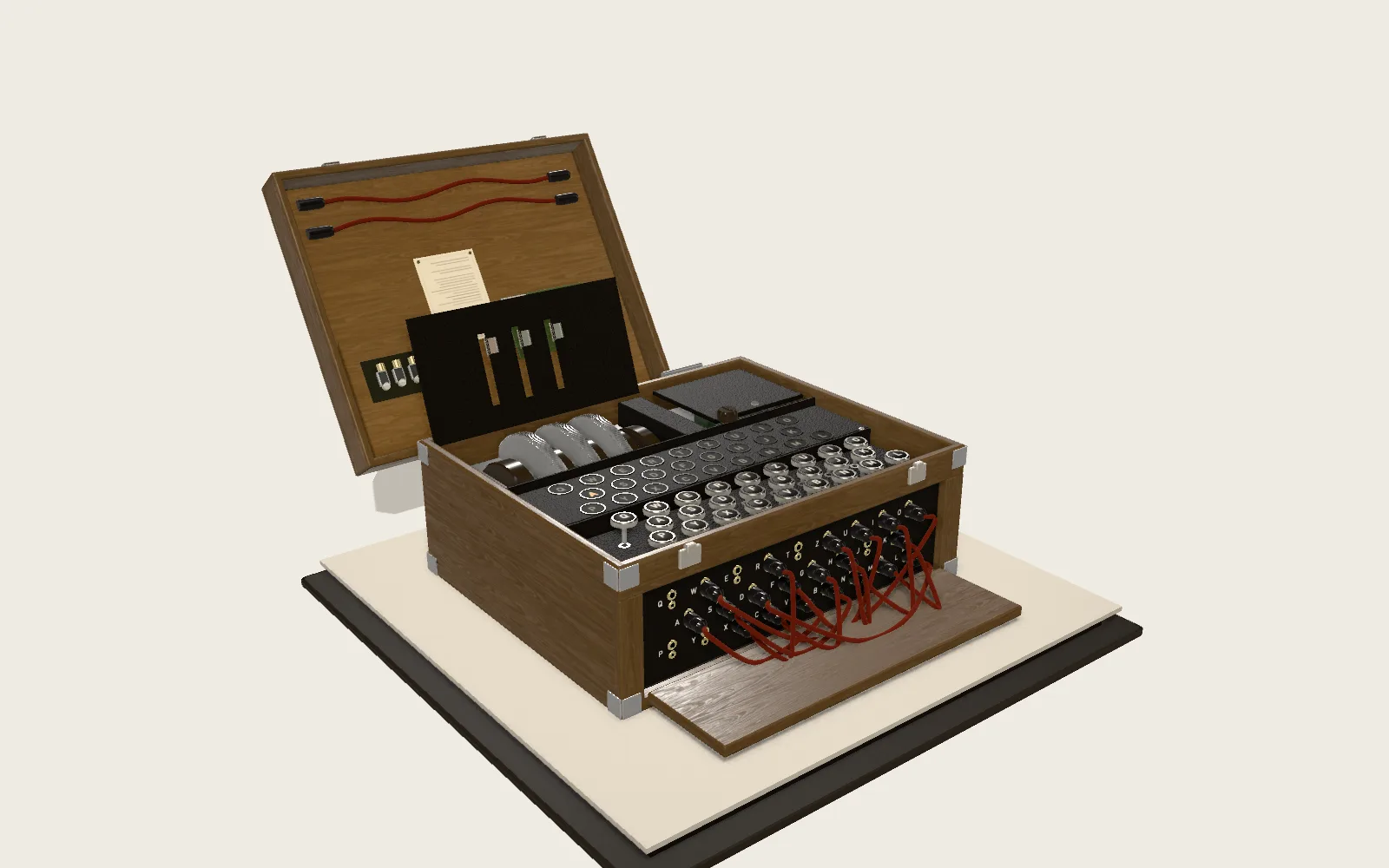
Press a key and the rotors step first; the current runs through the plugboard, three rotors and a reflector and back, and another letter lights up.
- Who it’s for
- Ages 12 to 18. Anyone who can type can try it; counting the settings needs multiplication and powers.
- Time
- 15 or 40 minutes
- You need
- A computer online and a projector; tablets help for the hands-on part
CC BY-NC 4.0Teachers may copy, adapt and print this page and the plate for class, with credit to world.lapla.si.
01Learning goals
- Say what happens when a key is pressed: the rotors step first, then the current runs through the plugboard, three rotors and the reflector and back, and another lamp lights.
- Explain why the same settings both encipher and decipher, and why no letter is ever enciphered as itself.
- See that a huge number of settings is not the same as security: known rotor wirings, letters that never become themselves and fixed openings cut the codebreakers’ work by many orders of magnitude.
0215 minutes
To open or close a lesson: you project and talk it through.
- 0–2 min
Project “Messages Anyone Can Hear”: anyone can pick up a radio message, so it has to be enciphered first.
Chapter 01Messages Anyone Can Hear→ - 2–5 min
“Press a Key, a Lamp Lights”: press A five times and five different lamps light, none of them A. Ask: why?
Chapter 02Press a Key, a Lamp Lights→ - 5–8 min
“The Path of the Current”: follow the current aloud, from key to lamp.
Chapter 03The Path of the Current→ - 8–12 min
“The Same Settings Decipher”: if A becomes B, B becomes A. Then the weakness that comes with it: no letter becomes itself.
Chapter 06The Same Settings Decipher→ - 12–15 min
At the bench, a student enciphers a word and presses “Decipher” to get it back.
Chapter 12Encipher a Line Yourself→
0340 minutes
A whole lesson, with time for students to work the model and talk.
- 0–4 min
Open with a question: how do you send a message only your own side can read? Then project “Messages Anyone Can Hear”.
Chapter 01Messages Anyone Can Hear→ - 4–8 min
“Press a Key, a Lamp Lights”: one operator presses keys, another writes down the lamps, and the message goes out in Morse.
Chapter 02Press a Key, a Lamp Lights→ - 8–12 min
“The Path of the Current”: students list the stages the current passes through, in order.
Chapter 03The Path of the Current→ - 12–17 min
“Rotors That Count Like an Odometer”: the turnover and the double step. Work out why the rotors come round after 16,900 keys, not 17,576.
Chapter 04Rotors That Count Like an Odometer→ - 17–20 min
“The Plugboard”: ten cables swap twenty letters in pairs, and six stay as they are.
Chapter 05The Plugboard→ - 20–25 min
“The Same Settings Decipher”: the convenience of a reflector that pairs its contacts, and the weakness it brings.
Chapter 06The Same Settings Decipher→ - 25–30 min
“How Many Settings”: students multiply 60, 17,576 and the plugboard count, then discuss why published figures differ.
Chapter 07How Many Settings→ - 30–36 min
Hands-on: check the machine against a published test, as in the steps below.
Chapter 12Encipher a Line Yourself→ - 36–40 min
“How It Was Broken”: the Polish Cipher Bureau read it from 1932; at Bletchley Park, cribs and bombes found each day’s settings.
Chapter 10How It Was Broken→
04Questions to ask
Press A five times. Why does a different lamp light each time?
A good answerAs each key goes down, the right-hand rotor steps first and only then does the circuit close. Once a rotor moves, the whole path of the current changes.
How does the receiver turn the cipher back into the message?
A good answerThey set the same rotors, rings, start positions and plugs as the sender and type the cipher in; the lamps spell out the message. The reflector joins its contacts in pairs, so at any one position, if A becomes B, B becomes A.
Why is no letter ever enciphered as itself, and why was that a weakness?
A good answerThe current turned back by the reflector can never return through the contact it came in by. Codebreakers slid a guessed stretch of plain text along the cipher, and any place where a letter met itself could be ruled out at once.
Why do the three rotors come round after 16,900 keys, not 26 × 26 × 26 = 17,576?
A good answerBecause of the double step. When the middle rotor reaches its notch, the next key steps it again together with the left rotor, so it rests in that position for only one key. That gives 26 × 25 × 26 = 16,900.
There were about 10²³ settings. Why was the Enigma broken anyway?
A good answerA huge number of settings is not security. The other side knew the rotor wirings, no letter ever became itself, messages often opened the same way, and operators had habits. Together these cut the work by many orders of magnitude. The Polish Cipher Bureau read it from 1932, and Britain built more than two hundred bombes on that work.
05Hands-on
Check the machine against a published test
- Go to the last chapter, “Encipher a Line Yourself”. Check that “Rotors” are I, II, III and that “Rings” and “Start” are all A · 01 (the page’s defaults).
- Delete every letter in the “Plugs” box and press Enter: no plugs now.
- Press “Type”, then type AAAAA on the keyboard. The “Lamps” line should read BDZGO, the published test result.
- Press “Decipher”: the machine goes back to the start and types BDZGO in again. What do the lamps spell now?
- Put a few pairs back in the “Plugs” box (AV BS CG, say), press Enter, press “Type” and type AAAAA again. Does the result change? Did any letter become itself?
Look forAAAAA becomes BDZGO, and BDZGO becomes AAAAA again: the same settings encipher and decipher. However it is set, the lamp that lights is never the key pressed.
06Common misconceptions
The ideaOne person broke the Enigma.
What the plate showsThe Polish Cipher Bureau read it from 1932; Britain, and later the United States, built hundreds of bombes on that work, with thousands of people involved.
The ideaWith that many settings, it must have been secure.
What the plate showsKnown rotor wirings, letters that never become themselves, fixed openings and operators’ habits cut the work by many orders of magnitude.
The ideaEvery German service used the same Enigma.
What the plate showsThe German Navy used other models, the M3 and later the four-rotor M4, which were much harder to break.
The ideaIt is a measured fact that breaking the Enigma shortened the war by years.
What the plate showsIt is an estimate, and historians differ. Questions of what would have happened cannot be tested.
07Sources
The plate’s own. Every fact on this page comes from the plate and these sources.
- Crypto Museum: Enigma wiring (rotors I–V, entry wheel, reflectors A/B/C, turnover letters)
- Crypto Museum: Enigma I (in service 1 June 1930, 12 cables with 10 in use, rotors IV and V added 15 December 1938, 4.5 V battery, more than 20,000 made)
- Crypto Museum: Enigma history (patent of 23 February 1918, Pyry meeting 25–26 July 1939, M4 from 1 February 1942)
- Frode Weierud, Cryptocellar: the test message in the 1930 Schlüsselanleitung zur Chiffriermaschine Enigma I (reflector A, rotors II I III, rings 24 13 22)
- Computer History Museum: Enigma I (about 34 × 28 × 15 cm, about 11.8 kg)
- Rotor details: the double step ADU, ADV, AEW, BFX; the test AAAAA → BDZGO
- Bletchley Park: Enigma (broken in Poland in 1932, shared with Britain in 1939, first wartime messages broken January 1940)
- Bletchley Park: six facts about the bombe (designed by Turing, run mostly by Wrens)
- Historic England: the bombe replica (first machine arrived March 1940; Welchman, Turing, Harold Keen)
- bombe.org.uk: 211 bombes at the end of the war
- Virtual Bletchley Park (Tony Sale): the Polish work (Schmidt’s documents, the cyclometer, Zygalski sheets, the bomba, the copies handed over at Pyry)
- MacTutor, University of St Andrews: Marian Rejewski (joined the Cipher Bureau 1 September 1932; permutation theory, 1932–33)
- Philip Marks and Frode Weierud: Recovering the wiring of Enigma’s Umkehrwalze A
- Harry Hinsley: The Influence of ULTRA in the Second World War (lecture at King’s College London, 18 February 1992)
- UK Government history blog: Polish cryptologists reveal they have cracked Enigma, 26 July 1939
08Use it in class
This page and the plate’s text, pictures and models are licensed CC BY-NC 4.0. You may copy, print and adapt them, hand them out to students and share them with colleagues, as long as you credit world.lapla.si (Laplace’s Mini World).
They may not be sold or used for other commercial purposes. Third-party data and pictures listed on the plate keep their own licences.
The licence in full (CC BY-NC 4.0) ↗