The Enigma Cipher Machine
Anyone can pick up a radio message, so it has to be unreadable to all but its own side. The Enigma is an electromechanical rotor machine: press a key, the rotors move on a step, the current takes a path that is different every time, and another letter lights on the lamp board. The model is the Enigma I the German Army used from 1930: an oak case, black crackle finish, three rotors, reflector B and a plugboard with ten cables. Type on it with your own keyboard.
Scroll
Messages Anyone Can Hear
Radio let units talk without laying wires, but radio waves go everywhere and the other side listens too. A message has to be enciphered before it is sent and deciphered when it arrives.
Codebooks worked by hand are slow and error-prone, and a captured book gives everything away. In the 1920s machines took over: with every letter the wiring inside changes, so the same letter comes out differently this time and the next. The Enigma I went into service with the German Army in 1930, later with the Air Force too; more than twenty thousand were built.
Press a Key, a Lamp Lights
The Enigma prints nothing. The operator presses a key, a letter lights up on the lamp board, and a second person writes it down. When the message is done it goes out by radio in Morse.
As the key goes down the right-hand rotor moves on one step, and only then does the circuit close. So press A five times and five different lamps light, and none of them is A.
The Path of the Current
A 4.5 V battery drives it. From the key the current goes through the plugboard into the entry wheel, through the right, middle and left rotors, and into the reflector. The reflector sends it back by another contact, back through the three rotors, the entry wheel and the plugboard, and it lights a lamp.
Each rotor has 26 contacts on each face and 26 wires inside that join them in a scrambled order. Turn a rotor one step and the whole path changes.
The path: key → plugboard → entry wheel → right → middle → left → reflector → left → middle → right → entry wheel → plugboard → lamp
Rotors That Count Like an Odometer
The right rotor steps once for every key. Each rotor’s ring has a notch: as the right rotor passes its notch it takes the middle rotor one step, and as the middle rotor passes its own it takes the left one. Rotors I to V turn over at Q, E, V, J and Z.
There is one difference from an odometer. When the middle rotor reaches its notch, the next key steps it again together with the left rotor: the double step. With rotors I, II, III the windows go ADU, ADV, AEW, BFX, and the middle rotor stays on E for only one key. So the three rotors come round after 26 × 25 × 26 = 16,900 keys, not 17,576.
The Army’s Enigma I had figures 01–26 on its rings; the figure in a window stands for the letters A–Z
The Plugboard
Fold down the wooden flap at the front and there is the plugboard. Each twin cable plugs into the sockets of two letters and swaps them: once before the current enters the rotors, once after it leaves. In the war ten cables were the rule, so twenty letters were swapped in pairs and six stayed as they were.
The plugboard does not change from key to key, but it hides the rotors’ wiring behind one more unknown. Each socket has a thick hole and a thin one, so a plug only goes in one way round.
The Same Settings Decipher
The reflector joins its contacts in pairs. So at any one position, if A becomes B, B becomes A. The receiver sets the same rotors, rings, start positions and plugs as the sender and types the cipher in, and the lamps spell out the message. Enciphering and deciphering are one machine and one action.
The same reason makes a weakness: the current cannot come back to the contact it came in by, so no letter is ever enciphered as itself. It looks harmless. It became a tool in the codebreakers’ hands.
How Many Settings
The day’s key says which three of the five rotors go in and in what order, 60 ways; the start positions, 26 × 26 × 26 = 17,576; and how the ten cables go in, 150,738,274,937,250 ways. Multiplied, that is about 1.59 × 10²⁰.
Count the rings too and only the middle and right ones change when a turnover comes, another factor of 676: about 1.07 × 10²³, roughly a 77-bit key. The left ring only renames the start position and adds nothing new. The figures quoted in different places differ because they count different things. And the count assumes the other side knows how the rotors are wired, which it did.
60 × 17,576 × 150,738,274,937,250 × 676 ≈ 1.07 × 10²³
Taken Apart
On top is the rotor cover, with three small windows that show the rotors’ positions and three slots the knurled thumbwheels stand through. Under it, from left to right: the reflector, the left, middle and right rotors, and the entry wheel; at the right, the box for the 4.5 V battery.
In the middle are the lamp board and its 26 bulbs, in front of them the 26 keys, and behind the folded-down flap the plugboard and its cables. Around it all is the oak case with its hinged lid, which holds spare bulbs, spare cables and a green filter.
One Rotor, Cut Open
Inside a rotor’s bakelite core run 26 wires. One face carries 26 spring-loaded brass pins, the other 26 flat brass plates, and each wire joins a pin on one side to a plate on the other in a scrambled order. Each of the five rotors is wired differently.
The ring turns against the core: that is the ring setting. It changes which letter in the window goes with which wiring position, and when the notch comes round. The wire picked out in the section is the one the current takes now.
How It Was Broken
From 1932, three mathematicians of the Polish Cipher Bureau, Marian Rejewski, Jerzy Różycki and Henryk Zygalski, worked on the Enigma. Rejewski used the theory of permutations, together with operating instructions and several months of keys that French intelligence had obtained from a German informant, Hans-Thilo Schmidt, to work out how the rotors were wired; Poland then built copies of the machine. They invented the cyclometer and Zygalski’s perforated sheets, and in 1938 a machine called the bomba to find each day’s settings.
In December 1938 the Germans added rotors IV and V, and the rotor orders went from 6 to 60. In July 1939, at Pyry near Warsaw, the Poles gave everything they had, copies of the machine included, to the French and the British. At Bletchley Park in England, Alan Turing designed the British bombe and Gordon Welchman added the diagonal board; the first arrived in March 1940, and by the end of the war there were more than two hundred, run mostly by women.
A bombe works from a crib: a stretch of plain text the codebreakers could guess, from a weather report or a fixed opening. Slide the crib along the cipher, and any place where a letter would meet itself is ruled out, because the Enigma never enciphers a letter as itself. The places left go to the bombe, which runs through rotor orders and start positions at speed and throws out plugboard guesses that contradict themselves.
Slide the guessed text along the cipher: in red, a letter meets itself, so that place is ruled out
What It Changed
In Britain the intelligence from broken messages was called Ultra. It helped convoys in the Atlantic route round the U-boats, and it gave German dispositions in North Africa and before and after the Normandy landings. The work was kept secret for nearly thirty years after the war and came out in the 1970s, and so did the Polish part in it.
How much Ultra changed the war is something historians estimate differently. Harry Hinsley, the official historian of British wartime intelligence, argued that without it the Normandy landings might have waited until 1946 and the war would have lasted much longer; others think the effect was smaller. Questions of what would have happened cannot be tested. What is clearer: the bombes turned codebreaking into an industry, and the Enigma taught later designers that the machine will become known to the other side sooner or later, so the secret has to lie in the key alone.
Encipher a Line Yourself
Pick three rotors, set the rings, the start positions and the plugs, then type with your keyboard or tap the keys on the model. “Decipher” turns the rotors back to the start and types the cipher in again.
Try thisEncipher a line, then type the cipher back in with the same settings. Why does the plain text come out?
What the model leaves out
The cipher is exactly the real one: the published wirings of rotors I–V and reflector B, the rings, the plugboard and the double step, checked against published test vectors (with rotors I, II, III, rings and start at 01 and no plugs, AAAAA enciphers as BDZGO) and the test message in the German Army’s instructions of 1930. The machine on the page has ten plugs in by default. The model follows the Enigma I, sized at about 34 × 28 × 15 cm; the case, keys and lamps are simplified, and it carries no maker’s plate or insignia of any kind. The real rings bore the figures 01–26; the readouts give the letters too. The pawls and ratchets that step the rotors, the switches under the keys, the wiring under the lamp board, the battery box’s contacts and the socket for outside power are not shown. Inside the cut rotor the wires’ routes are drawn freely; only where they start and end is real. In the path view the rotors are pulled apart and faded so the current can be seen; in the machine they sit tight together.
Some common misreadings
No one person broke the Enigma: the Polish Cipher Bureau read it from 1932, and Britain, and later the United States, built hundreds of bombes on that work, with thousands of people involved. A huge number of settings is not the same as security: known rotor wirings, letters that never become themselves, fixed openings and operators’ habits cut the work by many orders of magnitude. The German Navy used other models (the M3, and later the four-rotor M4), which were much harder to break. That Ultra shortened the war by some years is an estimate, not something measured.
Sources
- Crypto Museum: Enigma wiring (rotors I–V, entry wheel, reflectors A/B/C, turnover letters)
- Crypto Museum: Enigma I (in service 1 June 1930, 12 cables with 10 in use, rotors IV and V added 15 December 1938, 4.5 V battery, more than 20,000 made)
- Crypto Museum: Enigma history (patent of 23 February 1918, Pyry meeting 25–26 July 1939, M4 from 1 February 1942)
- Frode Weierud, Cryptocellar: the test message in the 1930 Schlüsselanleitung zur Chiffriermaschine Enigma I (reflector A, rotors II I III, rings 24 13 22)
- Computer History Museum: Enigma I (about 34 × 28 × 15 cm, about 11.8 kg)
- Rotor details: the double step ADU, ADV, AEW, BFX; the test AAAAA → BDZGO
- Bletchley Park: Enigma (broken in Poland in 1932, shared with Britain in 1939, first wartime messages broken January 1940)
- Bletchley Park: six facts about the bombe (designed by Turing, run mostly by Wrens)
- Historic England: the bombe replica (first machine arrived March 1940; Welchman, Turing, Harold Keen)
- bombe.org.uk: 211 bombes at the end of the war
- Virtual Bletchley Park (Tony Sale): the Polish work (Schmidt’s documents, the cyclometer, Zygalski sheets, the bomba, the copies handed over at Pyry)
- MacTutor, University of St Andrews: Marian Rejewski (joined the Cipher Bureau 1 September 1932; permutation theory, 1932–33)
- Philip Marks and Frode Weierud: Recovering the wiring of Enigma’s Umkehrwalze A
- Harry Hinsley: The Influence of ULTRA in the Second World War (lecture at King’s College London, 18 February 1992)
- UK Government history blog: Polish cryptologists reveal they have cracked Enigma, 26 July 1939
Follow the question
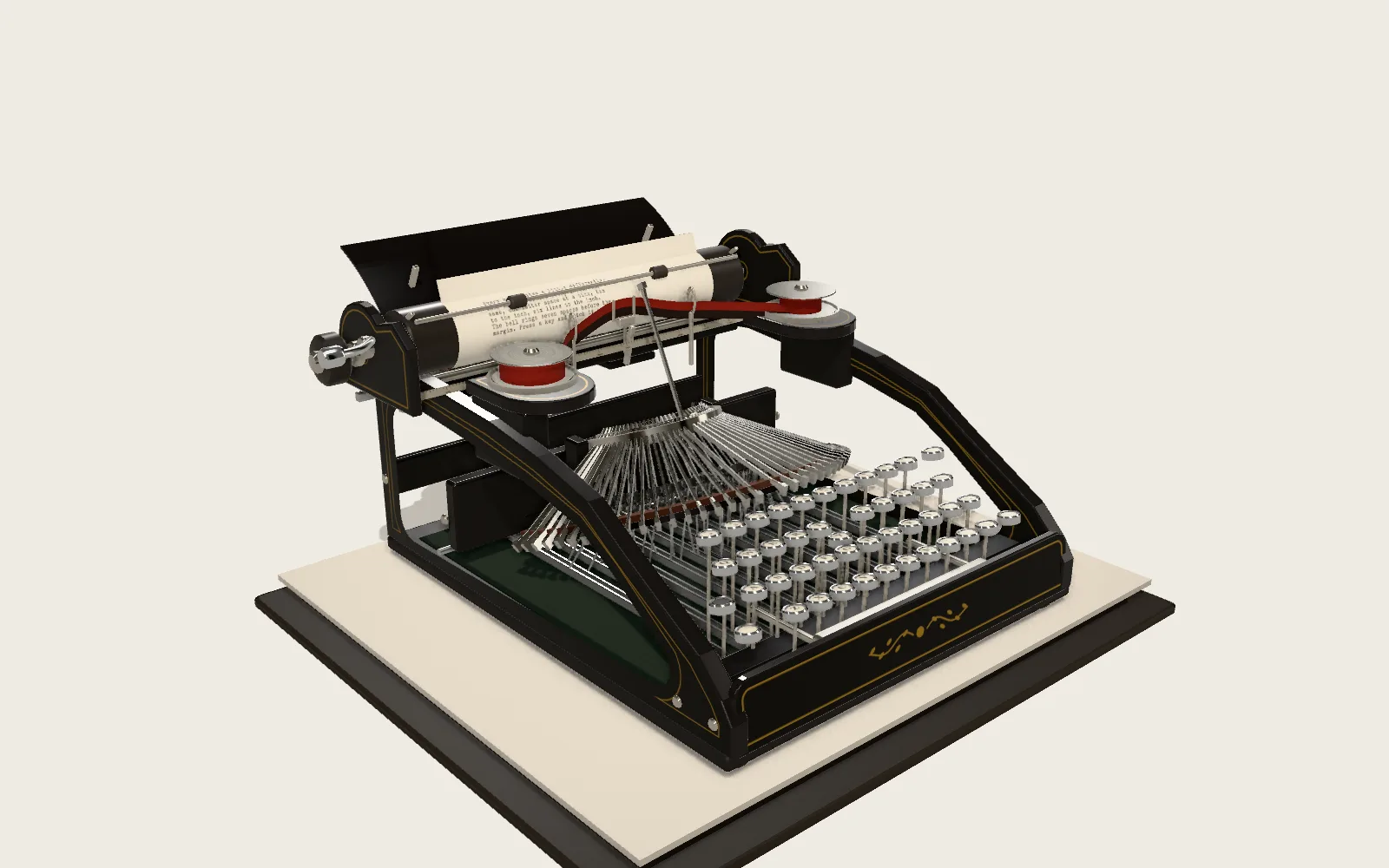 Plate C07The TypewriterPress a key and a typebar swings up and strikes the paper through the ribbon; let go and the carriage steps one space to the left.
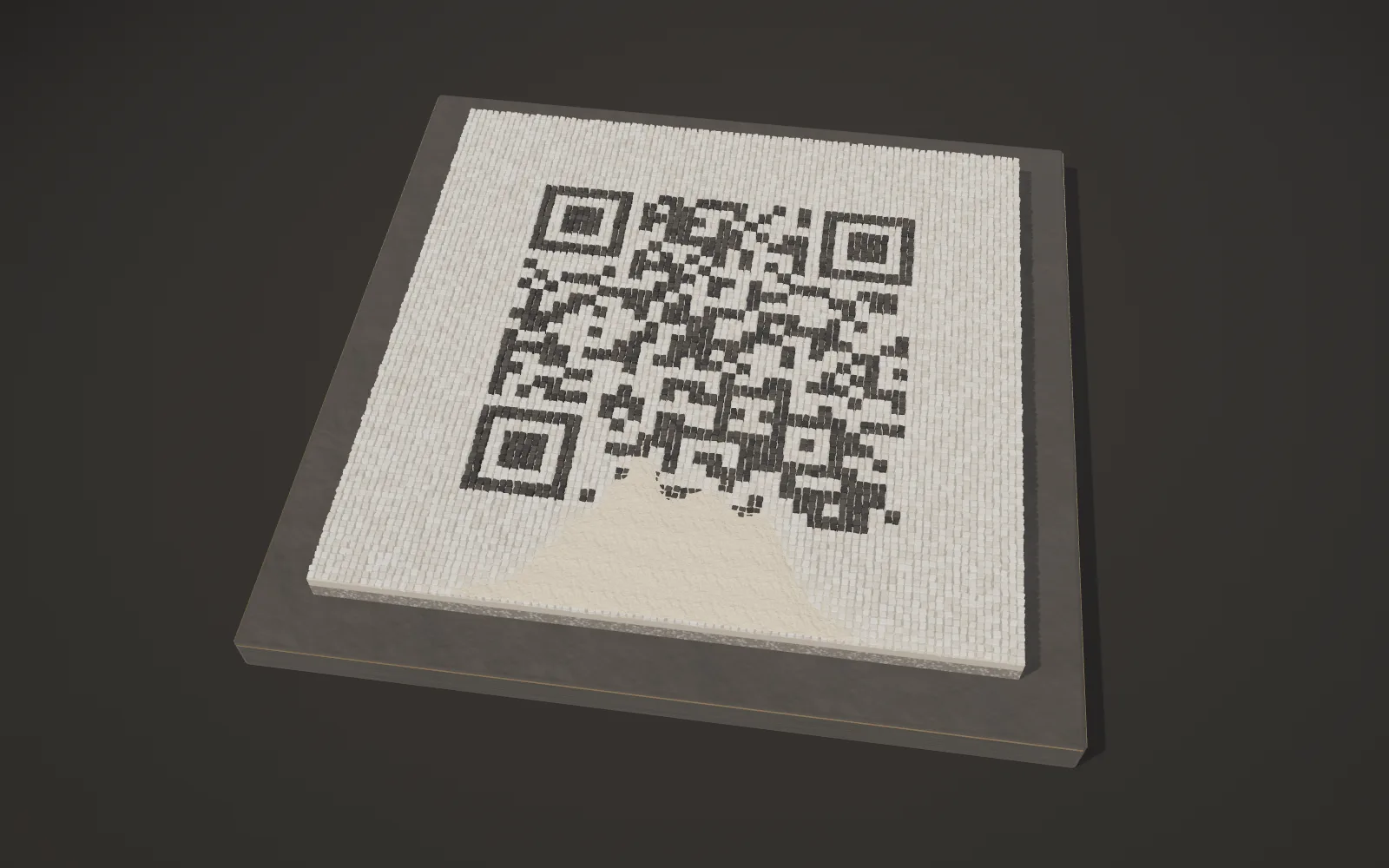 Plate 45A Code That Survives SandBury part of a QR code in sand and a phone still reads it. The secret is in its spare bytes, which say nothing at all but can work out what went wrong and how to put it right.