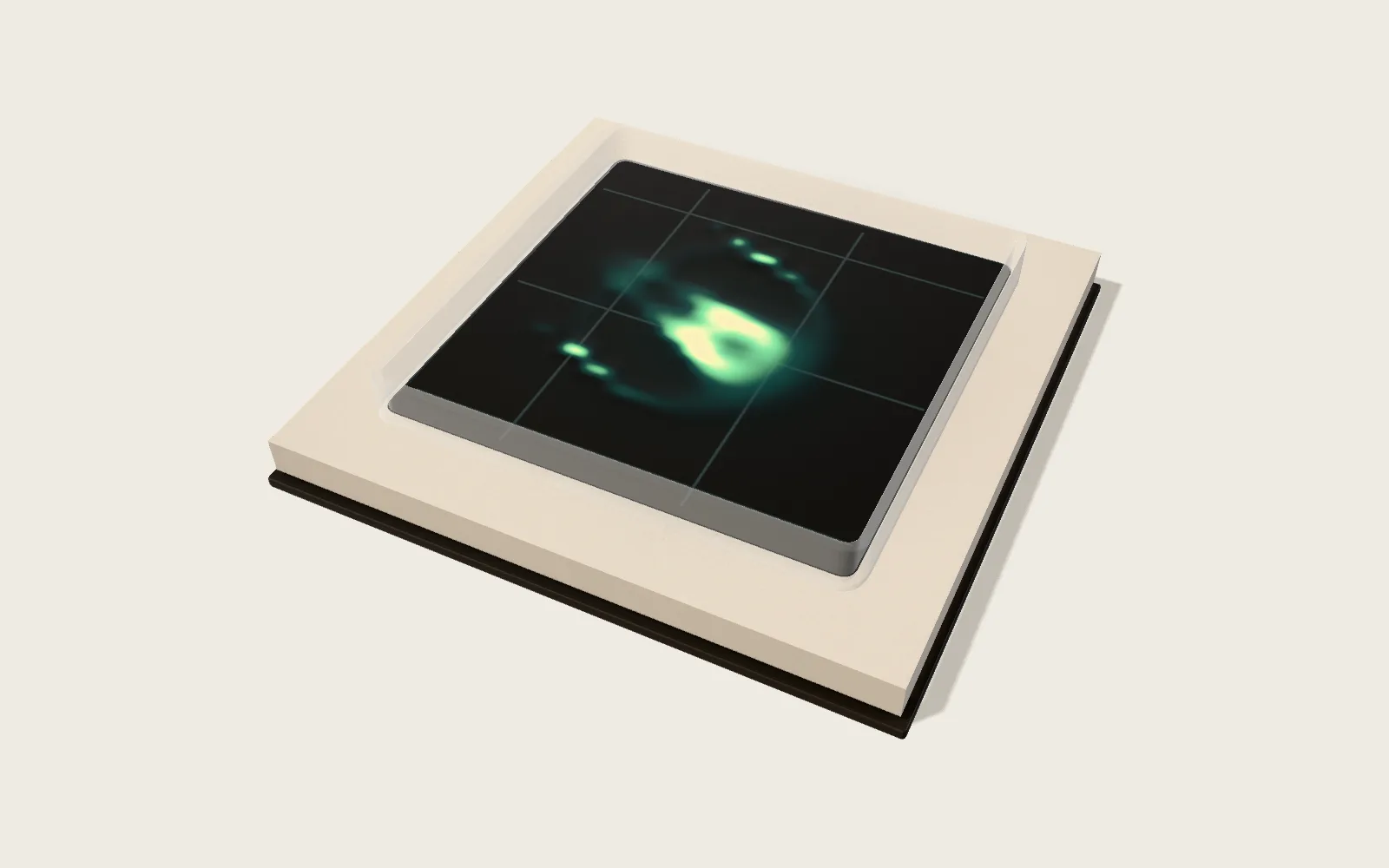
Slope and Area Undo Each Other
The derivative is the slope of a curve at a point; the integral is the area piled up under it. Push the right edge, and the area grows at a rate equal to the curve’s height there. So the two are inverse operations: integrate, then differentiate, and you are back at the curve you began with.
Scroll
Speedometer and Odometer
A car pulls away, cruises and brakes, all in 12 seconds. The edge of the brass template is its speed plotted against time.
The speedometer reads the speed at this moment: the curve’s height now. The odometer reads the distance covered so far: the area under the curve from 0 up to now.
A pen on the carriage draws the distance against time as it goes (scale on the right, in metres). That curve’s slope at each point is the speed at that moment: the faster the distance grows, the faster the car is going. On the road along the back, a model car moves as the odometer reads.
Zoom In, and It Is a Slope
The curve is y = x². A straightedge rests on two rollers, one at x and one at x + h. Its slope is (f(x + h) − f(x)) / h, the slope of a secant.
Bring the rollers together and h shrinks: the secant turns towards the tangent. For x² the secant’s slope is exactly 2x + h, closer to 2x the smaller h is.
With the carriage moved aside and the template lifted off, the glass keeps the curve and its tangent. Magnify the curve around a point and it looks more and more like a straight line, until it can hardly be told from the tangent. The derivative is that line’s slope: at x, the derivative of y = x² is 2x.
Area Is Many Thin Strips
The area under a curve can be cut into strips dx wide, each taken as a rectangle: width dx, height the curve’s value at one point. Add up the rectangles and you have a Riemann sum.
The height can be taken at a strip’s left edge, its right edge or its middle. As dx shrinks, all three sums close in on the true area. With the left or right edge the error is roughly proportional to dx; with the middle it is proportional to dx², and falls far faster.
As the strips grow ever thinner, the sums approach a limit: the integral ∫ f(x) dx.
How Fast the Area Grows
Push the carriage a little further, by dx, and the area gains one more strip: dx wide and very nearly f(x) tall, the curve’s height there. So the area grows by dA ≈ f(x)·dx.
Divide by dx: the rate at which the area grows as the right edge moves, dA/dx, equals f(x), and the smaller dx, the closer the match. This is the fundamental theorem of calculus.
The integrator on the carriage does this with metal. A disc turns as the carriage moves; a steel ball sits on it at a distance from the centre proportional to the curve’s height; a cylinder resting on the ball turns faster the further out the ball is. The cylinder’s total turn is proportional to the area, and the counter reads it as the area.
The pen draws the area curve A(x), and the glass shows its tangent at the carriage: that slope always equals the height of the first curve. Integrate, then differentiate, and you are back at f.
A Square Gains Two Strips
A square with side x has area x². Lengthen the side by dx, and the area gains two strips, x long and dx wide, plus a small dx × dx square in the corner.
The gain is 2x·dx + dx². When dx is small, the corner is tiny next to the strips and can be dropped. So the area grows at the rate 2x: the derivative of x².
Sine on the Unit Circle
On the unit circle, the point turned through an angle θ from the horizontal axis stands at height sin θ.
Move a little further round the arc, by dθ: the point moves at right angles to the radius. The upward part of that small step is cos θ·dθ, so the height grows at the rate cos θ.
So the derivative of sin is cos. The straightedge’s slope on the sine curve always equals the across coordinate of the matching point on the circle.
Growing at Its Own Value
eˣ is the one function that at every point grows at a rate equal to its own value, and equals 1 at x = 0.
The straightedge’s slope on eˣ is exactly the height at that point. Piling up area from x = −2.5, the area curve is eˣ − e⁻²·⁵, just 0.08 below eˣ; start further left and the gap shrinks, and from −∞ the two coincide.
The exponential of a complex number keeps the same rule: when the velocity is i times the position, the point turns steadily round the unit circle. That is Euler’s formula.
The Bench
The carriage can be dragged. Change the curve to x², sin or eˣ, or draw your own on the glass; set the strip width and take the height at the left edge, the right edge or the middle; switch on the car and the speedometer and odometer follow the carriage. The readouts give the height, the slope, the area read by the integrator, the exact area and the Riemann sum.
Try thisPick x² and set the strips to 0.25 wide. How far is each of the left, right and midpoint sums from the exact area? And with the width halved?
What the model leaves out
Real templates have to be unscrewed and changed; in the model they swap in place. A drawn curve is sampled at 25 evenly spaced points and joined by a cubic spline. The straightedge rests on two rollers and comes closer to the tangent the closer they are; outside the zoom chapter the rollers sit close together and the model lays the straightedge on the tangent. The integrator’s disc, ball and cylinder turn as the real kinematics say, and the ball follows the curve’s height through a pair of reduction gears; a real one is driven by friction and slips a little, the model doesn’t. The graph has different scales across and up, so the straightedge’s angle on the page isn’t the slope; read the slope from the coordinates.
Easy to misread
A derivative is not “a tiny dy divided by a tiny dx” itself, but the limit of the secant’s slope as h goes to 0. Where the curve dips below the axis, the integral counts that area as negative, which is why sin integrates to 0 over a whole period. The fundamental theorem needs f to be continuous. The area function is only fixed up to a constant: start piling up somewhere else and the curve shifts up or down, but its slope stays the same. The midpoint sum beats the left sum because what each strip gains on one side it largely loses on the other, not because the middle point is somehow “more typical”.
Sources
- James Thomson (1876), On an integrating machine having a new kinematic principle, Proceedings of the Royal Society 24: 262–265
- William Thomson (1878), Harmonic analyzer, Proceedings of the Royal Society 27: 371–373
- Smithsonian National Museum of American History, Amsler Type 3 Polar Planimeter
- MacTutor History of Mathematics, Jacob Amsler
- 3Blue1Brown, Essence of calculus (series)
Data
Seeing the derivative as zooming in, the integral as thin strips, and the square that grows by two strips follows Grant Sanderson’s series Essence of Calculus (3Blue1Brown). The videos are under Watch next. The integrator on the carriage is a disc, a ball and a cylinder, after James Thomson, “On an integrating machine having a new kinematic principle”, Proceedings of the Royal Society 24 (1875–76): 262–265, read on 3 February 1876. His brother William Thomson (Lord Kelvin) built five of them into his harmonic analyser (Proceedings of the Royal Society 27, 1878: 371–373), where “the cylinder … gives the continuously growing value of ∫ydx”. Jacob Amsler’s polar planimeter, made in his Schaffhausen workshop from 1854 and described in his paper Über das Planimeter (1856), measures an area with two arms and a rolling wheel, without cones or discs (MacTutor; Smithsonian National Museum of American History). The instrument is our own model; its sizes are chosen for the page, not copied from any machine.
The text, pictures and models on this page are licensed CC BY-NC 4.0: free to use and adapt for teaching and other non-commercial purposes, with credit to world.lapla.si. Third-party material listed above keeps its own licence.
Watch next
The player comes from YouTube and loads only when you press play.
Follow the question
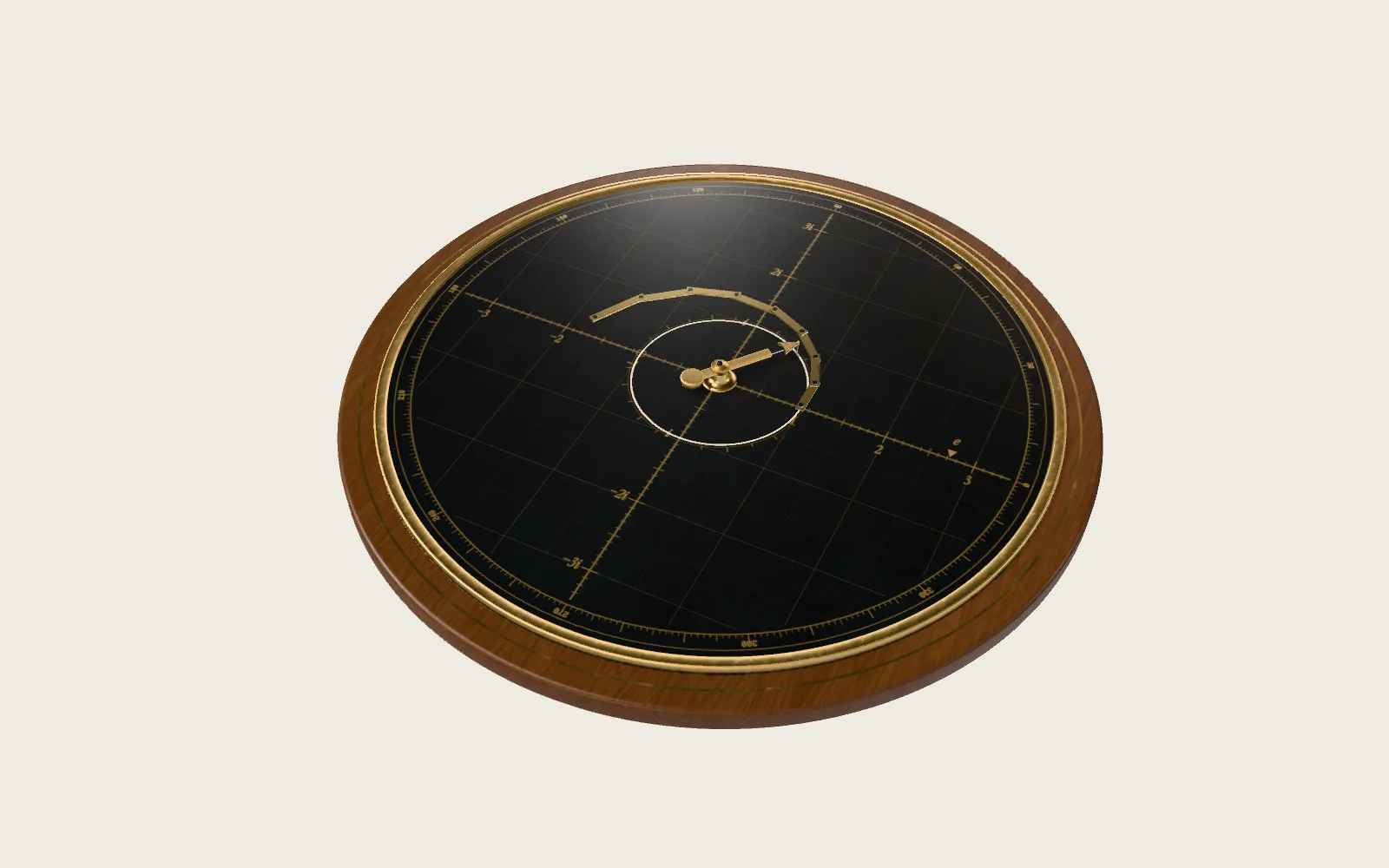 Plate M06Half a Turn Is e to the iπeⁱᵗ is a point walking round the unit circle at a steady pace, its velocity always i times its position. After time π it is at −1.
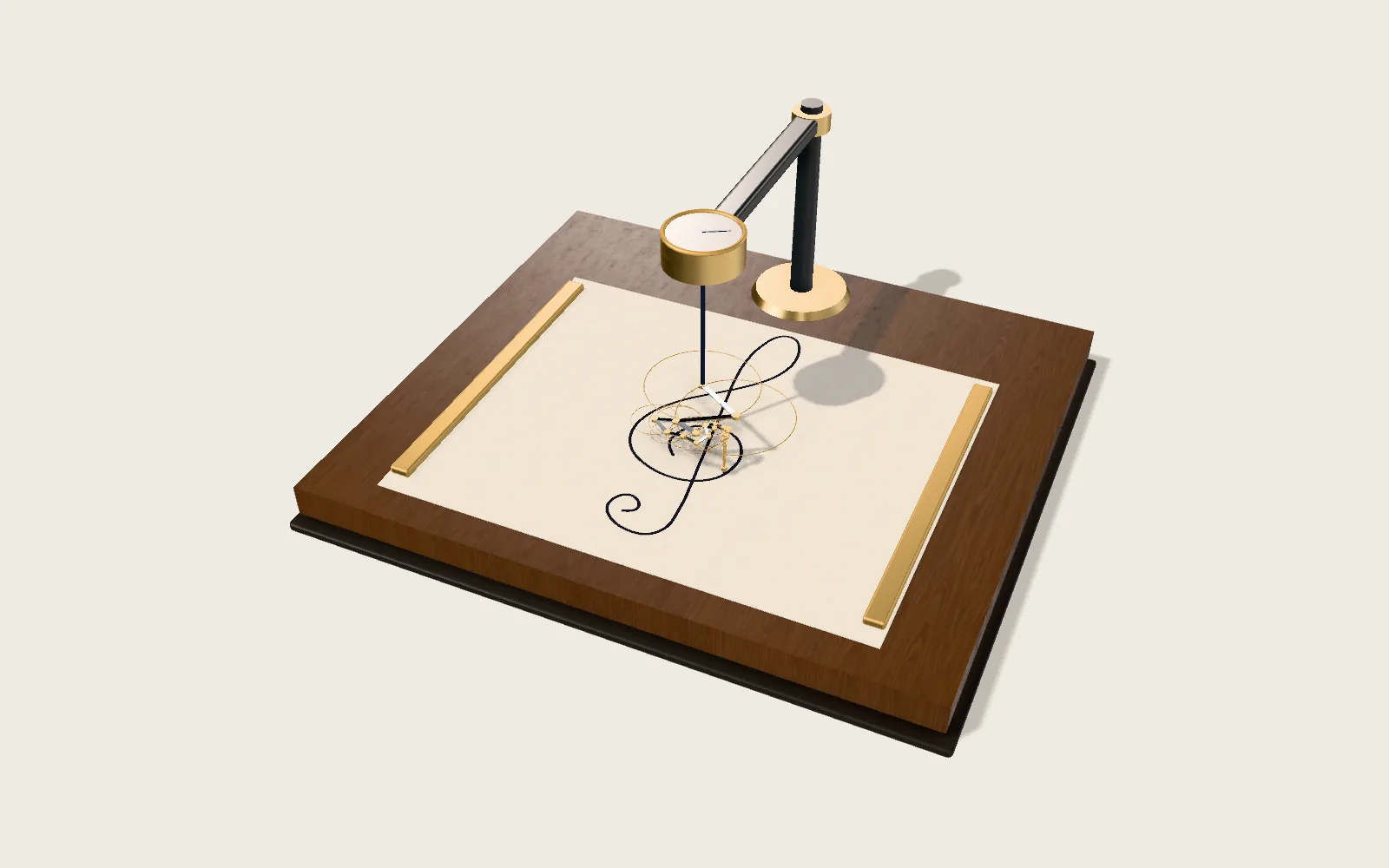 Plate M03Any Closed Line, Drawn by Turning CirclesA chain of arrows, head to tail, each turning at a whole-number speed: the last tip can draw any closed line.