Turbofan Engine
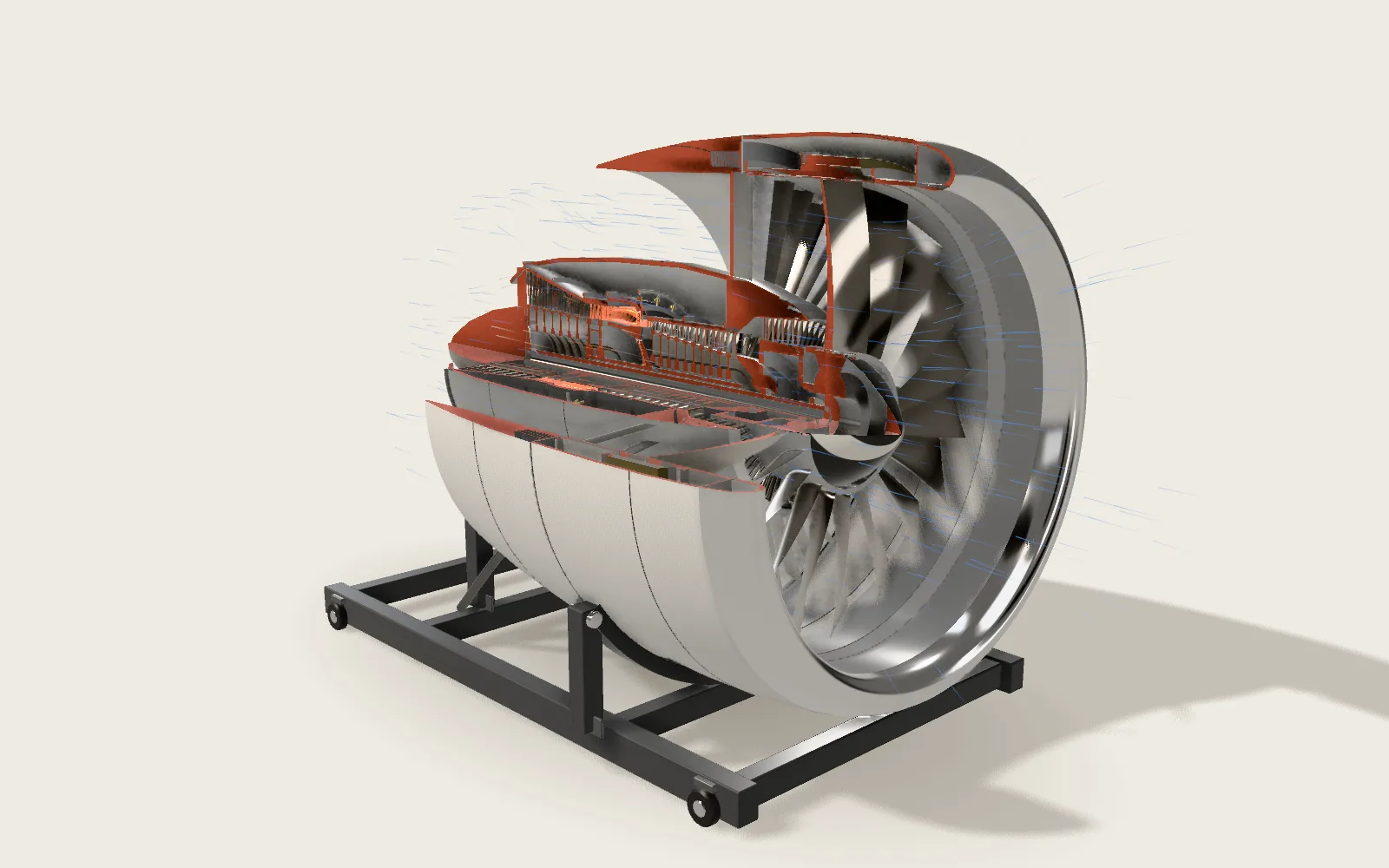
A high-bypass turbofan of the kind under a widebody’s wing, a quarter cut away: fan, ten-stage high-pressure compressor, annular combustor, two turbines. At take-off it swallows about 1.2 tonnes of air a second.
- Who it’s for
- Ages 13 to 18. Knowing that force is mass times acceleration helps; most of it works without.
- Time
- 15 or 40 minutes
- You need
- A computer online and a projector; tablets help for the hands-on part
CC BY-NC 4.0Teachers may copy, adapt and print this page and the plate for class, with credit to world.lapla.si.
01Learning goals
- Say where thrust comes from: the engine accelerates a great deal of air backwards, and the air pushes it forwards. In this engine about 85 % of the thrust comes from the bypass air the fan pushes.
- Name the parts the air passes through, in order, and what each stage does: compress, burn, expand.
- Explain why fans keep growing: pushing a lot of air gently uses less fuel than pushing a little air hard.
0215 minutes
To open or close a lesson: you project and talk it through.
- 0–3 min
Project “1.2 Tonnes of Air a Second”: at take-off the fan draws in about 1.2 tonnes of air a second, and its blade tips move faster than sound.
Chapter 011.2 Tonnes of Air a Second→ - 3–6 min
“Compress, Burn, Expand”: follow the air and point out what each stage does.
Chapter 02Compress, Burn, Expand→ - 6–10 min
“Most Thrust Comes from the Fan”: of every 10.5 kg of air, about 1 kg goes through the core. Ask: why is pushing a lot of air gently cheaper on fuel?
Chapter 03Most Thrust Comes from the Fan→ - 10–13 min
“Hotter than Melting”: the gas is hotter than the blade alloy’s melting point, yet the metal stays below it. Ask: how?
Chapter 09Hotter than Melting→ - 13–15 min
At the bench, pull the throttle back from “Take-off” to 80 % and see how much thrust is left.
Chapter 13Throttle→
0340 minutes
A whole lesson, with time for students to work the model and talk.
- 0–4 min
Open with a question: what pushes something as heavy as an airliner forwards? Then project “1.2 Tonnes of Air a Second”.
Chapter 011.2 Tonnes of Air a Second→ - 4–9 min
“Compress, Burn, Expand”: the air is squeezed about 44 times and the gas reaches about 1,430 °C; each turbine drives its own compressor or the fan.
Chapter 02Compress, Burn, Expand→ - 9–15 min
“Most Thrust Comes from the Fan”: thrust is the mass of air pushed back each second times the speed added to it. Students compare bypass and core: which stream is bigger, which faster?
Chapter 03Most Thrust Comes from the Fan→ - 15–19 min
“Cut Open”: students name the parts from front to back.
Chapter 04Cut Open→ - 19–23 min
“Two Shafts, Two Speeds”: the big fan must turn slowly, the small compressor fast.
Chapter 05Two Shafts, Two Speeds→ - 23–27 min
“Hotter than Melting”: single-crystal blades, cooling passages, a film of air and a ceramic coat.
Chapter 09Hotter than Melting→ - 27–30 min
“Throwing a Blade”: every engine type must pass a blade-out test before certification, and the case has to hold the pieces.
Chapter 10Throwing a Blade→ - 30–38 min
Hands-on: work the throttle as in the steps below and record the thrust and both shaft speeds.
Chapter 13Throttle→ - 38–40 min
“Real Engines”: set the model’s figures beside the GEnx-1B and the Trent 1000.
Chapter 11Real Engines→
04Questions to ask
Does a jet engine move by its exhaust “pushing on the air behind”?
A good answerNo. The engine accelerates air backwards, and the air pushes back on the engine: that reaction is the thrust. Most of it acts on the fan blades and the casings.
Where does most of this engine’s thrust come from?
A good answerThe fan. Of every 10.5 kg of air, only about 1 kg goes through the core; the rest goes round it. The bypass air leaves at only about 260 m/s, slower than the core jet, but there is far more of it, and it gives about 85 % of the thrust.
The turbine blades sit in gas hotter than their alloy’s melting point. Why don’t they melt?
A good answerIt is the gas that is that hot; the metal stays below its melting point. Cooling air runs through passages inside each blade and leaves through rows of small holes, laying a film of cooler air over the surface, and a ceramic coat about 0.25 mm thick covers it.
Why are the fan and the high-pressure compressor on two shafts turning at different speeds?
A good answerThe big fan must turn slowly to keep its tips in check; the small compressor must turn fast to do its work. The shafts are not geared together, so each finds its own speed: at take-off about 2,560 rpm for the fan’s shaft and about 11,400 for the other.
Pull the throttle back to 80 % N1. How much thrust is left, and why not 80 %?
A good answerThe model gives about 70 %. Thrust is the mass of air pushed back each second times the speed added to it. At lower speed the fan takes in less air and adds less speed to each kilogram of it, so the thrust falls faster than the fan speed.
05Hands-on
Ease the throttle: how much thrust goes?
- Go to the last chapter, “Throttle”, and push the throttle to “Take-off”. Write down “Thrust”, “N1 low-pressure shaft” and “N2 high-pressure shaft”.
- Pull it back to “80%” and write them down again. Work out what share of take-off thrust is left.
- Pull it back to “Idle” and look at the thrust and both shafts: what share of its take-off speed does each shaft keep?
- Push the throttle back to “Take-off” and read “Bypass thrust”: what share of the thrust comes from the air that goes round the core?
- Look at the “Airflow”: which air goes round the core, and which goes through the combustor and turbines?
Look forAt 80 % N1 the thrust is only about 70 % of take-off: thrust falls faster than fan speed. The two shafts keep their own speeds: at idle N1 keeps only about a fifth of its take-off speed, N2 about three-fifths. At take-off about 85 % of the thrust comes from the bypass air.
06Common misconceptions
The ideaA jet moves by its exhaust pushing on the air behind it.
What the plate showsThrust is the reaction of the air the engine accelerates backwards, and most of it acts on the fan blades and casings.
The ideaWith a high bypass ratio, the core hardly matters.
What the plate showsAll of the fan’s work comes from the core’s low-pressure turbine.
The ideaTurbine blades run above their melting point.
What the plate showsThe gas does. The metal itself stays below it, thanks to cooling and coatings.
The ideaThe fan-blade-out test is a failure demonstration.
What the plate showsIt is a test every engine type must pass to be certified.
07Sources
The plate’s own. Every fact on this page comes from the plate and these sources.
- EASA TCDS IM.E.102: GEnx (stages, take-off thrust, rotor speeds)
- GE Aerospace: GEnx (111.1 in fan, 18 composite blades, bypass ratio, pressure ratio)
- EASA TCDS E.036: Trent 1000 (three-shaft, 2.85 m, thrust)
- Rolls-Royce: Trent 1000 (over 85 % of thrust from the fan)
- Rolls-Royce: Trent 1000 infographic (20 blades, bypass ratio, pressure ratio)
- EASA TCDS IM.E.002: GE90-115B
- GE Aerospace: GE90
- GE Aerospace: GE9X (134 in fan, bypass ratio, pressure ratio)
- EASA TCDS E.111: Trent XWB
- EASA TCDS E.110: LEAP-1A
- EASA TCDS IM.E.093: PW1100G-JM (geared fan)
- Rolls-Royce (2012): single-crystal blades in gas up to 200 degrees above their alloy’s melting point
- The Naked Scientists: a Rolls-Royce metallurgist on turbine cooling (film cooling, thermal barrier coatings)
- BAM: solidus of CMSX-4
- T. M. Pollock, S. Tin (2006): Nickel-Based Superalloys for Advanced Turbine Engines, J. Propulsion and Power
- 14 CFR 33.94: blade containment and rotor unbalance tests
- EASA CS-E 810: compressor and turbine blade failure
- ACJ E 810 (JAR-E): conditions for the blade-out test
- NASA TM-2009-215784 (Guynn et al.): component efficiencies and T4 for turbofan cycles
- Georgia Tech AE 4451: turbofan performance notes
08Use it in class
This page and the plate’s text, pictures and models are licensed CC BY-NC 4.0. You may copy, print and adapt them, hand them out to students and share them with colleagues, as long as you credit world.lapla.si (Laplace’s Mini World).
They may not be sold or used for other commercial purposes. Third-party data and pictures listed on the plate keep their own licences.
The licence in full (CC BY-NC 4.0) ↗