The Wave That Hides in Deep Water
Out at sea it is almost impossible to notice. At the coast it can drown a town.
- Who it’s for
- Ages 10 to 15. Knowing that speed is distance divided by time is enough.
- Time
- 15 or 40 minutes
- You need
- A computer online and a projector; tablets help for the hands-on part
CC BY-NC 4.0Teachers may copy, adapt and print this page and the plate for class, with credit to world.lapla.si.
01Learning goals
- Tell a tsunami from a wind wave: a wind wave stirs a thin layer near the surface, while a tsunami moves the whole column of water, from the seafloor up.
- Explain why a tsunami is fast and low in deep water and grows tall only in the shallows.
- Know the warning signs and what to do: if the sea pulls back, if a strong or long earthquake is felt at the coast, or if there is a roar from the ocean, head for high ground or inland at once.
0215 minutes
To open or close a lesson: you project and talk it through.
- 0–2 min
Project the first chapter. Ask which dots in the cross-section are moving. Only a thin layer under the surface is.
Chapter 01Wind Stirs Only the Surface→ - 2–5 min
Turn to “The Seafloor Lurches”. Now every dot moves, from the seafloor to the surface. Ask: what is the difference between the two waves?
Chapter 02The Seafloor Lurches→ - 5–9 min
Tap the deep sea and read off the depth and the tsunami’s speed, then tap the shallows near the coast. Let the class put the rule into words: the deeper the water, the faster the wave.
Chapter 03As Fast as a Jet, and Nearly Invisible→ - 9–12 min
“Shallow Water Makes It Stand Up”: off this model coast, a wave under two meters high at sea grows to about six. Ask a student to explain it with “the back catches up with the front”.
Chapter 05Shallow Water Makes It Stand Up→ - 12–15 min
End on “When the Sea Pulls Back”. The class names the warning signs and the one thing to do: go to high ground or inland, without waiting for a warning.
Chapter 04When the Sea Pulls Back→
0340 minutes
A whole lesson, with time for students to work the model and talk.
- 0–5 min
Open with a question: what is the biggest wave you have seen, and what made it? Then project the first chapter and watch the dots turning only near the surface.
Chapter 01Wind Stirs Only the Surface→ - 5–10 min
“The Seafloor Lurches”: the seabed rises or drops within minutes and lifts all the water above it. Students show with their hands which water moves in a wind wave, and which in a tsunami.
Chapter 02The Seafloor Lurches→ - 10–18 min
In groups, tap two places in deep water and two in the shallows, write down the depth and the speed, and make a small table. Compare the groups’ tables.
Chapter 03As Fast as a Jet, and Nearly Invisible→ - 18–23 min
“Shallow Water Makes It Stand Up” and the next chapter, “Not One Wave but Many”: why the wave grows at the coast, and why the danger can last for hours or even days.
Chapter 05Shallow Water Makes It Stand Up→ - 23–28 min
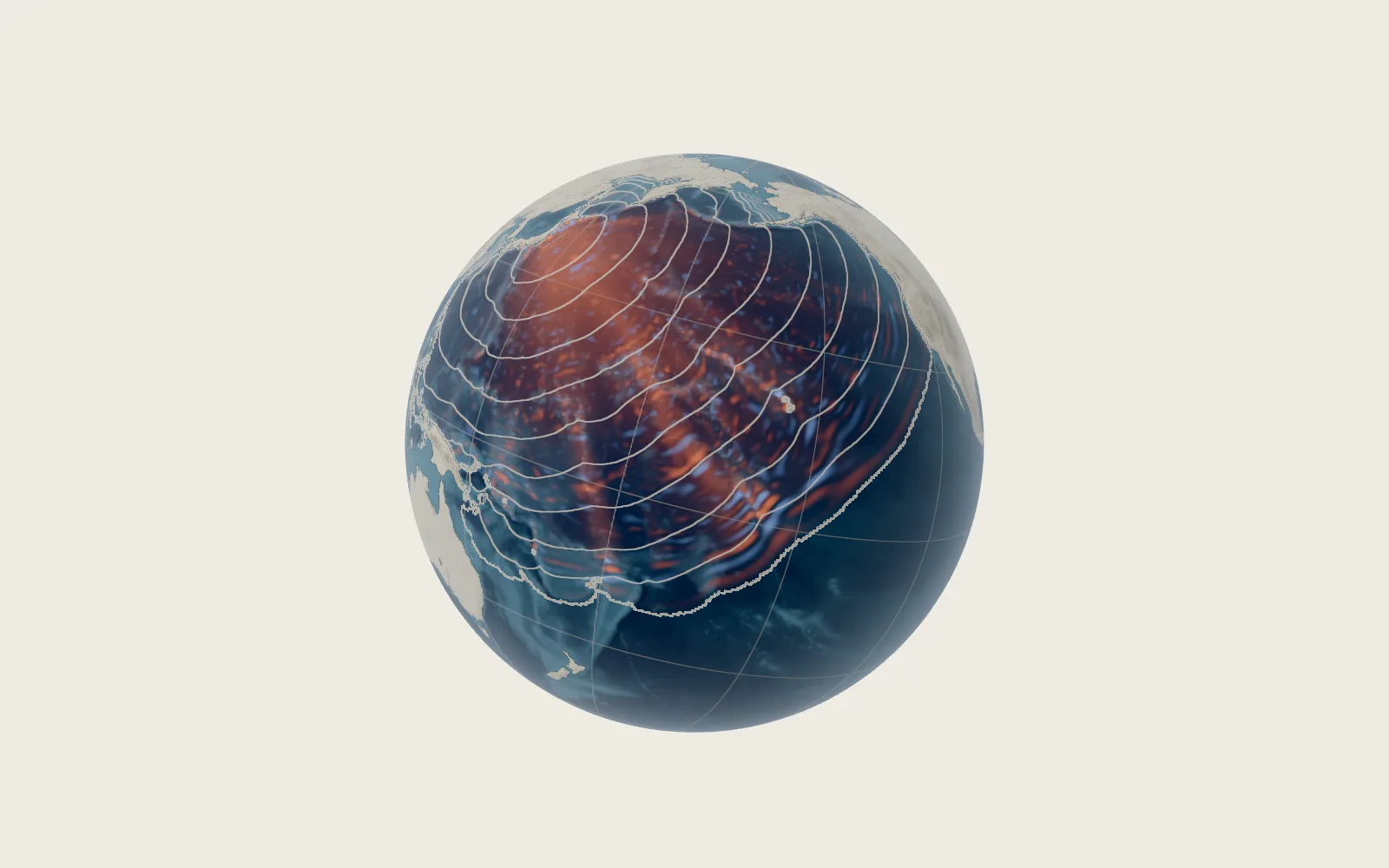
“March 11, 2011”: count the hours the tsunami took to reach Hawaii (the map shows the model’s arrival time). Point out that this wave is computed from the real seafloor and a simplified earthquake, so the heights on the map are not real local heights.
Chapter 07March 11, 2011→ - 28–36 min
At the bench, follow the hands-on steps below: with and without the landward side sinking, does the coast meet a crest or a trough first?
Chapter 08Your Turn→ - 36–40 min
Back to “When the Sea Pulls Back”: students say in their own words what to do at the coast.
Chapter 04When the Sea Pulls Back→
04Questions to ask
A ship far out at sea meets a tsunami. Why do the people on board usually notice nothing?
A good answerOut at sea the wave is rarely more than a meter high but hundreds of kilometers long, so its slope is very gentle. The ship is lifted and lowered slowly.
Where is a tsunami faster, in deep water or at the shore? By how much?
A good answerIn deep water, by far. Over water four kilometers deep it covers more than 700 kilometers an hour, about as fast as a jetliner. At the shore it is down to 30 to 50 kilometers an hour, the speed of a car in town.
Why does a tsunami grow taller in shallow water?
A good answerThe front reaches the shallows first and slows down, while the back is still in deep water, moving faster. The back catches up, the same water is squeezed into less and less distance, and it has nowhere to go but up.
At the beach, the sea suddenly drains away and leaves fish on the sand. What should you do?
A good answerTreat it as a tsunami: the trough may have arrived first. Don’t go down to look. Head for high ground or inland straight away, without waiting for a warning.
The first wave has gone back out. Is it safe to return to the beach?
A good answerNo. A tsunami is a series of waves; the first may not be the last or the largest, and the danger can last for hours or even days. Stay on high ground until officials say it is safe.
05Hands-on
Crest or trough first?
- Go to the last chapter, “Your Turn”, and press “Before the earthquake”.
- Turn “Landward side sinks” on and press “Another earthquake”. Watch the shore: does a crest (red) or a trough (blue) get there first?
- Press “Before the earthquake” again, turn “Landward side sinks” off and set off another earthquake. What arrives first this time?
- Set a smaller and then a larger “Earthquake size”, pressing “Another earthquake” after each, and compare the wave at the coast.
- Tap the sea in deep water and near the shore, and write down the depth and the tsunami’s speed each time.
Look forWhen the seafloor near land sinks, the coast meets a trough first: the sea drops before the first crest. Without the sinking, a crest comes first. The shallower the water, the lower the speed.
06Common misconceptions
The ideaA tsunami is a wall of water marching across the open ocean.
What the plate showsIn deep water it is low, long and nearly invisible. Its danger appears only in the shallows.
The ideaA tsunami is a “tidal wave”.
What the plate showsIts most common cause is a great earthquake under the sea. Tides have little to do with it.
The ideaA tsunami breaks on the beach and slides back, like any wave, and then it is over.
What the plate showsIt comes ashore like a fast-rising flood, and it comes as a series of waves. The first may not be the largest.
The ideaWhen the sea pulls back, it is safe to go down and look.
What the plate showsA sudden retreat can be the trough arriving first. It is the signal to head for high ground or inland at once.
07Sources
The plate’s own. Every fact on this page comes from the plate and these sources.
- NOAA: Tsunami propagation
- NOAA National Ocean Service: What is a tsunami?
- National Weather Service: During a tsunami
- NOAA Pacific Marine Environmental Laboratory: Honshu tsunami, March 11, 2011
- NASA Earth Observatory: Ten Years After the Tsunami (2021)
- USGS Hawaiian Volcano Observatory: the 2011 tsunami on the Island of Hawaiʻi
- Bates et al. (2010): the method the model uses
- Terrain Tiles on AWS Open Data
08Use it in class
This page and the plate’s text, pictures and models are licensed CC BY-NC 4.0. You may copy, print and adapt them, hand them out to students and share them with colleagues, as long as you credit world.lapla.si (Laplace’s Mini World).
They may not be sold or used for other commercial purposes. Third-party data and pictures listed on the plate keep their own licences.
The licence in full (CC BY-NC 4.0) ↗