Full-Flow Rocket Engine
The hard part of a rocket engine is not the burning but the pumping: hundreds of kilograms of liquid a second, forced into a chamber at 300 bar. In a full-flow staged-combustion engine all of the methane and all of the oxygen pass through a turbine first. This is a cutaway model at the size of SpaceX’s Raptor, lying on a horizontal test stand.
Scroll
A Pump with a Chamber
The gas in the chamber is at about 300 bar, the pressure three kilometres down in the sea. The propellants must be at a higher pressure still to get in.
By this page’s model, the engine takes in about 690 kg of propellant a second: about 150 kg of methane and 540 kg of liquid oxygen. The methane pump raises its methane to about 910 bar, the oxygen pump its oxygen to about 830 bar.
The two turbopumps make about 90 MW between them, close to the whole power of a large cruise ship, in two housings about a metre long.
Chamber 300 bar · propellant ≈ 690 kg/s · pump power ≈ 90 MW (this model)
Thrust from Pressure
The gas reaches the speed of sound at the throat, expands and speeds up in the bell, and leaves at about 3.3 km/s.
Thrust is chamber pressure times throat area, times a coefficient set only by the nozzle’s shape and the gas: F = CF · pc · At. Double the pressure and the same throat gives almost double the thrust.
At sea level the model gives about 2.25 MN, about 230 tonnes-force, at a specific impulse of about 334 s. SpaceX gives 230 tf for Raptor 2 and 280 tf for Raptor 3 (company statements).
F = CF · pc · At · Isp = F / (ṁ g0) · 2.25 MN · 334 s (model, sea level)
Five Ways to Feed an Engine
Pressure-fed: gas under pressure pushes the propellants out of their tanks; no pumps. The tanks must hold more than the chamber, so the chamber stays at a dozen bar or so.
Gas generator: a small stream of propellant burns to drive the turbine, and its exhaust is thrown away. The F-1 and the Merlin work this way, at about 70 to 100 bar. The stream thrown away gives little thrust.
Staged combustion: the turbine’s exhaust is not thrown away but sent on into the main chamber to finish burning. Russia’s RD-180 uses one oxygen-rich preburner, at about 257 bar; the Space Shuttle’s RS-25 fuel-rich preburners, at about 206 bar.
Full-flow staged combustion: two preburners, one fuel-rich and one oxygen-rich, and every kilogram of propellant passes through a turbine.
Chamber pressure each cycle can reach, by the model: pressure-fed ≈ 16 · gas generator ≈ 190 · fuel-rich staged ≈ 240 · oxygen-rich staged ≈ 250 · full flow ≈ 360 bar
All the Flow through the Turbines
All of the methane and a little oxygen burn in the fuel-rich preburner into methane-rich gas at about 600 °C, which drives the methane pump’s turbine.
All of the oxygen and a little methane burn in the oxygen-rich preburner into oxygen-rich gas at about 400 °C, which drives the oxygen pump’s turbine. Both gases go on into the main chamber, where the burning is finished.
With more gas through a turbine, each kilogram has less work to do, and the gas can be cooler. With a single fuel-rich preburner the same 300 bar needs gas at about 1,040 °C (model).
Turbine inlet: fuel-rich ≈ 870 K · oxygen-rich ≈ 670 K (full flow) | single fuel-rich preburner ≈ 1,310 K (model, 300 bar)
Cut Open
From the nozzle to the thrust plate: the regeneratively cooled bell, the chamber and throat with their copper-alloy liner, the main injector, the oxygen turbopump on the axis, the oxygen-rich preburner beside it, and above the engine the methane turbopump with its fuel-rich preburner on top.
The cut faces are painted red, as on museum cutaways. The lines, valves and harness follow the cycle; they are not drawn from the real engine’s drawings.
The arrangement of turbopumps and preburners is schematic; throat 0.23 m and exit 1.34 m at Raptor class
Two Shafts, Two Gases
Each turbopump is one shaft: a turbine at one end, a pump impeller and inducer at the other. The turbine gives exactly the power the pump takes: the engine’s power balance.
The turbines let the gas down from about 720 bar to about 360 bar, into the injector. The pumps must deliver more than the turbines take in, so each extra bar in the chamber costs two or three at the pumps.
The oxygen pump’s turbine runs in oxygen-rich gas, the methane pump’s in methane-rich gas. Each shaft touches only one propellant, so no seal is needed to keep oxygen and methane apart on the same shaft.
Methane side ≈ 40 MW · oxygen side ≈ 49 MW · turbine pressure ratio 2 (model)
Gas Meets Gas
The face of the main injector is set with rings of coaxial elements. What arrives from the two preburners is already gas: oxygen-rich gas through the centre of each element, methane-rich gas round it.
Gas mixes with gas far faster than droplets can boil and mix, so the burning is more complete and steadier.
Oxygen-rich gas straight down from the turbine on the axis; methane-rich gas through the hot duct into the outer manifold
Hotter than Copper Melts
The chamber gas is at about 3,770 K, about 3,500 °C. The liner is a copper alloy, which melts at about 1,085 °C.
Fine channels are milled into the back of the liner. Cold methane enters at a manifold half-way down the nozzle, runs along the channels all the way to the top of the chamber, carrying the heat away, and goes on to the preburner. This is regenerative cooling: the heat is not lost but goes back into the propellant.
The section shows three layers: the copper liner, the lands between the channels, the steel jacket outside.
Tc ≈ 3,770 K (model) · copper melts at about 1,085 °C · coolant: methane
Sea-Level Bell, Vacuum Bell
The ratio of the nozzle’s exit area to its throat area is the expansion ratio. The sea-level engine’s is about 34, its exit about 1.34 m across, and the gas leaves at about the pressure of the air at sea level.
The vacuum engine’s bell is much larger, an expansion ratio of about 80 (an unofficial figure), and gains a dozen seconds or more of specific impulse in vacuum. Fired at sea level, its gas would be over-expanded and torn off the wall before the exit, and the side loads could wreck the bell.
This page’s model: the sea-level engine about 355 s in vacuum, the vacuum engine about 371 s. SpaceX gives about 350 s and about 380 s (company statements).
ε 34 → exit 1.34 m · ε 80 → 2.06 m · exit pressure pe against ambient pa
Why Methane
Kerosene cokes in fuel-rich gas, leaving carbon that clogs turbines and lines, which is why kerosene engines rarely run fuel-rich staged. In NASA’s tests, liquid-oxygen and methane gas generators left no carbon at any mixture ratio tested.
Methane boils at 111.7 K, close to liquid oxygen’s 90.2 K, so the two tanks can share a bulkhead. It is far denser than liquid hydrogen (about 422 kg/m³), so the tanks are small.
Methane can also be made on Mars from carbon dioxide and water (the Sabatier reaction), one of SpaceX’s reasons for choosing it.
Liquid methane 422 kg/m³ · 111.7 K | liquid oxygen 1,141 kg/m³ · 90.2 K (NIST)
Sixty Years to Fly
The Soviet Glushko bureau’s RD-270 was the first full-flow engine, burning UDMH and nitrogen tetroxide at about 261 bar. Between 1967 and 1969, 22 engines were fired 27 times; it stopped with the UR-700 moon rocket and never flew.
In 2006 the Integrated Powerhead Demonstrator (IPD), built by Rocketdyne and Aerojet for NASA and the US Air Force (hydrogen and oxygen, about 1.1 MN), reached full power at Stennis.
SpaceX’s Raptor reported 268.9 bar in February 2019 and 330 bar in August 2020. In 2024 SpaceX gave Raptor 1 to 3 as 185, 230 and 280 tf at sea level, with engine masses of 2,080, 1,630 and 1,525 kg (company statements).
RD-270 (1967–69) → IPD (2006) → Raptor 1 / 2 / 3 (2019–)
Taken Apart
The parts slide apart along the engine’s axis. Rest the pointer on one and it is lifted out on its own and named.
Test Stand
Open the throttle; change the chamber pressure, the mixture ratio and the expansion ratio; swap the bell and the cycle. Thrust, specific impulse, both turbopumps’ power and the turbine temperatures come from the model as you go; a cycle past its temperature limit turns red.
Try thisSwitch the cycle to fuel-rich staged combustion: how hot must its turbine run at 300 bar, and why does full flow run so much cooler?
What the model leaves out
This is a generic full-flow engine at Raptor’s size, not Raptor itself: the turbopumps, preburners, valves and lines are arranged to show the cycle. Performance uses the ideal-rocket relations: chamber temperature, molar mass and characteristic velocity come from an equilibrium table computed with Cantera from NASA’s CEA thermodynamic data; the nozzle uses one fitted effective ratio of specific heats; c* efficiency 0.98, nozzle efficiency 0.985; an over-expanded bell whose exit pressure falls below 0.4 of the ambient counts as separated (Summerfield’s criterion). Turbopumps: pump efficiency 0.75, turbine efficiency 0.8, every staged turbine at a pressure ratio of 2, preburner gas burnt completely and frozen; turbine inlet limits taken as 1,100 K fuel-rich and 800 K oxygen-rich; a gas generator may take at most 3 % of the propellant; a pressure-fed tank at most 25 bar; injector drop 20 % of chamber pressure, cooling channels 25 %. Every cycle is compared on methane and oxygen (the F-1 and RD-180 burn kerosene, the RS-25 hydrogen). The turbine temperatures are what the cycle balance gives, not a real engine’s data: Raptor’s preburner temperatures and pump powers are not public. Spin is shown much slowed.
Common misconceptions
A rocket does not move by its exhaust pushing on the air behind it: thrust is the sum of the gas pressure on the chamber and nozzle walls, and it is there in vacuum too, larger. “Full flow” does not mean the propellants burn up in the preburners: each preburner burns only a little, and most of the burning happens in the main chamber. A high chamber pressure is not about burning “harder”: for an engine of the same size, a higher pressure gives more thrust and lets the nozzle be more compact or expand further. SpaceX’s 350 s for the sea-level engine is its specific impulse in vacuum, not at sea level.
Common questions · 4
- What is full-flow staged combustion?
Full-flow staged combustion: two preburners, one fuel-rich and one oxygen-rich, and every kilogram of propellant passes through a turbine.
03Five Ways to Feed an Engine ↑- Why is no seal needed between the two propellants?
The oxygen pump’s turbine runs in oxygen-rich gas, the methane pump’s in methane-rich gas. Each shaft touches only one propellant, so no seal is needed to keep oxygen and methane apart on the same shaft.
06Two Shafts, Two Gases ↑- The chamber is hotter than copper melts. Why doesn’t the liner melt?
Fine channels are milled into the back of the liner. Cold methane enters at a manifold half-way down the nozzle, runs along the channels all the way to the top of the chamber, carrying the heat away, and goes on to the preburner.
08Hotter than Copper Melts ↑- Why methane rather than kerosene?
Kerosene cokes in fuel-rich gas, leaving carbon that clogs turbines and lines, which is why kerosene engines rarely run fuel-rich staged. In NASA’s tests, liquid-oxygen and methane gas generators left no carbon at any mixture ratio tested.
10Why Methane ↑
Sources
- SpaceX (X, 2024-08-03): Raptor 3 thrust, Isp, mass (company statement)
- SpaceX (X, 2024-08-03): Raptor 1 / 2 / 3 comparison (company statement)
- E. Musk (X, 2019-09-09): sea-level Raptor’s vacuum Isp about 350 s, about 380 s with the vacuum nozzle (company statement)
- E. Musk (X, 2020-08-17): 330 bar (company statement)
- E. Musk (X, 2020-08-18): maximum about 225 t, minimum about 90 t (company statement)
- Universe Today (2019-02): 268.9 bar, past the RD-180
- Spaceflight Now (2026-05-12): Raptor 3 flight ratings on Starship V3
- NASA MSFC (Betts): Waking a Giant, F-1 engine data
- Glavkosmos / NPO Energomash: RD-180
- Pratt & Whitney: RD-180 fact sheet
- L3Harris: RS-25 spec sheet (2024)
- lpre.de: RD-270
- Sass et al. (2004, NASA Stennis): IPD oxidiser turbopump testing
- NASA / AFRL (2006): IPD reaches full power
- Bossard et al. (NASA): carbon deposition in LO2/methane gas generators
- NIST Chemistry WebBook: methane saturation properties
- NIST Chemistry WebBook: oxygen saturation properties
- NASA SP-125 (Huzel, Huang): Design of Liquid Propellant Rocket Engines
- NACA Report 1135: Equations, Tables and Charts for Compressible Flow
- G. P. Sutton, O. Biblarz: Rocket Propulsion Elements (9th ed., ch. 3, the ideal rocket)
- NASA CEA (Chemical Equilibrium with Applications)
- Cantera
Data
Combustion tables computed with Cantera (cantera.org, BSD licence) from NASA’s CEA thermodynamic data (McBride, Zehe & Gordon, NASA TP-2002-211556). The plume shader follows the exhaust plume of AirsupHQ/machine-skill (github.com/AirsupHQ/machine-skill), MIT licence, © 2026 Air Supply Technologies Inc.; the section caps come through the site’s turbofan plate from the same project. The engine model, the cycle model, the figures it gives and the words are the site’s own.
The text, pictures and models on this page are licensed CC BY-NC 4.0: free to use and adapt for teaching and other non-commercial purposes, with credit to world.lapla.si. Third-party material listed above keeps its own licence.
Cite this plate
Laplace’s Mini World, Plate F16, “Full-Flow Rocket Engine”, https://world.lapla.si/en/raptor/, CC BY-NC 4.0, updated 2026-10-17.
Follow the question
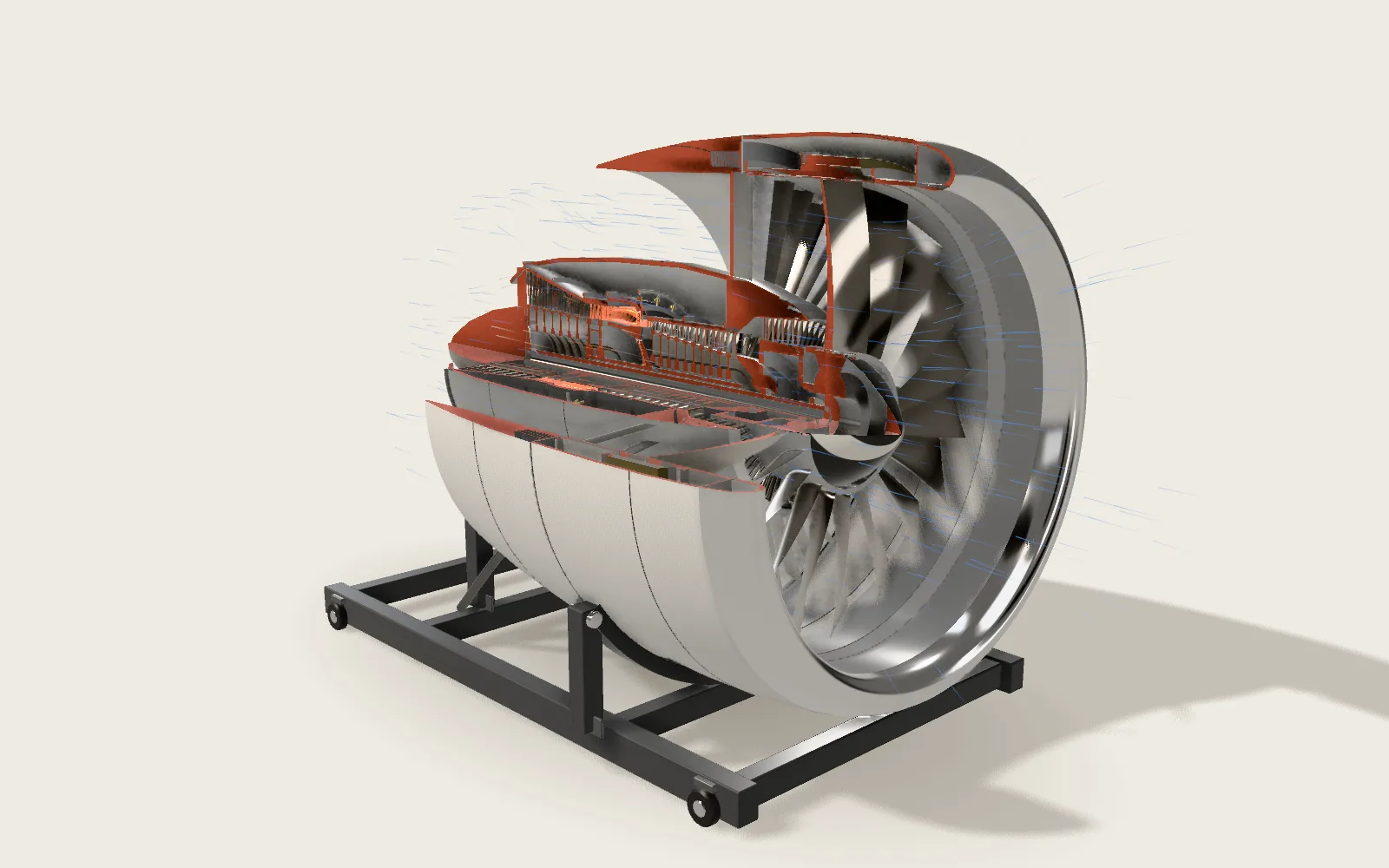 Plate F07Turbofan EngineA high-bypass turbofan of the kind under a widebody’s wing, a quarter cut away: fan, ten-stage high-pressure compressor, annular combustor, two turbines. At take-off it swallows about 1.2 tonnes of air a second.
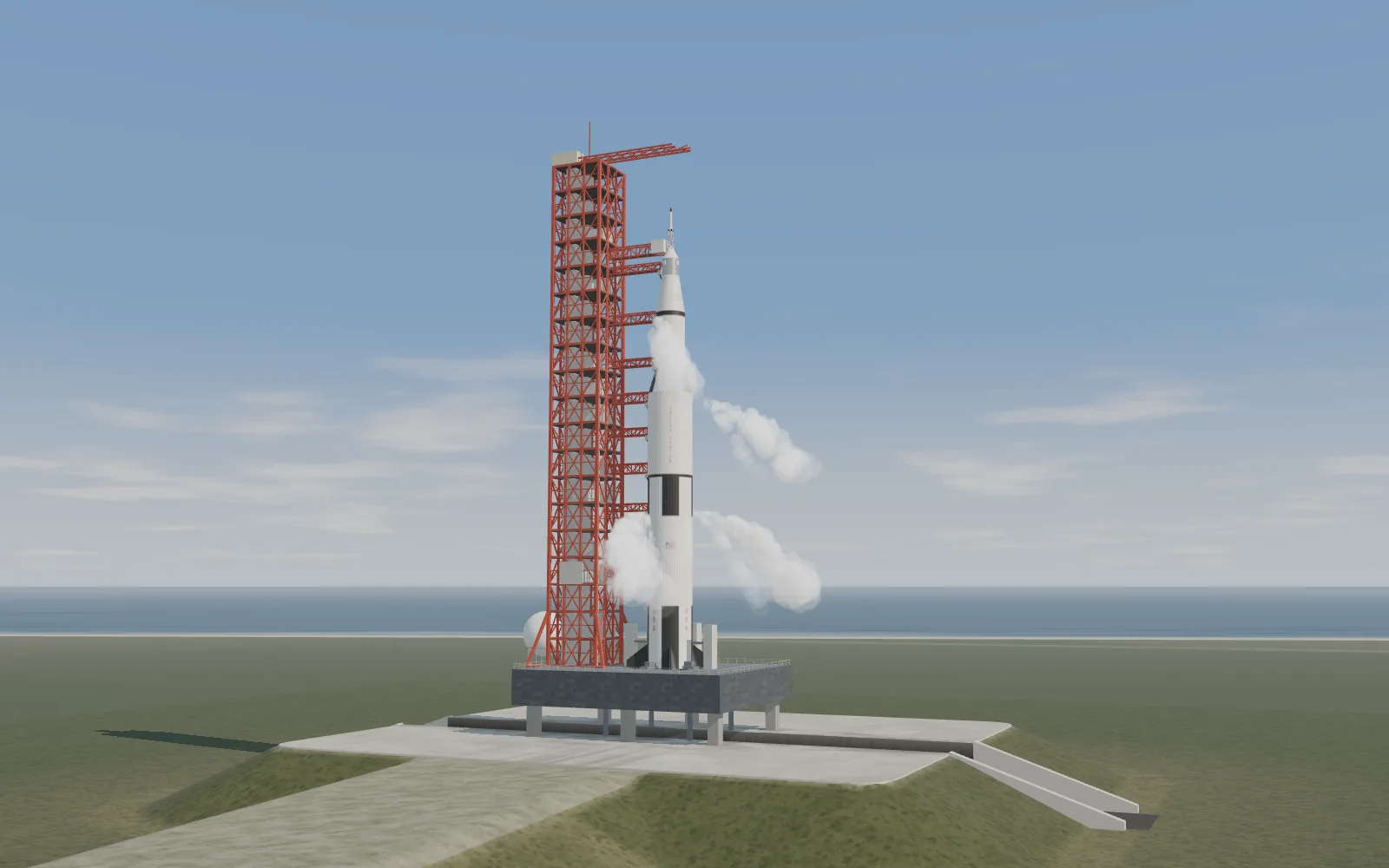 Plate 27What Pushes a RocketA rocket doesn’t push against the air. It throws a large part of itself backwards very fast, and the rest of it is pushed forwards.
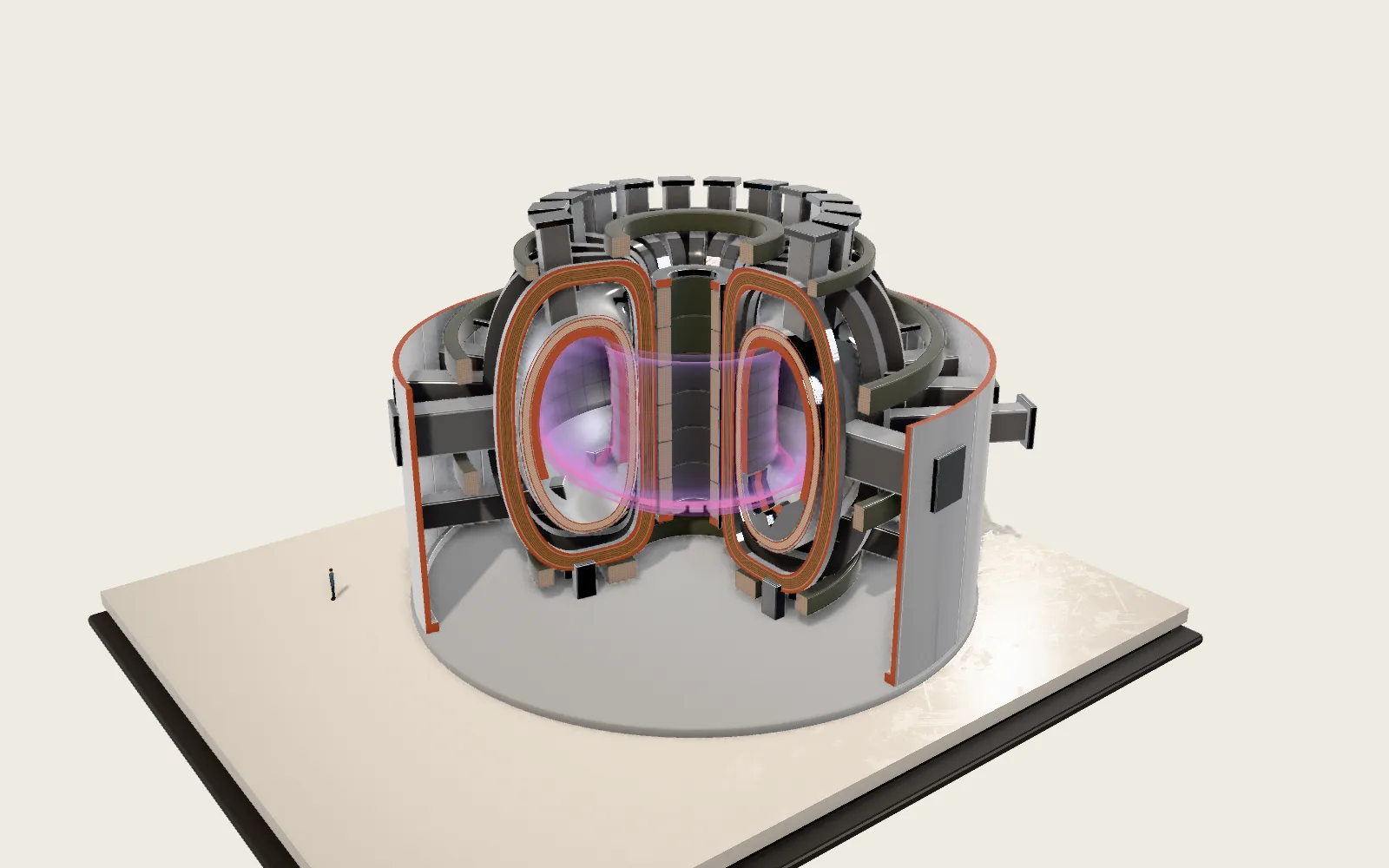 Plate F06Tokamak Fusion ReactorA tokamak like ITER: eighteen D-shaped superconducting coils round a ring-shaped vacuum vessel, inside which a deuterium–tritium plasma at about 150 million degrees hangs in a magnetic field.