The Fourth Direction
Three dimensions have five regular solids, four have six regular polytopes, and every dimension above that has only three. This model builds their projections into our space from brass struts and steel nodes, and shows their slices in coloured glass.
Scroll
Flatland
In 1884 Edwin Abbott published Flatland under the pen name “A Square”. Its narrator lives in a plane and knows only points, lines and polygons. A Sphere visits and passes through his plane, and what he sees is a circle: it appears, grows, shrinks again and vanishes.
He sees a series of the sphere’s sections. When a three-dimensional thing passes through a two-dimensional world, the people there see only the slice where it meets their plane.
The tank shows the same thing. A cube hangs corner down and sinks slowly into the water. The surface is the plane; the shape it cuts is first a triangle, a regular hexagon halfway, then a triangle again. Lowered face first, the cube would cut a square all the way.
From a Point to a Tesseract
Drag a point in some direction and you get a segment; drag the segment as far in a direction at right angles and you get a square; drag the square in a third such direction and you get a cube. Each drag doubles the corners: 1, 2, 4, 8.
This is how the Sphere explains the cube to the Square in the book. The Square carries on: a cube dragged in a fourth direction should have 16 corners and be bounded by 8 cubes.
That is the tesseract: 16 vertices, 32 edges, 24 squares, 8 cubes. Charles Howard Hinton named it in 1888, in A New Era of Thought, spelled “tessaract”; it later became “tesseract”.
Unfolding It
A cube’s six faces can be cut and laid flat as a cross. A tesseract’s eight cubes can be laid out too, only into three-dimensional space.
On the model, the bottom cube stays put. Each of its six neighbours turns 90° about the square it shares with it, and the turn happens in a plane that contains the fourth direction; the eighth cube hangs from one of them and turns with it. The result is a cross: a column of four cubes with four more around the second.
Salvador Dalí’s 1954 painting Crucifixion (Corpus Hypercubus), now in The Metropolitan Museum of Art in New York, shows such a cross; it is described here, not reproduced. A paper net of a cube folds back into a cube; this cross folds back only in four dimensions.
Six Regular Polytopes
Between 1850 and 1852 the Swiss mathematician Ludwig Schläfli wrote Theorie der vielfachen Kontinuität, proving that four-dimensional space has exactly six regular polytopes. Only parts appeared in his lifetime; the whole was published in 1901. In 1880 Washington Irving Stringham in the United States found the same six on his own and published the first drawings of them.
They are the 5-cell, the 8-cell (the tesseract), the 16-cell, the 24-cell, the 120-cell and the 600-cell, named for their cells, the regular solids that bound them. The Schläfli symbol {p, q, r} means: the cells are {p, q}, and r cells meet round each edge.
Each satisfies V − E + F − C = 0 (vertices, edges, faces, cells). The 24-cell is the one with no counterpart in three dimensions: its cells are octahedra, three round each edge.
A Hyperplane Passes Through
When a four-dimensional object passes through our space, what we can see is a series of three-dimensional sections, as the Square saw a series of circles. Every section is a convex solid, and its shape changes as it goes.
A tesseract coming corner first: a small regular tetrahedron appears, grows, has its corners cut off and becomes a truncated tetrahedron, is an octahedron at the middle, then goes back the same way. In the tank, the cube, also corner first, cuts a triangle, a hexagon, a triangle.
On the model, the amber glass is the section; the brass struts are the part still on one side of the hyperplane, and the blued-steel ones have passed to the other side, as if under water.
Sections in Card
Alicia Boole Stott (1860–1940) was the daughter of the mathematician George Boole and of Mary Everest Boole. She worked out the three-dimensional sections of the regular four-dimensional polytopes on her own, and built them as card models.
In 1900 she published series of sections of the 120-cell and the 600-cell in the proceedings of the Royal Academy of Sciences in Amsterdam. For the 120-cell, the hyperplanes are parallel to a cell, and the first section is a whole regular dodecahedron. She worked with the Groningen mathematician Pieter Hendrik Schoute for about twenty years, and received an honorary doctorate from the University of Groningen in 1914. She also brought the word “polytope” into English.
The eight card models on the rail below are computed the same way: the 120-cell, the hyperplane parallel to a cell, through each layer of vertices down to the middle. Her own models are kept today at the University Museum Groningen.
Perspective: the Schlegel Diagram
The other way to look is to project. Put the eye out in the fourth direction, just outside one cell, and draw what it sees in perspective into three dimensions: cells near the eye come out large, cells far away small.
With the eye close enough to that cell, it becomes the outer frame, and every other cell is drawn inside it with none overlapping. This is a Schlegel diagram. For the tesseract it is a large cube with a small one inside, each pair of faces joined by a distorted cube.
The Schlegel diagram of the 120-cell: one regular dodecahedron outside, the other 119 packed in. In four dimensions they are all the same size; they shrink only because they are farther from the eye.
Stereographic Projection
The vertices of all six polytopes lie on a three-dimensional sphere (the unit sphere of four-dimensional space). Replace each edge by an arc of a great circle on that sphere, and project from a point of the sphere outwards: this is stereographic projection.
It keeps angles and takes circles to circles: every edge becomes an arc, every cell a swollen bubble. The cell around the point of projection turns inside out to become the outside; the cell opposite lands in the middle.
The projection magnifies near the point of projection. On the model the struts thicken in the same proportion, so what you see is the true image of struts of even thickness on the sphere; the parts that would be too far out are cut away.
Turning in a Plane
A rotation in three dimensions turns about an axis. A rotation in four dimensions turns a plane, and the plane at right angles to it stays fixed. The four axes make six planes in pairs, so there are six basic rotations.
Turn a tesseract in a plane that contains the fourth direction and its projection seems to turn itself inside out: the small inner cube moves to the outside, the outside comes in. Nothing passes through anything in four dimensions; the projection only draws the far side small and the near side large.
Four-dimensional space also allows turning in two perpendicular planes at once (a double rotation). At equal speeds, every point except the centre turns through the same angle, and no point stays still.
Only Three From Five Dimensions Up
Why five in three dimensions and six in four? In four dimensions at least three cells must meet round each edge, and their dihedral angles must add up to less than 360° for them to close up. The tetrahedron’s is 70.53°, so three, four or five fit; the cube’s 90°, the octahedron’s 109.47° and the dodecahedron’s 116.57° allow three each; the icosahedron’s 138.19° makes three already more than 360°. Six in all.
In five dimensions, four-dimensional cells meet round each face. The 5-cell’s dihedral angle, 75.52°, allows three or four; the tesseract’s 90°, three; the 16-cell and 24-cell have 120°, and three make exactly 360°, which lies flat; the 120-cell’s 144° and the 600-cell’s 164.48° do not fit at all. Three remain, the simplex, the hypercube and the cross-polytope, and every dimension after has just these three.
Schläfli wrote the condition as one inequality: {p, q, r} exists exactly when sin(π/p)·sin(π/r) > cos(π/q). Equality gives a honeycomb that fills space, such as {4, 3, 4}, cubes stacked.
The Bench
Choose a polytope and a projection, turn it in any of the six planes, or stop it. In orthographic and perspective view, move the hyperplane to see the section; in stereographic view the struts become arcs.
Try thisOn the bench, take the tesseract in orthographic view and move the slice from a corner: which shapes come and go, and why is the middle one an octahedron?
What the model leaves out
A four-dimensional object does not fit in three dimensions; everything on the model is a projection. The struts and nodes sit where the edges and vertices land after projection, and lengths and angles are distorted by it. In perspective and orthographic view the struts are all equally thick, like a built model; in stereographic view their thickness follows the magnification, and the parts that come too close to the point of projection, and too large, are cut away. The glass of the section and the blued “under water” struts are colours added to make things readable. The water in the tank is a tinted veil, without refraction. The cards on the rail are computed by Boole Stott’s method, not copies of her models. Dalí’s painting is described, not reproduced.
Easy to misread
In the Schlegel diagram of the tesseract the small cube in the middle is no smaller than the outer one: all eight cells are the same size in four dimensions, and the distortion comes only from the projection. Nothing passes through anything when it turns in four dimensions. A section is not a projection: the section is where the hyperplane meets the polytope, the projection is the shadow of all of it. In Flatland the visitor is a sphere, not a cube; the book mentions the cube when it counts the corners of a point, a line, a square and a cube. The word “polytope” was coined by Hoppe in 1882; Boole Stott brought it into English.
Sources
- E. A. Abbott (A Square), Flatland: A Romance of Many Dimensions, Seeley & Co., 1884 (Project Gutenberg text)
- C. H. Hinton, A New Era of Thought, Swan Sonnenschein, 1888 (scan; chapter “Genesis of a Tessaract”)
- MacTutor, Ludwig Schläfli (University of St Andrews)
- W. I. Stringham (1880), Regular figures in n-dimensional space, American Journal of Mathematics 3: 1–14
- MacTutor, Washington Irving Stringham
- MacTutor, Alicia Boole Stott
- A. Boole Stott (1900), On certain series of sections of the regular four-dimensional hypersolids, Verhandelingen der Koninklijke Akademie van Wetenschappen te Amsterdam 7 (as described by T. Phillips, AMS Feature Column)
- University Museum Groningen, Knutselen met dimensies (Boole Stott’s card models)
- I. Polo-Blanco, J. González-Sánchez (2010), Four-dimensional polytopes: Alicia Boole Stott’s algorithm, The Mathematical Intelligencer 32(3)
- H. S. M. Coxeter, Regular Polytopes (Methuen 1948; Dover 3rd ed. 1973), prefaces
- The Metropolitan Museum of Art, Salvador Dalí, Crucifixion (Corpus Hypercubus), 1954, 55.5
- MathWorld, Regular Polychoron (Schläfli’s condition)
- J. Leys, É. Ghys, A. Alvarez, Dimensions (film; chapters 3 and 4 on the regular polytopes)
Data
Every strut, section and card on the model is computed for this page from the exact vertex sets of the six polytopes (circumradius 1), turned by true rotations of four-dimensional space. History after the MacTutor History of Mathematics archive (University of St Andrews), E. A. Abbott’s Flatland (Project Gutenberg), and the University Museum Groningen. Dalí’s Crucifixion (Corpus Hypercubus), 1954, The Metropolitan Museum of Art, is described, not shown. The card sections follow the series Alicia Boole Stott published in 1900; the cards on the rail are our own, computed, not copies of her models.
The text, pictures and models on this page are licensed CC BY-NC 4.0: free to use and adapt for teaching and other non-commercial purposes, with credit to world.lapla.si. Third-party material listed above keeps its own licence.
Watch next
The player comes from YouTube and loads only when you press play.
Follow the question
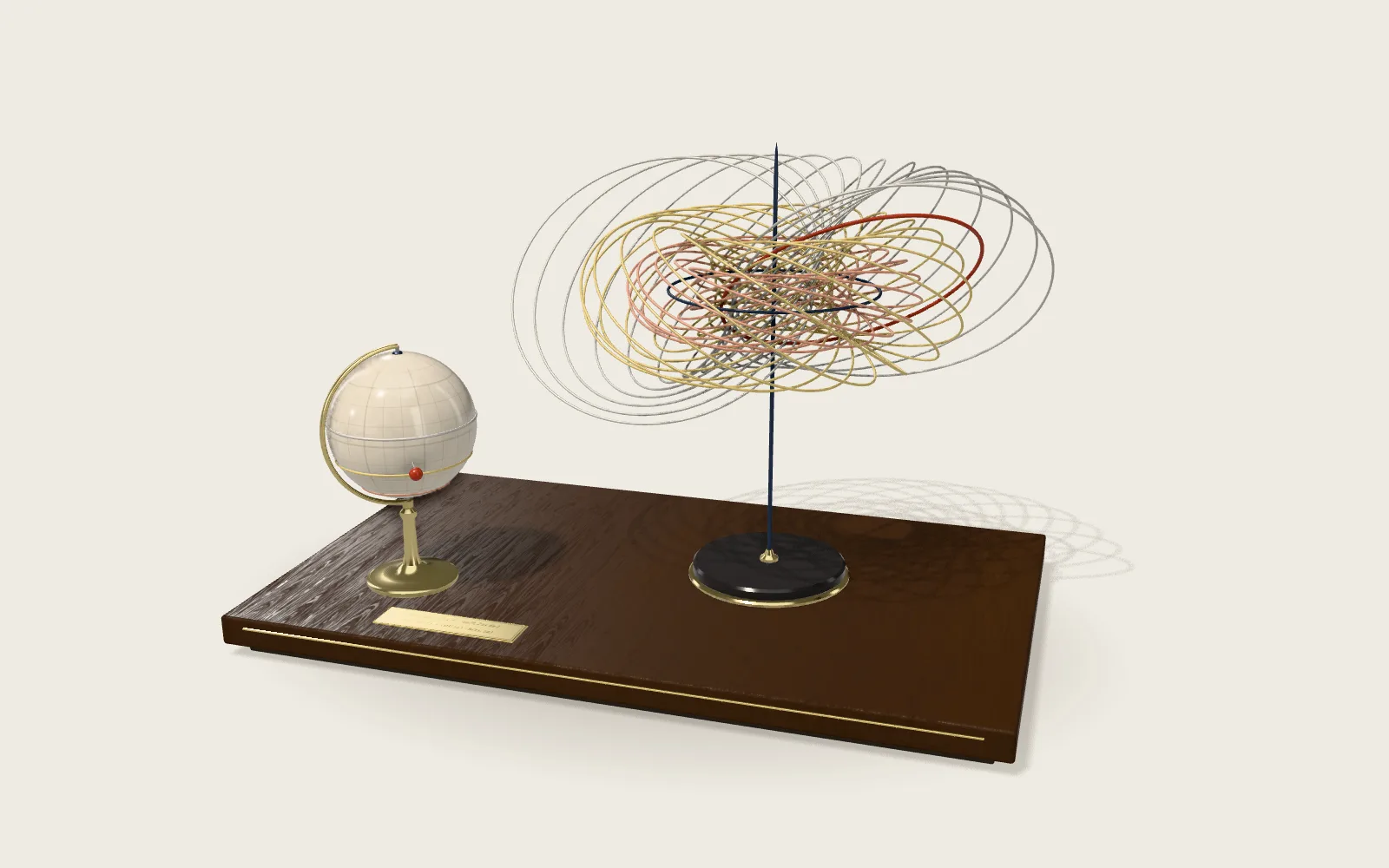 Plate M12Every Two Circles LinkedThe three-dimensional sphere in four-dimensional space falls apart into circles that never meet, one for each point of an ordinary sphere. Projected into three dimensions, every two of them are linked.
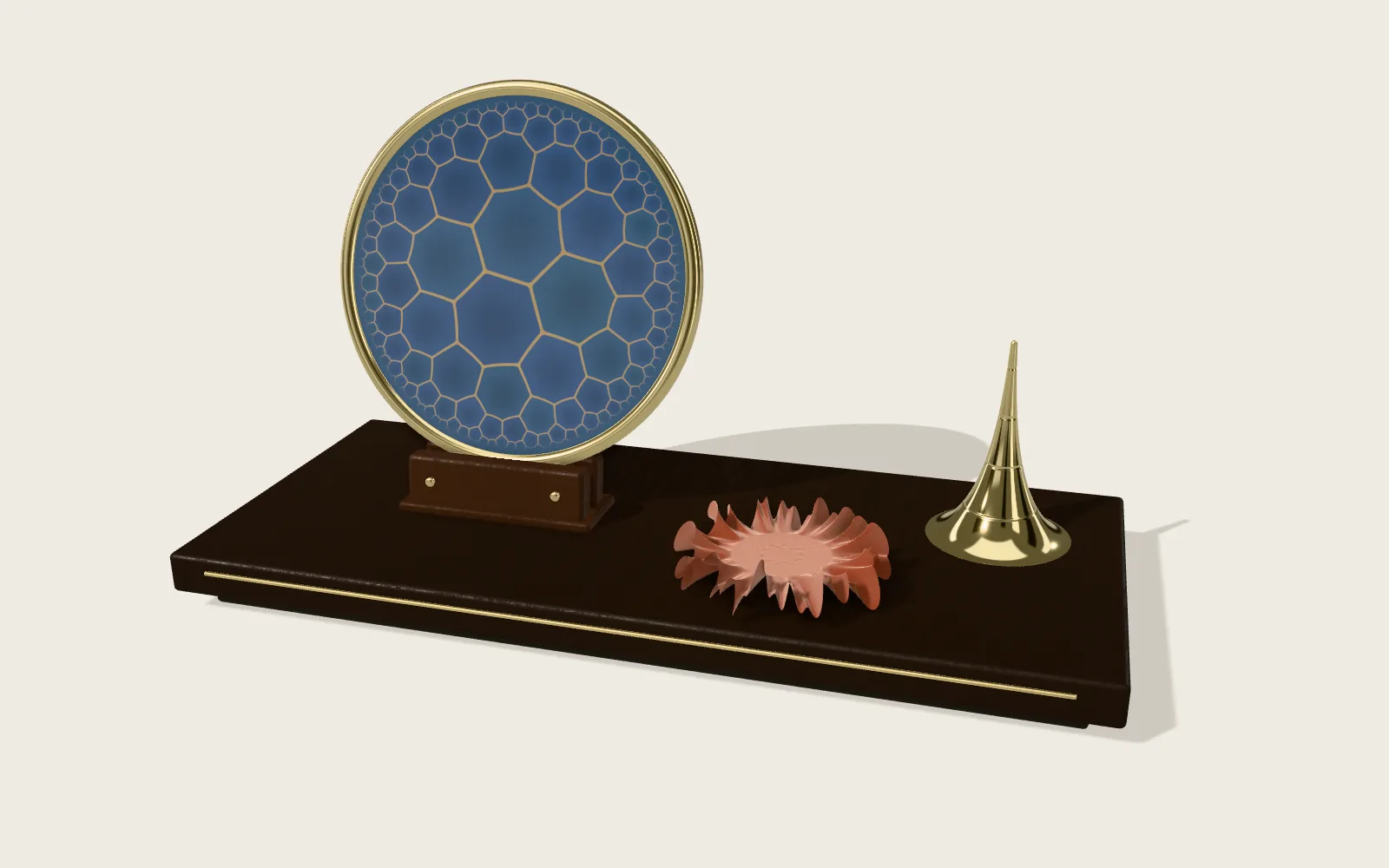 Plate M16More Than One ParallelReplace Euclid’s fifth postulate by “through a point off a line there is more than one parallel”, and you get a world just as consistent: triangles add up to less than 180°, and space grows exponentially.