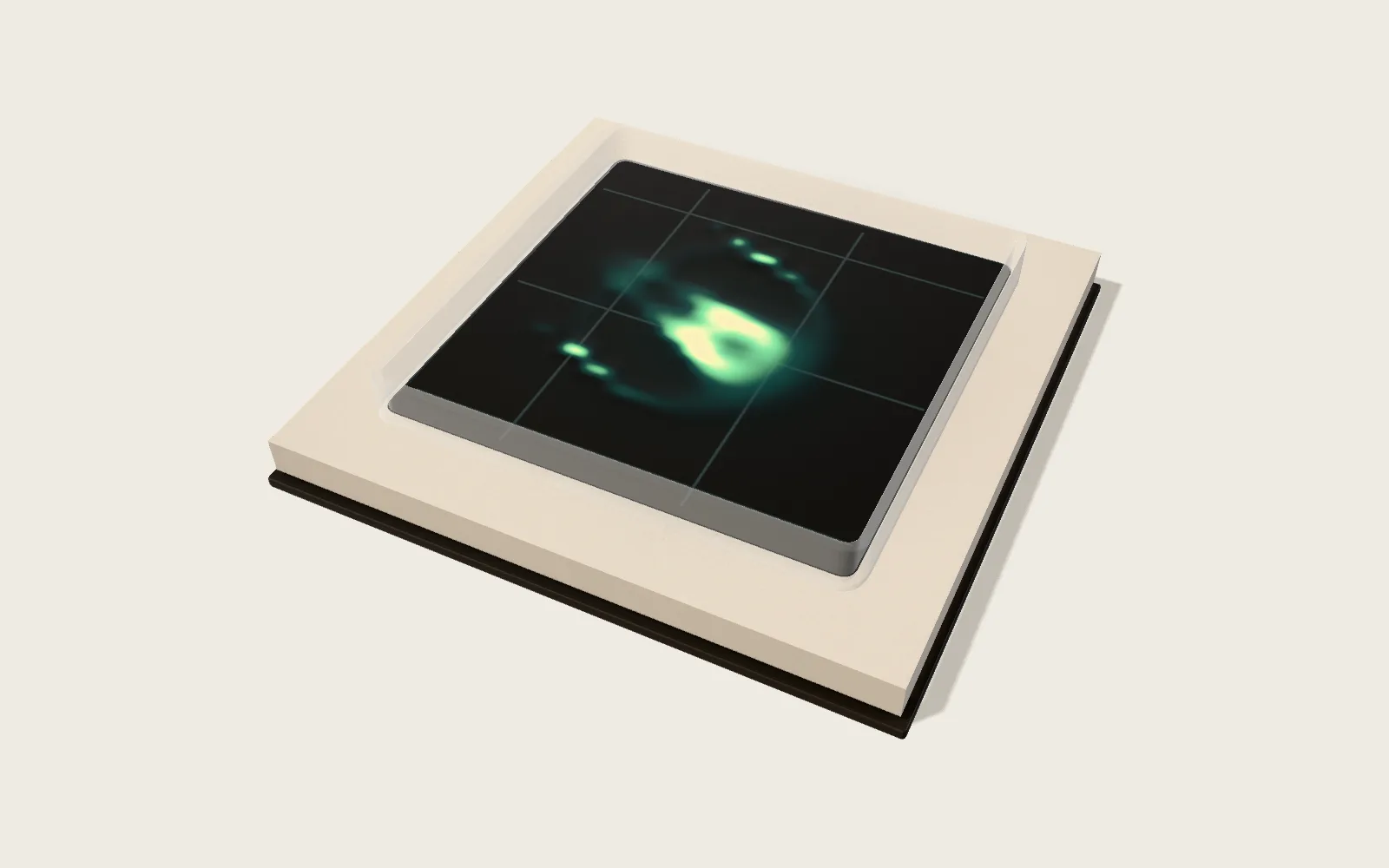
More Than One Parallel
For two thousand years people tried to derive Euclid’s fifth postulate from the others, and failed. In the nineteenth century several people found, each on their own, that replacing it gives a geometry with no contradiction. Every tile on this enamel plate is the same size.
Scroll
The Fifth Postulate
Euclid’s Elements, written around 300 BCE, opens with five postulates. The first four are short, such as “a straight line can be drawn between any two points”. The fifth is much longer: if a line falling on two lines makes the inner angles on one side add up to less than two right angles, the two lines, extended, meet on that side.
It is equivalent to a better-known form (Playfair, 1795): through a point off a line there is exactly one line that never meets it.
Many felt it read less like a postulate than like a theorem that ought to be provable. From ancient Greece to the eighteenth century, one “proof” after another turned out to assume something equivalent to it. In 1733 Saccheri assumed it false and hoped to reach a contradiction; he reached a series of strange results, none of them contradictory.
More Than One
In the 1820s János Bolyai in Hungary and Nikolai Lobachevsky in Kazan, Russia, each went further: they accepted that through a point off a line there is more than one parallel, and worked out a whole geometry from it. Lobachevsky published in 1829; Bolyai’s work appeared in 1832 as an appendix to his father’s book. Gauss had similar ideas earlier but never published them.
In this geometry, infinitely many lines through a point P never meet a line L. They lie between two “limiting parallels”, which meet L only at infinity.
The angle between a limiting parallel and the perpendicular from P to L is the angle of parallelism Π(d), where d is the distance from P to L. Lobachevsky found tan(Π/2) = e⁻ᵈ: the farther P is, the smaller the angle. At short distances it is close to 90°, and the geometry looks Euclidean.
A Real Surface
Could this geometry hide a contradiction somewhere? In 1868 Eugenio Beltrami showed that on a surface called the pseudosphere, the shortest paths and the triangles they make obey exactly its rules.
The pseudosphere is a tractrix turned about its axis, like an endless horn. Its Gaussian curvature is −1/R² everywhere, the opposite of a sphere’s +1/R². Going up the surface from the rim, the circumference halves every R·ln 2; the horn is infinitely tall, yet its area is only 2πR².
A pseudosphere holds only a small piece of the hyperbolic plane, and its rim is a sharp edge. In 1901 Hilbert proved that no complete, smooth surface in three-dimensional space can hold the whole hyperbolic plane. To see the whole plane, it has to be drawn another way.
Infinity in a Disc
The Poincaré disc draws the whole hyperbolic plane inside a circle. Its straight lines (shortest paths) are arcs that meet the rim at right angles, and diameters. Angles are drawn true, lengths are not: the nearer the rim, the shorter the same length is drawn.
Every tile on the plate is really the same size and shape; nearer the rim it is only drawn smaller. The rim itself is not part of the plane; it lies at infinity. From the centre to 0.9 of the way to the rim is a hyperbolic distance of 2.94; to 0.99, 5.29; to 0.999, 7.6.
The plate is moving slowly. The motion keeps every distance (a Möbius transformation), so tiles grow as they come towards the centre and shrink as they move to the rim, and always fit together exactly.
The Upper Half-Plane
The same plane can be drawn another way: the upper half-plane. The boundary is a horizontal line, and the plane is everything above it. Straight lines here are semicircles centred on the boundary line, and vertical lines.
Lengths scale with height above the boundary: at height y, a short piece is as long as it is drawn, divided by y. So tiles shrink towards the boundary line, which also lies at infinity.
An angle-keeping map takes the disc to the half-plane; on the model, the plate’s rim opens out and straightens. Both pictures show the same plane, seen from different places.
Less Than 180°
On the hyperbolic plane, the angles of a triangle always add up to less than 180°. What is missing is exactly the triangle’s area (for curvature −1): area = π − (α + β + γ). This is a case of the Gauss–Bonnet theorem.
So the larger the triangle, the smaller its angle sum. With all three corners pushed out to infinity, all three angles are 0 and the area is π: no triangle has more.
There are no similar triangles here: two triangles with the same angles have the same area, and are congruent. Length has a natural unit.
Regular Tilings
Cover the plane with equal regular p-gons, q meeting at each corner, and you have the tiling {p, q}. The flat plane has only three, {3, 6}, {4, 4} and {6, 3}; the sphere has five, the five regular solids.
The hyperbolic plane has {p, q} whenever (p − 2)(q − 2) > 4, so there are infinitely many. Take {7, 3}: regular heptagons, three at each corner, every angle 120°, where a flat regular heptagon has angles of about 128.6°.
Each tile’s area follows from the Gauss–Bonnet theorem: (p − 2)π − 2πp/q. A tile of {7, 3} has area π/3.
Made by Mirrors
Each regular polygon cuts into 2p equal right triangles, with angles π/p, π/q and 90°. Reflect this triangle in its three sides, again and again, and you get the whole tiling, black and white, neighbours always opposite.
Every tile on the model is computed this way: each point of the plate is moved back, step by step, into the central tile by reflections (or the turns they make), and the steps and the small triangle it lands in are noted.
In 1957 the geometer H. S. M. Coxeter drew such a picture in a paper: triangles with angles of 30°, 45° and 90°, black and white, filling a disc. The next year the artist M. C. Escher saw it, wrote that it gave him “quite a shock”, and went on to build a series of prints on the idea.
Circle Limit
Escher’s Circle Limit series is four woodcuts, made from 1958 to 1960. Each is a disc in which fish, angels or bats shrink towards the rim; mathematically they are all the same size.
In Circle Limit III the fish swim nose to tail along white arcs. These arcs are not straight lines: they meet the rim at about 80° (79.97°), not 90°. Coxeter computed the angle in 1979. The arcs are equidistant curves, which keep a fixed distance from a straight line.
On the model, the white arc is an equidistant curve and the red one the straight line beside it: they meet the rim at the same two points, at different angles. The prints themselves are under copyright; the patterns here are our own.
Space That Grows Exponentially
On the flat plane a circle of radius r has circumference 2πr. On the hyperbolic plane it is 2π sinh r, which grows exponentially. At radius 10 it is over a thousand times the flat one.
The tiles do the same. Counting outwards from the central tile of {7, 3}, one layer per edge crossed: 1, 7, 21, 56, 147, 385 … Each layer is about 2.618 times the last, (3 + √5)/2.
This is why trees and networks fit hyperbolic space so well: structures that branch more and more need room that grows exponentially, which the flat plane lacks and the hyperbolic plane has.
Made With a Hook
In June 1997, at a workshop at Cornell, the mathematician Daina Taimiņa crocheted a model of the hyperbolic plane; before that, people taped paper rings together, which tore easily. The method is simple: after every n stitches, add one more, so each row is (n + 1)/n times as long as the one before, and the rows grow exponentially.
The plane has no room for the extra length, so the fabric ruffles and folds over. Everywhere on it the bending is about the same, like a piece of hyperbolic plane that keeps growing. The piece on the model uses n = 3: each row is 4/3 of the last.
Kelp, some corals, and the edges of kale and lettuce leaves ruffle in a similar way: the edge grows faster than the inside, and the extra length has nowhere to go but into folds. Their curvature is not the same everywhere, but the cause is the same: experiments and calculations on leaves show that a little extra growth at the edge throws up a cascade of ruffles.
The Bench
Drag on the plate and the whole plane moves with it; click a point and it glides to the centre. Choose p and q for another tiling. With “Geodesic”, click two points for the straight line through them and their distance; with “Triangle”, click three points for the three angles, their sum and the area.
Try thisMeasure a triangle on the bench and pull its corners towards the rim. What happens to the angle sum, and why can the area never pass π?
What the model leaves out
The hyperbolic plane is infinite; the plate draws tiles only until they are a few pixels across, and blends the rest into one tone. The rim is not part of the plane. The brass wires have a fixed hyperbolic width, so they thin towards the rim. The colours of the tiles are decoration and mean nothing mathematical. The pseudosphere is cut off where its radius is about 4% of the rim’s and capped with a round head; a true one goes up for ever. The crocheted piece is a surface computed from “each row 4/3 as long”, not a simulation of yarn. The half-plane chapter shows only the part inside the round plate. Escher’s prints are not reproduced; only their geometry is described.
Easy to misread
The tiles near the rim are not smaller than the ones in the middle, only drawn smaller; a creature living on the plate would measure them all the same. Hyperbolic geometry is not a “wrong” geometry: it is exactly as consistent as Euclid’s, and if it held a contradiction, so would Euclid’s. A saddle looks hyperbolic only near one point; its curvature is not the same everywhere. The white arcs of Circle Limit III are not hyperbolic straight lines. Corals and lettuce ruffle only roughly like a hyperbolic plane. Gauss had similar ideas but did not publish them; the geometry is usually credited to Bolyai and Lobachevsky.
Sources
- Euclid, Elements, Book I, Postulate 5 (D. E. Joyce’s online edition)
- MacTutor, Non-Euclidean geometry (University of St Andrews)
- MacTutor, János Bolyai
- MacTutor, Nikolai Lobachevsky
- MacTutor, Eugenio Beltrami
- J. Stillwell (1996), Sources of Hyperbolic Geometry, AMS/LMS (Beltrami, Klein and Poincaré in English)
- D. Hilbert (1901), Über Flächen von konstanter Gaußscher Krümmung, Trans. AMS 2: 87–99
- J. W. Cannon et al. (1997), Hyperbolic Geometry, in Flavors of Geometry, MSRI Publications 31
- H. S. M. Coxeter (1979), The non-Euclidean symmetry of Escher’s picture “Circle Limit III”, Leonardo 12: 19–25
- D. Schattschneider (2010), The Mathematical Side of M. C. Escher, Notices of the AMS 57(6): 706–718
- H. S. M. Coxeter (1957), Crystal symmetry and its generalizations, Trans. Royal Society of Canada III 51: 1–13 (as described in the AMS Feature Column)
- D. Dunham, the {p, q} behind the Circle Limit prints ({6, 4} for I and IV, {8, 3} for II and III)
- D. W. Henderson, D. Taimiņa (2001), Crocheting the hyperbolic plane, The Mathematical Intelligencer 23(2): 17–28
- D. Taimiņa, Crocheting Adventures with Hyperbolic Planes (A K Peters 2009; 2nd ed. CRC 2018)
- Institute For Figuring, Crochet Coral Reef
- E. Sharon, B. Roman, M. Marder, G.-S. Shin, H. L. Swinney (2002), Buckling cascades in free sheets, Nature 419: 579
Data
Every tile on the plate is computed for this page: the regular tiling {p, q} is folded into one fundamental triangle by the isometries that the reflections in its sides generate, pixel by pixel. History after the MacTutor History of Mathematics archive (University of St Andrews) and J. Stillwell, Sources of Hyperbolic Geometry (AMS/LMS, 1996). Escher’s Circle Limit prints are described, not shown; they are © The M.C. Escher Company. The patterns on the plate are our own. The crochet recipe is Daina Taimiņa’s (one extra stitch after every n). The plate, the brass pseudosphere and the crocheted sheet are our own model.
The text, pictures and models on this page are licensed CC BY-NC 4.0: free to use and adapt for teaching and other non-commercial purposes, with credit to world.lapla.si. Third-party material listed above keeps its own licence.
Watch next
The player comes from YouTube and loads only when you press play.
Follow the question
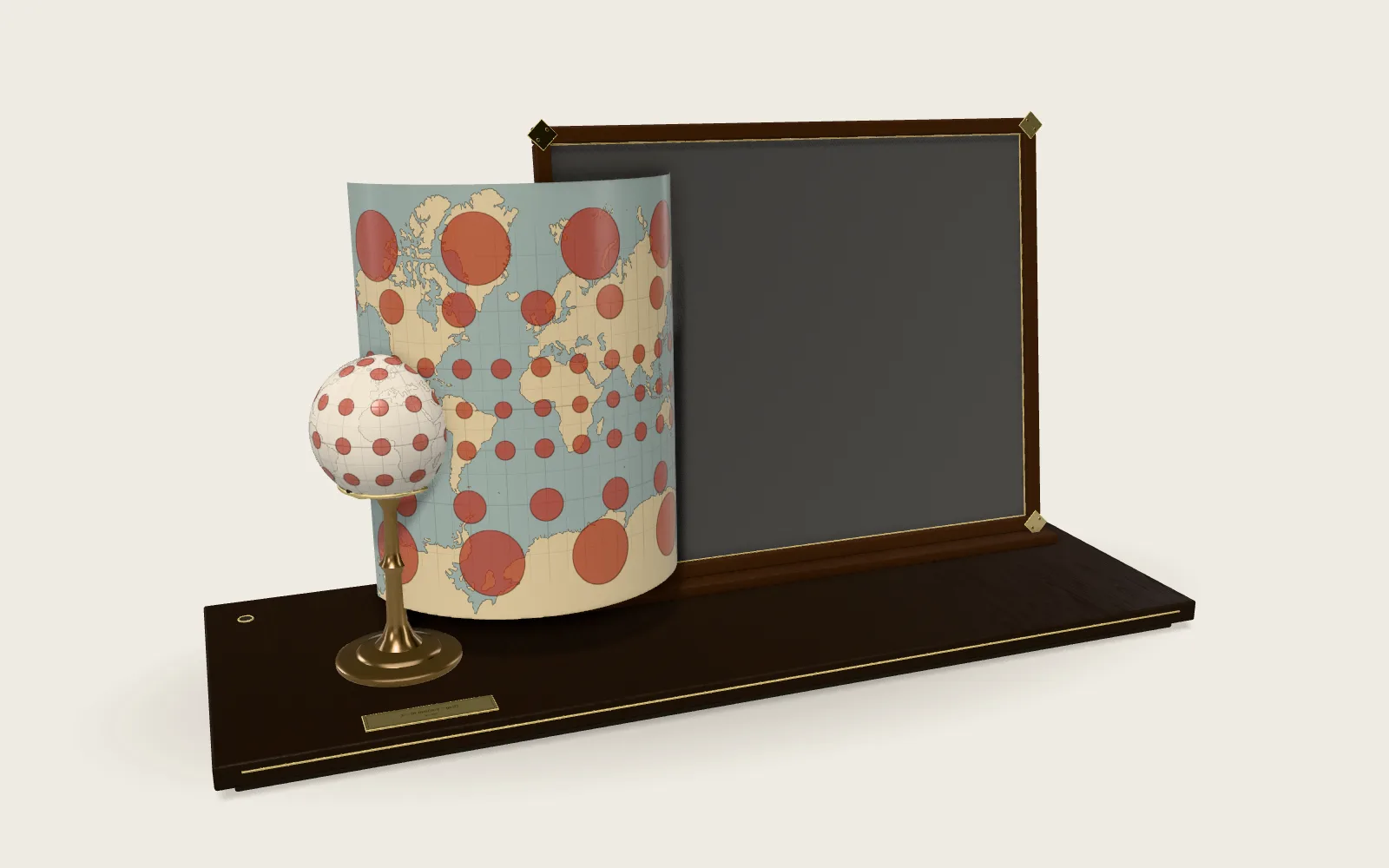 Plate M15A Sphere Will Not Lie FlatA sphere cannot be flattened without distortion. Every map projection gives something up: area, angles, distance or straight lines.
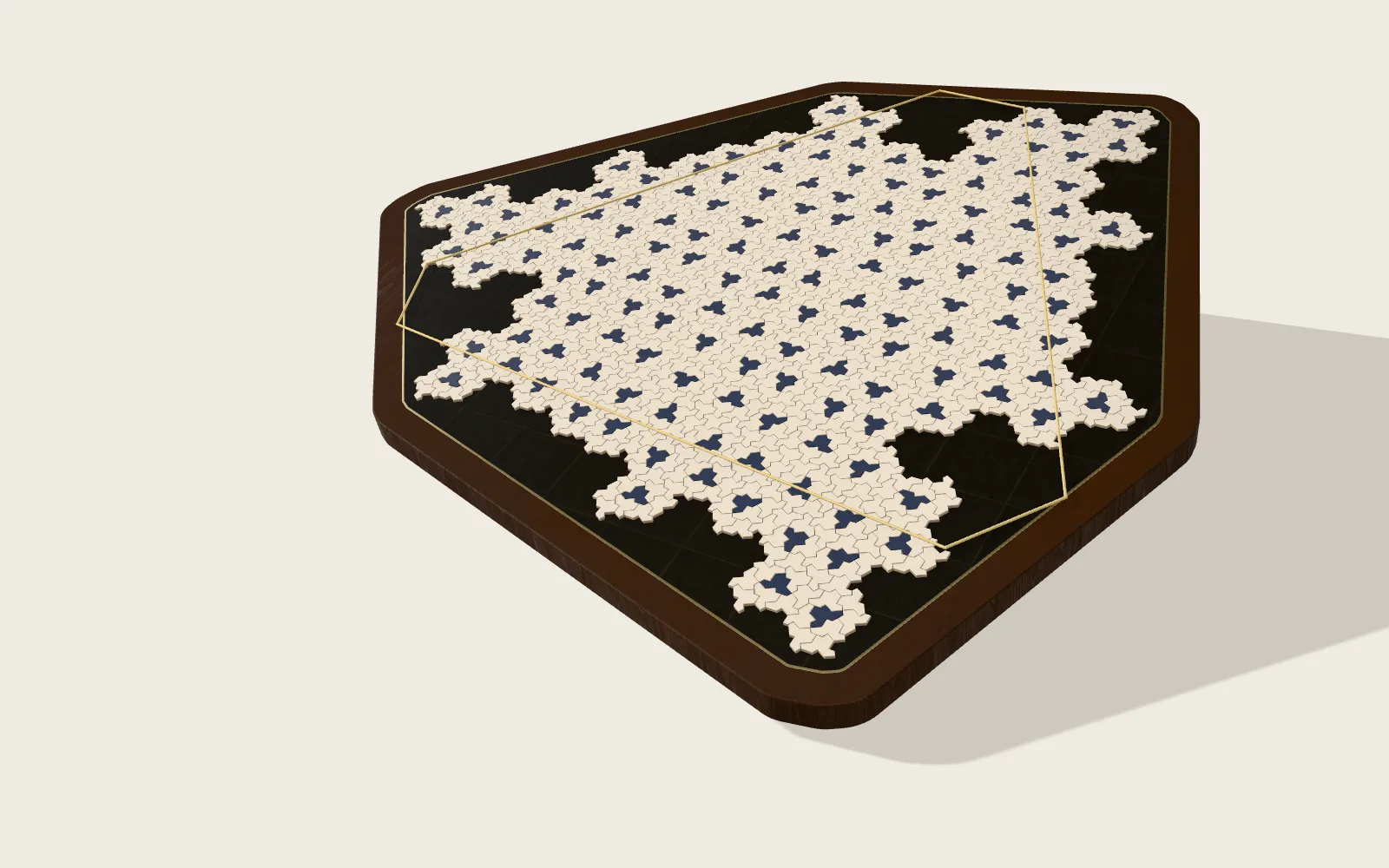 Plate M14One Shape, Never RepeatingA thirteen-sided shape made of eight kites covers the whole plane, yet however it is laid, the pattern never repeats periodically.