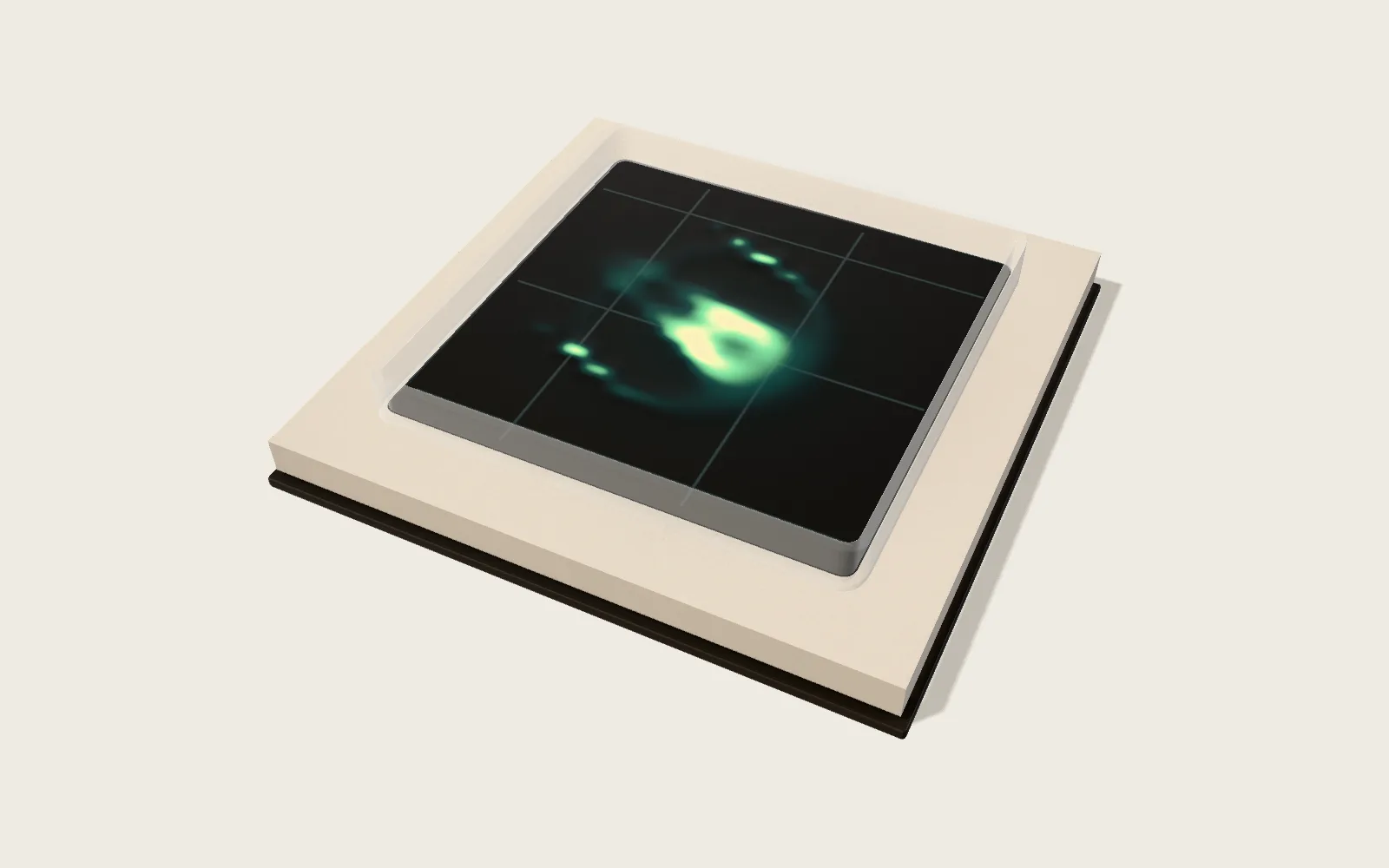
One Shape, Never Repeating
A single shape that covers the plane, but only in patterns that never repeat periodically, is called an aperiodic monotile. The search took more than fifty years. In 2023 the “hat” turned up: a thirteen-sided shape made of eight kites.
Scroll
Eight Kites
Join the centre of a regular hexagon to the midpoints of its six sides, and it falls into six kites. Hexagons like this cover the plane and make a grid of kites. Each kite has two short sides of length 1, two long sides of length √3, and area √3.
The hat is eight kites of this grid, with area 8√3. It has 13 sides: one of length 2, the rest of length 1 or √3. Count the side of length 2 as two sides of length 1, and it has 14 sides, each either 1 or √3 long.
The tile lifted from the model is one hat. Where it sat, the board shows the grid of kites engraved in it.
Covering, Never Repeating
A tiling is periodic when the whole pattern can be shifted some distance and land exactly on itself. A set of shapes that covers the plane, but only in tilings that are not periodic, is called aperiodic.
In 1966 the first set of tiles proved aperiodic had 20,426 shapes. In the 1970s the number came down to two. Whether one shape could do it stayed open. Such a single tile is also called an einstein, German for “one stone”.
The hat was first found by hand, on paper and with puzzle software. Computers gave two early hints: if it could not cover the plane, it could still be ringed at least 16 times round; if it tiled periodically, a period would hold at least 64 differently placed tiles. Either would have broken the records of the time by far. The paper of March 2023 proved that it covers the plane, and only aperiodically.
Some Turned Over
The hat has no symmetry at all: its mirror image is not the same as itself. Turn a tile over, and you have the mirror image. The tiles on the model are glazed white on the front and deep blue on the back; the blue ones are the tiles laid face down.
Every tiling by hats needs tiles turned over, but only a few: each one is ringed by three unturned tiles, always in the same way.
From the substitution rules, the number of unturned tiles to turned ones tends to φ⁴ ≈ 6.854, where φ is the golden ratio (1 + √5)/2. The readout is the ratio counted on this patch of the model.
Is a turned tile a different shape? In geometry, two figures that can be brought together by shifts, turns or mirror reflections are congruent, so the hat is still one shape.
Four Clusters
Hats always come in groups, of four kinds: a turned tile with the three around it, four tiles in all; a single tile held between three such groups; and a pair of tiles side by side, used in two different ways.
Straighten the outline of each group and you get four simple shapes: a hexagon H, a triangle T, a parallelogram P and a pentagon F, called metatiles. How the hats fit decides how these may meet, and the rules can be written on their edges.
The brass frames on the model are the outlines of the metatiles. They cut across hats: the metatiles are shapes drawn for the argument, and the hats are carried along with them.
Larger, and Larger Again
Metatiles fit together in a fixed way into larger pieces, and these again come in four kinds, H, T, P and F, meeting each other as the originals did. So the building can go on for ever, each level made of the one below.
One H is made of 3 H, 1 T, 3 P and 3 F; a T of 1 H; a P of 2 H, 1 P and 2 F; an F of 2 H, 1 P and 3 F.
Each level is not an exact enlargement of the one before, but it comes closer and closer. Lengths grow by about φ² ≈ 2.618 per level, areas by φ⁴ ≈ 6.854. The nested H pieces on the model hold 4, 25, 169 and 1156 hats: 2², 5², 13², 34².
This nesting rules out a period. If the pattern landed on itself after a shift, a large enough piece would overlap its shifted copy, and the hats there would belong to two different pieces. Using two independently written programs to go through every case, the paper proves that each hat’s place in the hierarchy is unique.
A Family of Shapes
The hat has sides of only two lengths. Replace each side of length 1 by a and each side of length √3 by b, keeping the angles, and you get Tile(a, b). The hat is Tile(1, √3); Tile(√3, 1) is made of ten kites and is called the “turtle”.
Whenever a and b are both above 0 and unequal, Tile(a, b) is an aperiodic monotile, and its tilings match the hat’s one for one: the same tiling, with other side lengths. All the tiles on the model change shape together, and stay a perfect fit.
There are three exceptions, and each can tile periodically: the chevron Tile(0, 1), the comet Tile(1, 0), and the equilateral Tile(1, 1).
Among shapes of up to 24 kites, a computer search found only these two aperiodic ones: the hat and the turtle.
Why It Cannot Repeat
The paper gives two proofs. One is the hierarchy of the last chapter, which needs a computer to check a great many cases. The other uses geometry alone.
Suppose the hat had a periodic tiling. Shrink every side of length 1 to nothing, and each hat becomes a chevron: four equilateral triangles of side √3, area 3√3. Shrink the sides of length √3 instead, and each becomes a comet: eight triangles of side 1, area 2√3. Both new tilings are periodic, their periods match one for one, and the map between them scales areas by 2/3.
The paper then shows that this map must be a uniform scaling, so lengths would scale by √(2/3). But on a triangular grid the square of the distance between two points is always of the form m² + mn + n², with an even number of factors 2, so no two grid distances can be in the ratio √2. That is a contradiction: there is no periodic tiling.
A Tile That Never Turns
Tilings by the hat always need tiles turned over, and some said it was really two tiles. Two months later the same authors answered: if turning over is forbidden, the equilateral Tile(1, 1) can tile only aperiodically.
Then replace its straight sides by curved ones, bulging out and in by turns, and a turned tile no longer fits anywhere. Such a shape is called a Spectre: when it covers the plane, every tile faces the same way, and the tiling cannot be periodic.
Its substitution has only two rules: a Spectre becomes a Mystic (a pair of tiles) and seven Spectres; a Mystic becomes a Mystic and six Spectres. Each step grows areas by 4 + √15 ≈ 7.873, and turns every tile’s handedness the other way.
The darker tiles on the model are the second tile of each Mystic, turned by 30°. The number of other tiles to these also tends to 4 + √15.
The Bench
The level buttons build outwards one level at a time. The slider changes the whole patch through the Tile(a, b) family: the hat, the turtle, the equilateral tile, the chevron and the comet all lie along it. Point at a tile to light up the metatiles of each level that hold it. The readouts are the number of hats in the patch, how many are turned over, and their ratio.
Try thisDrag the slider to Tile(1, 1): the tiling still fits. Why can this equilateral one tile periodically after all?
What the model leaves out
A real tiling is infinite; the model has the 1156 tiles of one level-3 H supertile. The tiles stand about 0.4 mm apart with bevelled edges, so they look slightly smaller than the mathematical shapes. The brass frames follow the construction in section 2 of the paper; the matching rules on their edges are not drawn. In the morph, Tile(a, b) is scaled to keep its area, so the picture keeps its size. The curved sides of the Spectre are one choice among many that work, and the tiling in that chapter is not the same one as the hat’s.
Easy to misread
Aperiodic is not disorderly: a hat tiling built by substitution is strictly hierarchical, and any small patch of it turns up again and again elsewhere; only the whole pattern cannot be shifted onto itself. The ratio φ⁴ of turned tiles is a limit; a finite patch only comes close. “Einstein” is German ein Stein, one stone, and has nothing to do with the physicist. That the hat must be turned over to cover the plane is a property, not a flaw: in geometry a mirror image is congruent to the original.
Sources
- D. Smith, J. S. Myers, C. S. Kaplan, C. Goodman-Strauss (2024), An aperiodic monotile, Combinatorial Theory 4(1), #6 (arXiv:2303.10798)
- D. Smith, J. S. Myers, C. S. Kaplan, C. Goodman-Strauss (2024), A chiral aperiodic monotile, Combinatorial Theory 4(2), #13 (arXiv:2305.17743)
- arXiv:2303.10798 (the hat, preprint)
- arXiv:2305.17743 (the Spectre, preprint)
- Robert Berger (1966), The Undecidability of the Domino Problem, Memoirs of the AMS 66
- Roger Penrose (1979), Pentaplexity, The Mathematical Intelligencer 2: 32–37
- Craig S. Kaplan, hatviz (BSD-3-Clause; reference for the metatile construction)
- Craig S. Kaplan, interactive Spectre tool (reference)
Data
The hat and its tilings: David Smith, Joseph Samuel Myers, Craig S. Kaplan and Chaim Goodman-Strauss, “An aperiodic monotile”, Combinatorial Theory 4(1) (2024), #6 (arXiv:2303.10798). The Spectre: the same authors, “A chiral aperiodic monotile”, Combinatorial Theory 4(2) (2024), #13 (arXiv:2305.17743). The metatile construction follows Craig S. Kaplan’s hatviz (BSD-3-Clause) and the Spectre layout the appendix of the second paper; both are rewritten here, and every tile on the board is computed for this page. The board, its glazed tiles and the brass frames are our own model.
The text, pictures and models on this page are licensed CC BY-NC 4.0: free to use and adapt for teaching and other non-commercial purposes, with credit to world.lapla.si. Third-party material listed above keeps its own licence.
Watch next
The player comes from YouTube and loads only when you press play.
Follow the question
 Plate M10A Fold That Opens in One PullA sheet folded into parallelograms opens all at once when one corner is pulled, and closes all at once when it is pushed back. One angle sets every crease.
 Plate 08Why Snowflakes Have Six PointsEvery snowflake grows from one tiny six-sided crystal of ice.