Neutrinos in Water and Ice
Neutrinos pass through the Earth and almost never stop. Once in a while one hits a nucleus in water or ice, and the charged particle it knocks out moves faster than light does in water, trailing a ring of pale blue light. Thousands of photomultipliers record it.
Chapters · 14
- 01About Thirty a Day
- 02Under a Kilometre of Rock
- 03Faster Than Light in Water
- 04Sharp Rings, Fuzzy Rings
- 05Cut Open: 50,000 Tonnes
- 06A 50-Centimetre Eye
- 07Water With Gadolinium
- 08The Supernova of 1987
- 09Fewer Through the Earth
- 10A Cubic Kilometre of Ice
- 11One Optical Module
- 12High-Energy Neutrinos
- 13Taken Apart
- 14Ring by Ring
Scroll
About Thirty a Day
Fusion in the Sun’s core sends out neutrinos in huge numbers. By the standard solar model about 6.5 × 10¹⁰ of them reach each square centimetre of the Earth every second. They hardly touch matter, and most pass straight through the whole planet.
Super-Kamiokande’s tank is about 1,600 square metres side-on. From that flux the page works out that about 10²³ solar neutrinos pass through it every day. Super-Kamiokande records about 30 neutrino events a day. To learn anything from so few, a detector must be very large, very clean, and hidden from every other signal.
Through it: about 10²³ a day (the page’s estimate from the flux and side area) · recorded: about 30 a day (Super-Kamiokande)
Under a Kilometre of Rock
Muons made by cosmic rays in the air rain down on the ground all the time. Super-Kamiokande lies in the Kamioka mine in Hida, Gifu, 1,000 m under Mount Ikeno; the rock above weighs as much as 2,700 m of water. Only about one muon in 100,000 gets this far.
Even so, about 2 muons a second cross the tank, each leaving a large, bright ring that is easy to tell apart. Above the tank is a cavern dug out of the rock, and on the tank’s lid stand huts for the electronics.
1,000 m underground · 2,700 m water equivalent · muons cut to about 1/100,000 · still about 2 a second
Faster Than Light in Water
Light travels more slowly in water than in a vacuum, at about 0.75 of its vacuum speed (water’s refractive index is about 1.33). A charged particle can go faster than that. Then the light it gives off along its path piles up into a cone, like the bow wave of a boat: Cherenkov radiation.
The cone’s half-angle is set by cos θ = 1/(nβ), where β is the particle’s speed over the speed of light in a vacuum. For a particle near light speed in water the half-angle is about 41 degrees. Below a speed of 1/n there is no light: an electron needs about 0.26 MeV of kinetic energy, a muon about 54 MeV. Each centimetre of track gives about 330 photons between 300 and 600 nm.
cos θ = 1/(nβ) · θ ≈ 41° in water · about 330 photons per cm (the page’s Frank–Tamm count)
Sharp Rings, Fuzzy Rings
A neutrino hits a nucleus in the water, and the electron or muon it knocks out flies on; the light of its cone lands on the wall as a ring. A muon is heavy and runs nearly straight, slowing as it goes, so its cone narrows: the ring has a sharp outer edge and a filled middle.
An electron soon sets off an electromagnetic shower: many electrons and positrons fly off in slightly different directions, their cones overlap, and the ring’s edge blurs. Super-Kamiokande tells the two apart by the shape of the ring, and gets single-ring events wrong about 0.7% to 0.8% of the time. Every ring on this page is worked out photon by photon.
Muon: a sharp edge · electron: a fuzzy edge · wrong about 0.7–0.8% (simulated single-ring events)
Cut Open: 50,000 Tonnes
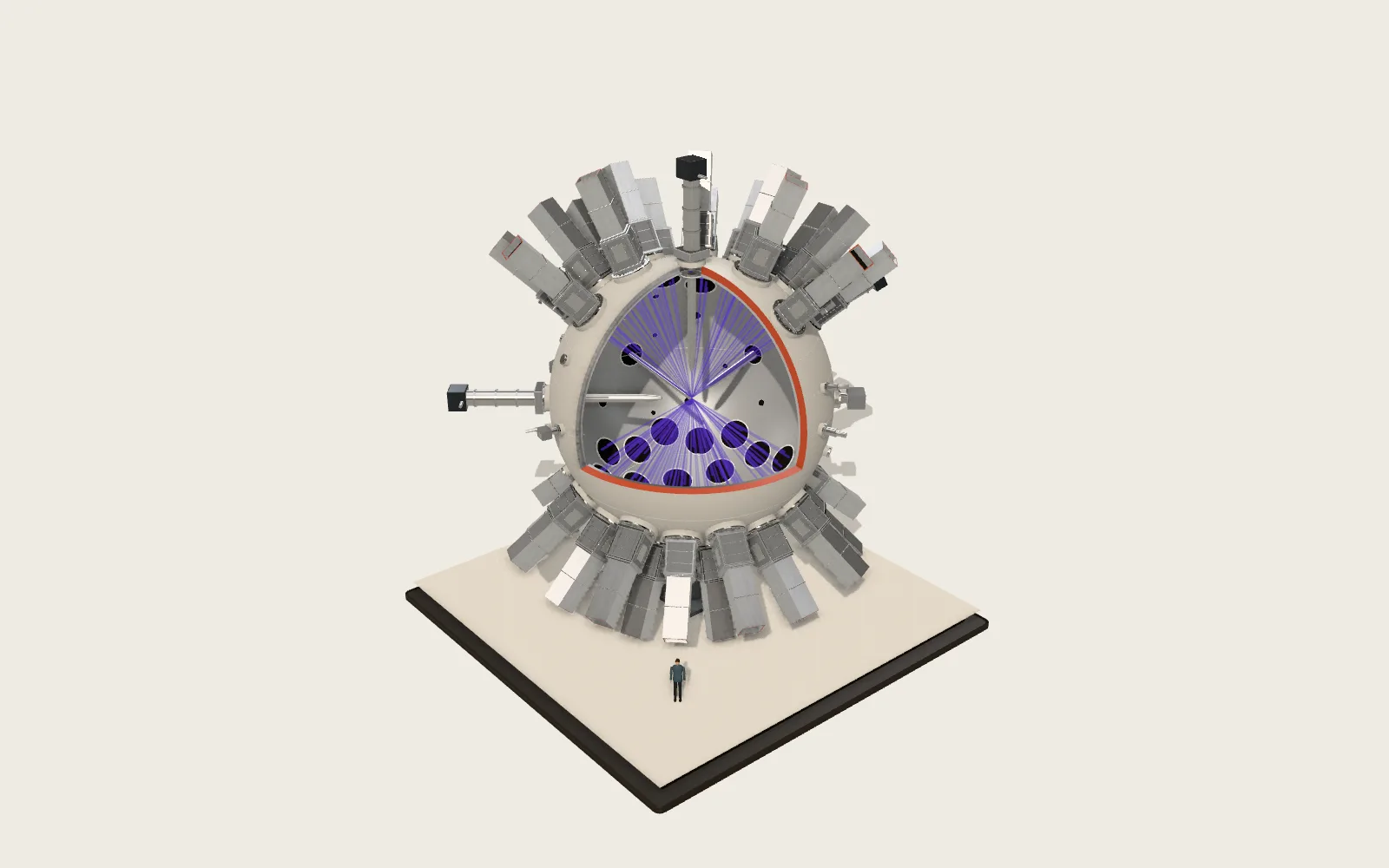
Super-Kamiokande is a cylindrical stainless-steel tank 39.3 m across and 41.4 m tall, holding 50,000 tonnes of ultrapure water. This model is 1 : 40; the figure on the tank’s lid is 1.75 m tall.
A stainless-steel structure inside divides the tank in two. Within it is the inner detector, 33.8 m across and 36.2 m tall, with 11,129 photomultipliers 50 cm across looking inwards, covering about 40% of the wall, and black PET sheet between them. Outside it is the outer detector, with 1,885 photomultipliers 20 cm across looking outwards and walls lined with white Tyvek, to spot particles coming in from outside.
39.3 × 41.4 m · 50,000 t · 11,129 inner PMTs (11,146 in 1996) · 1,885 outer · model 1 : 40
A 50-Centimetre Eye
The inner detector’s photomultipliers are Hamamatsu Photonics R3600s, 50 cm across. A photon striking the bialkali photocathode on the inside of the glass may free an electron, with a peak chance of about 22% near 400 nm. The electron passes down a chain of Venetian-blind dynodes and multiplies, again and again, into a current that can be measured. A single photoelectron is timed to about 2 ns.
On 12 November 2001, while the tank was being filled, a tube at the bottom imploded, and the shock wave broke 6,777 inner tubes and 1,100 outer tubes in a chain. Since then every inner tube sits in a fibreglass case with an acrylic cover in front. By 2006 the detector was back to 11,129. Here the water is lowered and a rubber boat floats on it, as in repair work.
R3600 · 50 cm · bialkali photocathode · peak quantum efficiency about 22% · about 2 ns for one photoelectron
Water With Gadolinium
Light must cross tens of metres of water to reach the wall, so the water has to be extremely clear. Super-Kamiokande’s water is purified as it circulates, and light’s attenuation length in it is about 90 to 120 m.
Since the summer of 2020 the water has held gadolinium sulphate: first 13 tonnes, about 0.01% gadolinium; in 2022 another 26.1 tonnes, to about 0.03%. An antineutrino that hits a proton makes a positron and a neutron. The positron flashes at once; the neutron wanders in the water until gadolinium captures it and gives off gamma rays of about 8 MeV in all, on average 115 µs later at 0.01%. Two flashes, one after the other, mark an antineutrino. At 0.03% about 75% of the neutrons are caught by gadolinium.
13 t + 26.1 t of gadolinium sulphate · about 0.03% · about 75% of neutrons captured · about 8 MeV of gamma rays
The Supernova of 1987
At 7:35:35 UT on 23 February 1987 (to within a minute), Kamiokande-II, Super-Kamiokande’s forerunner, recorded 11 electron events in 13 seconds, with energies of 7.5 to 36 MeV. They came from the supernova SN 1987A in the Large Magellanic Cloud, about 160,000 light years away. The IMB detector in the United States recorded 8 in 6 seconds.
Kamiokande-II held 3,000 tonnes of water and had 948 photomultipliers 50 cm across. Its name comes from the Kamioka Nucleon Decay Experiment: it was first built to look for proton decay. One half of the 2002 Nobel Prize in Physics went to Raymond Davis Jr. and Masatoshi Koshiba “for pioneering contributions to astrophysics, in particular for the detection of cosmic neutrinos”.
Kamiokande-II: 11 events in 13 s · IMB: 8 in 6 s · 2002 Nobel Prize
Fewer Through the Earth
Cosmic rays make neutrinos in the air too, on every side. Those from overhead travel about 15 km; those from below, through the Earth, about 13,000 km. If neutrinos did not change on the way, as many muon neutrinos would arrive from below as from above.
In 1998 Super-Kamiokande reported from 535 days of data that multi-GeV muon-like events came from below markedly less often than from above: an asymmetry of −0.296 ± 0.048 ± 0.01, more than six standard deviations from zero. The muon neutrinos had turned into another flavour on the way. This is oscillation, and it needs neutrinos to have mass. With two flavours the chance of surviving is 1 − sin²2θ · sin²(1.27 Δm² L/E). The page works out the ratio of up to down from it.
The 2015 Nobel Prize in Physics went to Takaaki Kajita of the Super-Kamiokande Collaboration and Arthur B. McDonald of the Sudbury Neutrino Observatory Collaboration “for the discovery of neutrino oscillations, which shows that neutrinos have mass”.
Asymmetry A = −0.296 ± 0.048 ± 0.01 (multi-GeV muon-like) · Δm² ≈ 2.4 × 10⁻³ eV² · 2015 Nobel Prize
A Cubic Kilometre of Ice
At the South Pole the ice is about 2,800 m thick, and deep down it is very clear. IceCube drilled 86 holes and lowered a cable into each, carrying 60 digital optical modules from 1,450 to 2,450 m deep, 17 m apart. Seventy-eight of the strings stand on a triangular grid 125 m apart, around about a cubic kilometre of ice. It was finished on 18 December 2010.
The eight strings packed in the middle are DeepCore: their lowest 50 modules sit 7 m apart from 2,100 to 2,450 m, below a dust layer from about 2,000 to 2,100 m that scatters light more. On the surface, IceTop’s 162 ice-filled tanks record cosmic-ray air showers. In the 2025/26 summer five more densely packed strings went in at the centre; they are not drawn. This model is 1 : 3000, with the modules drawn far larger than they are.
86 strings · 5,160 modules · 1,450–2,450 m · 125 m apart · 17 m between modules · model 1 : 3000
One Optical Module
Each module is a sphere of borosilicate glass 13 inches across and half an inch thick, built to stand 250 bar for good and up to 690 bar while the ice freezes back round it. Inside, looking down, is a 10-inch Hamamatsu R7081-02 photomultiplier, held to the glass by about 1 cm of silicone gel, with a mu-metal cage round it against the Earth’s magnetic field.
The upper half holds the electronics: the main board digitises the pulses, its ATWD at 300 million samples a second and a fast ADC at 40 million; a flasher board carries 12 LEDs at 405 nm with which the modules calibrate one another. Each module draws about 5.7 W on average, counting supply and transmission losses. It is drawn here at 1 : 1.
13-inch glass sphere · 10-inch photomultiplier · gain 10⁷ · 12 LEDs · about 5.7 W
High-Energy Neutrinos
IceCube sees two shapes. A muon leaves a long track whose direction is known to within 1 degree; a shower is a nearly round burst of light whose direction is known only to about 10 degrees, though its energy is measured well. In 2013 IceCube reported 28 events with deposited energies of 30 to 1,200 TeV in two years of data, where background predicted about 10.6, rejecting a purely atmospheric origin at about 4σ. It was evidence for high-energy neutrinos from beyond the Earth.
On 22 September 2017 a neutrino of about 290 TeV pointed to the flaring blazar TXS 0506+056; chance coincidence was disfavoured at the 3σ level. In 2022 IceCube found about 79 neutrinos above background from the direction of NGC 1068, an active galaxy about 47 million light years away, at 4.2σ. The 2026 Nobel Prize in Physics went to Francis Halzen “for decisive contributions to the IceCube Neutrino Observatory and the discovery of high-energy neutrinos of astrophysical origin”.
2013: 28 events, 4σ · 2017: TXS 0506+056, 3σ · 2022: NGC 1068, 4.2σ · 2026 Nobel Prize
Taken Apart
The rock and the cavern, the tank and the outer detector, the inner detector (structure, photomultipliers and water), the huts on the lid, one by one.
Point at a part and it lifts out alone, the rest fading; at rest, every part is named.
Ring by Ring
The lever sets the lepton’s kinetic energy; the buttons choose a muon or an electron neutrino. Each event starts at a random point in a random direction. The page sends Cherenkov photons from every short piece of the track, decides from the water’s attenuation, the photocathodes’ coverage and their efficiency which are recorded, and counts each on the tube it lands on.
The unrolled wall shows the top, the barrel and the bottom. Below is a simple test: the light’s angle from the track’s direction, and how much of it falls more than 8 degrees beyond the 41-degree edge of the cone. A muon’s ring has almost none; an electron’s about a fifth. Super-Kamiokande uses a far finer likelihood fit; this only shows the difference between the two rings.
Try thisPush the energy to 1.5 GeV and watch a few muon and electron neutrinos: how much light falls beyond the cone’s edge for each, and whose ring has the sharper edge?
What the model leaves out
The Super-Kamiokande model follows the sizes the collaboration publishes, at 1 : 40: the tank, the inner and outer detectors, the 55 cm structure between them, the 11,146 inner-detector positions on a 70.7 cm grid (the layout of 1996; there are 11,129 tubes now), the outer tubes and their 60 cm wavelength-shifting plates are in the right places; the rock, the cavern’s vault, the huts, the rails, the hatch and the boat are schematic, the structure is drawn as a lattice in the section, and the thickness of the tank wall is schematic too. The outer tubes are spread evenly to their total, not to the real layout. The inner tubes are drawn as bronze-gold domes, as they look in photographs. The IceCube model is 1 : 3000: the strings stand on a 125 m triangular grid with DeepCore at its average spacing, not at their real coordinates; the modules are beads about 8 m across (they are 33 cm); the IceTop tanks and the IceCube Lab are placed schematically; the five strings added in 2025/26 are not drawn. The optical module is 1 : 1, its insides arranged after the description in the JINST paper. All events are simulated by the page: a muon loses about 220 MeV a metre, taken in 5 cm steps, with multiple scattering from the Highland formula; an electron shower follows a longitudinal profile in radiation lengths of 36 cm with a critical energy of 78 MeV, its pieces spread about 0.2 to 0.5 radians round the axis; photons travel in straight lines to the wall with an attenuation length of 90 m and no scattering or reflection; the photocathodes’ effective efficiency is 11.8%, so an electron gives about 6 photoelectrons per MeV (PDG gives about 6 for Super-Kamiokande). The neutrino’s interaction itself is not simulated: the lepton’s kinetic energy is the lever’s value, and the recoiling nucleon is not drawn. Solar neutrinos, cosmic-ray muons, the supernova and the gadolinium use the same simulation; on the model in the supernova chapter these are low-energy events, not the 1987 data (which are in the figure at top right). IceCube’s events use textbook forms of the light’s fall-off (a track e^(−d/λ)/√d, a shower e^(−d/λ)/d², with λ = 30 m), not the collaboration’s tables. Oscillation uses the two-flavour formula with Δm² = 2.445 × 10⁻³ eV² (PDG 2026), sin²2θ = 0.996, a production height of 15 km and energies spread log-normally; the angle between the muon and its neutrino is ignored. Super-Kamiokande’s papers often give the cone as 42 degrees; with a refractive index of 1.333 the page gets about 41.
Common misreadings
“Faster than light” means faster than light travels in water, not faster than light in a vacuum; nothing goes faster than that. Cherenkov light is not given off by the neutrino but by the charged particle it knocks out; a detector never sees the neutrino itself. The struck tubes light up on this page only to show them; real tubes take in light and give none out. Oscillation shows that neutrinos have mass, but it measures only differences of squared masses, not the mass of any one neutrino. The 1998 paper reported “evidence” for oscillation. The results on TXS 0506+056 and NGC 1068 are evidence at 3σ to 4.2σ, not 5σ discoveries. The 2002 Nobel material speaks of 12 events; the Kamiokande-II paper counts 11, the twelfth lying below its 7.5 MeV threshold.
Common questions · 5
- How many neutrinos does Super-Kamiokande record a day?
Super-Kamiokande records about 30 neutrino events a day.
01About Thirty a Day ↑- How deep underground is Super-Kamiokande?
Super-Kamiokande lies in the Kamioka mine in Hida, Gifu, 1,000 m under Mount Ikeno; the rock above weighs as much as 2,700 m of water.
02Under a Kilometre of Rock ↑- What is the angle of the Cherenkov cone in water?
For a particle near light speed in water the half-angle is about 41 degrees.
03Faster Than Light in Water ↑- Who won the Nobel Prize for neutrino oscillations?
The 2015 Nobel Prize in Physics went to Takaaki Kajita of the Super-Kamiokande Collaboration and Arthur B. McDonald of the Sudbury Neutrino Observatory Collaboration “for the discovery of neutrino oscillations, which shows that neutrinos have mass”.
09Fewer Through the Earth ↑- How many optical modules does IceCube have?
IceCube drilled 86 holes and lowered a cable into each, carrying 60 digital optical modules from 1,450 to 2,450 m deep, 17 m apart.
10A Cubic Kilometre of Ice ↑
Sources
- Super-Kamiokande: Detector (39.3 × 41.4 m; 11,129 inner PMTs, about 40%; black PET sheet; outer PMTs with 60 cm wavelength shifters; about 2 muons a second, cut to about 1/100,000; about 30 neutrinos a day)
- Super-Kamiokande: Overview (50,000 t; Kamioka mine, Hida, 1,000 m underground)
- Super-Kamiokande: History (started 1 April 1996; the 2001 accident, 6,777 + 1,100 tubes; back to 11,129 in 2006; Kamiokande 3,000 t, “Kamioka Nucleon Decay Experiment”)
- Super-Kamiokande: SK-Gd (13 t, 0.01%; 120 t an hour circulated; about 75% captured at 0.03%)
- K. Abe et al. (2014): Calibration of the Super-Kamiokande detector, NIM A 737, 253 (R3600; bialkali photocathode, Venetian-blind dynodes; PMT counts; 2,700 m water equivalent; 2.1 ns at one photoelectron)
- Y. Ashie et al. (2005): A measurement of atmospheric neutrino oscillation parameters by Super-Kamiokande I, PRD 71, 112005 (16.9 m radius, 36.2 m high; 55 cm; 2.5 ns; misidentification 0.7% / 0.8%; attenuation 90–120 m)
- E. Kearns (2002): the Super-Kamiokande accident (12 November 2001, 6,777 + 1,100 tubes)
- K. Abe et al. (2016): Solar neutrino measurements in Super-Kamiokande-IV, PRD 94, 052010 (42° cones)
- K. Abe et al. (2022): First gadolinium loading to Super-Kamiokande, NIM A 1027, 166248 (13 t, 0.011%; about 8 MeV of gamma rays; mean capture time 115 ± 1 µs)
- K. Abe et al. (2024): Second gadolinium loading to Super-Kamiokande, NIM A 1065, 169480 (26.1 t, 0.033%; 75% capture efficiency)
- Y. Fukuda et al. (1998): Evidence for oscillation of atmospheric neutrinos, PRL 81, 1562 (33.0 kiloton-years, 535 days; A = −0.296 ± 0.048 ± 0.01; 15 km and 13,000 km)
- K. Hirata et al. (1987): Observation of a neutrino burst from the supernova SN1987A, PRL 58, 1490 (7:35:35 UT; 11 events in 13 s, 7.5–36 MeV)
- R. M. Bionta et al. (1987): Observation of a neutrino burst in coincidence with supernova 1987A, PRL 58, 1494 (IMB, 8 events in 6 s)
- T. J. Loredo, D. Q. Lamb (2002): Bayesian analysis of neutrinos observed from supernova SN 1987A, PRD 65, 063002 (Table III: times and energies of the events)
- Nobel Prize: 2002 physics press release (Davis, Koshiba, Giacconi)
- Nobel Prize: 2015 physics press release (Kajita, McDonald)
- Nobel Prize: 2026 physics press release (Francis Halzen)
- N. Vinyoles et al. (2017): A new generation of standard solar models, ApJ 835, 202 (the fluxes of each branch, adding up to about 6.5 × 10¹⁰ per cm² per second)
- Particle Data Group (2026): Neutrino mixing (Eqs. 14.40 and 14.43: two-flavour oscillation)
- Particle Data Group (2026): Leptons summary (Δm²₃₂ = 2.445 × 10⁻³ eV², sin²θ₂₃ = 0.533)
- Particle Data Group (2026): Passage of particles through matter (Cherenkov radiation, Eqs. 34.41–34.44)
- Particle Data Group: properties of water (refractive index 1.333; minimum ionisation 1.981 MeV/cm; radiation length 36.08 cm; critical energy 78.33 MeV)
- Particle Data Group (2026): Non-accelerator detectors (about 6 photoelectrons per MeV for Super-Kamiokande; peak quantum efficiency about 20%; fuzzy and sharp rings)
- IceCube Collaboration (2017): The IceCube Neutrino Observatory: instrumentation and online systems, JINST 12, P03012 (86 strings, 5,160 modules, 1,450–2,450 m, 125 m, 17 m; DeepCore; IceTop’s 162 tanks; the glass sphere, R7081-02, gel, mu-metal cage, ATWD and fADC, 12 LEDs, 5.7 W; finished 18 December 2010)
- IceCube Collaboration (2012): The design and performance of IceCube DeepCore, Astropart. Phys. 35, 615
- IceCube Collaboration (2013): Measurement of South Pole ice transparency with the IceCube LED calibration system, NIM A 711, 73 (ice 2.8 km thick; cone about 41°; the dust layer)
- IceCube Collaboration (2013): Evidence for high-energy extraterrestrial neutrinos at the IceCube detector, Science 342, 1242856 (28 events, 30–1,200 TeV, background 10.6, 4σ)
- IceCube Collaboration et al. (2018): Multimessenger observations of a flaring blazar coincident with high-energy neutrino IceCube-170922A, Science 361, eaat1378 (about 290 TeV; 3σ)
- IceCube Collaboration (2018): Neutrino emission from the direction of the blazar TXS 0506+056 prior to the IceCube-170922A alert, Science 361, 147
- IceCube Collaboration (2022): Evidence for neutrino emission from the nearby active galaxy NGC 1068, Science 378, 538 (79 events, 4.2σ)
- IceCube: press release of 12 February 2026 (the Upgrade: five new strings)
- IceCube: Facts (about 450 scientists, 58 institutions, 14 countries)
Data
The Super-Kamiokande model follows the sizes the collaboration publishes (39.3 × 41.4 m tank, 33.8 × 36.2 m inner detector, the 55 cm structure, 20-inch PMTs on a 70.7 cm grid); the rock, the cavern’s vault, the huts, the rails and the boat are schematic. The IceCube model follows the instrumentation paper (JINST 12 P03012) for counts and depths; its string map is a regular grid, not the real coordinates. Every event on the page is simulated by the page itself (photons traced from a lepton’s track to the wall of PMTs; a textbook light model in the ice); none is collaboration data. The 1987 supernova events are from the compilation by T. J. Loredo and D. Q. Lamb (Phys. Rev. D 65, 063002, 2002). Material presets, parts and the softbox studio of the site’s model kit are ported from AirsupHQ/machine-skill (MIT, © 2026 Air Supply Technologies Inc.).
The text, pictures and models on this page are licensed CC BY-NC 4.0: free to use and adapt for teaching and other non-commercial purposes, with credit to world.lapla.si. Third-party material listed above keeps its own licence.
Cite this plate
Laplace’s Mini World, Plate F30, “Neutrinos in Water and Ice”, https://world.lapla.si/en/neutrino/, CC BY-NC 4.0, updated 2026-10-21.
Follow the question
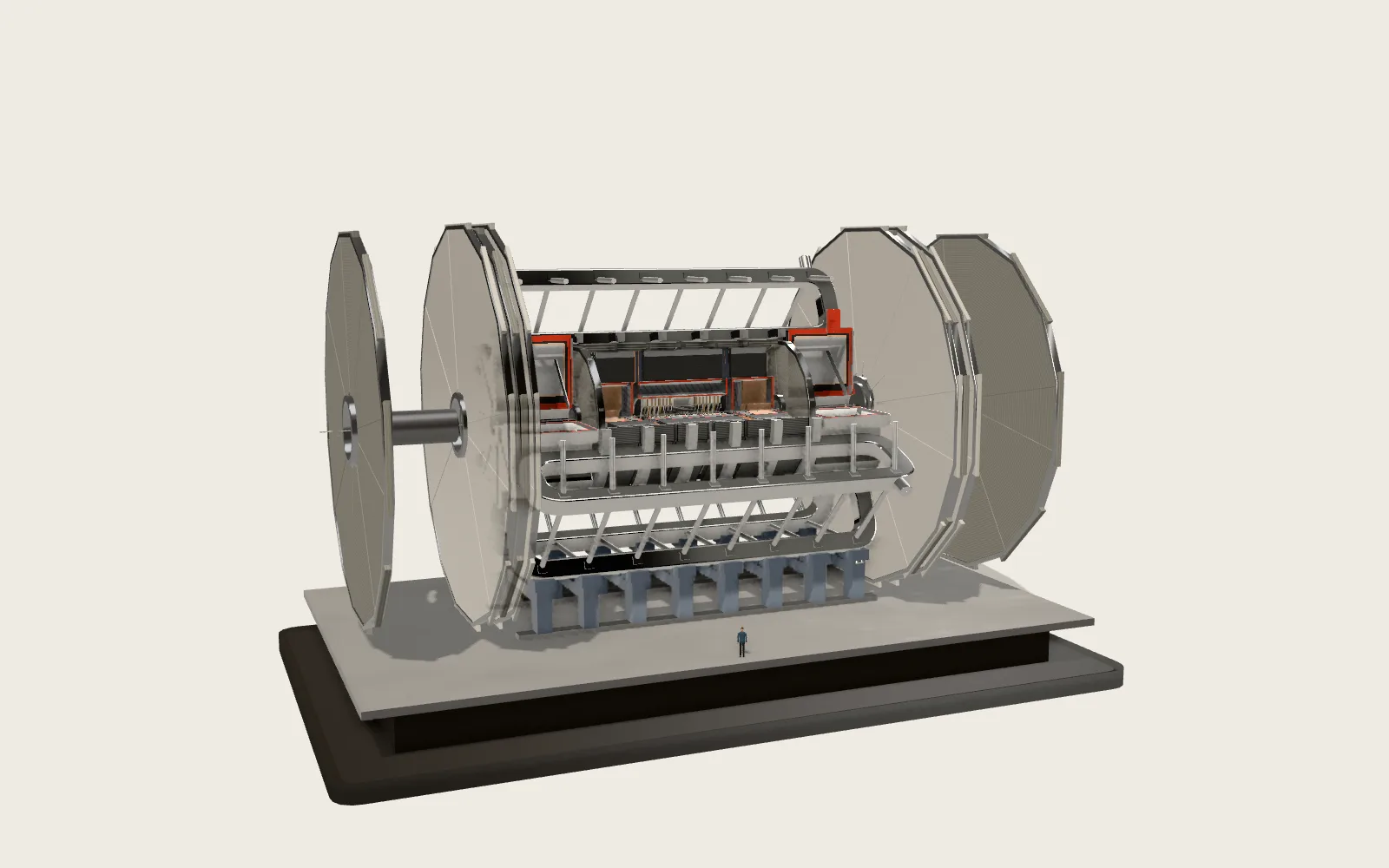 Plate F28ATLAS and the Higgs BosonThe Large Hadron Collider smashes protons head-on, and the energy of the collision becomes new particles. A Higgs boson decays as soon as it is made; ATLAS records the photons and leptons it leaves and works its mass back out.
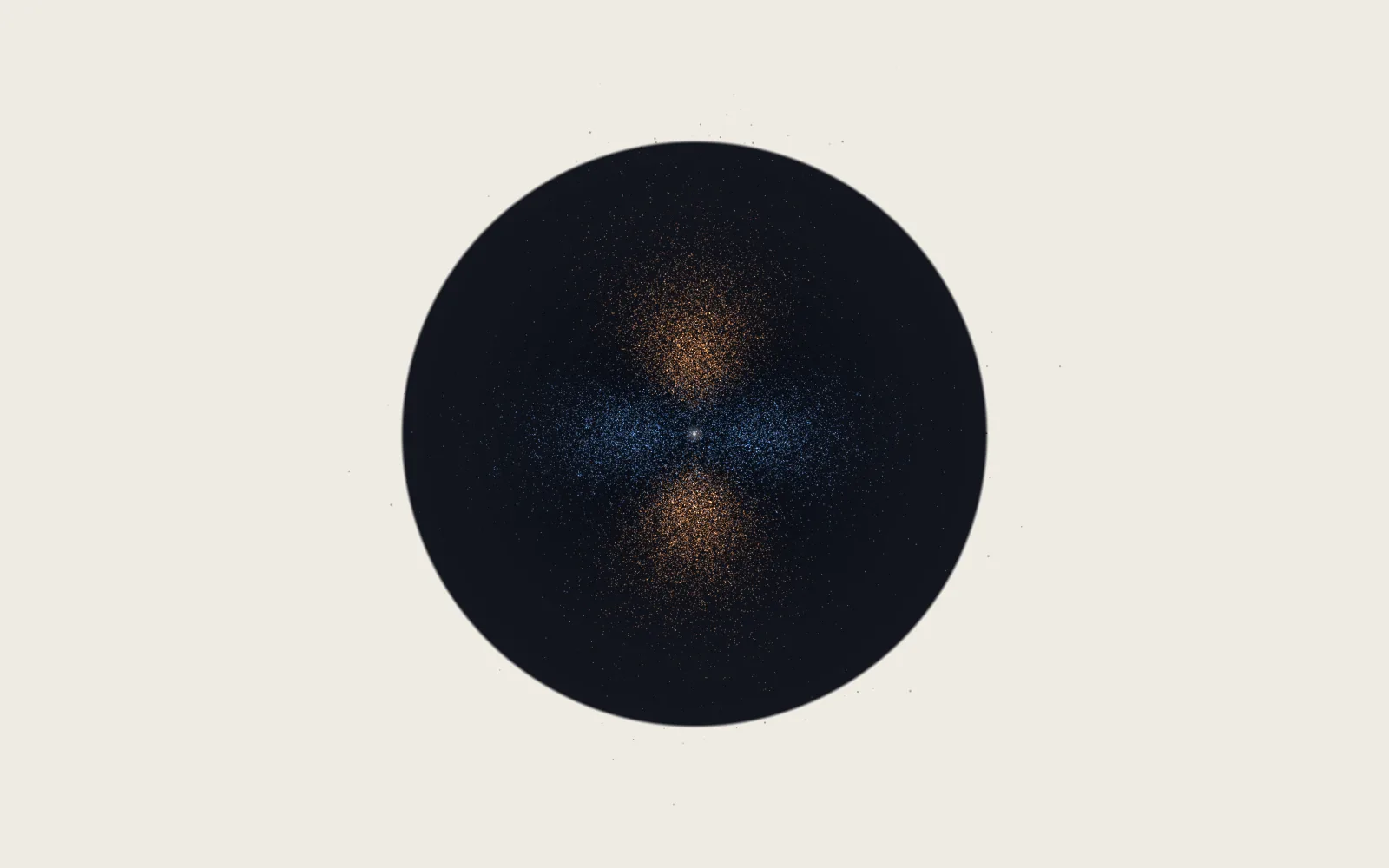 Plate 36Where Is the Electron?Textbooks often draw electrons as little balls circling the nucleus. In fact an electron has no orbit. It is more like a cloud: all we can say is where it is likely to be.