How Rain Carves a Mountain
A single storm changes almost nothing. But the rain never stops.
- Who it’s for
- Ages 9 to 14. No geography needed beforehand.
- Time
- 15 or 40 minutes
- You need
- A computer online and a projector; tablets help for the hands-on part
CC BY-NC 4.0Teachers may copy, adapt and print this page and the plate for class, with credit to world.lapla.si.
01Learning goals
- Describe how rain carves valleys: water takes the steepest way down and gathers, and the more water and the steeper the slope, the more soil it carries.
- Know that eroded soil is not lost: where the water slows, it settles, and at river mouths it builds new land.
- Show what rain and soil do with a fair test: change one thing at a time and keep everything else the same.
0215 minutes
To open or close a lesson: you project and talk it through.
- 0–2 min
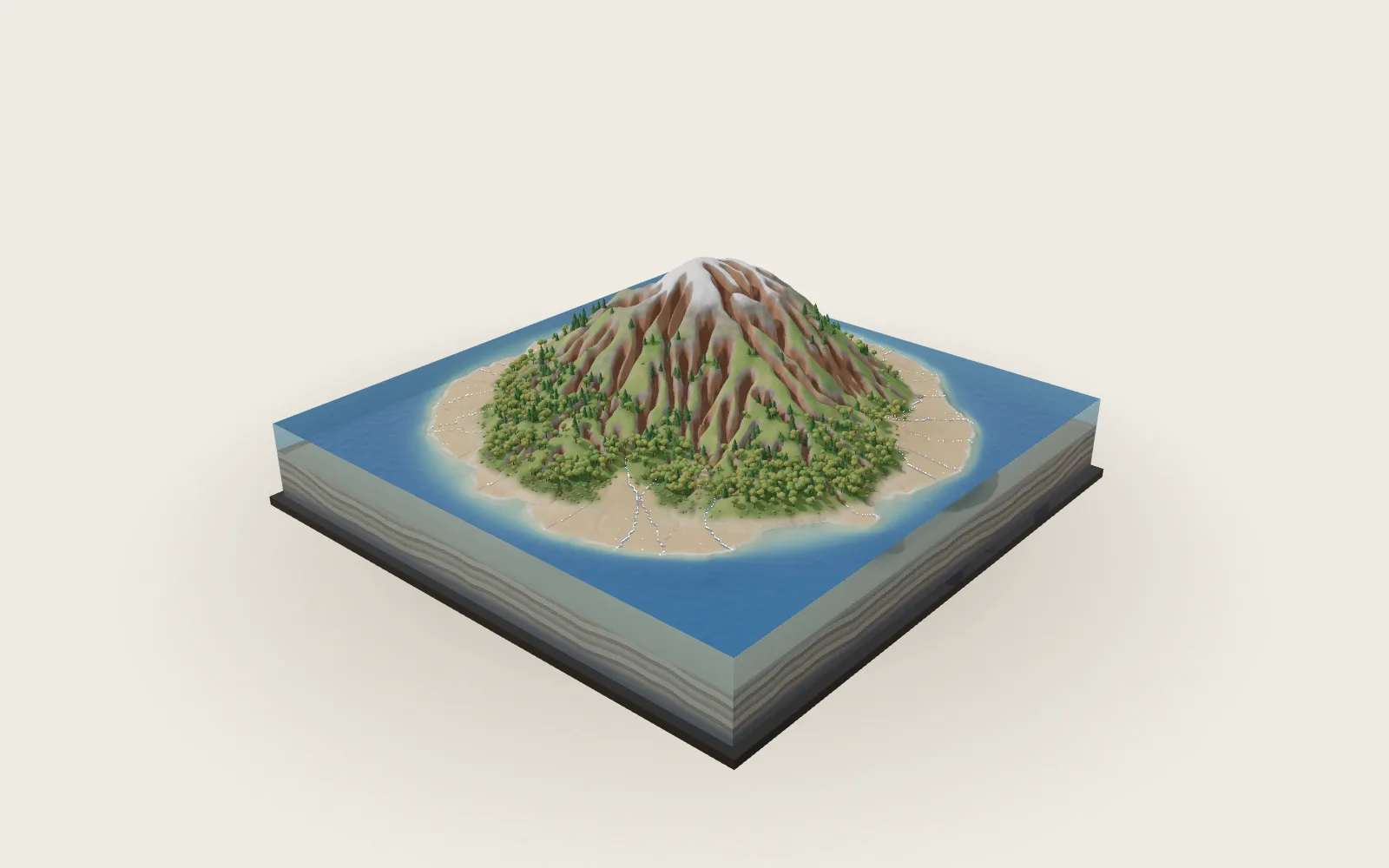
Project “A New Island”. Ask: when rain falls on this island, where does it go?
Chapter 01A New Island→ - 2–5 min
“Water Knows Only Downhill”: a student taps a slope and follows a raindrop to the sea, then taps another spot. Where do the two paths join?
Chapter 02Water Knows Only Downhill→ - 5–8 min
“The Valleys Deepen”: the ridges barely change while the valleys cut down. Ask: why does the water keep coming back to the same places?
Chapter 03The Valleys Deepen→ - 8–11 min
“Where the Soil Goes”: find the new land at the river mouths.
Chapter 04Where the Soil Goes→ - 11–15 min
“Grand Canyon: One River, Five or Six Million Years”: close on the misconception that valleys are cut by a single great storm.
Chapter 09Grand Canyon: One River, Five or Six Million Years→
0340 minutes
A whole lesson, with time for students to work the model and talk.
- 0–4 min
Open with a question: what wears a mountain down? Then project “A New Island”, with its smooth slopes and clean shoreline.
Chapter 01A New Island→ - 4–9 min
Students take turns tapping slopes and following raindrops. Where do their paths meet?
Chapter 02Water Knows Only Downhill→ - 9–14 min
“The Valleys Deepen” and “Where the Soil Goes”: where the soil is taken from, and where it settles.
Chapter 03The Valleys Deepen→ - 14–18 min
“A Forest Is a Net”: what roots and leaves do. Look at the low woodland: the slopes around it are scored with gullies, the forest floor largely intact.
Chapter 05A Forest Is a Net→ - 18–28 min
Hands-on, in pairs or at the board: the fair test below.
Chapter 10Your Turn→ - 28–32 min
“Before and After”: drag the divider. What survived, and what changed?
Chapter 06Before and After→ - 32–38 min
Three real places in the plate’s order: Taranaki (the beginning), Kauai (much later), the Grand Canyon. Students compare how deeply water has cut into each.
Chapter 07Taranaki: The Beginning→ - 38–40 min
Close: valleys are cut by countless ordinary rains over a very long time. Remind the class that the model compresses time, so its pace is not real years.
04Questions to ask
A raindrop lands on a slope. Which way does it go?
A good answerThe steepest way down. Wherever it meets other water they travel on together: rills become streams, streams become rivers, all the way to the sea.
Why do the valleys keep deepening while the ridges barely change?
A good answerThe ground is worn hardest where the water gathers, and the water keeps coming back to the same places, so each pass makes the next one easier. Little water runs over the ridges, so little soil leaves them.
Where does the soil washed off the slopes end up?
A good answerIt doesn’t vanish. When the water slows, on flat ground, in a lake or at the sea, it can no longer carry its load and the sediment settles. At river mouths it piles up until it becomes new land.
Why is erosion gentler where a forest grows?
A good answerRoots knit the soil together, and leaves and litter catch the rain, so more of it sinks into the ground instead of racing across the surface.
Was the Grand Canyon torn open by one great flood?
A good answerNo. The Colorado River has been cutting through that rock for five to six million years. The rock in the walls is far older than the canyon; the river has been uncovering it layer by layer.
05Hands-on
A fair test: what does more rain do?
- Go to the last chapter, “Your Turn”. Set “Place” to “Model island” and press “Back to the start”.
- Leave “Rainfall” and “Soil” at 1.0×. Press “Start the rain”, press “Stop the rain” when “Model steps” reaches a number agreed beforehand (1,000, say), and write down “Soil moved”.
- Press “Back to the start” and turn only “Rainfall” up to 3.0×. Let it rain to the same number of steps and write the result down again.
- Press “Back to the start” once more, set the rainfall back to 1.0×, and this time make only the “Soil” as loose as it goes. Repeat.
- Last, let it rain with “Forest” on and look at the low woodland. The slopes around it are cut by gullies; what about the ground under the trees?
Look forMore rain and looser soil both move more soil. A fair test keeps everything else the same, the island and the number of steps, and changes one thing at a time. Under the trees the ground stays largely intact.
06Common misconceptions
The ideaValleys are cut by a single great storm.
What the plate showsLandscapes are shaped mostly by countless ordinary rains over very long spans of time.
The ideaEroded soil is gone.
What the plate showsIt has only moved, and builds plains, fans and deltas somewhere else.
The ideaA canyon is as old as the rock in its walls.
What the plate showsThe oldest layers of the Grand Canyon formed nearly two billion years ago; the river cut the canyon in five or six million.
07Sources
The plate’s own. Every fact on this page comes from the plate and these sources.
08Use it in class
This page and the plate’s text, pictures and models are licensed CC BY-NC 4.0. You may copy, print and adapt them, hand them out to students and share them with colleagues, as long as you credit world.lapla.si (Laplace’s Mini World).
They may not be sold or used for other commercial purposes. Third-party data and pictures listed on the plate keep their own licences.
The licence in full (CC BY-NC 4.0) ↗