Hunting Dark Matter
Ten tonnes of liquid xenon, about 1.5 km down a former gold mine, wait for one faint collision: a dark-matter particle striking a xenon nucleus.
Scroll
Seeing nothing is a result
About 85 % of the matter in the universe gives off no light and shows itself only through gravity: stars at the edges of galaxies orbit too fast, and distant light is bent by mass no one can see. What this dark matter is, nobody knows. One idea is a heavy particle that barely interacts with ordinary matter, called a WIMP; it is one candidate among several.
LZ waits for such a particle to strike a xenon nucleus. In the results published in 2024, 280 live days and 4.2 tonne-years of exposure showed no more events than the backgrounds explain. For a WIMP of 40 GeV/c², a cross section with nucleons larger than 2.2 × 10⁻⁴⁸ cm² would have been seen (at 90 % confidence). This is an upper limit, not a discovery.
2.2 × 10⁻⁴⁸ cm² · 40 GeV/c² · 90 % upper limit (2024)
Nearly a mile of rock
LZ sits at the Sanford Underground Research Facility (SURF) in Lead, South Dakota, in the Davis Cavern 4,850 ft (about 1,478 m) down. This was the Homestake gold mine, worked for more than a century; on this same level Ray Davis caught neutrinos from the Sun in a 100,000-gallon tank of perchloroethylene, work that won the 2002 Nobel Prize in Physics. LZ’s predecessor, LUX, used the same water tank from 2013 to 2016.
At the surface, muons made by cosmic rays cross each square centimetre about once a minute. The rock overhead is worth 4,300 m of water, and down here there are about three million times fewer: LZ itself counts about 11 muons a day crossing the detector. The rock stops cosmic rays; it cannot stop the radioactivity of the detector’s own materials, the xenon itself, or neutrinos.
4,850 ft ≈ 1,478 m · 4,300 m water equivalent · about 11 muons a day
Two flashes
At the heart of LZ is a time projection chamber: a cylinder 1.456 m tall and 1.456 m across holding 7 tonnes of liquid xenon at about −99 °C. When a particle strikes a xenon nucleus (or an electron), that spot gives off a flash of ultraviolet light at about 178 nm, called S1. Two arrays of photomultiplier tubes, above and below, record it.
The same collision frees some electrons. A vertical electric field in the cylinder (97 V/cm in 2024) pushes them upwards at about 1.4 mm per microsecond. At the liquid surface a stronger field pulls them into the 8 mm of xenon gas between the surface and the anode, where they make a second, brighter flash, called S2. The time between the two flashes is the distance the electrons travelled.
S1: the flash in the liquid · S2: the electrons’ light in the gas · up to about 1,050 μs
Where it happened
The electrons drift at a steady speed, so the microseconds between S1 and S2 say how deep below the surface the event was. The S2 is made just below the top array, and the tubes right above it get the most light: where the light falls gives the event’s position across the chamber.
In the 2022 data, with a bright enough S2, the position across was known to about 4 mm, and near the cathode the depth to about 0.7 mm. Knowing where each event happened, the analysis can keep only the quietest xenon in the middle.
depth = drift time × about 1.4 mm/μs · across: about 4 mm · depth near the cathode: about 0.7 mm (2022)
Nucleus or electron
A WIMP would knock a nucleus, and so does a neutron; gamma rays and beta decays knock an electron. For the same S1, an electron recoil frees more electrons and gives a larger S2; a nuclear recoil gives a much smaller one. The ratio of S2 to S1 tells the two kinds apart.
The separation is not perfect: the design assumed 99.5 % of electron recoils rejected while half of the nuclear recoils are kept. The 1,220 events left in the 2024 data are almost all electron recoils and form a band on the chart; nuclear recoils would fall below it.
electron recoils: large S2/S1 · nuclear recoils: small S2/S1 · design: 99.5 % of electron recoils rejected
Cut open: layer within layer
From the outside in: a water tank 7.6 m across holds 238 tonnes of ultrapure water; standing in it, ten acrylic tanks hold 17 tonnes of liquid scintillator loaded with 0.1 % gadolinium, about 61 cm thick; inside them, two titanium vessels with a vacuum between them for insulation; and at the centre, the time projection chamber full of liquid xenon.
Both titanium vessels were made from a single 5-tonne slab of titanium chosen for its low radioactivity. There are 10 tonnes of xenon in all: 7 in the time projection chamber, and about 2 more in the “skin” around it, which has its own photomultipliers and spots gamma rays coming in from outside.
water 238 t · scintillator 17 t · titanium cryostat · xenon 10 t (7 t in the chamber)
Why xenon
Xenon’s nucleus is heavy: atomic number 54, average mass number about 131. For the kind of interaction in which a WIMP scatters off the whole nucleus at once, the cross section grows with the square of the mass number, and a heavy nucleus wins. Liquid xenon is about 2.88 g/cm³, and gamma rays coming in scatter within a few centimetres: at 1 MeV they travel only 6 cm on average.
So the outer xenon shields the middle from most gammas and neutrons. The analysis uses only a central “fiducial volume”: in 2022 it dropped events within 4 cm of the wall, within 12.8 cm of the gate and within 2.2 cm of the cathode, leaving 5.5 tonnes. Xenon is not quite free of radioactivity: xenon-136 and xenon-124 decay so slowly that their half-lives are over a hundred billion times the age of the universe, and both are counted among the backgrounds.
Z = 54 · 2.88 g/cm³ · 1 MeV gammas: 6 cm on average · fiducial 5.5 t
494 eyes
Above and below the chamber sit arrays of 3-inch photomultiplier tubes: 253 at the top, in the gas, looking down, hexagonal in the middle and in rings at the edge; 241 at the bottom, in the liquid, looking up, closely packed. They can register a single photoelectron.
The gaps between the tubes are covered with white PTFE (Teflon); the field cage’s inner wall is PTFE too and reflects about 97 % of the ultraviolet light in liquid xenon, so more of it reaches a tube. The skin has 131 smaller tubes of its own, and the outer detector watches its scintillator with 120 8-inch tubes.
253 + 241 3-inch tubes · skin 131 · outer detector 120 8-inch tubes
The outer layer
A neutron striking a nucleus looks much like a WIMP. But a neutron rarely stops after one hit: usually it leaves the chamber, enters the scintillator outside and is captured by gadolinium, which gives off about 8 MeV in all, in 4.7 gamma rays on average. The scintillator glows, and the photomultipliers in the water see it.
With gadolinium, a thermal neutron is captured in about 30 μs on average (about 200 μs without). If the outer detector sees a signal in a window after the S1, the event is thrown out. Calibrated with a neutron source in 2024, the outer detector caught 89 % of the neutrons. A WIMP hits once and leaves no trace outside.
gadolinium capture about 8 MeV · about 30 μs · 89 % of neutrons caught (2024)
What still gets in
The hardest background is radon. Radon-222 seeps out of all kinds of materials into the flowing xenon; its daughter lead-214 beta-decays in the middle of the liquid, and that is an electron recoil. Of the 1,210 background events expected in the 2024 data, 743 came from it. LZ tracks where radon decays, to mark where its lead-214 is likely to turn up.
Then there are the neutrinos no shield can stop. Solar pp neutrinos knock electrons; boron-8 neutrinos from the Sun scatter off the whole xenon nucleus and look like a WIMP of about 5–6 GeV/c². In 2025 LZ saw them in 417 live days, at a significance of 4.5σ. At still smaller cross sections, neutrinos become ever harder to tell from a signal, a region called the “neutrino fog”: sensitivity still improves there, but it takes far more data.
lead-214: 743 of 1,210 (expected, 2024) · boron-8 neutrinos 4.5σ (2025)
What the results say
By 2025, LZ had seen no WIMPs anywhere between 3 and 10,000 GeV/c². On the chart, cross sections above the line are excluded and those below it are still allowed: these are upper limits, not measurements. The limits also depend on what is assumed about the dark matter in the Galaxy, usually 0.3 GeV per cubic centimetre near the Sun.
Seeing nothing does not mean there is no dark matter: the evidence for it is gravitational and does not depend on LZ. What LZ rules out are WIMPs of certain masses and interaction strengths. In September 2026 LZ reported one high-energy event it cannot explain, at a global significance of 2.6σ, in a paper not yet peer reviewed; the collaboration says it is not claiming to have seen dark matter, and a discovery in physics needs 5σ. The plan is over 1,000 live days by 2028; the next detector, XLZD, would hold 60 tonnes of xenon.
90 % upper limits · a discovery needs 5σ · the 2026 event: 2.6σ (preprint)
Taken apart
The water tank’s lid, the outer detector’s acrylic tanks, the outer and inner titanium vessels, the time projection chamber and its two arrays of photomultipliers rise one out of another.
Point at a part (tap it on a phone) and it lifts on its own, with its name; the rest fade.
Place an event
The lever sets how deep below the liquid surface the event happens. The S1 comes at once; the electrons drift up at about 1.4 mm per microsecond, and only at the surface is there an S2. The times in the readout are this page’s, from the 2024 drift speed: the deeper the event, the longer the wait, about 1,050 μs from the very bottom.
Nuclear and electron recoils differ in the S2: for the same S1, an electron recoil’s S2 is much larger. The shape of the signals is schematic.
Try thisPut the event at the bottom: how many microseconds between the two flashes? Switch to an electron recoil: what happens to the S2?
What the model leaves out
The model is at 1:8. The sizes of the water tank, the outer detector’s side tanks, the two titanium vessels and the time projection chamber are the collaboration’s published numbers; the shapes of the top and bottom tanks, the vessels’ heads, flanges and bolts, the conduits’ routes, the ladders and the supports follow the papers’ drawings and are schematic. The water is left out except for its surface. The acrylic tanks are drawn as pale green solid blocks; the real tanks are clear and the scintillator in them is nearly colourless. The PMT arrangement is generated by this page as the paper describes it (hexagonal in the middle and in rings at the edge at the top, closely packed at the bottom); it is not the real coordinates. Xenon’s light is invisible ultraviolet and is drawn violet; the event is slowed down enormously, and the readouts give real times. The light on each PMT comes from this page’s simple light model (straight lines, total reflection at the liquid surface, no reflections from the PTFE), and the cross on the position map is the light-weighted centre. The gamma hits, the neutron’s path and its capture are drawn by this page; the shapes and heights of the signal traces are schematic too. The limit curves and the 2024 events are LZ’s public data; the blue line on the events is the middle this page computed from them.
Common misconceptions
“LZ found dark matter” is wrong: every result so far agrees with backgrounds alone; the 2026 event has a global significance of only 2.6σ, and a discovery needs 5σ. Seeing nothing does not show there is no dark matter: the evidence is gravitational. Nor are WIMPs “ruled out”: what is excluded is the region above the line on the chart. A limit is not a measurement of the cross section. The neutrino fog is not a hard floor; more data can still push slowly into it. Dark matter is about 85 % of the matter and about a quarter of all the energy in the universe, not 85 % of the universe. Xenon is not free of radioactivity; two of its isotopes just decay extremely slowly. Underground is not free of cosmic rays: about 11 muons a day still cross the detector. The S2 is not a particle hitting the gas but the light of electrons freed in the liquid and drifted into the gas. The outer detector does not detect dark matter; it recognises neutrons. Of the 10 tonnes of xenon, the analysis uses the central 5.5. The drift field was designed for 300 V/cm and ran at 193 V/cm in 2022 and at 97 V/cm since 2023.
Common questions · 4
- How deep underground is the LZ detector?
LZ sits at the Sanford Underground Research Facility (SURF) in Lead, South Dakota, in the Davis Cavern 4,850 ft (about 1,478 m) down.
02Nearly a mile of rock ↑- How does LZ record a collision?
When a particle strikes a xenon nucleus (or an electron), that spot gives off a flash of ultraviolet light at about 178 nm, called S1.
03Two flashes ↑- Has LZ found dark matter?
By 2025, LZ had seen no WIMPs anywhere between 3 and 10,000 GeV/c².
11What the results say ↑- What is the neutrino fog?
At still smaller cross sections, neutrinos become ever harder to tell from a signal, a region called the “neutrino fog”: sensitivity still improves there, but it takes far more data.
10What still gets in ↑
Sources
- LZ Collaboration (2020): The LUX-ZEPLIN (LZ) Experiment, NIM A 953, 163047 (25 ft × 20 ft water tank; 10 acrylic vessels; titanium cryostat; 1.456 m; 58 PTFE layers; 253 + 241 R11410-22; 120 8-inch tubes)
- LZ Collaboration (2017): LUX-ZEPLIN (LZ) Technical Design Report (side tanks 97.5–163.5 cm; vessel sizes; 178 nm)
- LZ Collaboration (2020): Projected WIMP sensitivity of the LZ dark matter experiment, Phys. Rev. D 101, 052002 (design: 99.5 % electron recoils rejected; 1,000 days, 1.4 × 10⁻⁴⁸)
- LZ Collaboration (2023): First Dark Matter Search Results from the LZ Experiment, Phys. Rev. Lett. 131, 041002 (60 days; −99 °C; 193 V/cm; 4 mm, 0.7 mm; fiducial 5.5 t)
- LZ Collaboration (2025): Dark Matter Search Results from 4.2 Tonne-Years of Exposure of the LZ Experiment, Phys. Rev. Lett. 135, 011802 (280 days, 4.2 t·yr; 2.2 × 10⁻⁴⁸ at 40 GeV/c²; 97 V/cm; 1,220 events; background table)
- LZ Collaboration (2026): Searches for Light Dark Matter and Evidence of Coherent Elastic Neutrino-Nucleus Scattering of Solar Neutrinos, Phys. Rev. Lett. 137, 091806 (417 days; boron-8 neutrinos at 4.5σ)
- LZ Collaboration (2026, preprint): Search for dark matter particle interactions in an extended nuclear recoil energy window, arXiv 2609.02823 (one event; 2.6σ global)
- LZ Collaboration (2023): Background Determination for the LZ Dark Matter Experiment, Phys. Rev. D 108, 012010 (4,300 m water equivalent; backgrounds mainly internal)
- LZ Collaboration (2026, preprint): Measurement of the Muon Flux at SURF with the LZ Detector, arXiv 2602.16799 (10.94 muons a day)
- LZ Collaboration (2017): Identification of Radiopure Titanium for the LZ Dark Matter Experiment, Astropart. Phys. 96, 1
- Linehan et al. (2022): Design and production of the high voltage electrode grids and electron extraction region for the LZ TPC, NIM A 1031, 165955 (extraction field)
- LZ Collaboration (2024): The Design, Implementation, and Performance of the LZ Calibration Systems, JINST 19, P08027
- Heise (2026): Construction and Science of SURF, Annu. Rev. Nucl. Part. Sci. 76, 69 (depth; LUX 2013–2016)
- SURF: LUX-ZEPLIN (experiment page)
- SURF: Our Story (the Homestake mine, 1876–2001)
- SURF (2025): LZ sets a world’s best in the hunt for galactic dark matter (over 1,000 days by 2028; into the neutrino fog)
- DOE Office of Science (2026): LZ Sees Surprising Result in Search for Dark Matter (not 5σ; “We are not claiming to have seen dark matter”)
- Nobel Prize: The Nobel Prize in Physics 2002 (Raymond Davis Jr.)
- Baudis, Profumo (PDG, 2025): Dark Matter (evidence; WIMPs; about 84 % of matter; coherent A² enhancement)
- PDG (2022): Cosmic Rays (about one muon per cm² per minute at sea level)
- Planck Collaboration (2020): Planck 2018 results. VI. Cosmological parameters, A&A 641, A6 (Ω_c h² = 0.1200)
- Baxter et al. (2021): Recommended conventions for reporting results from direct dark matter searches, Eur. Phys. J. C 81, 907 (0.3 GeV/cm³)
- O’Hare (2021): New Definition of the Neutrino Floor for Direct Dark Matter Searches, Phys. Rev. Lett. 127, 251802 (the neutrino fog)
- NeutrinoFog (MIT License, © 2019 cajohare): the xenon neutrino-fog boundary data
- NIST XCOM: Photon Cross Sections Database (xenon’s gamma attenuation; this page computes the mean free paths from it)
- XLZD Collaboration (2025): The XLZD Design Book, Eur. Phys. J. C 85, 1192 (60 t)
- HEPData: LZ 2022 data (CC0)
- HEPData: LZ 2024 data, limit curve and 1,221 event rows (CC0)
- HEPData: LZ 2025 light-dark-matter data (CC0)
Data
The model follows the LZ collaboration’s description of the detector (The LUX-ZEPLIN (LZ) Experiment, NIM A 953, 163047, 2020, and the Technical Design Report): the water tank, the outer detector’s acrylic vessels, the titanium cryostat, the TPC with its 253 and 241 PMTs. Where no size is published, it is read off their drawings; the notes list what is simplified. The limit curves and the WS2024 events are LZ’s public data on HEPData (records 144760, 155182, 167350; CC0). The neutrino fog’s boundary for xenon is from C. A. J. O’Hare’s NeutrinoFog (MIT License, © 2019 cajohare). The PMT positions, the light on each PMT, the drift times, the gamma hits and the neutron’s path are computed or drawn by this page. Material presets, parts and the softbox studio of the site’s model kit are ported from AirsupHQ/machine-skill (MIT, © 2026 Air Supply Technologies Inc.).
The text, pictures and models on this page are licensed CC BY-NC 4.0: free to use and adapt for teaching and other non-commercial purposes, with credit to world.lapla.si. Third-party material listed above keeps its own licence.
Cite this plate
Laplace’s Mini World, Plate F48, “Hunting Dark Matter”, https://world.lapla.si/en/darkmatter/, CC BY-NC 4.0, updated 2026-10-26.
Follow the question
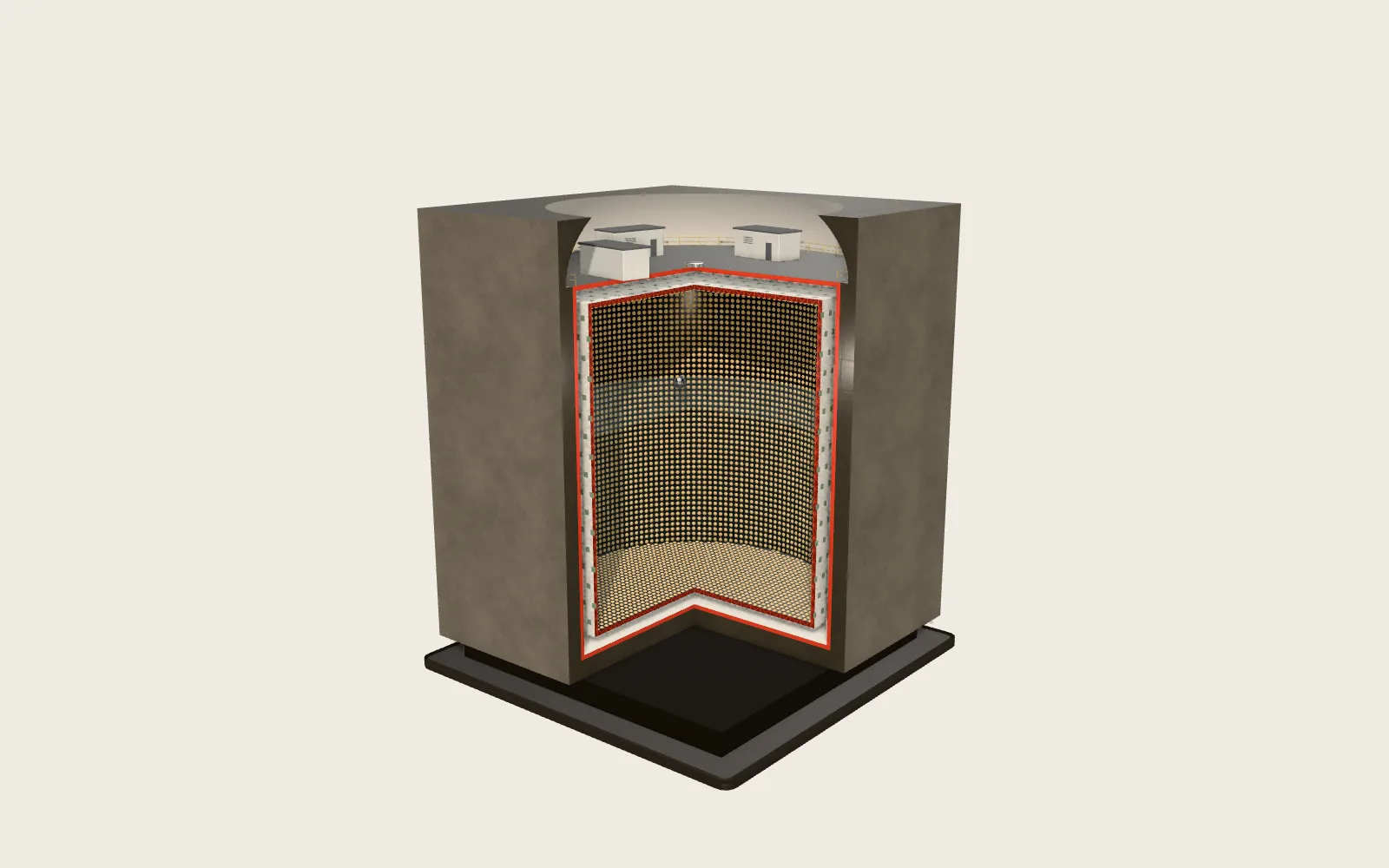 Plate F30Neutrinos in Water and IceNeutrinos hardly touch matter. Super-Kamiokande fills a tank with 50,000 tonnes of pure water under a kilometre of rock; IceCube hangs 5,160 optical modules in the Antarctic ice. Both wait for the rare neutrino that hits a nucleus and leaves a ring of light.
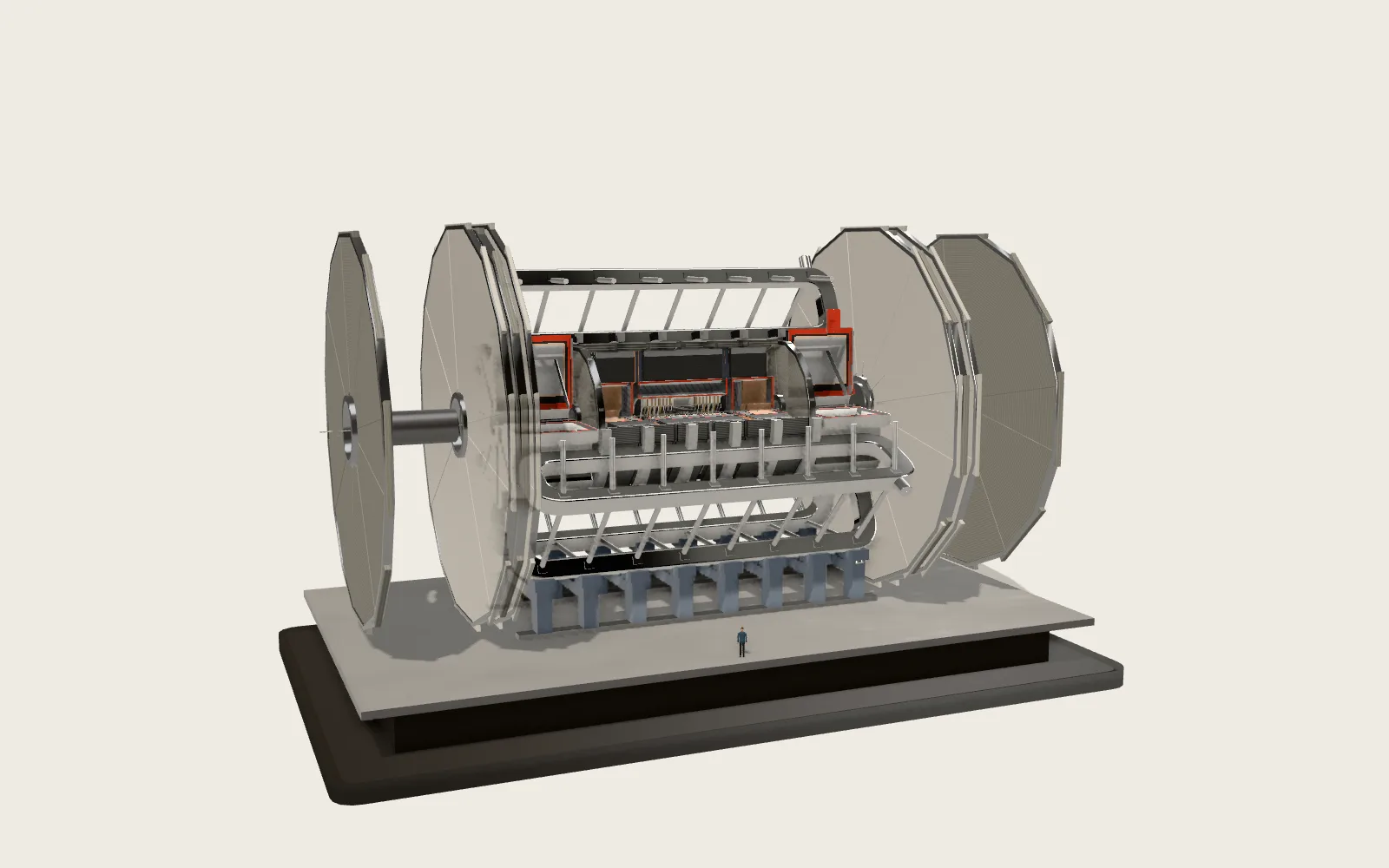 Plate F28ATLAS and the Higgs BosonThe Large Hadron Collider smashes protons head-on, and the energy of the collision becomes new particles. A Higgs boson decays as soon as it is made; ATLAS records the photons and leptons it leaves and works its mass back out.