Opposite Points, Same Weather
At any moment there are two exactly opposite points on Earth with the same temperature and the same pressure. It follows from the shape of a sphere, not from the weather.
Scroll
Two Opposite Points on the Equator
Start with a circle. Go round the equator, and every place has a temperature T(x). Call the point exactly opposite −x.
Let h(x) = T(x) − T(−x). Swapping x for −x swaps the two terms, so h changes sign: h(−x) = −h(x). If h is positive at x, it is negative at −x.
Going along the equator from x to −x, h goes from positive to negative, so somewhere on the way it is 0 (the intermediate value theorem). There, the two opposite points have the same temperature.
On the model, the two needles on the steel ring always point at the two ends of a diameter. The globe turns beneath them, and pauses when the difference between the two ends is 0.
Temperature and Pressure at Once
Every point of the Earth’s surface has two numbers, temperature and pressure. Together they are a map from the sphere S² to the plane R², f(x) = (T(x), p(x)).
The Borsuk–Ulam theorem: if f is continuous, there is a point x with f(x) = f(−x). At any moment, then, there are two opposite points on Earth with the same temperature and the same pressure.
The red line runs through the points where T(x) = T(−x), the blue line where p(x) = p(−x). Each is symmetric through the centre: if x is on it, so is −x. Where they cross are the points we want, in pairs; the needles rest on one pair.
The theorem holds in every dimension: a continuous map from the n-sphere Sⁿ to Rⁿ sends some pair of opposite points to the same point. It was first put forward as a conjecture by Ulam and proved by Borsuk in 1933.
Why There Must Be One
Let g(x) = f(x) − f(−x). It satisfies g(−x) = −g(x); such a map is called odd. What has to be shown is that g has a zero.
Suppose g is never zero, and watch its direction. From x along the equator to −x, g ends up reversed, so its direction has turned through an odd number of half turns; the second half of the way mirrors the first and turns just as far. Over the whole circle g goes round the origin an odd number of times, never 0.
Now shrink the circle towards the North Pole. As long as g is not zero on the way, the count can only change continuously, and it is a whole number, so it stays the same. But shrunk to the pole the loop is a single point, and the count is 0. An odd number is not 0, so g must have a zero.
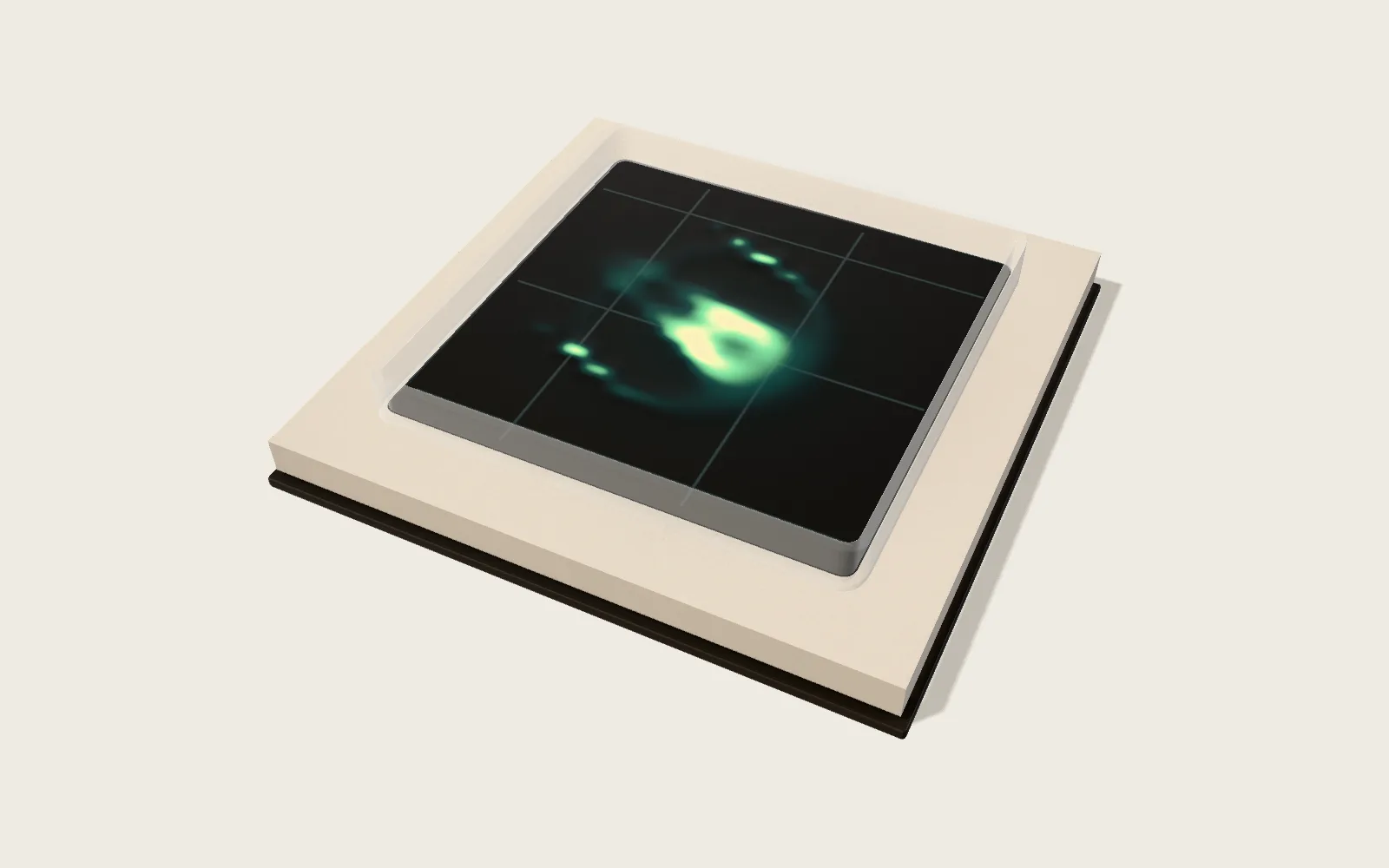
The figure shows the image of the latitude loop in the (ΔT, Δp) plane. Each time the loop sweeps over a zero the count changes, and at the pole it is 0. So in general there is an odd number of such pairs.
One Cut, Three Halves
Take any three solid things in space. There is always one plane that cuts each of them into two halves of equal volume. This is the ham sandwich theorem: bread, ham and cheese, one cut, all three halved.
The proof is Borsuk–Ulam. For each direction u, take the plane at right angles to u that halves the brass, and note how much of the porcelain and of the ebony lies on one side of it. That is a map from S² to R².
For −u it is the same plane with its sides swapped. So some direction u leaves both sides with equal shares: the porcelain and the ebony are halved too.
Each of the three in the case is several spheres; the pieces need not touch, and the theorem still holds. While it searches, the plane always halves the brass; the readout is the share of each solid on one side.
Two People, One Necklace
An open necklace carries two kinds of stones, an even number of each. Two people want to share each kind equally. How few cuts will do?
Think of the necklace as a segment. Take a point x = (x₁, x₂, x₃) on the sphere and cut the segment into three pieces in the proportions x₁², x₂², x₃². Pieces with a positive coordinate go to the first person, negative ones to the second.
How many of each stone the first person gets is a map from S² to R²; −x swaps the two people. The theorem gives an x where both get the same, with at most two cuts. If a cut falls inside a bead, it can be moved to a gap between beads and the split stays fair.
This necklace has 8 garnets and 10 pearls. One cut cannot share them fairly; two cuts give each person 4 garnets and 5 pearls. With k kinds of stone, k cuts are enough; shared among q people (each count a multiple of q), (q − 1)k cuts.
Three Pieces Are Not Enough
Four closed regions can cover the sphere with no pair of opposite points in any one of them: project a regular tetrahedron from its centre onto the sphere, and take its four faces.
Three cannot. If three closed sets cover the sphere, one of them contains a pair of opposite points. This is Lyusternik and Schnirelmann’s result of 1930, and it is equivalent to the Borsuk–Ulam theorem.
From Borsuk–Ulam: call the three sets A₁, A₂, A₃ and let f(x) = (distance from x to A₁, distance from x to A₂). Some x has f(x) = f(−x). If the first distance is 0, x and −x are both in A₁; if the second is, both are in A₂; if neither, both lie outside A₁ and A₂, so both are in A₃.
On the model, two of the four regions merge into one, and the needles’ two ends land in the same region.
The Bench
The warm, cold, high and low pins on the globe can be dragged; the weather changes with them, and the needles on the ring find a pair of points with equal temperature and pressure. On a phone, a tap on the globe brings the nearest pin there. The three groups of spheres in the case can be dragged along its floor, and the cut follows. “Shuffle” deals a new random weather. The readouts are the temperature and pressure at both ends, and how many such pairs there are.
Try thisIf temperature, pressure and humidity are compared at once, is a pair of opposite points with all three equal still guaranteed?
What the model leaves out
The weather is made up: temperature falls with latitude, plus two warm and two cold blobs and one planetary wave; pressure has its belts, two highs, two lows and a wave. Real temperature and pressure need not be continuous everywhere (they change steeply across a front), and the theorem needs continuity. The globe is a true sphere; the coastlines are decoration and play no part in the weather. Readouts show one decimal; the computed pair agrees to better than a millionth of a degree.
Easy to misread
Opposite points are the two ends of a diameter: opposite latitudes and longitudes 180° apart, not two points on the same latitude. The theorem only says such a pair exists, not where; when the weather changes, the pair moves. Two quantities are the limit: add a third, such as humidity, and in general no pair agrees in all three. The ham sandwich theorem halves volumes and asks for no symmetry of shape; in n dimensions it halves n things at once.
Sources
- Karol Borsuk (1933), Drei Sätze über die n-dimensionale euklidische Sphäre, Fundamenta Mathematicae 20: 177–190 (Satz II and note 7: Ulam’s conjecture; Satz III: n + 1 closed sets)
- Jiří Matoušek (2003), Using the Borsuk–Ulam Theorem, Springer Universitext (Theorems 2.1.1 and 3.1.1; necklaces in Chapter 3)
- C. H. Goldberg, D. B. West (1985), Bisection of Circle Colorings, SIAM J. Algebraic Discrete Methods 6: 93–106
- N. Alon, D. B. West (1986), The Borsuk–Ulam Theorem and Bisection of Necklaces, Proc. AMS 98: 623–628
- N. Alon (1987), Splitting Necklaces, Advances in Mathematics 63: 247–253
- A. H. Stone, J. W. Tukey (1942), Generalized “sandwich” theorems, Duke Math. J. 9: 356–359
- W. A. Beyer, A. Zardecki (2004), The Early History of the Ham Sandwich Theorem, Amer. Math. Monthly 111: 58–61
- Coastlines: ETOPO1, NOAA
Data
Karol Borsuk proved the theorem in “Drei Sätze über die n-dimensionale euklidische Sphäre”, Fundamenta Mathematicae 20 (1933), where the equal-values form is credited as a conjecture of Stanisław Ulam; the covering form is in L. Lusternik and L. Schnirelmann’s 1930 monograph. The proofs and applications follow Jiří Matoušek, Using the Borsuk–Ulam Theorem (Springer, 2003); the necklace theorem is due to C. H. Goldberg and D. B. West (1985), with the short Borsuk–Ulam proof of N. Alon and D. B. West (1986) and the many-thief version of N. Alon (1987). The weather on the globe is made up for this page; the coastlines come from ETOPO1 (NOAA). The globe, the caliper, the case and the necklace are our own model; the 3Blue1Brown videos served only as a reference.
The text, pictures and models on this page are licensed CC BY-NC 4.0: free to use and adapt for teaching and other non-commercial purposes, with credit to world.lapla.si. Third-party material listed above keeps its own licence.
Watch next
The player comes from YouTube and loads only when you press play.
Follow the question
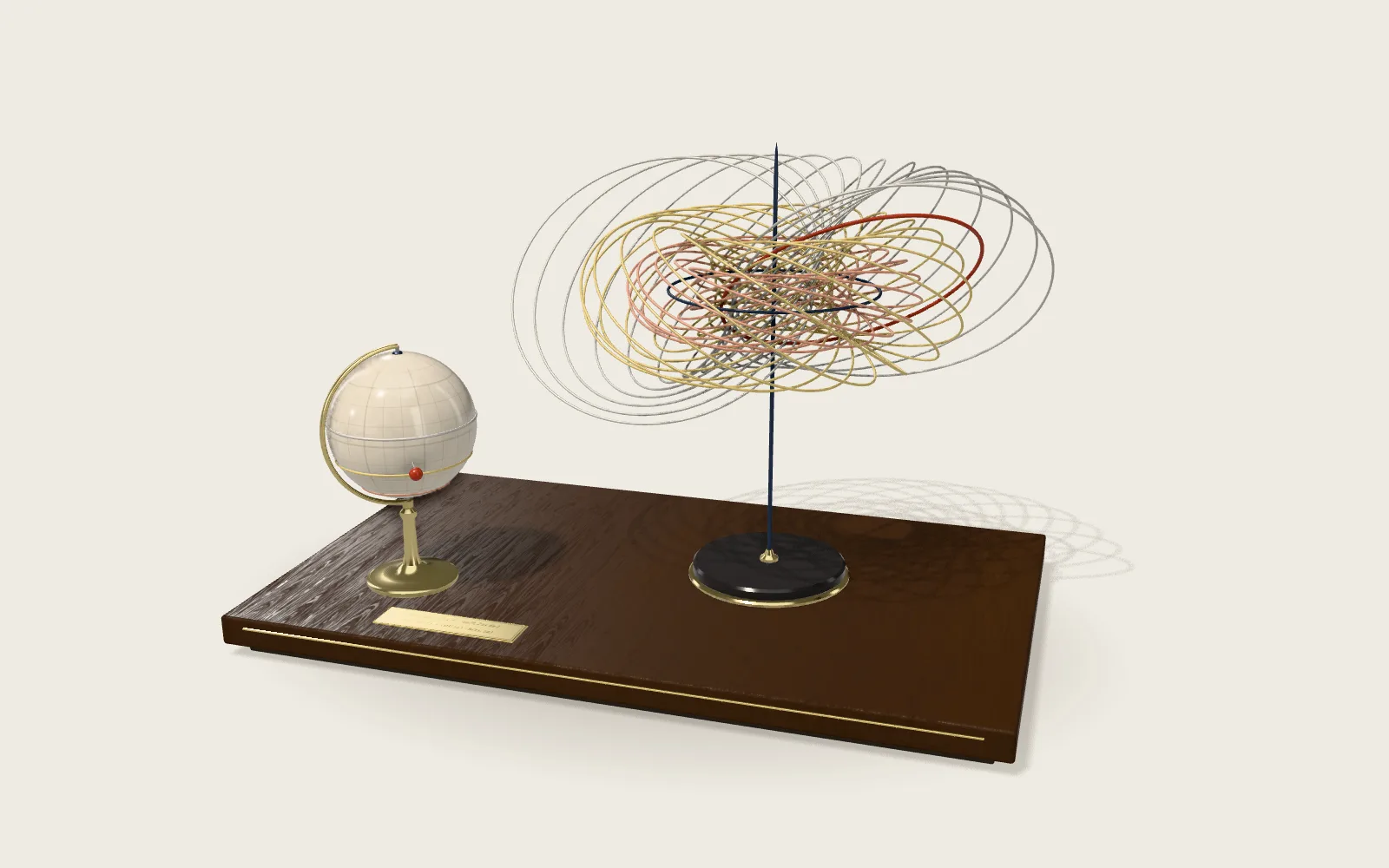 Plate M12Every Two Circles LinkedThe three-dimensional sphere in four-dimensional space falls apart into circles that never meet, one for each point of an ordinary sphere. Projected into three dimensions, every two of them are linked.
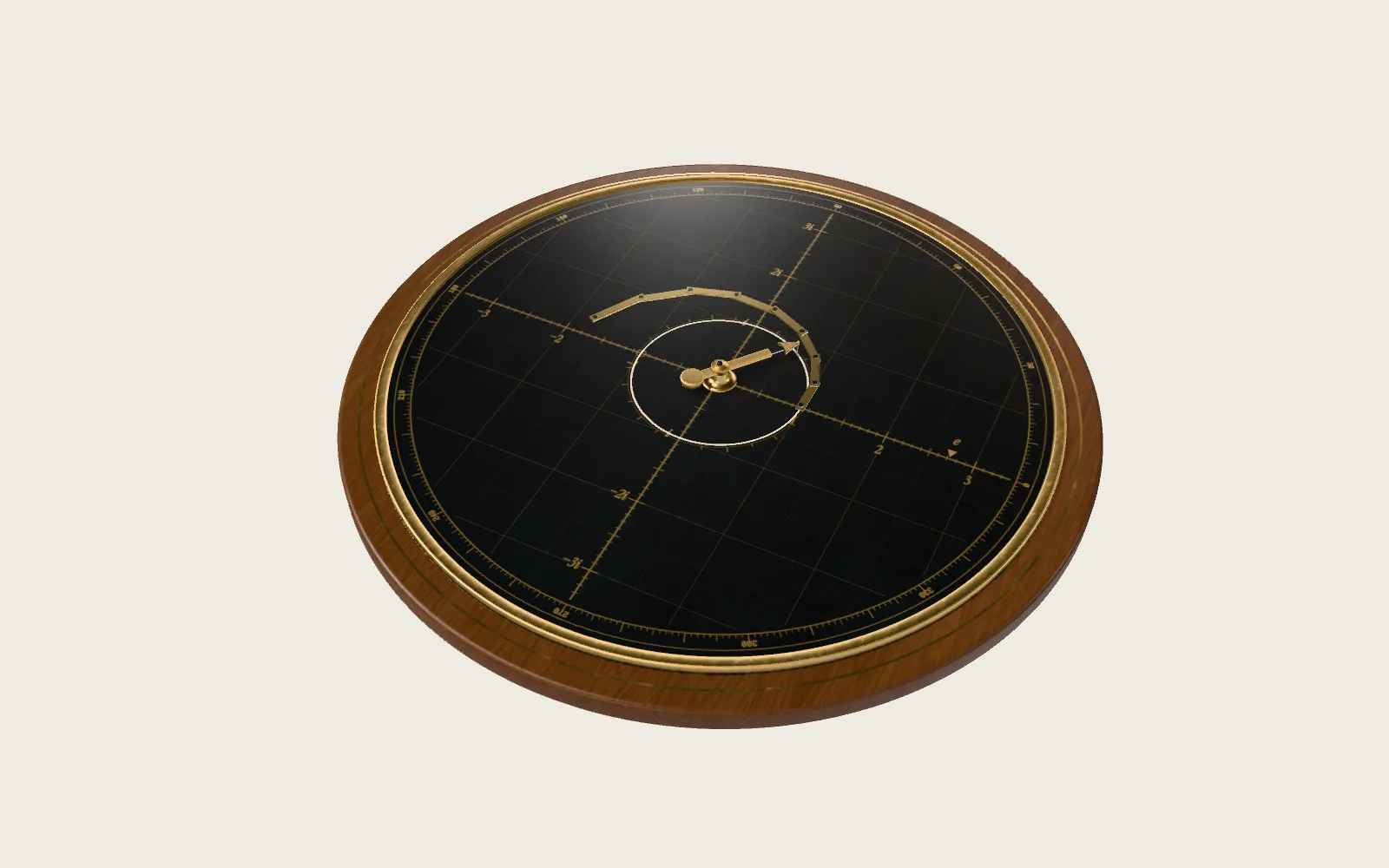 Plate M06Half a Turn Is e to the iπeⁱᵗ is a point walking round the unit circle at a steady pace, its velocity always i times its position. After time π it is at −1.