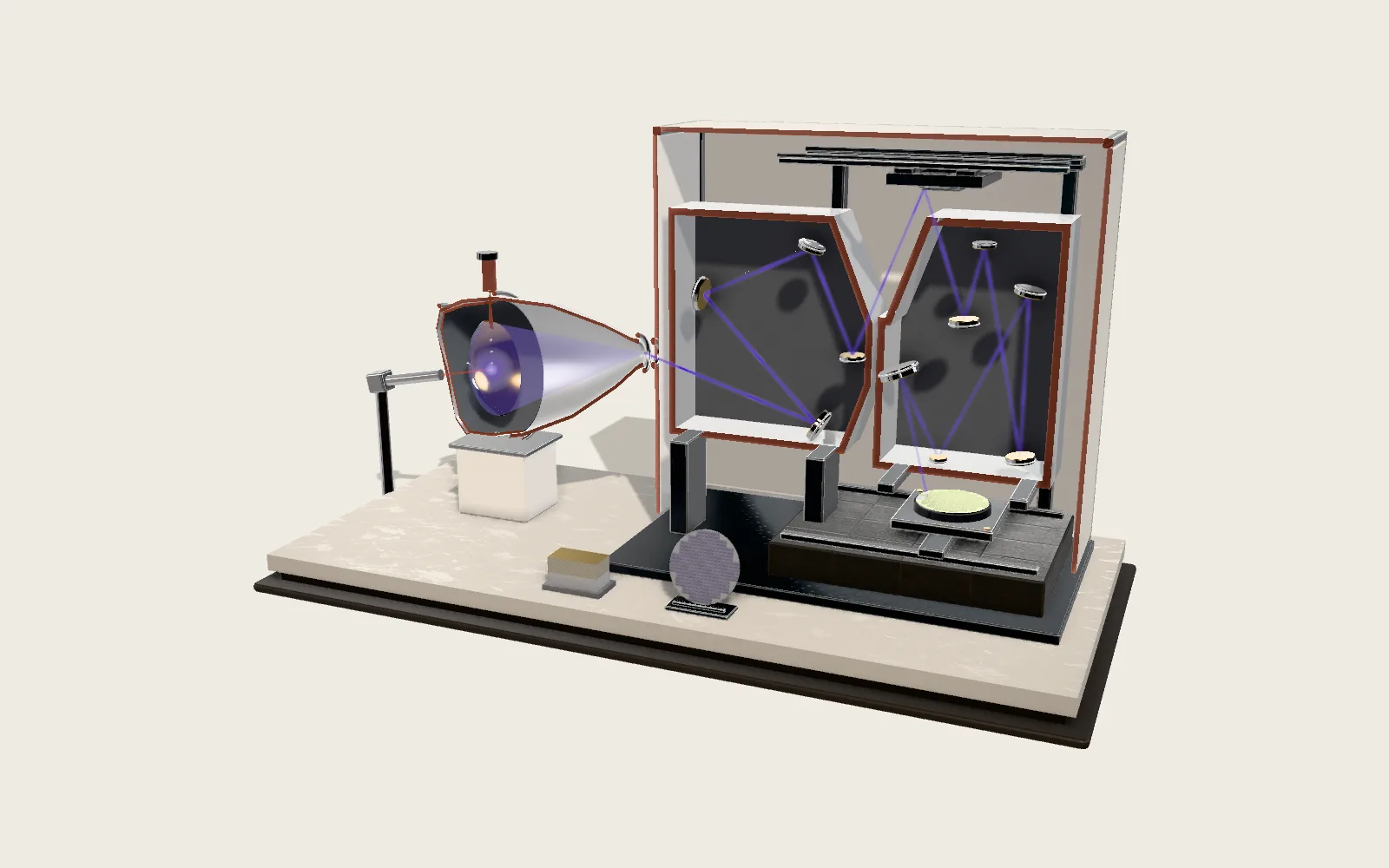
Surgical Robot
Laparoscopic surgery works through a few holes 8 to 12 mm wide in the body wall. Robot-assisted surgery uses the same approach, but the surgeon no longer holds the instruments: from a console, the hands’ motion is scaled down, stripped of tremor, and passed by arms at the bedside to the instruments inside. The most widely used system is the da Vinci.
Scroll
Eight Millimetres
The instrument’s shaft is 8 mm across; some are 5 mm. It enters through a small port in the body wall and ends in a wrist that bends and a pair of jaws.
The maker’s example: the surgeon’s hand moves 3 mm, the tip moves 1 mm. Tremor in the hand is filtered out before it gets there.
Shaft 8 mm across · hand 3 mm → tip 1 mm
A Fulcrum in the Body Wall
In ordinary laparoscopic surgery the surgeon holds a long, straight instrument. Where it passes through the body wall it pivots: the hand goes up, the tip goes down; the hand goes left, the tip goes right.
How far the tip moves depends on the ratio of the lengths inside and outside, and changes with depth. A straight instrument has no wrist: it can only swing about the pivot, slide in and out, turn on its axis, and open its jaws. The surgeon watches a flat screen.
Hand and tip move opposite ways · ratio ≈ length inside / length outside
The Point That Stays Still
A robot’s instruments come through the same small ports and must not tear them. So each arm turns its instrument about one point at the incision: the remote centre of motion.
The da Vinci’s arms hold that point with a parallelogram linkage, described in the maker’s patents; other designs reach it by coordinating the joints in software. Here the two long bars stay parallel, and the instrument’s line always passes through the same point.
The instrument turns about a point at the incision · parallelogram linkage
Cut Open: Cables in the Wrist
The wrist is pulled by steel cables. They leave the drive housing at the back, run through the hollow shaft, pass over guide pulleys on the first pin, and end on each jaw’s own pulley.
One published patent arranges it like this: four cables drive three motions. Pull one of a jaw’s two cables and let out the other, and the jaw turns; pull both of one jaw’s cables and let out both of the other’s, and the whole wrist bends. The insides of production instruments are not published.
Four cables · three motions (the scheme of patent US 5,792,135)
The Surgeon’s Console
The surgeon sits at a console, usually in the same room as the patient. Head in the viewer, each eye sees its own image: the endoscope carries two separate camera channels, like two eyes, so the picture is in depth.
The hands hold two controllers; closing the fingers closes the jaws. Foot pedals switch control to the endoscope, release a clutch, or send current to an instrument to seal tissue.
Two images, one per eye · two hand controllers · foot pedals
Four Arms at the Bedside
The cart at the bedside has up to four arms: one holds the endoscope, the others hold instruments. Each instrument rides on a rail at the end of its arm and slides along its own shaft. On newer models the endoscope is 8 mm across too.
The arms move only with the surgeon’s hands. In the FDA’s words, it cannot perform surgery without direct human control.
One endoscope arm · three instrument arms
Seven Degrees of Freedom
The FDA filing counts them like this: the arm swings the instrument about the incision in pitch and yaw and slides it in and out, three; the instrument turns on its axis, bends its wrist two ways and opens its jaws, four. Seven in all.
A straight instrument lacks the wrist’s two bends. With them the tip can turn a corner and reach or stitch from the side, no longer bound to the angle of the port.
Arm 3 + instrument 4 = 7 degrees of freedom
Scaled Down, Tremor Out
Every hand has a physiological tremor, 8 to 12 times a second (some studies measure 6 to 12), from tens of micrometres to about 0.15 mm. The system filters that fast shaking out of the hand’s motion, then scales it down for the tip.
The maker’s example is 3:1; clinical settings reported in the literature run from 1.5:1 to 3:1, and 5:1 appears in an early patent and in lab studies. The tremor here is greatly enlarged; the filter is the model’s own, since the maker does not publish its design.
Tremor 8–12 Hz · scaling 1.5:1–3:1 · tremor shown enlarged
An Instrument Taken Apart
An instrument is a drive housing at the back, a long thin shaft, the wrist and the jaws. Discs under the housing couple to the drive on the arm; as they turn, they reel the cables in and out.
Each instrument has a limited number of uses, counted by a chip inside: often 10, extended to 12 to 18 for some instruments.
What It Can’t Do
Most models give no force feedback; the surgeon judges force by watching tissue deform. The da Vinci 5, cleared in 2024, offers optional force-feedback instruments that pass push and pull forces at the tip to the hands, though not grip force; in tests on animal tissue and models, force on tissue fell by up to about 43 %.
A system sells for about US$0.7 to 3.1 million, with US$900 to 3,700 of instruments and supplies per operation. Results differ by procedure: a randomised trial in rectal cancer found no significant difference in conversion to open surgery; hysterectomy showed similar complication rates at higher cost; a large study of gallbladder removal found more bile duct injuries.
Hand and Tip
The hand’s motion is filtered, then scaled down, then passed to the tip. The larger the scaling, the further the hand travels and the steadier the tip.
Try thisChange the scaling from 1:1 to 5:1: how much further must the hand travel to pick up the same bead, and how much tremor is left?
What the model leaves out
This is a model of the principle, not of any machine’s design. The arms are drawn as a textbook double parallelogram; the lengths and joint positions are illustrative, and the sterile drapes that cover real arms in surgery are left off. The cart, table and console are drawn at roughly room scale; the instruments inside the body are drawn thicker than life. The two instruments at the front are enlarged 7.5 times, with their shafts shortened. The wrist’s cables follow the four-cable scheme of patent US 5,792,135. Filtering and scaling are computed with the model’s own filter (fourth-order low-pass, 4 Hz cut-off), and the tremor shown is far larger than a real one. The vision cart (screen, light source and electrosurgical unit) is not drawn.
Some common misreadings
It does not act on its own: every motion comes from the surgeon’s hands. Seven degrees of freedom is the count at the tip, three of them from the arm; the wrist itself does not have seven joints. Scaling makes the tip steadier and finer, not faster: the hand has further to go. Force feedback exists only with the da Vinci 5’s optional instruments, and only for push and pull. Using a robot does not by itself mean a better result: for some operations outcomes match laparoscopy at higher cost, and some complications are more common.
Sources
- Intuitive Surgical, 2025 annual report (10-K): up to four arms, two camera channels, 3 mm to 1 mm, tremor filtering, instrument uses and chip, price US$0.7–3.1 M, US$900–3,700 per procedure
- Intuitive Surgical, Q4 2024 release: about 2.68 million procedures in 2024, 9,902 systems installed
- Intuitive Surgical press release (14 March 2024): da Vinci 5 cleared, force-feedback instruments, up to 43 % less force on tissue in preclinical tests
- FDA 510(k) K232610: da Vinci IS5000, a sensor passes directional forces at the instrument to the hand controls
- FDA 510(k) K013416: EndoWrist instruments, 4 degrees of freedom in the instrument + 3 from the arm
- FDA 510(k) K990144 (July 2000): first clearance, for laparoscopic surgery
- FDA 510(k) K191736: X/Xi 8 mm stereo endoscope
- FDA: Computer-assisted surgical systems (cannot perform surgery without direct human control)
- A. R. Lanfranco et al. (2004): Robotic surgery: a current perspective, Ann. Surg. (fulcrum effect, 4 degrees of freedom, 2D view)
- S. W. Wong and P. Crowe (2024): Manipulation ergonomics and robotic surgery, Ann. Laparosc. Endosc. Surg. (scaling settings, no force feedback)
- A. J. Madhani and J. K. Salisbury, US patent 5,792,135: a three-degree-of-freedom wrist driven by four cables
- US patent 8,562,594 (Intuitive Surgical): parallelogram linkages and the remote centre
- US patent 6,493,608 (Intuitive Surgical): a 5:1 scaling example and tremor filtering
- C. N. Riviere et al. (2006): physiological tremor in microsurgery (about 6–12 Hz), Proc. IEEE
- M. M. Awad et al. (2024): preclinical evaluation of force feedback, Surg. Endosc.
- D. Jayne et al. (2017): the ROLARR randomised trial, JAMA
- J. D. Wright et al. (2013): complications and cost of robotic vs laparoscopic hysterectomy, JAMA
- C. L. Mullens et al. (2025): bile duct injury after robotic vs laparoscopic cholecystectomy, JAMA Netw. Open
- Review of technical aspects of the da Vinci Si and Xi (12 mm and 8 mm endoscopes)
Follow the question
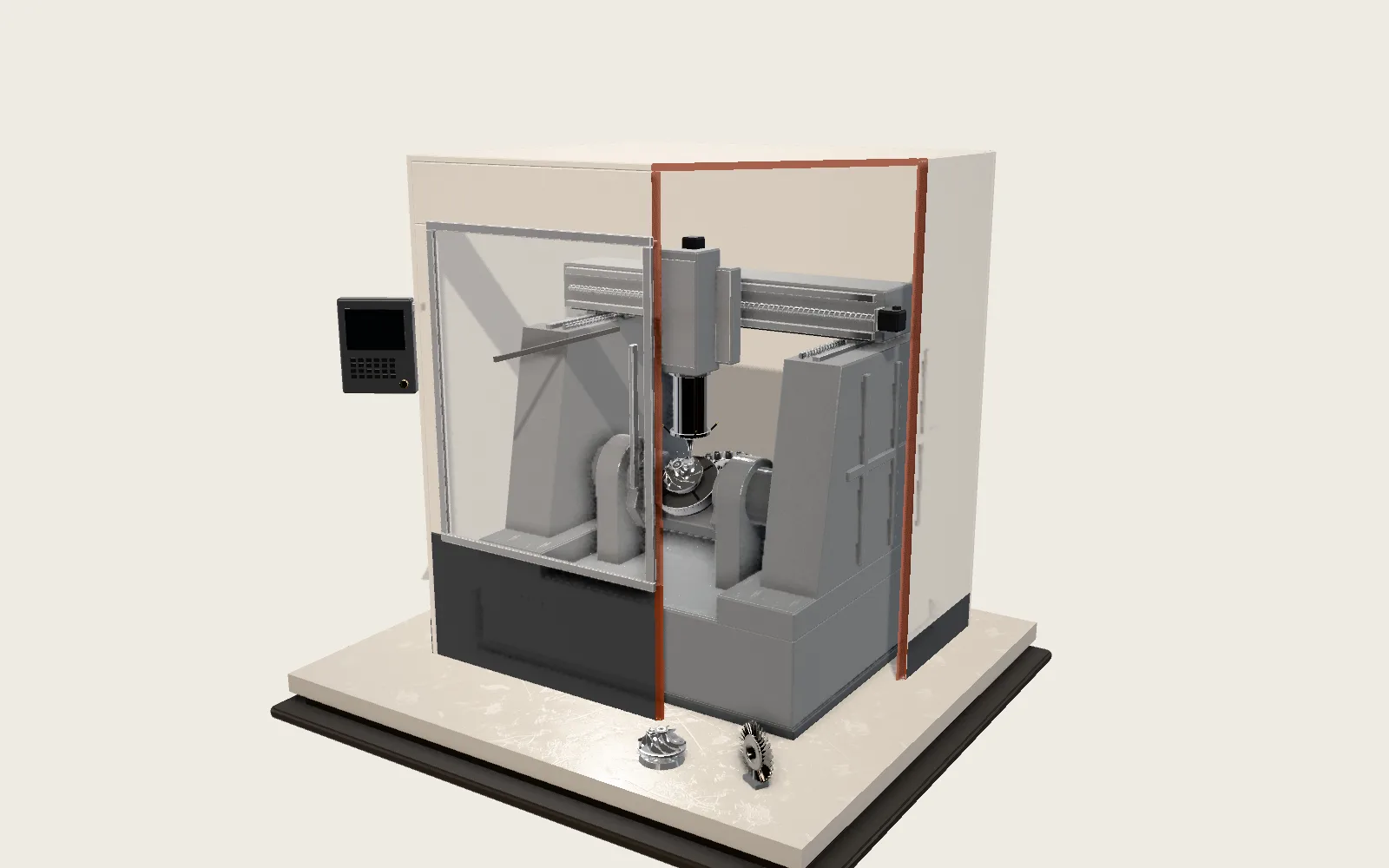 Plate F02Five-Axis Machining CentreThree straight axes move the spindle, two rotary axes turn the part, and all five move together to cut an impeller from a solid block of aluminium.
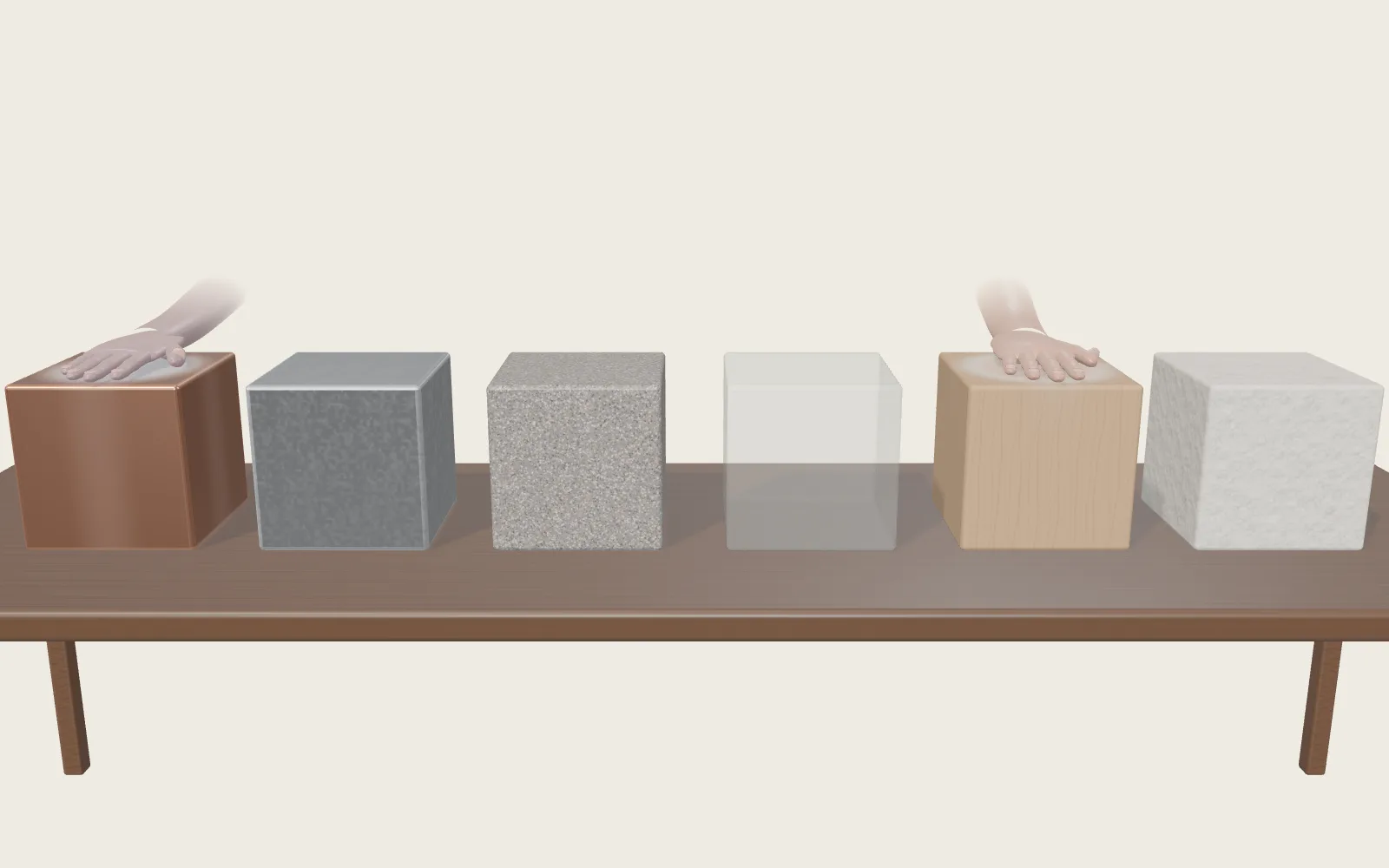 Plate 31Why Metal Feels ColdA metal spoon and a wooden spoon left in the same room are exactly the same temperature, yet the metal one feels much colder. What your hand feels is how fast heat leaves it.