The Largest Digital Camera
The Rubin Observatory’s LSST Camera: 1.65 m across, 3.73 m long. Behind its three lenses sit 189 sensors, 3.2 billion pixels; a filter is on its way into the beam.
Chapters · 14
- 01A Ten-Year Film of the Sky
- 02The Size of a Small Car
- 03Wide, Not Zoomed
- 04189 Sensors
- 05Colder Than −100 °C
- 06Cut Open: Three Lenses
- 07Six Colours, Five Slots
- 08A Filter in Ninety Seconds
- 09Thirty Seconds, Then Move
- 10Alerts Within a Minute
- 11Stretched a Little
- 12From California to the Andes
- 13Taken Apart
- 14The Laboratory
Scroll
A Ten-Year Film of the Sky
At the end of June 2026 the Rubin Observatory began its ten-year Legacy Survey of Space and Time (LSST). The telescope stands on Cerro Pachón in Chile, 2,647 m up, and takes about 700 exposures a night, a new image about every 40 seconds. The main survey covers about 18,000 square degrees of the southern sky, each patch about every three days.
Over ten years each patch is photographed about 800 times across six colours. Line up the images of one patch in time and you have a time-lapse film of the sky: whatever moves or brightens shows. Each night brings about 10 TB of data.
began June 2026 · ten years · each patch about 800 times · about 700 exposures a night
The Size of a Small Car
The LSST Camera is 1.65 m across and 3.73 m long and weighs about 3 tonnes (published figures run from 2,800 to 3,060 kg): the size of a small car. Guinness World Records lists it as the largest digital camera. It was built at the SLAC National Accelerator Laboratory in California.
Here a quarter is cut away at the front and top; the cut is painted red. From the front: the first two lenses, the filter changer, the carousel round the cryostat, the focal plane inside the cryostat, and at the back the utility trunk with its electronics and lines. Beside it stands a person in a clean-room suit, 1.75 m tall.
1.65 m across · 3.73 m long · about 3 t
Wide, Not Zoomed
This camera does not magnify more than other telescopes. Its strength is a wide field: one image covers 9.6 square degrees, 3.5° across, the area of about 45 full Moons and seven Moons wide.
Multiply that field by the 8.4 m mirror (about 6.5 m effective) and the product of light-collecting area and field is 319 m² deg²; the Sloan Digital Sky Survey has 5.9. So it covers the visible southern sky in three or four nights. How sharp the images are is set by the air: stars there are typically about 0.7″ wide, a pixel only 0.2″.
9.6 deg² · about 45 full Moons · 319 m² deg²
189 Sensors
The focal plane is 0.64 m across and carries 189 science CCDs, each 4,096 × 4,096 pixels; a pixel is 10 µm wide, 0.2″ on the sky. Nine CCDs make a “raft”, and 21 rafts stand in a square; four more rafts in the corners carry the sensors for guiding and for measuring the wavefront.
The 189 CCDs hold about 3.2 billion pixels (this page’s arithmetic: 189 × 4,096²). They come from two makers, and all nine in a raft from the same one. The whole focal plane is flat to within a tenth of a hair’s width. Each CCD has 16 outputs, and all of them read at once.
189 CCDs · 21 rafts · about 3.2 billion pixels · 10 µm pixels
Colder Than −100 °C
The CCDs sit in the cryostat, a cold vessel pumped to a vacuum of about 10⁻⁷ Torr, with L3 as its window. The design temperature is about −100 °C; a 2026 paper reports the focal plane run at 150 K, about −123 °C. The cold keeps down bright defective pixels: the warmer silicon is, the more charge it makes on its own.
The cooling uses a mix of ten liquids and gases. Behind each raft are its readout boards, also inside the cryostat and designed to work at about −10 °C. The lines leave through the back of the cryostat into the utility trunk.
design about −100 °C · run at 150 K · about 10⁻⁷ Torr
Cut Open: Three Lenses
Starlight reflects off the primary, secondary and tertiary mirrors and arrives already converging, then passes three fused-silica lenses. L1 is 1.57 m across, believed to be the largest high-performance optical lens ever made; L2 is 1.10 m; L3 is about 0.7 m across and about 6 cm thick, and is also the cryostat’s vacuum window, just 2.85 cm from the focal plane.
The three lenses do not magnify. They correct the colour errors that a thick window brings and flatten the image, so that the flat focal plane is sharp everywhere. The rays drawn here are schematic and leave out the bending inside the lenses.
L1 1.57 m · L2 1.10 m · L3 about 0.7 m · 2.85 cm from the focal plane
Six Colours, Five Slots
The CCDs record only brightness, not colour. Colour comes from the filters: u, g, r, i, z and y, from the ultraviolet through visible light to the near infrared, together 320 to 1,050 nm. Each is 75 cm across and weighs 25.5 to 38 kg, with about 100 coating layers a surface that pass one band and reflect the rest.
The carousel inside the camera holds only five; six is “geometrically impossible”: the five sockets stand in a pentagon round the cryostat. The sixth waits outside the camera and is swapped in by day with a loader, about every few weeks.
u g r i z y · 320–1,050 nm · 75 cm and 25.5–38 kg each
A Filter in Ninety Seconds
To change colour, the carousel turns the chosen filter to the stand-by position at the top; the auto-changer takes it out of its socket and sets it in the beam to within 100 µm. It takes under 90 seconds, up to 40 times a night.
The real path is a complex three-dimensional one, drawn here as a simple curved rail. Once the filter is in place, the light that crosses it keeps only its band.
under 90 s · placed to 100 µm · up to 40 a night
Thirty Seconds, Then Move
A “visit” is one 30-second exposure (38 s in u). The shutter’s two halves slide apart and close again, each in about a second. The original design was two 15-second exposures; after commissioning it became one.
With the shutter closed, every pixel is read out: 2 s by design, slowed to about 3 s for lower noise. Meanwhile the telescope swings to the next patch, in a median 4.8 s. So a new image arrives about every 40 seconds.
expose 30 s · read about 3 s · slew 4.8 s · an image about every 40 s
Alerts Within a Minute
Each new image is compared with earlier images of the same patch, and anything that has brightened, faded or moved makes an alert. The design calls for 98 % of alerts out within 60 seconds of the readout, at least 10,000 a visit on average and 10 million a night over the long run; the observatory now expects about 7 million a night. The alerts are public worldwide and sorted by seven automated “broker” systems.
When the First Look images came out in June 2025, about 10 hours of observing had found 2,104 asteroids never seen before, 7 of them near-Earth asteroids, none dangerous. Over ten years the survey expects to catalogue about 6 million Solar System objects and see about 10 million supernovae.
98 % within 60 s (design) · about 7 million a night · 2,104 new asteroids in 10 hours
Stretched a Little
Light from distant galaxies is bent by the gravity of the mass in front of them, and each galaxy is stretched a little: weak gravitational lensing. One galaxy shows nothing, because galaxies come in many shapes, scattered by about 0.26 in each direction. By this page’s estimate, seeing a 1 % stretch takes about 680 galaxies averaged together.
So it is statistics: the survey will measure the shapes of about 2 billion galaxies and work out how matter, most of it unseen dark matter, is spread and how it has gathered over time. The observatory is named after Vera Rubin, whose measurements of how galaxies rotate gave strong evidence for unseen matter. For a dark-matter detector underground, see the plate “Hunting Dark Matter”.
shapes of about 2 billion galaxies · σₑ = 0.26 · a 1 % stretch takes about 680 galaxies
From California to the Andes
The camera was built at SLAC in California. The focal plane was finished in January 2020, and that September it took the first 3,200-megapixel photos: with no lenses yet, a 150 µm pinhole projected the images, among them a head of Romanesco. The camera was completed in April 2024 and shipped to Chile in May.
In March 2025 it was lifted onto the Simonyi Survey Telescope; on 15 April it first looked at the sky, and on 23 June the First Look images were released. The ten-year survey began on 29 June 2026. For an infrared telescope in space, see the plate “The Webb Space Telescope”.
first 3,200-megapixel photos 2020 · completed 2024 · first sky 15 April 2025 · survey from June 2026
Taken Apart
The camera body, the front lenses, the auto-changer, the shutter, the carousel, the cryostat and the utility trunk come apart one by one.
Point at a part (tap it on a phone) and it lifts on its own, with its name; the rest fade.
The Laboratory
Pick a filter, how long each exposure lasts and how many times to photograph one patch. The readouts give the faintest star it reaches (5σ point-source magnitude; a larger number is fainter), the galaxies it counts across the field, and the raw data.
This is this page’s model, not the observatory’s survey simulation: one 30 s visit reaches the depth the observatory publishes; longer or repeated exposures go deeper by 1.25 × log₁₀(total time ÷ 30 s), an approximation for when the sky’s glow sets the limit. Galaxies come from DESC’s fit for the i band, at the i-band depth of the same exposures; beyond 25.3 it is an extrapolation. The data assume 2 bytes a pixel, about 6.3 GB an image.
Try thisIn the lab, pick the i band and 30 s: how many times as many galaxies do 20 visits to one field show as a single visit?
What the model leaves out
The camera is at 1:4. The published sizes are used as they are: 1.65 m across and 3.73 m long; L1 1.57 m, L2 1.10 m, L3 about 0.72 m (clear aperture); filters 75 cm; the focal plane 0.64 m; L3 2.85 cm from the focal plane. The rest is read off the published cutaway, exploded views and photographs, without published numbers: the lengths and walls of each section, the lens surfaces, the look of the carousel and the auto-changer, the shutter’s place and shape, the inside of the cryostat and the utility trunk, the white handling stand. The real path of a filter from the carousel to the beam is a complex three-dimensional one, drawn as a curved rail. The gaps between CCDs are drawn wider; the two makers’ rafts are drawn in two shades, not where each maker’s rafts really are. The rays are schematic, without the bending inside the lenses. The laboratory is this page’s model.
Common misconceptions
This camera does not magnify more: its strength is a wide field and a big mirror, which make it fast. 3.2 billion pixels do not mean finer detail: sharpness is set by the air, and a pixel is much smaller than a star’s image. The CCDs do not take colour pictures; colour comes from one filter at a time. It does not cover the whole sky every night, but the visible southern sky every three or four nights. Dark matter is not “seen” in any one image; it is worked out from the statistics of many galaxies’ shapes. The alerts and data per night are design figures or estimates. The “201 sensors” sometimes quoted include the 12 in the corners; 189 take the science images.
Common questions · 5
- How big is the LSST Camera?
The LSST Camera is 1.65 m across and 3.73 m long and weighs about 3 tonnes (published figures run from 2,800 to 3,060 kg): the size of a small car. Guinness World Records lists it as the largest digital camera.
02The Size of a Small Car ↑- Does the Rubin camera magnify more than other telescopes?
This camera does not magnify more than other telescopes. Its strength is a wide field: one image covers 9.6 square degrees, 3.5° across, the area of about 45 full Moons and seven Moons wide.
03Wide, Not Zoomed ↑- How many pixels does the LSST Camera have?
The 189 CCDs hold about 3.2 billion pixels (this page’s arithmetic: 189 × 4,096²).
04189 Sensors ↑- Why does the LSST Camera hold only five filters?
The carousel inside the camera holds only five; six is “geometrically impossible”: the five sockets stand in a pentagon round the cryostat. The sixth waits outside the camera and is swapped in by day with a loader, about every few weeks.
07Six Colours, Five Slots ↑- How often does the LSST photograph each patch of sky?
Over ten years each patch is photographed about 800 times across six colours.
01A Ten-Year Film of the Sky ↑
Sources
- Ivezić et al. (2019): LSST: From Science Drivers to Reference Design and Anticipated Data Products, ApJ 873, 111 (0.64 m focal plane; 0.2″ pixels; about 173 K; L3 as the cryostat window; visits per band; étendue 319 m² deg²; seeing limits sharpness; shapes of about 2 billion galaxies; the cutaway drawing)
- LSST Camera team (2026): The On-Sky Performance of the LSST Camera CCD Array, arXiv:2606.31806 (189 CCDs; two makers; 3 s readout; 150 K; about 10⁻⁷ Torr; first photon on 15 April 2025; the exploded view)
- Boucaud et al. (2026): The filter exchange system of the LSSTCam at the Vera C. Rubin Observatory, arXiv:2606.31995 (the pentagonal carousel; a complex 3D trajectory; under 90 s; 100 µm; up to 40 a night; 25.5–38 kg)
- Olivier et al. (2012): LSST Camera Optics Design, SPIE (three fused-silica lenses; L3 about 6 cm thick, 2.85 cm from the focal plane; about 100 coating layers a surface)
- SLAC and Rubin Observatory (2025): The LSST Camera (LSSTCam), technical documentation (16 amplifiers per CCD; shutter about 1 s; the six bands’ centres and widths)
- Rubin Observatory: Key numbers (updated May 2026: 3,060 kg; 9.6 deg²; 4.8 s slews; about 700 visits a night; 10 TB a night; depths by band; altitude 2,647 m)
- Rubin Observatory: Rubin Numbers (2,800 kg; about 45 full Moons; 320–1,050 nm; about 6 million Solar System objects; about 10 million supernovae)
- Rubin Observatory: LSST Camera (the size of a small car; about −100 °C, to limit bright defective pixels; six filters do not fit; the loader)
- Rubin Observatory: Telescopes (the 8.4 m primary, about 6.5 m effective; three mirrors)
- Rubin Observatory: The Legacy Survey of Space and Time (started June 2026; about every three days)
- Rubin survey scheduling: Updates to the baseline (single 30 s visits, 38 s in u; 3.07 s readout)
- Graham et al.: LSST Alerts: Key Numbers, DMTN-102 (98 % within 60 s; at least 10,000 a visit; 10⁷ a night)
- Rubin Observatory: Alert Stream and Alerts and brokers (about 7 million a night; seven full-stream brokers)
- LSST Dark Energy Science Collaboration (2018): The LSST DESC Science Requirements Document, arXiv:1809.01669 (the i-band galaxy-count fit; σₑ = 0.26)
- SLAC (2020): Sensors of world’s largest digital camera snap first 3,200-megapixel images (the pinhole; the Romanesco; a tenth of a hair’s width)
- SLAC (2024): SLAC completes construction of the largest digital camera ever built for astronomy (the 1.57 m lens; completion)
- Rubin Observatory (2025): Rubin Observatory Installs LSST Camera on Telescope
- NOIRLab (2025): Installing the Biggest Camera in the World (L2 1.10 m; L3 0.69 m; ten liquids and gases)
- NOIRLab (2025): First Look press release (about 10 hours, 2,104 new asteroids, 7 near-Earth)
- SLAC (2026): Rubin Observatory begins capturing the greatest cosmic movie ever made (the survey begins; a new image about every 40 s)
- Guinness World Records: Largest digital camera (1.65 m × 3.73 m, 2,800 kg)
- Rubin Observatory: Who was Vera Rubin?
Data
The camera follows the LSST Camera team’s published drawings: the ¾-section cutaway in Ivezić et al., ApJ 873, 111 (2019), the exploded views in arXiv:2606.31806 and arXiv:2606.31995 (T. Lange, SLAC), and photographs by SLAC (J. Ramseyer Orrell, G. Stewart, F. Abbott) and NOIRLab (T. Lange, B. Quint). The published sizes are used where they exist (1.65 m × 3.73 m; L1 1.57 m, L2 1.10 m, L3 about 0.72 m; filters 75 cm; the focal plane 0.64 m; L3 2.85 cm from the focal plane); the rest is read off the drawings, and the notes list what is simplified. The visits, depths, galaxy counts, data volumes and the laboratory are computed by this page (src/topics/rubin/science.js, tests/rubin.test.js) from the figures quoted in its sources; the laboratory is this page’s model, not the observatory’s survey simulation. Material presets, parts and the softbox studio of the site’s model kit are ported from AirsupHQ/machine-skill (MIT, © 2026 Air Supply Technologies Inc.).
The text, pictures and models on this page are licensed CC BY-NC 4.0: free to use and adapt for teaching and other non-commercial purposes, with credit to world.lapla.si. Third-party material listed above keeps its own licence.
Cite this plate
Laplace’s Mini World, Plate F63, “The Largest Digital Camera”, https://world.lapla.si/en/rubin/, CC BY-NC 4.0, updated 2026-11-04.
Follow the question
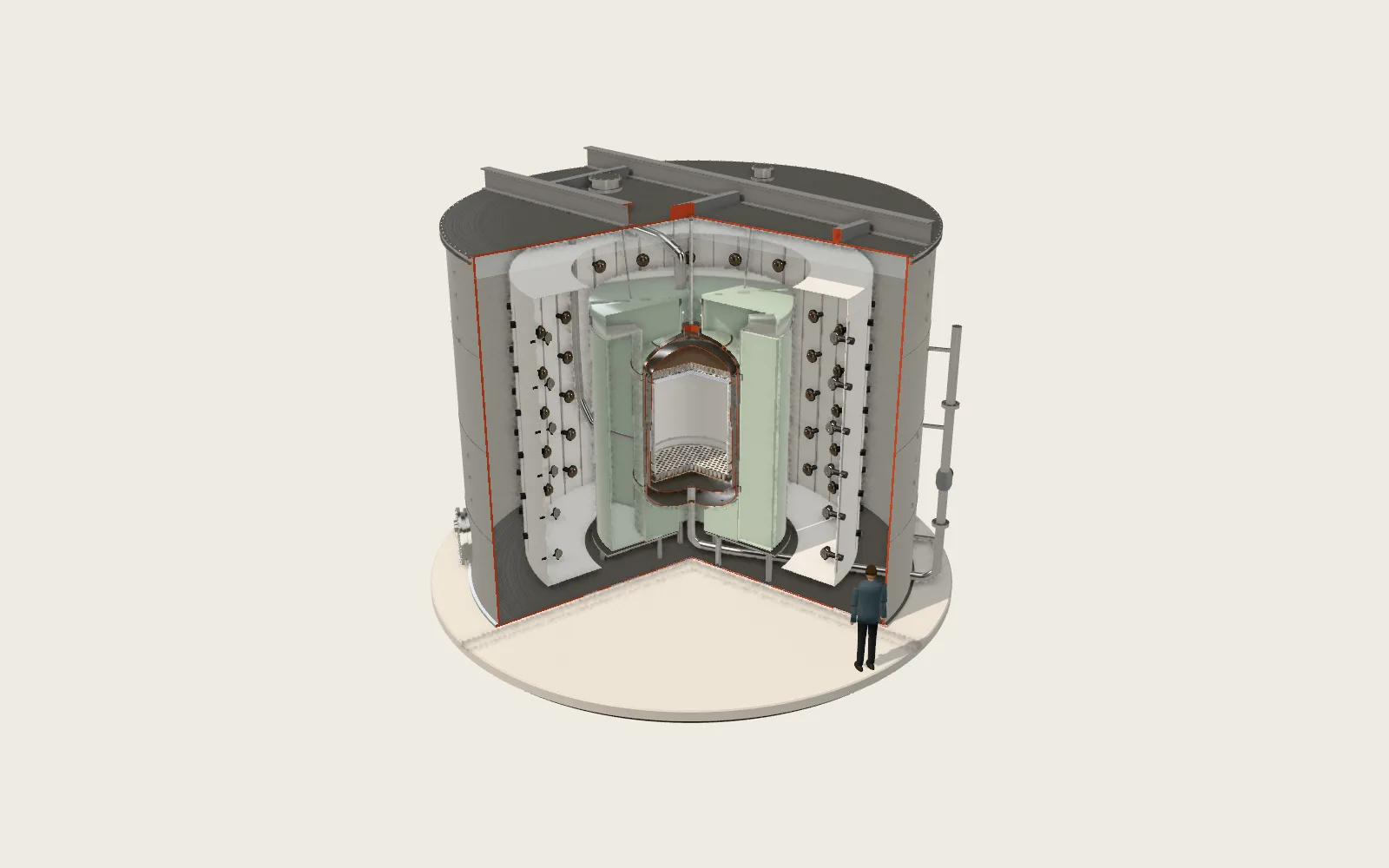 Plate F48Hunting Dark MatterA tank of liquid xenon about 1.5 km underground, waiting for a dark-matter particle to strike a xenon nucleus: the LZ detector in South Dakota.
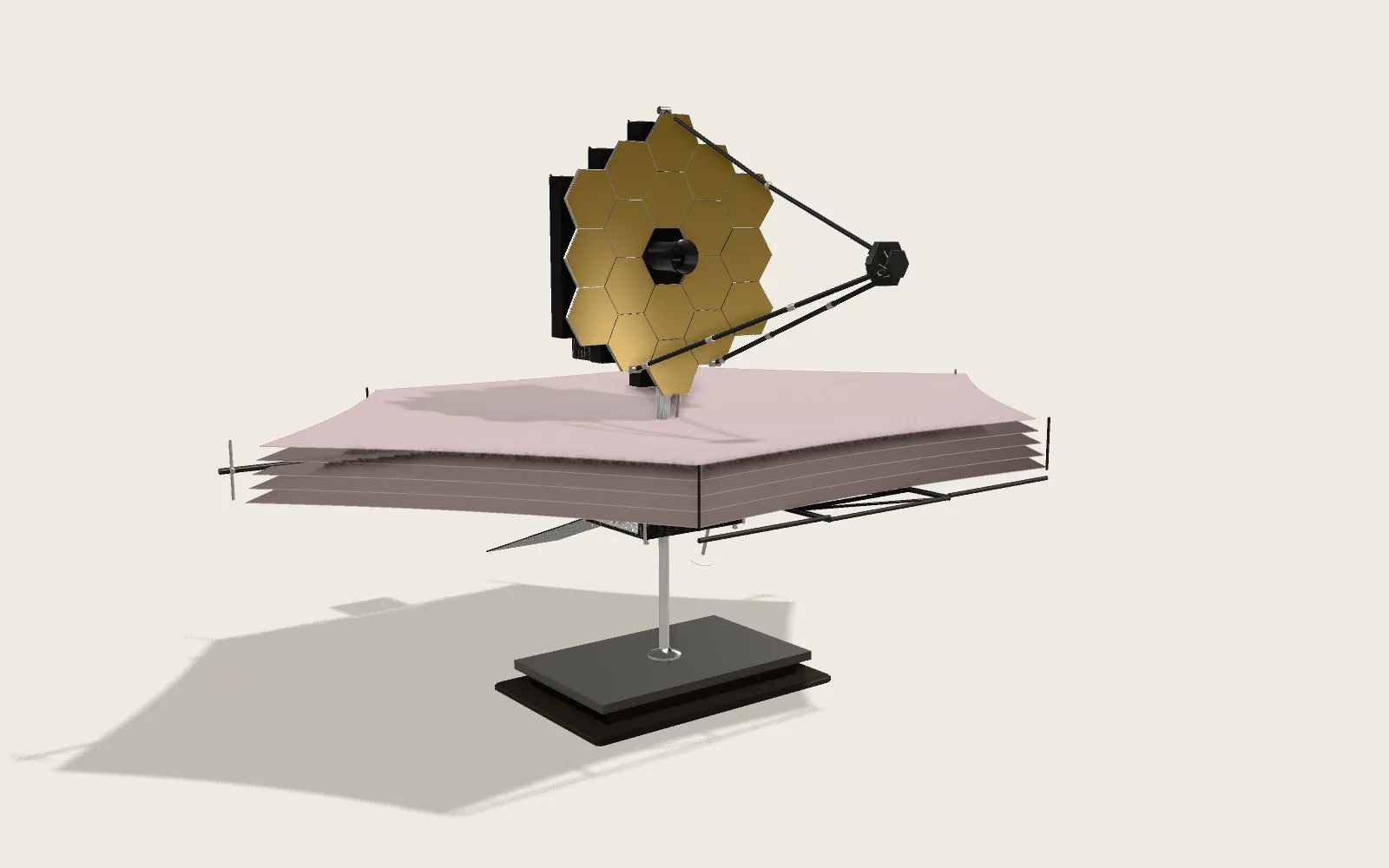 Plate F09The Webb Space TelescopeEighteen gold-coated segments make one 6.5 m mirror, and five layers of film keep the Sun’s heat off it. It was launched folded and unfolded itself in space over two weeks.