The Optical Lattice Clock
It counts the swings of a laser, about 429 trillion a second, kept on time by strontium atoms held in light. Raise it by a centimetre and it runs measurably faster.
Scroll
Eighteen Digits
How good a clock is depends on how sure we can be of its frequency. In 2024 a strontium lattice clock at JILA in the United States added up every known systematic error and put the total at 8.1 parts in 10¹⁹.
The caesium fountain clocks that define the second reach about 1 part in 10¹⁶ at best, more than a hundred times worse. A 2022 paper from JILA notes that clocks of three kinds of atom already had systematic errors equal to less than a second over the lifetime of the universe. Optical clocks of different atoms, compared with one another, have measured their frequency ratios to 18 significant figures.
8.1 × 10⁻¹⁹ (JILA, 2024) · caesium fountains about 1 × 10⁻¹⁶
A Centimetre Up
By general relativity, time runs a little faster higher up: for every metre, a clock gains about 1.1 parts in 10¹⁶. A clock good to 10⁻¹⁸ shows the difference over a single centimetre.
In 2020 two transportable lattice clocks went to the Tokyo Skytree, one on the observatory floor 450 m up and one at its foot. The upper clock gained about 4.26 nanoseconds a day; from the difference, the clocks put the height between them at 452.603 m, to about 4 cm, and laser ranging gave 452.596 m. In 2022 JILA measured the frequency difference across one cloud of atoms about a millimetre tall, about 1 part in 10¹⁹, as predicted.
Δf / f = g·Δh / c² ≈ 1.1 × 10⁻¹⁶ per metre · 1 mm ≈ 1.1 × 10⁻¹⁹
Counting Swings
A clock has two parts: something that swings at a steady rate, and a counter that keeps track of the swings. A pendulum clock counts a pendulum’s beats, a quartz watch its crystal’s 32,768 vibrations a second; how a mechanical clock does it is the plate “The Escapement”.
The faster the swings, the finer a second is cut. A caesium clock counts microwaves, 9,192,631,770 cycles a second; an optical lattice clock counts the red light strontium atoms absorb, at 698 nm, about 429 trillion cycles a second, some 47,000 times faster.
quartz 32,768 Hz · caesium 9,192,631,770 Hz · strontium about 4.29 × 10¹⁴ Hz
Atoms Keep Time
Strontium’s clock line is extremely narrow: an excited atom takes about 118 seconds, some two minutes, on average, to fall back by itself. The clock laser shines on the atoms, its frequency nudged a little each time, and then the excited atoms are counted: blue light makes the ones left in the lower level glow. When the frequency is exactly right, the most are excited.
How wide the line looks depends on how long each probe lasts: one second gives a width of about 0.8 Hz. The clock keeps probing either side of the line and moves the laser towards whichever side excites more. The laser’s swings stay locked to the atoms.
Each dot is one probe · a 1 s Rabi line, about 0.8 Hz wide (computed by this page)
Magic Wavelength
Atoms must be held still to be measured for long without bumping. What holds them is light again: a laser beam sent up and back down, forming layers of light. But light shifts an atom’s energy levels, and the upper and lower levels shift by different amounts, which pushes the clock off.
In 2001 Hidetoshi Katori proposed holding strontium atoms in an optical lattice at a wavelength chosen so that both levels shift by the same amount. This “magic wavelength” was measured near 813.5 nm in 2003, and the first lattice clock ran in 2005. Today’s value is 813.43 nm.
Strontium-87: clock transition 698 nm · magic wavelength 813.43 nm
Cut Open
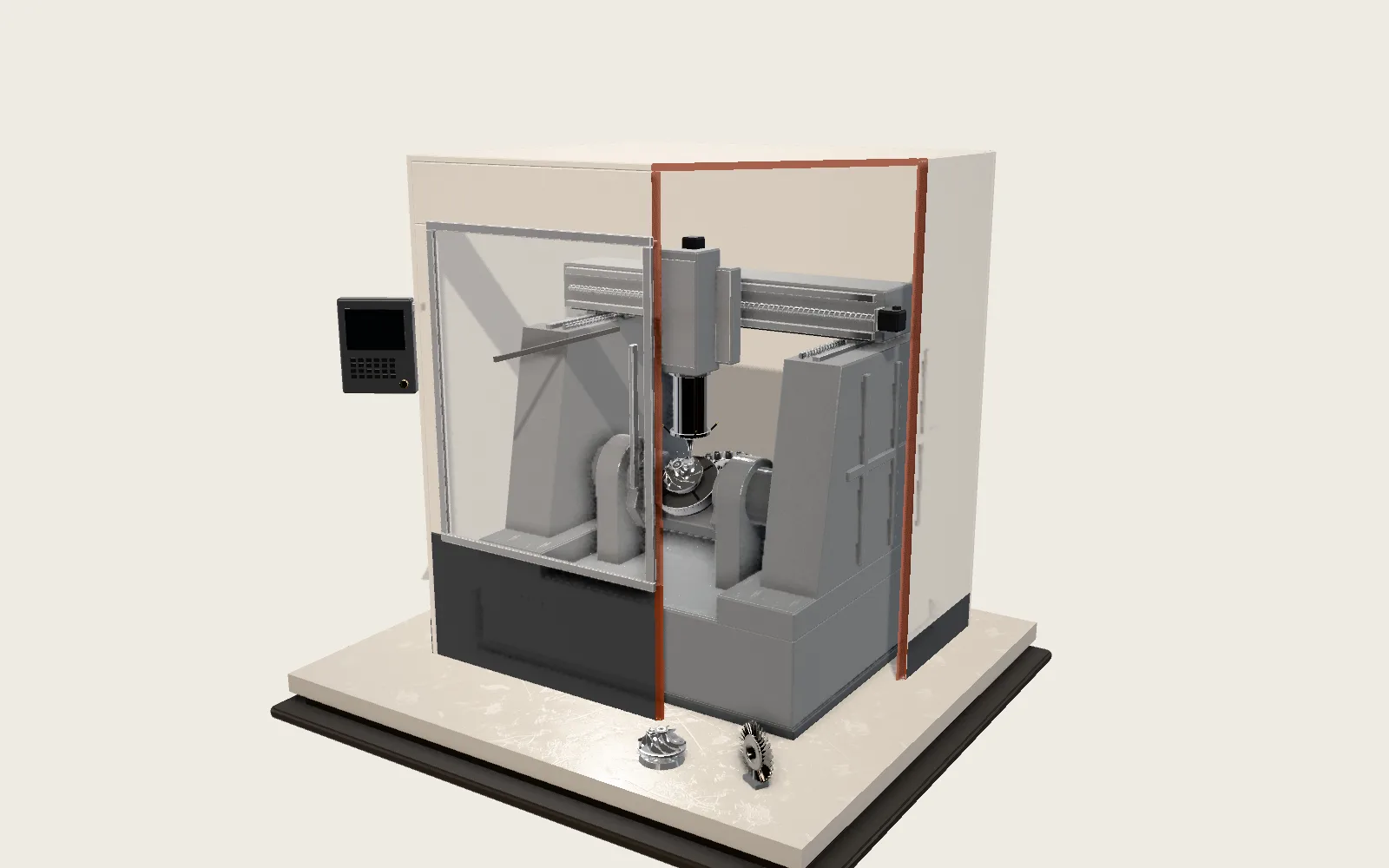
In the middle is an octagonal stainless-steel vacuum chamber with eight windows round its sides and a large one above and below, pumped to ultra-high vacuum. A pair of copper coils above and below makes a magnetic field; beams of blue light enter through the windows and cross at the centre.
Atoms leave the oven on the left, pass through the Zeeman slower into the chamber, are cooled and trapped, then loaded into the vertical lattice. The clock laser shares the lattice’s path: in through the lower window, while a mirror above sends the lattice light back down.
Octagonal chamber · two 6-inch and eight 2.75-inch windows · layout schematic
Hot to Ultracold
In the oven, strontium is heated to some 450 to 530 °C and leaves as a beam of atoms moving at hundreds of metres a second. In the Zeeman slower a beam of 461 nm blue light coming the other way keeps pushing them back, while the coils’ field changes along the way so the slowing atoms stay in tune with the light.
At the centre of the chamber, six blue beams and the coils’ field gather the atoms into a cloud at about a thousandth of a kelvin. Red light at 689 nm then takes them down to a few millionths of a kelvin above absolute zero.
Oven about 450–530 °C → blue MOT about 1 mK → red MOT a few µK
Layers of Light
An 813 nm laser beam passes up through the atoms, is sent back down by the mirror above and overlaps itself in a standing wave: bright and dark layers, one every 407 nm. The atoms settle into the bright layers, stacked one above another; a cloud a millimetre tall spans more than two thousand of them.
Held like this, each atom moves less than the clock light’s wavelength, so neither the Doppler effect nor the kick of a photon shifts the line. Thousands to a hundred thousand atoms are measured at once, which averages down far faster than measuring one.
Standing wave every λ/2 ≈ 407 nm · vertical · layers drawn hugely enlarged
A Steady Ruler
The atoms give a reading only at the end of each probe. In between, the laser is held steady by a ruler: a glass bar with a mirror at each end, called a reference cavity. Light bounces between the mirrors tens of thousands of times, and only light whose wavelength fits the length exactly builds up.
If the length changes, the frequency changes with it. So the cavity sits in a vacuum, on a platform that damps vibration, held at the temperature where it neither grows nor shrinks. JILA’s strontium clock has used a 40 cm cavity of ultra-low-expansion glass, giving a 26 mHz line; silicon cavities cooled to 124 K give 1.5 µm lasers lines of about 5 mHz, and a frequency comb passes that steadiness on to the clock laser.
Ultra-low-expansion glass, 40 cm · 26 mHz | silicon at 124 K · about 5 mHz
Gears for Light
No electronics can count 429 trillion cycles a second. An optical frequency comb turns it into numbers that can be counted: a laser sends out a train of extremely short pulses, which in frequency form a row of evenly spaced lines, like the teeth of a comb.
Each tooth sits at its number times the repetition rate plus an offset, and both are radio frequencies that electronics can count. With a repetition rate of 250 MHz, strontium’s frequency falls beside tooth number 1,716,912; count the beat between the clock laser and that tooth, and the optical frequency is tied to microwaves. Half of the 2005 Nobel Prize in Physics went to John L. Hall and Theodor W. Hänsch for their contributions to laser-based precision spectroscopy, including the optical frequency comb technique.
fₙ = n · f_rep + f₀ · Nobel Prize in Physics 2005
A New Second
Since 1967 the second has been the time taken by 9,192,631,770 cycles of a transition in the caesium-133 atom, and it still is. In 2022 the General Conference on Weights and Measures noted that optical standards had surpassed caesium by a factor of up to 100 and set to work on a new definition. Its meeting in October 2026 had not yet chosen an atom, or a set of atoms, and aims at a proposal in 2030. Strontium is a candidate.
Better clocks are also new instruments: comparing clocks in two places measures the difference in their heights, which is called relativistic geodesy, and comparing clocks of different atoms tests whether the constants of nature change over time. Satellite navigation runs on atomic clocks too: see the plate “How a Phone Knows Where It Is”.
Caesium 9,192,631,770 Hz (1967) · CGPM 2022, Resolution 5 · CGPM 2026, Resolution 4
Taken Apart
The oven, the Zeeman slower, the vacuum chamber, the two coils, the ion pump, the optics, the camera, the reference cavity, the clock laser and the frequency comb come apart, piece by piece.
Whichever piece the pointer rests on is lifted out and the rest fade; left alone, the pieces are all named.
Tune the Lattice
The lever is the lattice laser’s wavelength. The figure shows how far the light shifts each of the two levels: at most wavelengths the two lines part and the clock is pushed off; near 813.4 nm they cross and the error vanishes.
“Scan” sweeps the clock laser across the line; each dot is one probe. The line’s centre moves with the lattice’s error: a little way off the magic wavelength, it leaves the scan’s window.
Try thisTune the lattice laser slowly from 800 nm to 830 nm: where does the clock’s frequency error change sign? How large is it 1 nm away from the magic wavelength?
What the model leaves out
The apparatus follows the layout strontium lattice clocks share in their published descriptions: an oven, a Zeeman slower, a two-stage MOT, a vertical one-dimensional lattice, a reference cavity and a frequency comb. The chamber, coils and optics are common sizes; their arrangement is schematic, not any laboratory’s plans. In a laboratory the lasers, the reference cavity and the comb usually sit on other tables or in racks, linked by optical fibre; here they share one board. A MOT has six beams (three pairs); only the two horizontal pairs are drawn. The clock laser is drawn as one box; in practice it is first locked to a reference cavity, and a frequency comb often brings it the steadiness of a laser on a silicon cavity. The lattice’s layers and the atom cloud are drawn about a hundred thousand times larger. The light-shift curves add up the contributions of a few of the strongest transitions, with the crossing set to the measured 813.43 nm and the slope to the review by Ludlow and colleagues (about 10 Hz per nm per recoil energy of depth), so their shape is approximate; the laboratory uses a lattice 35 recoil energies deep. The line is a Rabi line with the random scatter of counting atoms; noise from the laser itself is left out.
Some common misreadings
Good to 10⁻¹⁸ does not mean a strontium clock’s frequency is known in hertz to eighteen digits: the second is still defined by caesium, so a frequency in hertz can be no better than a caesium clock, about 10⁻¹⁶. What reaches 10⁻¹⁸ is how well the clock reproduces its atoms’ own frequency, and the ratio between two optical clocks. Nor does the magic wavelength stop light from acting on the atoms: both levels still shift, only by the same amount, and the smaller effects that remain must still be measured and taken off. And a clock running faster higher up is not a fault in the clock: time itself passes a little faster there.
Common questions · 3
- How accurate is an optical lattice clock?
In 2024 a strontium lattice clock at JILA in the United States added up every known systematic error and put the total at 8.1 parts in 10¹⁹.
01Eighteen Digits ↑- Why does a clock run faster higher up?
By general relativity, time runs a little faster higher up: for every metre, a clock gains about 1.1 parts in 10¹⁶. A clock good to 10⁻¹⁸ shows the difference over a single centimetre.
02A Centimetre Up ↑- What is the magic wavelength?
In 2001 Hidetoshi Katori proposed holding strontium atoms in an optical lattice at a wavelength chosen so that both levels shift by the same amount.
05Magic Wavelength ↑
Sources
- H. Katori, M. Takamoto, V. G. Pal’chikov, V. D. Ovsiannikov (2003): Ultrastable optical clock with neutral atoms in an engineered light shift trap, PRL 91, 173005 (a lattice at a wavelength where both levels shift equally; calculated near 800 nm)
- M. Takamoto, H. Katori (2003): Spectroscopy of the ¹S₀–³P₀ clock transition of ⁸⁷Sr in an optical lattice, PRL 91, 223001 (magic wavelength measured at 813.5 ± 0.9 nm)
- M. Takamoto, F.-L. Hong, R. Higashi, H. Katori (2005): An optical lattice clock, Nature 435, 321 (the first lattice clock)
- K. Kim, A. Aeppli, T. Bothwell, J. Ye (2023): PRL 130, 113203 (magic frequency 368 554 825.9 MHz, i.e. 813.427 nm)
- A. Aeppli, K. Kim, W. Warfield, M. S. Safronova, J. Ye (2024): Clock with 8 × 10⁻¹⁹ systematic uncertainty, PRL 133, 023401
- T. Bothwell et al. (2022): Resolving the gravitational redshift across a millimetre-scale atomic sample, Nature 602, 420 (about 100,000 atoms, millimetre-scale; gradient −1.09 × 10⁻¹⁹ per mm)
- T. Bothwell et al., arXiv:2109.12238 (the comparison with “less than 1 s over the lifetime of the Universe”)
- M. Takamoto et al. (2020): Test of general relativity by a pair of transportable optical lattice clocks, Nature Photonics 14, 411 (Tokyo Skytree, about 450 m)
- University of Tokyo press release (7 April 2020, Japanese): the Skytree clocks, Δν/ν = (49,337.8 ± 4.3) × 10⁻¹⁸; height 452.603 m ± 39 mm; laser ranging 452.596 m
- J. A. Muniz et al. (2021): Phys. Rev. Research 3, 023152 (³P₀ natural linewidth 1.35 mHz, lifetime 118 s)
- T. L. Nicholson et al. (2015): Nature Communications 6, 6896 (Zeeman slower and blue MOT to 1 mK, red to a few µK; about 2,000 atoms; a 40 cm ULE cavity, 26 mHz)
- A. D. Ludlow, M. M. Boyd, J. Ye, E. Peik, P. O. Schmidt (2015): Optical atomic clocks, Rev. Mod. Phys. 87, 637 (the lasers’ wavelengths; about 10 Hz per nm per recoil energy near the magic wavelength)
- D. G. Matei et al. (2017): 1.5 μm lasers with sub-10 mHz linewidth, PRL 118, 263202 (silicon cavities at 124 K)
- E. Oelker et al. (2019): Nature Photonics 13, 714 (a comb at 250 MHz passing the silicon-cavity laser’s steadiness to the clock laser)
- BACON Collaboration (2021): Frequency ratio measurements at 18-digit accuracy using an optical clock network, Nature 591, 564
- T. P. Heavner et al. (2014): First accuracy evaluation of NIST-F2, Metrologia 51, 174 (a caesium fountain, systematic uncertainty 1.1 × 10⁻¹⁶)
- Nobel Prize: press release for the 2005 Physics prize (Glauber; Hall and Hänsch)
- Nobel Committee: scientific background to the 2005 Physics prize (fₙ = n·f_rep + f_CEO; f–2f self-referencing)
- BIPM: the definition of the second
- BIPM: recommended values of standard frequencies (strontium-87: 429 228 004 229 872.992 Hz, 2025 list)
- BIPM: 27th CGPM (2022), Resolution 5, on the future redefinition of the second
- BIPM: 28th CGPM (2026), Resolution 4, on the future definition of the second (no consensus yet; a proposal in 2030)
Data
The apparatus follows the layout that strontium lattice clocks share in their published descriptions (oven, Zeeman slower, a two-stage MOT, a vertical one-dimensional lattice, a reference cavity and a frequency comb); it is not drawn from any one laboratory’s plans. The light shifts, the resonance line and the other figures are computed by this page; they are not measured data. Material presets, parts and the softbox studio of the site’s model kit are ported from AirsupHQ/machine-skill (MIT, © 2026 Air Supply Technologies Inc.).
The text, pictures and models on this page are licensed CC BY-NC 4.0: free to use and adapt for teaching and other non-commercial purposes, with credit to world.lapla.si. Third-party material listed above keeps its own licence.
Cite this plate
Laplace’s Mini World, Plate F23, “The Optical Lattice Clock”, https://world.lapla.si/en/opticalclock/, CC BY-NC 4.0, updated 2026-10-19.
Follow the question
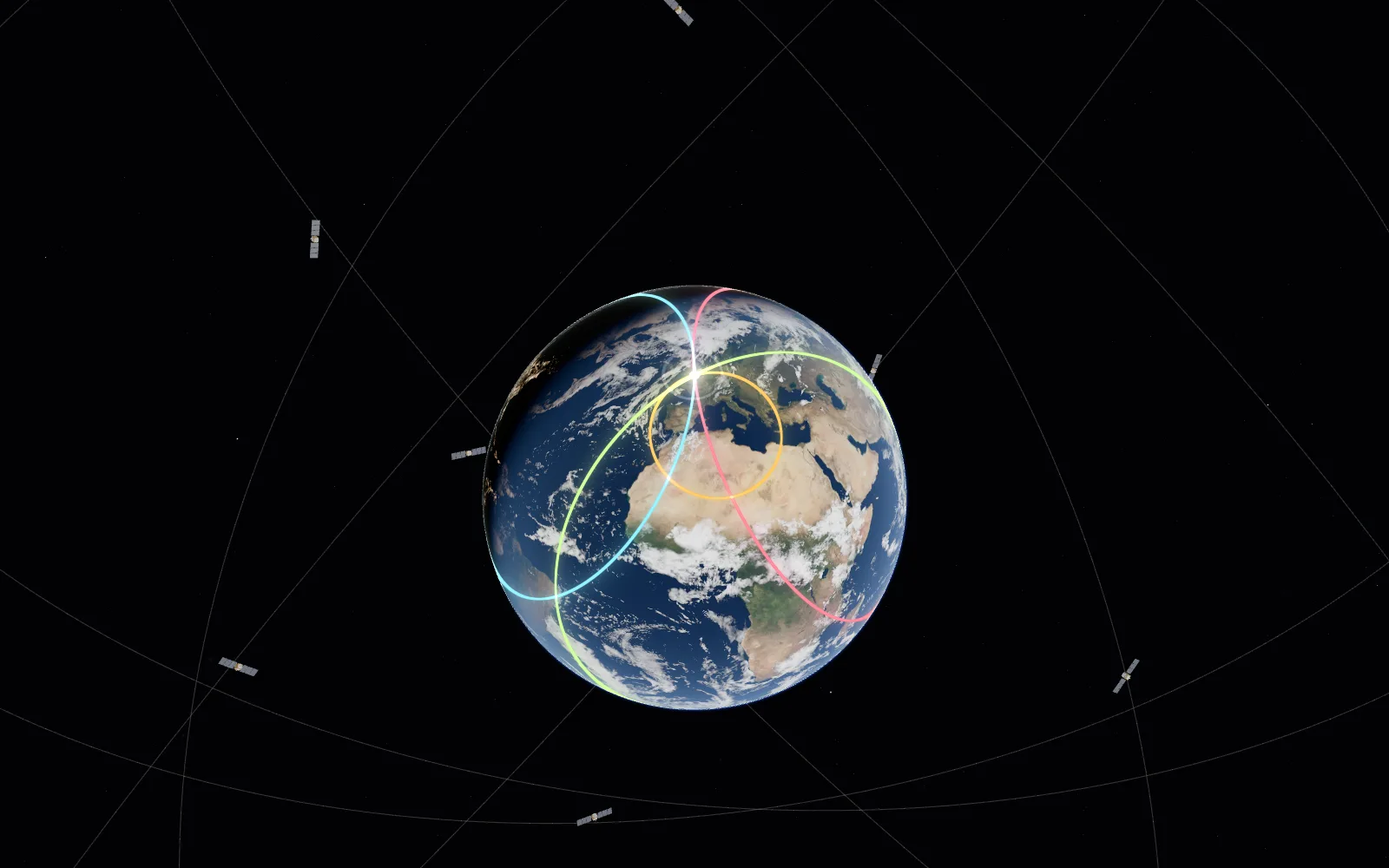 Plate 41How a Phone Knows Where It IsThirty-odd satellites, 20,200 km up, keep announcing the time. A phone only listens, and from how late each announcement arrives it works out where it is, to within a few metres.
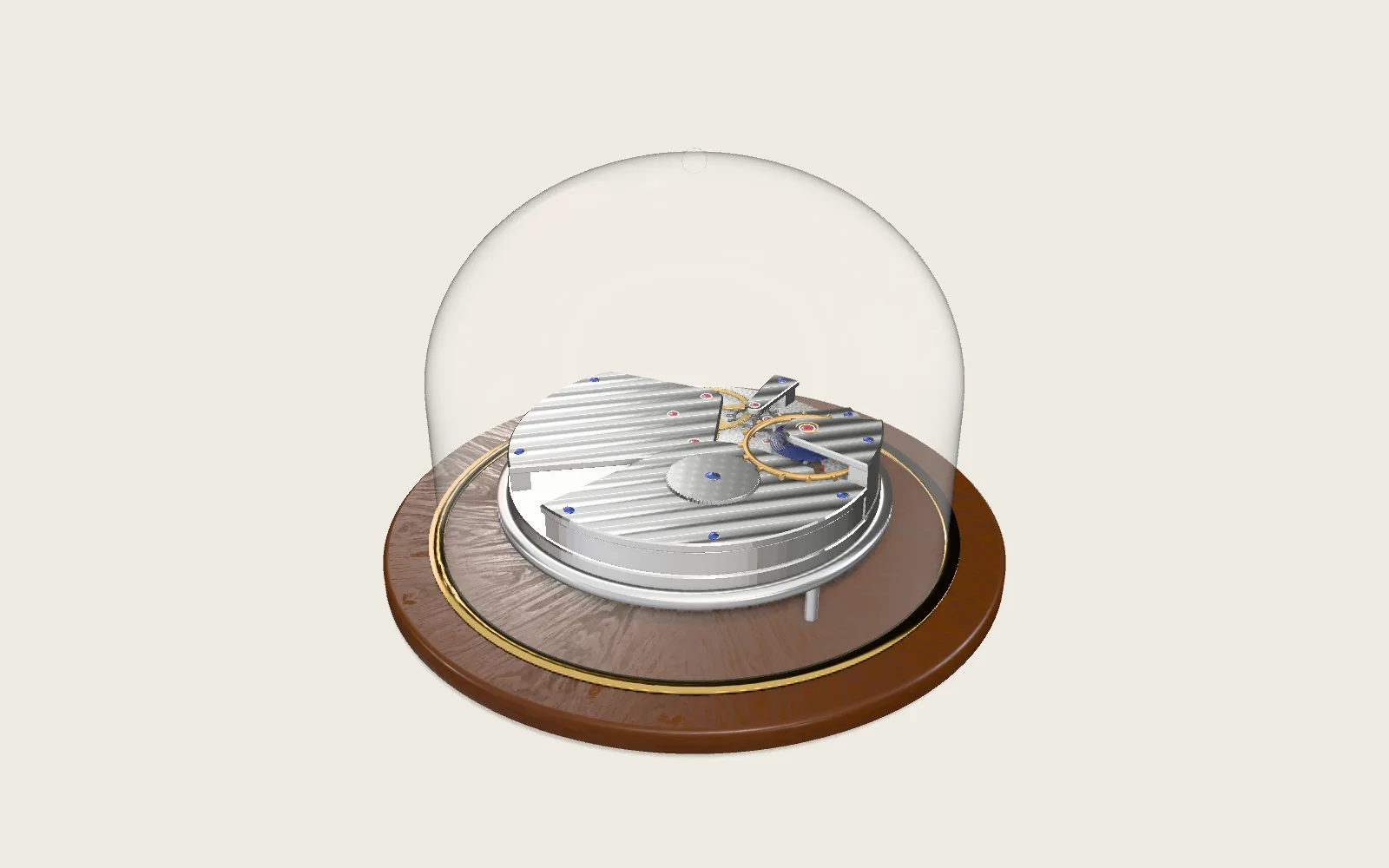 Plate C03The EscapementA spring or a falling weight, let go, gives up its energy all at once. The escapement lets it out in equal small steps, one per beat, timed by something that swings back and forth.