The Gravitational-Wave Interferometer
When a gravitational wave passes, space is stretched in one direction and squeezed in the direction at right angles to it. A laser interferometer compares the two with a pair of long arms set at right angles. LIGO in the United States has two, one at Hanford, Washington, and one at Livingston, Louisiana.
Chapters · 13
- 01Smaller Than a Proton
- 02One Beam, Two Paths
- 03One Arm Longer, One Shorter
- 04About 300 Trips Along Each Arm
- 05Tens of Watts In, Hundreds of Kilowatts in the Arms
- 06Cut Open: Tube and Vacuum
- 07Mirrors on a Four-Stage Pendulum
- 08Cut Off From the Ground
- 09Squeezed Light
- 10Two Sites, 3,000 km Apart
- 1114 September 2015
- 12Taken Apart
- 13Laboratory
Scroll
Smaller Than a Proton
Each of LIGO’s arms is about 4 km long. It can measure changes in an arm’s length as small as about 10⁻¹⁹ m.
A proton is about 1.7 × 10⁻¹⁵ m across, more than ten thousand times that. The first gravitational wave detected, in 2015, changed the difference between the arms by about 4 × 10⁻¹⁸ m, about a four-hundredth of a proton’s diameter.
Strain h = ΔL / L · GW150914 peak h ≈ 10⁻²¹ · ΔL ≈ 4 × 10⁻¹⁸ m
One Beam, Two Paths
In the corner station a beam splitter divides the laser light in two, one beam into the X arm and one into the Y arm. Mirrors at the far ends send them back, and they meet again at the beam splitter.
The arms are set so that the two beams cancel at the exit that leads to the detector. That exit is called the dark port.
Laser → beam splitter → two arms → beam splitter → dark port
One Arm Longer, One Shorter
When a gravitational wave passes overhead, one arm gets longer and the other shorter; half a cycle later it is the other way round.
The two beams no longer travel the same distance, they no longer cancel at the exit, and light leaks onto the photodetector. The leaking light rises and falls with the wave. The stretch in the picture is exaggerated; by how much is shown at the top right.
Difference in arm length → phase difference → light at the exit
About 300 Trips Along Each Arm
Each arm has a mirror at both ends, called test masses: the input test mass near the beam splitter and the end test mass at the far end. Together they form a Fabry–Pérot cavity, and the light bounces back and forth about 300 times before it returns to the beam splitter.
That multiplies the wave’s effect on the light’s phase about 300 times, as if the 4 km arms were about 1,200 km long.
Cavity finesse about 450 · phase multiplied about 300 times
Tens of Watts In, Hundreds of Kilowatts in the Arms
The light comes from an Nd:YAG laser at 1064 nm. It is infrared and invisible to the eye; the picture draws it red. It first passes an input mode cleaner, which tidies up the beam.
Almost no light leaves through the dark port, so nearly all of it comes back from the beam splitter towards the laser. A power-recycling mirror there sends it back in, and the power builds up. In the third observing run in 2019, Hanford put in about 34 W, had about 1,500 W at the beam splitter and about 200 kW in each arm. The stronger the light, the smaller, relatively, the flicker from photons arriving at random.
1064 nm · 34 W → about 1,500 W → about 200 kW per arm (2019, Hanford)
Cut Open: Tube and Vacuum
Inside each arm runs a stainless steel tube 1.2 m across with walls only 3 mm thick, under a concrete cover. It is pumped down to about 10⁻⁹ torr, about a trillionth of an atmosphere. Each site holds about 10,000 m³ of vacuum, which LIGO calls the third largest vacuum system in the world.
Baffles in the tube catch light scattered off the beam’s path. The mirrors sit in stainless steel vacuum chambers; the one cut open here holds the X arm’s input test mass.
Tube 1.2 m · wall 3 mm · about 10⁻⁹ torr · about 10,000 m³ per site
Mirrors on a Four-Stage Pendulum
A test mass is a block of fused silica 34 cm across, 20 cm thick and 40 kg, with a reflective coating on the face towards the arm.
It hangs at the bottom of a quadruple pendulum: the top mass hangs from blade springs, then come the upper intermediate mass, the penultimate mass and the test mass. The last stage hangs on four fused-silica fibres 0.4 mm thick. The whole suspension weighs about 360 kg. Behind it hangs a reaction chain: coils push on the two middle stages, and the end reaction mass pushes on the test mass electrostatically, holding the arm cavity at its length.
Fused silica 34 × 20 cm · 40 kg · four 0.4 mm silica fibres
Cut Off From the Ground
The ground never stops moving: ocean waves, wind, passing traffic. The test masses must hardly follow it.
The suspension stands on an active isolation platform, where sensors and actuators cancel most of the shaking first. Each pendulum stage then cuts down shaking faster than its own swing by a large factor. Above 10 Hz the ground’s motion reaches the mirror more than ten orders of magnitude smaller. The shaking in the picture is exaggerated.
Isolation above 10 Hz > 10¹⁰
Squeezed Light
One noise comes from the light itself: photons arrive at random moments, and quantum mechanics does not let that flicker go to zero.
Since 2019 LIGO has injected “squeezed light” at the dark port, making one kind of flicker smaller at the cost of another. Above 50 Hz that lowered the noise by up to 3 dB. Since 2023 the squeezing changes with frequency, using a filter cavity 300 m long.
Since 2019 · up to 3 dB above 50 Hz · since 2023 a 300 m filter cavity
Two Sites, 3,000 km Apart
Hanford and Livingston are about 3,002 km apart in a straight line, about 10 ms for light. A real signal must show up at both, no more than 10 ms apart.
The signal of 14 September 2015 reached Livingston first and Hanford about 6.9 ms later. The delay and the strength at each site told roughly which patch of sky it came from. Today Virgo in Italy and KAGRA, underground in Japan, observe too; both have 3 km arms.
Straight line 3,002 km ≈ 10 ms · GW150914: Livingston 6.9 ms first
14 September 2015
At 09:50:45 UTC both detectors recorded a signal about 0.2 s long: over about 8 cycles its frequency rose from 35 to 150 Hz and its amplitude grew. Two black holes were orbiting each other faster and faster, and merged.
They were about 36 and 29 solar masses, and the black hole they made about 62; about 3 solar masses of energy left as gravitational waves. They were about 1.3 billion light years away. The 2017 Nobel Prize in Physics went one half to Rainer Weiss and the other half jointly to Barry C. Barish and Kip S. Thorne, for decisive contributions to the LIGO detector and the observation of gravitational waves.
36 + 29 → 62 solar masses · about 3 radiated · 410 Mpc
Taken Apart
The quadruple pendulum comes apart: isolation platform, frame, top mass, upper intermediate mass, penultimate mass, test mass and the reaction chain behind. Whichever piece the pointer rests on is lifted out and named.
Laboratory
The lever is the gravitational wave’s amplitude. The small instrument at the top right is the exit: on the left, the light at the exit against the difference between the arms; in the middle, the spot at the exit; on the right, the photodetector’s reading. GW150914 can be played back here too, or the view switched to the scale of the Earth.
Try thisSet the amplitude to 10⁻²¹: how many metres does the difference between the arms change, and what fraction of a proton’s diameter is that?
What the model leaves out
This is a model of the principle. The arms are shortened about 35 times against the buildings and the tube (the real arms are 4 km long, the tube 1.2 m across). The corner station’s shape and the number and size of its chambers are simplified, and the chambers in the end stations are not drawn. The quadruple pendulum and its reaction chain are simplified from public photographs and diagrams: the cage, the isolation platform, the upper masses’ shapes and the wire lengths are estimated, and only the test mass’s size and weight and the silica fibres come from the sources. The observatory follows Hanford (desert scrub, mid-stations). The shaking in the isolation chapter and the arms’ stretch in the laboratory are greatly exaggerated. The laser is infrared and drawn red; the light makes about 300 trips in the cavity, and the picture only shows light flowing back and forth. The GW150914 waveform is real Hanford and Livingston data (GWOSC), whitened and band-passed 35–350 Hz, so its vertical axis has no unit; the Livingston curve is shifted 6.9 ms and flipped, as in the discovery paper. The sound is synthesised with the same frequency sweep; it is not a recording. The L marks on the globe are greatly enlarged.
Some common misreadings
If the wave stretches the arm, it also stretches the light in it, so how can it be measured? It can: the interferometer compares how long the light takes to go up and down each arm, and the light arriving fresh from the laser has not been stretched. In operation the exit is not completely dark: LIGO holds the interferometer slightly off the dark fringe (about 10 picometres), so that the leaking light is proportional to the difference in length. 10⁻¹⁹ m is not a length measured with a ruler at rest but a difference in length changing fast, around 100 Hz. LIGO’s own pages put the comparison differently (“a ten-thousandth” or “a thousandth” of a proton’s width); here it is calculated directly with a proton diameter of 1.68 × 10⁻¹⁵ m (CODATA 2022). The number of trips along an arm was given by LIGO Lab as about 280 in earlier pages and about 300 now. A gravitational wave is not a sound; its frequencies happen to fall in the range of human hearing, so it can be turned into one.
Sources
- B. P. Abbott et al. (LIGO and Virgo Collaborations) (2016): Observation of Gravitational Waves from a Binary Black Hole Merger, PRL 116, 061102 (date and time, h = 1.0 × 10⁻²¹, 35 → 150 → 250 Hz, 8 cycles, 36/29/62 M☉, 3.0 M☉, 410 Mpc, 6.9 ms, 10 ms, phase ×300, isolation above 10 Hz > 10 orders)
- J. Aasi et al. (2015): Advanced LIGO, CQG 32, 074001 (arm cavity 3994.5 m, finesse 450, test mass 34 × 20 cm 40 kg, fibres 0.4 × 596 mm, design power, DC readout)
- A. Buikema et al. (2020): Sensitivity and performance of the Advanced LIGO detectors in the third observing run, PRD 102, 062003 (34 W input, power-recycling gain 44, 201 kW in the arms, 10 pm offset)
- E. Capote et al. (2024): Advanced LIGO detector performance in the fourth observing run, arXiv:2411.14607 (280–370 kW in the arms, 300 m filter cavity)
- M. Tse et al. (2019): Quantum-enhanced Advanced LIGO detectors in the era of gravitational-wave astronomy, PRL 123, 231107 (up to 3 dB above 50 Hz)
- D. Ganapathy et al. (2023): Broadband quantum enhancement of the LIGO detectors with frequency-dependent squeezing, PRX 13, 041021
- LIGO Lab: Facts (sites 3,002 km apart, third-largest vacuum, 3 mm tube walls)
- LIGO Lab: LIGO’s Interferometer (about 300 reflections, about 1,200 km)
- LIGO Lab: What is an Interferometer (the dark port and the leaking light)
- LIGO Lab: Vacuum (1.2 m tube, 10,000 m³, 10⁻⁹ torr)
- LIGO Lab: Vibration Isolation (10⁻¹⁹ m, 360 kg quadruple pendulum, 0.4 mm fibres, active isolation)
- LIGO Lab: Laser (Nd:YAG, 1064 nm)
- nobelprize.org: The Nobel Prize in Physics 2017
- GWOSC: GW150914 event page and strain data (CC BY 4.0)
- LALSuite: LALDetectors.h (site positions and arm directions)
- Virgo: the detector (3 km arms)
- KAGRA: Gravitational Wave Science Center, ICRR, University of Tokyo (underground at Kamioka, 3 km)
- NIST CODATA 2022: proton charge radius 0.84075 fm
Data
The GW150914 waveform uses LIGO Hanford and Livingston strain data from the Gravitational Wave Open Science Center (gwosc.org), licensed under CC BY 4.0; it is whitened and band-passed for display (docs/plates/ligo/gw150914.py). The sound is synthesised, not recorded. This research has made use of data or software obtained from the Gravitational Wave Open Science Center (gwosc.org), a service of the LIGO Scientific Collaboration, the Virgo Collaboration, and KAGRA. This material is based upon work supported by NSF’s LIGO Laboratory which is a major facility fully funded by the National Science Foundation, as well as the Science and Technology Facilities Council (STFC) of the United Kingdom, the Max-Planck-Society (MPS), and the State of Niedersachsen/Germany for support of the construction of Advanced LIGO and construction and operation of the GEO600 detector. Additional support for Advanced LIGO was provided by the Australian Research Council. Virgo is funded, through the European Gravitational Observatory (EGO), by the French Centre National de Recherche Scientifique (CNRS), the Italian Istituto Nazionale di Fisica Nucleare (INFN) and the Dutch Nikhef, with contributions by institutions from Belgium, Germany, Greece, Hungary, Ireland, Japan, Monaco, Poland, Portugal, Spain. KAGRA is supported by Ministry of Education, Culture, Sports, Science and Technology (MEXT), Japan Society for the Promotion of Science (JSPS) in Japan; National Research Foundation (NRF) and Ministry of Science and ICT (MSIT) in Korea; Academia Sinica (AS) and National Science and Technology Council (NSTC) in Taiwan. Open data paper: R. Abbott et al. (LIGO Scientific Collaboration and Virgo Collaboration), “Open data from the first and second observing runs of Advanced LIGO and Advanced Virgo”, SoftwareX 13 (2021) 100658. The model is our own.
Follow the question
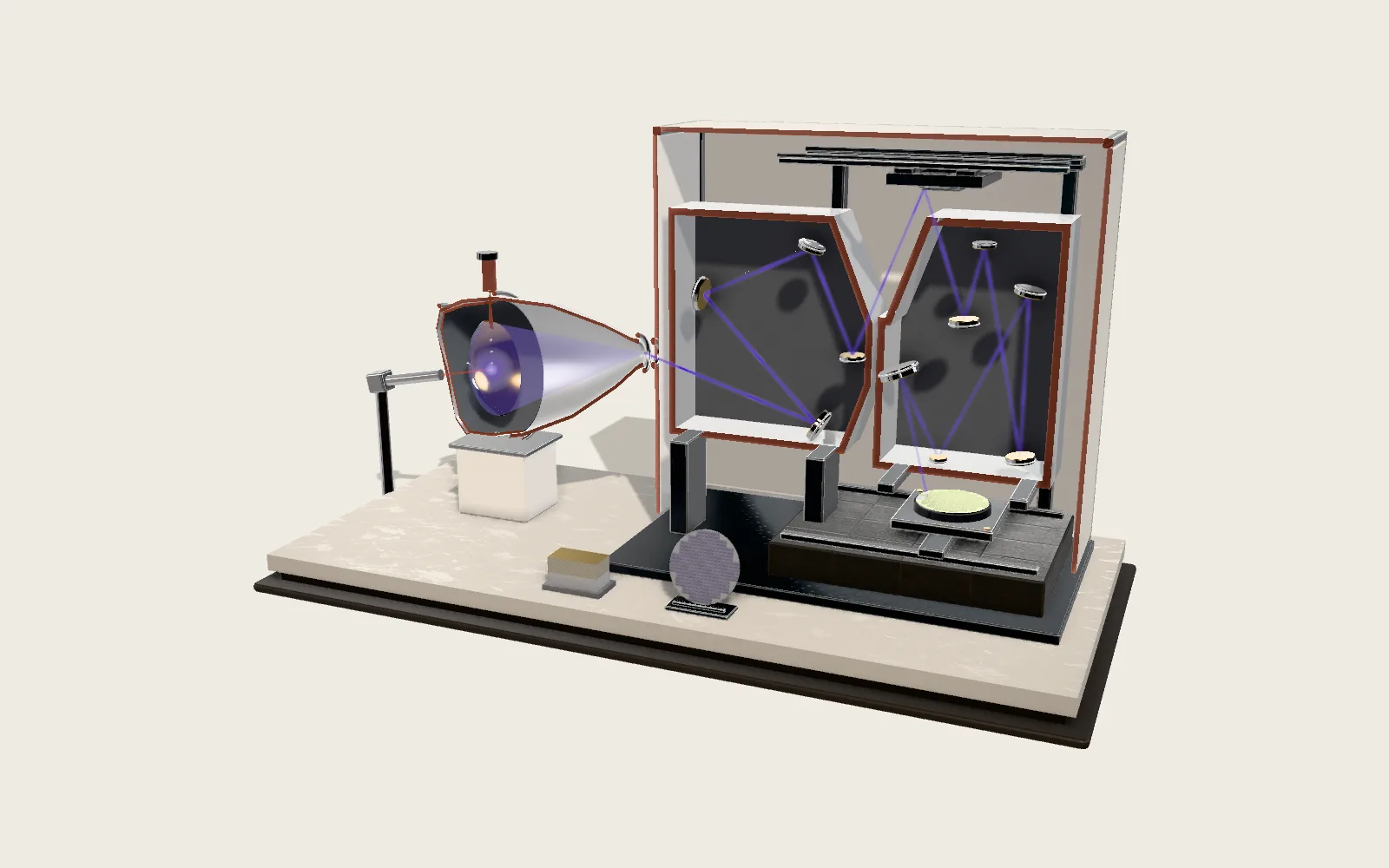 Plate F01EUV Lithography MachineLight 13.5 nm long prints a chip’s circuits on silicon, four times smaller than the mask. It comes from tin droplets turned to plasma, and travels only by mirrors.
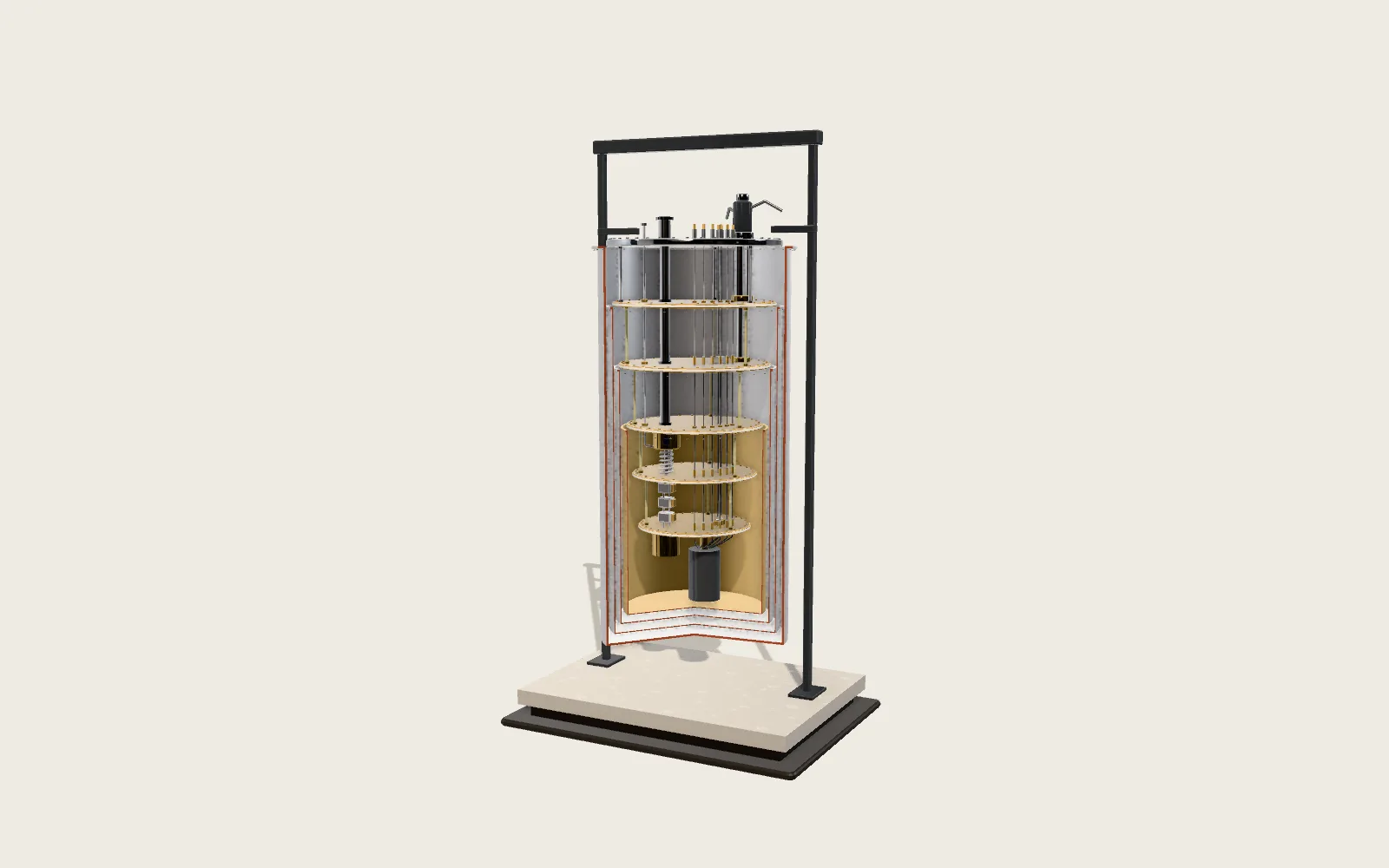 Plate F05The Dilution RefrigeratorA superconducting quantum computer hangs from a gold-plated “chandelier”. Each stage is colder than the one above; the last is about 10 mK, hundreds of times colder than space.