Not All Salt Water Is Neutral
Eight salts at 0.1 mol/L, the same indicator in each: table salt stays green, washing soda turns violet, alum red.
Chapters · 12
- 01Eight Tubes, One Indicator
- 02Why Salt Water Stays Green
- 03Acetate Takes a Proton
- 04Ammonium Gives One Away
- 05One in Thirteen Thousand
- 06Small Ions, Big Charges
- 07Baking Soda, Washing Soda
- 08The Colour Is Only a Guide
- 09Laundry, Heartburn, Fields
- 10It Began with Syrup of Violets
- 11The Bench, Piece by Piece
- 12Pick a Salt, Then Dilute
Scroll
Eight Tubes, One Indicator
Each of the eight test tubes holds 14 mL of a salt solution at 0.1 mol/L, with the same universal indicator in every one. They stand in a clear acrylic rack in front of an LED light box, and the light comes through each tube from behind.
From left to right: alum, ammonium chloride, magnesium chloride, sodium chloride (table salt), sodium hydrogencarbonate (baking soda), sodium acetate, sodium hydrogenphosphate and sodium carbonate (washing soda). The colours run from red, orange, yellow and green to blue and violet.
As this page computes them, their pH values are 3.7, 5.1, 6.2, 7.0, 8.3, 8.9, 9.7 and 11.7. All are salts; only the table salt is neutral, some are acidic and some basic.
14 mL each at 0.1 mol/L · 25 °C, water free of carbon dioxide · pH 3.7 to 11.7 · colours after CDH’s pH 4–11 chart
Why Salt Water Stays Green
Water trades protons with itself: one molecule hands an H⁺ to another, making H₃O⁺ and OH⁻, and they soon swap back. At 25 °C the product of their concentrations is Kw = 1.0 × 10⁻¹⁴, so pure water has 1.0 × 10⁻⁷ mol/L of each and a pH of 7.00. That is neutral.
Table salt dissolves into Na⁺ and Cl⁻, each held in a ring of water molecules. Cl⁻ is what hydrochloric acid, a strong acid, leaves behind, and it hardly takes a proton back from water; Na⁺ hardly gives one up. So salt water at 0.1 mol/L stays at pH 7.00 and the indicator stays green.
Left open, it changes: carbon dioxide from the air dissolves into a very weak acid. As this page computes it, at today’s 427 ppm of carbon dioxide both pure water and salt water settle near pH 5.6, the figure the US EPA gives for normal rain. Classroom demonstrations often use water that has been boiled, and this page’s numbers are for water free of carbon dioxide.
H₂O + H₂O ⇌ H₃O⁺ + OH⁻ · Kw = 1.0 × 10⁻¹⁴ at 25 °C · neutral at pH 7.00 · open to air, about pH 5.6
Acetate Takes a Proton
Acetic acid is a weak acid: it lets its proton go reluctantly. The other way round, acetate, CH₃COO⁻, what is left when it does, will take a proton. Now and then it takes an H⁺ from a water molecule, becomes acetic acid again and leaves an OH⁻.
CH₃COO⁻ + H₂O ⇌ CH₃COOH + OH⁻. The extra OH⁻ makes the solution basic: sodium acetate at 0.1 mol/L has a pH of 8.88 as this page computes it, and the indicator turns blue. Na⁺ only looks on.
Titrate acetic acid with sodium hydroxide and the flask holds a sodium acetate solution at the equivalence point, which is why its pH there is not 7; see Acetic Acid Instead in Acid–Base Titration.
CH₃COO⁻ + H₂O ⇌ CH₃COOH + OH⁻ · sodium acetate at 0.1 mol/L, pH 8.88
Ammonium Gives One Away
Ammonia is a weak base, and ammonium, NH₄⁺, is ammonia with one proton taken on. Now and then ammonium hands that proton to a water molecule, becomes ammonia again and leaves an H₃O⁺.
NH₄⁺ + H₂O ⇌ NH₃ + H₃O⁺. So the solution is acidic: ammonium chloride at 0.1 mol/L has a pH of 5.12 as this page computes it, and the indicator turns orange. This time Cl⁻ looks on.
When both ions trade protons with water, the stronger wins. In ammonium acetate, ammonium gives protons and acetate takes them, almost equally strongly, and the solution sits at pH 7.00; yet it is not neutral the way salt water is: about 6 acetates in 1,000 have become acetic acid.
NH₄⁺ + H₂O ⇌ NH₃ + H₃O⁺ · ammonium chloride at 0.1 mol/L, pH 5.12 · ammonium acetate, pH 7.00
One in Thirteen Thousand
A weak acid’s Ka times its partner’s Kb is exactly Kw: Ka × Kb = Kw. Acetic acid’s Ka is 1.75 × 10⁻⁵, so acetate’s Kb is 5.7 × 10⁻¹⁰. The weaker the acid, the readier its partner is to take a proton.
With a Kb that small, only about 0.0075% of the acetate in sodium acetate at 0.1 mol/L has taken a proton, as this page computes it: about one in 13,000. The salt has not “split”; a very few ions have traded one proton with water.
That is enough. The OH⁻ left behind comes to about 7.6 × 10⁻⁶ mol/L, more than seventy times the amount in pure water, and the pH rises from 7 to 8.88. In ammonium chloride, too, only about 0.0075% of the ammonium has given up its proton. Ions that take protons more strongly react in far larger shares, as carbonate in washing soda does.
Ka × Kb = Kw · acetic acid Ka 1.75 × 10⁻⁵ → acetate Kb 5.7 × 10⁻¹⁰ · 0.0075%, about one in 13,000
Small Ions, Big Charges
The alum tube is red because of aluminium. In water Al³⁺ is held by six water molecules, as [Al(H₂O)₆]³⁺. The ion is small and highly charged; it pulls on the O–H bonds of those water molecules, and one of them readily gives up an H⁺.
[Al(H₂O)₆]³⁺ + H₂O ⇌ [Al(H₂O)₅OH]²⁺ + H₃O⁺. In this page’s simple model, alum at 0.1 mol/L has a pH of 3.7; counting the ion pairs aluminium forms with sulfate as well, about 4.1–4.3. Either way the indicator shows red.
More charge and less size usually means more acid. The CRC Handbook gives pKa values of 14.8 for Na⁺, 11.4 for Mg²⁺ and 5.0 for Al³⁺. So magnesium chloride is only faintly acidic, pH 6.2 at 0.1 mol/L, and the indicator leans yellow. Fe³⁺ is more acidic still, pKa about 2.2, and part of the yellow-brown of iron(III) chloride comes from the ion that has lost an H⁺; see Two Ions of Iron.
[Al(H₂O)₆]³⁺ + H₂O ⇌ [Al(H₂O)₅OH]²⁺ + H₃O⁺ · pKa: Na⁺ 14.8, Mg²⁺ 11.4, Al³⁺ 5.0 (CRC)
Baking Soda, Washing Soda
Sodium hydrogencarbonate (baking soda) and sodium carbonate (washing soda) are both salts of carbonic acid, yet at 0.1 mol/L one has a pH of 8.34 and the other 11.65. Carbonate, CO₃²⁻, takes protons with a Kb of 2.1 × 10⁻⁴; hydrogencarbonate’s is only 2.3 × 10⁻⁸, about ten thousand times less. In washing soda about 4.5% of the carbonate has taken a proton.
Hydrogencarbonate can both take a proton and give one, and the two cancel, so its pH settles half-way between the two pKa values: (6.35 + 10.33) ÷ 2 = 8.34. Diluting it hardly moves the pH: from 1 mol/L down to 0.001 mol/L it only falls from 8.34 to 8.30, as this page computes it.
Sodium acetate and ammonium chloride behave otherwise: each tenfold dilution moves their pH 0.50 towards 7, and washing soda falls by about 0.5 too. For how a balance shifts when it is diluted, see Pale in Ice, Dark in Heat.
CO₃²⁻ Kb 2.1 × 10⁻⁴ · HCO₃⁻ Kb 2.3 × 10⁻⁸ (OpenStax) · baking soda pH ≈ (pKa₁ + pKa₂) ÷ 2 = 8.34
The Colour Is Only a Guide
Universal indicator is a mix of several indicators, each changing colour over about pKa ± 1, and together they run from red to violet. This page’s colours follow CDH Fine Chemical’s pH 4–11 chart: 4 red, 5 orange red, 6 yellow, 7 light green, 7.5 green, 8.5 greenish blue, 9 blue, 10 violet, 11 deeper reddish violet. Other makers’ charts differ by about a pH unit, and baking soda at 8.3 and sodium acetate at 8.9 differ by only a shade.
To read decimals takes a pH meter: a glass electrode in the solution, reading to 0.01. The beaker holds sodium carbonate at 0.1 mol/L and the meter shows 11.39. It measures the activity of H⁺, which in a solution full of ions comes out a little below the 11.65 computed from concentrations, here corrected with the Davies equation; a handbook gives 11.37 measured for a 1% solution.
CDH chart: 4 red · 6 yellow · 7 light green · 9 blue · 10 violet · a pH meter reads to 0.01 · sodium carbonate: 11.65 by concentration, 11.39 by activity
Laundry, Heartburn, Fields
Washing soda makes a basic solution because carbonate takes protons from water; its makers sell it as a cleaner that cuts grease. The solid stings the eyes.
Baking soda is one of the active ingredients in antacids: the US rules for over-the-counter antacids list sodium bicarbonate. It takes the H⁺ of stomach acid and gives off carbon dioxide, HCO₃⁻ + H⁺ → H₂O + CO₂.
Ammonium fertilisers slowly make soil more acidic, but not mainly because ammonium gives up its own proton: in soil at pH 5–7 only 0.006–0.56% of the ammonium is ammonia, as this page computes it. Soil bacteria oxidise ammonium to nitrate and release two H⁺ for every nitrogen, NH₄⁺ + 2O₂ → NO₃⁻ + 2H⁺ + H₂O; Cornell University’s course calls this often the largest single source of acidity in fertilised fields.
washing soda: carbonate takes H⁺ · baking soda: HCO₃⁻ + H⁺ → H₂O + CO₂ · ammonium fertiliser: nitrification releases H⁺
It Began with Syrup of Violets
In 1664 Robert Boyle wrote in Experiments and Considerations Touching Colours: put a little syrup of violets on white paper, add two or three drops of spirit of salt or vinegar, and the syrup turns red at once; use a solution of potashes instead, and the blue is “turn’d in a moment into a perfect Green”.
He used it as a test: a syrup turned red mostly argues an acid; turned green, it argues a salt “repugnant to that of the Tribe of Acids”. He set down what he saw and did not say why a salt’s solution should turn the syrup green.
In 1909 Søren Sørensen, at the Carlsberg Laboratory, introduced pH; in 1923 Brønsted and Lowry described acids as things that give up protons and bases as things that take them. That is the account this page gives of every tube.
1664 Boyle: syrup of violets · 1909 Sørensen: pH · 1923 Brønsted, Lowry: giving and taking protons
The Bench, Piece by Piece
Eight test tubes, an acrylic rack, an LED light box, a pH meter, a glass electrode, a beaker, an electrode stand, four jars of solids and a bottle of universal indicator. The tubes are 16 × 160 mm borosilicate glass; the colours read clearly only when the light comes from behind.
tubes · rack · light box · pH meter · electrode · beaker · stand · solids · indicator
Pick a Salt, Then Dilute
This is the page’s model, computed in the browser from the charge balance: 25 °C, water free of carbon dioxide, concentrations taken as activities, constants from the CRC Handbook. The colour follows the CDH chart; below pH 4 and above 11 it stays at the chart’s end colours.
Change the salt, set the concentration anywhere from 1 mol/L down to 0.001 mol/L, or dilute it tenfold at a time: the middle tube’s colour, its pH and the share of ions that traded a proton change together.
this page’s model · constants from the CRC Handbook (Perrin 1982) · colours after the CDH 901000 chart
Try thisIn the lab, take sodium acetate and dilute it from 0.1 to 0.001 mol/L: how far does the pH move? And baking soda?
What the model leaves out
The bench is this page’s model: tubes in the size of DURAN 16 × 160 mm borosilicate test tubes, a light box with the 22 × 16 cm lit area of a Kaiser slimlite plano, and a rack, pH meter, beaker and jars of common kinds, not a copy of any one set. Each pH is computed exactly from the charge balance at 25 °C, with concentrations taken as activities and no carbon dioxide in the water; real solutions differ by 0.1–0.5 because of activities, and solutions left open drift towards 5.6. For alum only aluminium’s first step and hydrogensulfate are counted, not polynuclear aluminium. The colours are drawn from the colour words of the CDH chart, with the absorption interpolated between neighbouring points, not from measured spectra; the chart is for 0.2 mL of indicator in 10 mL of solution. How the drop of indicator spreads is the page’s own drawing. In the magnifier the sizes, places and pace of the molecules are a sketch: the real exchange is far faster, and at any moment only about one acetate in 13,000 is acetic acid.
Easy to get wrong
Not every salt is neutral. A solution is neutral when neither ion trades protons with water, as in sodium chloride; ammonium acetate is at pH 7 too, but because its two ions’ exchanges cancel. Hydrolysis is not the salt “splitting”: a few ions trade one proton with water, about one acetate in 13,000 in sodium acetate, though about 4.5% of carbonate and more of stronger ions. Rules such as “a salt of a weak acid and a strong base is basic” give only the direction; the pH depends on Ka, Kb and the concentration: tenfold dilution lowers sodium acetate’s pH by 0.5 and leaves baking soda’s almost unchanged. Universal indicator is good to about one pH unit, and makers’ colours differ; decimals need a pH meter. Ammonium fertilisers acidify soil mainly through bacterial nitrification, not through ammonium’s own hydrolysis. The page does not show how to do this at home: solid washing soda irritates the eyes, and universal indicator is a flammable alcohol solution.
Common questions · 5
- Why is salt water neutral?
Cl⁻ is what hydrochloric acid, a strong acid, leaves behind, and it hardly takes a proton back from water; Na⁺ hardly gives one up.
02Why Salt Water Stays Green ↑- Why is sodium acetate solution basic?
Acetic acid is a weak acid: it lets its proton go reluctantly. The other way round, acetate, CH₃COO⁻, what is left when it does, will take a proton.
03Acetate Takes a Proton ↑- Why is ammonium chloride solution acidic?
Ammonia is a weak base, and ammonium, NH₄⁺, is ammonia with one proton taken on. Now and then ammonium hands that proton to a water molecule, becomes ammonia again and leaves an H₃O⁺.
04Ammonium Gives One Away ↑- Why is an alum solution acidic?
In water Al³⁺ is held by six water molecules, as [Al(H₂O)₆]³⁺. The ion is small and highly charged; it pulls on the O–H bonds of those water molecules, and one of them readily gives up an H⁺.
06Small Ions, Big Charges ↑- Why does baking soda’s pH barely change on dilution?
Hydrogencarbonate can both take a proton and give one, and the two cancel, so its pH settles half-way between the two pKa values: (6.35 + 10.33) ÷ 2 = 8.34.
07Baking Soda, Washing Soda ↑
Sources
- OpenStax: Chemistry 2e, 14.1 (Brønsted and Lowry, 1923: an acid donates a proton, a base accepts one; conjugate pairs; Kw)
- OpenStax: Chemistry 2e, 14.2 (neutral at pH 7.00; indicators only estimate; a portable pH meter reads to 0.01)
- OpenStax: Chemistry 2e, 14.3 (Ka × Kb = Kw; the stronger the acid, the weaker its conjugate base)
- OpenStax: Chemistry 2e, 14.4 (hydrolysis of salts; Na⁺ and Cl⁻ barely react; hydrated metal ions give up protons, more so with more charge and less size)
- OpenStax: Chemistry 2e, 14.5 (carbonate Kb 2.1 × 10⁻⁴, hydrogencarbonate Kb 2.3 × 10⁻⁸)
- OpenStax: Chemistry 2e, 14.7 (an indicator changes colour over about pKa ± 1)
- OpenStax: Chemistry 2e, 18.6 (carbonate solutions are basic: the carbonate ion accepts a proton from water)
- CRC Handbook of Chemistry and Physics, 91st ed.: Dissociation Constants of Inorganic Acids and Bases (after Perrin 1982: pKa of NH₄⁺, carbonic and phosphoric acid, HSO₄⁻, Al³⁺, Mg²⁺, Na⁺)
- CRC Handbook of Chemistry and Physics, 91st ed.: Dissociation Constants of Organic Acids and Bases (acetic acid, pKa 4.756)
- USGS: the PHREEQC database phreeqc.dat (hydrolysis of Fe³⁺ and Al³⁺; aluminium–sulfate ion pairs)
- USGS: minteq.v4.dat (stability constants from NIST SRD 46)
- D. L. Parkhurst, C. A. J. Appelo (1999): User’s Guide to PHREEQC, USGS WRIR 99-4259 (the Davies activity correction)
- NOAA: Mauna Loa annual mean carbon dioxide (427.35 ppm in 2025)
- NIST Chemistry WebBook: Henry’s law constant of carbon dioxide (compiled by R. Sander)
- US EPA: What is Acid Rain? (normal rain has a pH of about 5.6)
- CDH Fine Chemical: Universal Indicator Solution pH 4–11, product 901000 specification (pH and colour table)
- Flinn Scientific: Hydrolysis of Salts — Acidic, Basic, or Neutral?, AP6187 (a classroom demonstration; water boiled to remove carbon dioxide)
- University of Colorado Boulder: Lecture Demonstration E780, Salts as Acids and Bases (salt water near pH 5 when open to air)
- PubChem: Sodium bicarbonate, pH (Merck Index: a fresh 0.1 molar solution, 8.3)
- PubChem: Sodium carbonate, pH (Kirk-Othmer: a 1% solution, 11.37)
- Fisher Scientific: aluminum potassium sulfate dodecahydrate safety data sheet (pH 3.0–3.5, 10% solution)
- CLEAPSS: Student Safety Sheets (33 sodium carbonate, 37 ammonium chloride, 45 alum; universal indicator is flammable)
- Merton Group: Dri-Pak Soda Crystals technical data sheet (sold as a grease-cutting cleaner; a maker’s sheet)
- US Code of Federal Regulations, 21 CFR 331.11 (antacid active ingredients: sodium bicarbonate)
- US National Library of Medicine: MedlinePlus, Sodium Bicarbonate (an antacid for heartburn and acid indigestion)
- Cornell University: Nutrient Management, Soil pH and Liming (nitrification gives 2 H⁺ per N, often the largest single source of acidity in fertilised soils)
- Robert Boyle (1664): Experiments and Considerations Touching Colours, part III, experiment XX (Project Gutenberg)
- Science History Institute: Søren Sørensen (pH, 1909, at the Carlsberg Laboratory)
- PHYWE: Test tubes, 160 × 16 mm (17471, DURAN, wall 1.0–1.2 mm)
- Kaiser Fototechnik: slimlite plano LED light box (8 mm thick, 5000 K, lit areas from 22 × 16 cm)
Data
The chemistry after OpenStax Chemistry 2e (Flowers, Theopold, Langley, Robinson; Rice University, 2019; access for free at openstax.org: 14.1–14.5, 14.7, 18.6); the acid constants from the CRC Handbook of Chemistry and Physics, 91st edition (after D. D. Perrin, 1982), the USGS PHREEQC database and NIST SRD 46; the activity correction after the USGS PHREEQC manual (Davies equation). Air’s carbon dioxide after NOAA’s Mauna Loa record and the NIST Chemistry WebBook; normal rain after the US EPA. Every pH, share and Kb the page gives is computed here from those values. The indicator’s colours after the colour table of CDH Fine Chemical’s Universal Indicator Solution pH 4–11 (product 901000); the classroom demonstration after Flinn Scientific (AP6187) and the University of Colorado Boulder’s lecture demonstrations (E780); measured pH values from a Fisher Scientific safety data sheet and from the Merck Index and Kirk-Othmer as given by PubChem; safety after CLEAPSS Student Safety Sheets. Everyday uses after 21 CFR 331, MedlinePlus and Cornell University’s nutrient management course. History after Robert Boyle’s Experiments and Considerations Touching Colours (1664, Project Gutenberg), the Science History Institute and OpenStax. The bench is this page’s model, in the size of DURAN 16 × 160 mm test tubes and a light box with a 22 × 16 cm lit area (as Kaiser’s slimlite plano), with an acrylic rack, a portable pH meter and its electrode, a 50 mL beaker and small jars; not a copy of any one set. The indicator’s colours are drawn from the chart’s colour words; the drop of indicator spreading and the molecules in the magnifier are the page’s own drawing. Material presets and the model kit as on the site’s other model plates (public/looks/CREDITS.md).
The text, pictures and models on this page are licensed CC BY-NC 4.0: free to use and adapt for teaching and other non-commercial purposes, with credit to world.lapla.si. Third-party material listed above keeps its own licence.
Cite this plate
Laplace’s Mini World, Plate 94, “Not All Salt Water Is Neutral”, https://world.lapla.si/en/hydrolysis/, CC BY-NC 4.0, updated 2026-11-04.
Follow the question
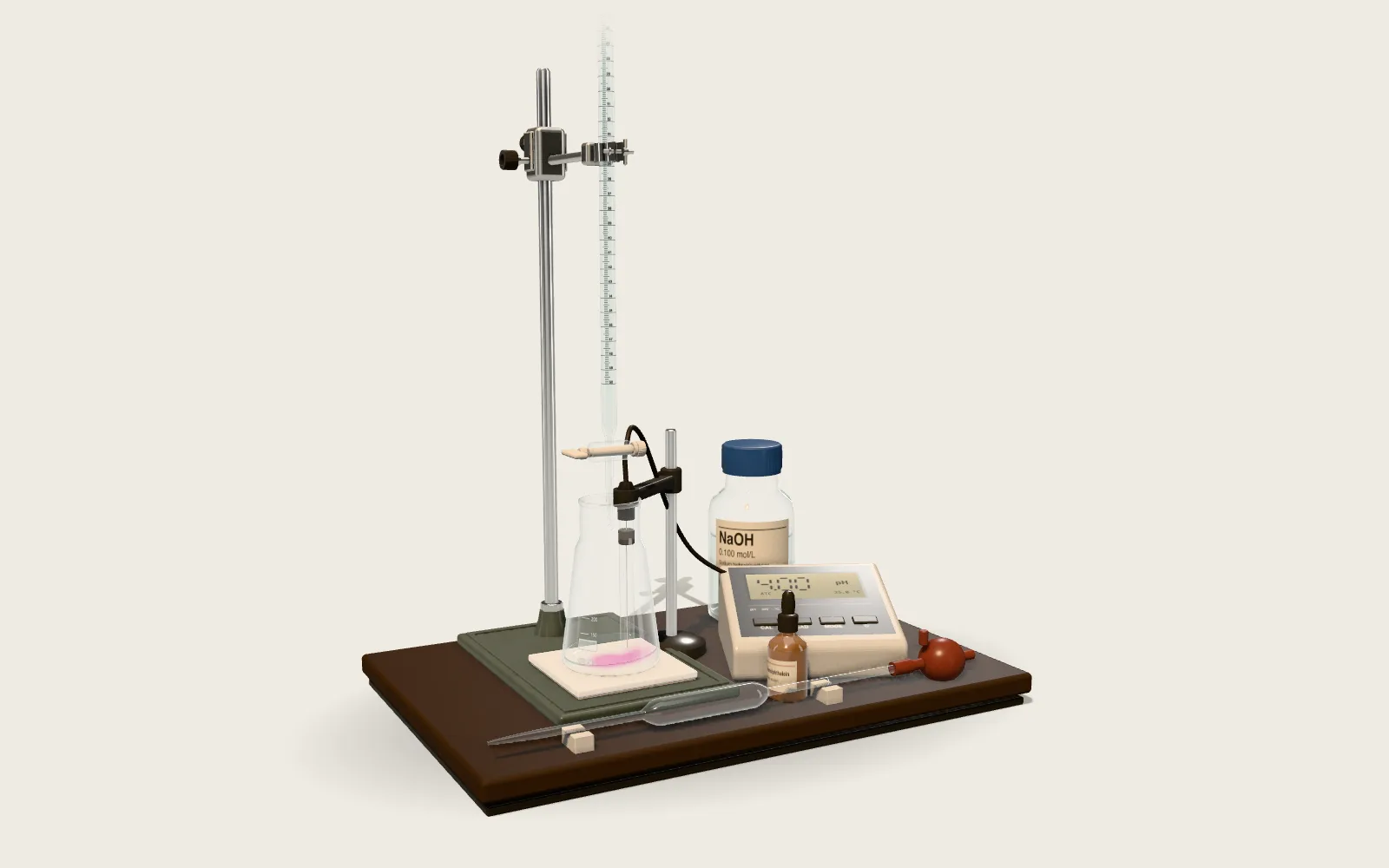 Plate 86Acid–Base TitrationA conical flask holds 25.00 mL of acid of unknown strength; a burette holds sodium hydroxide at 0.100 mol/L. The base goes in drop by drop until the indicator changes colour, and the volume used tells how much acid the flask held. Plotted as pH against volume, the curve is nearly flat for over twenty millilitres, then leaps by about six pH units in the last two drops, which is why one drop can flip the colour. The indicator has to change on that leap: for a weak acid such as acetic acid the equivalence point is at pH 8.72, so phenolphthalein suits it, while methyl orange has finished changing 17 mL too early.
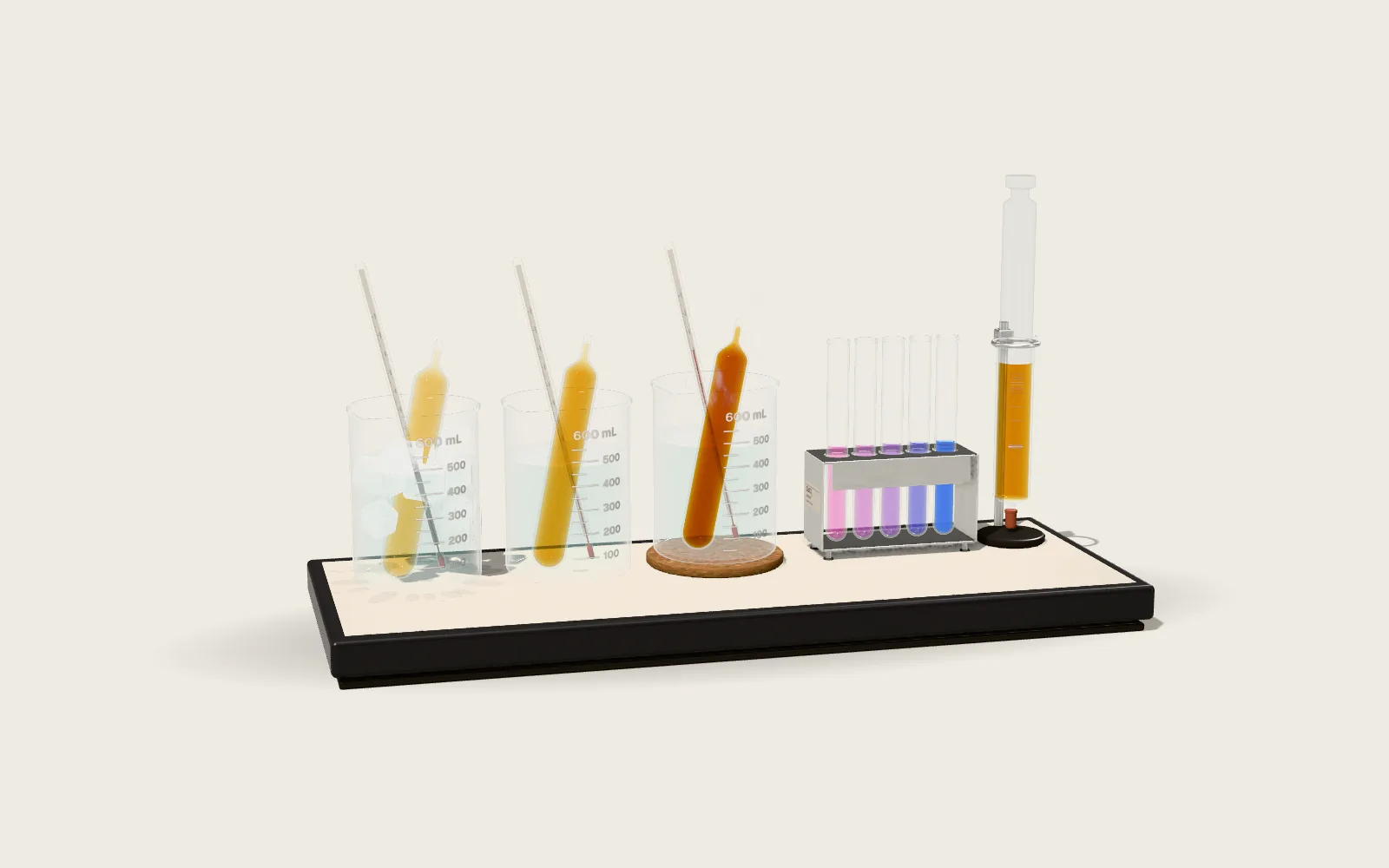 Plate 92Pale in Ice, Dark in HeatNitrogen dioxide, NO₂, is brown; two NO₂ molecules can pair into colourless N₂O₄, and N₂O₄ splits again. Sealed in a glass tube, both go on all the time; when they run at the same rate the colour stops changing: chemical equilibrium. Pairing gives out heat, so in the cold more pairs and the colour fades; in the heat more splits and it darkens. Squeezing favours N₂O₄, the side with fewer molecules. Cobalt chloride in solution does the same: pink with water round the cobalt, blue with chloride; heat or chloride turns it blue, cooling or water turns it pink. Le Chatelier’s principle gives the direction; the amount comes from the equilibrium constant, which changes only with temperature.