The Shapes of Carbon
A carbon atom’s four bonds point to the corners of a tetrahedron. Join the same atoms another way and you have another substance.
Scroll
Why Four
A black carbon ball has four holes; put a white hydrogen in each and you have methane, the main part of natural gas. Carbon has four valence electrons and makes one bond to each hydrogen.
The four bonds are identical and point to the corners of a regular tetrahedron, as far from each other as they can be. Measured, every H–C–H angle is 109.5° and every C–H bond about 109 pm long. A picometre is a millionth of a millionth of a metre.
The models on the desk are built at 2.5 cm to 100 pm, but the balls’ sizes and colours are not to scale. Atoms are not coloured balls and bonds are not sticks; a ball-and-stick model only shows where the atoms are and which are joined.
CH₄ · H–C–H 109.5° · C–H 108.7 pm (measured) · model: 2.5 cm to 100 pm
One, Two, Three Bonds
Two carbons can be joined by one, two or three bonds: ethane, ethene, ethyne. The more bonds, the closer the carbons. Measured, they are 153.6, 133.9 and 120.3 pm apart.
All six atoms of ethene lie in one plane, at angles close to 120° (H–C–H about 117.6°); the four atoms of ethyne lie on a straight line. A double bond is not twice as strong as a single one either.
Kits build double and triple bonds from two or three bent, flexible links. That is only a way of building them: two tetrahedral carbons joined by bent links leave ethene’s H–C–H at 109.5°, and one maker calls the method geometrically incorrect. The models on the desk put every atom where it was measured.
C–C 153.6 pm · C=C 133.9 pm · C≡C 120.3 pm (measured)
Turns, or Won’t
Ethane’s two methyl groups can turn about the single bond between them. A full turn crosses three low humps of about 12 kJ/mol each: most crowded when hydrogen faces hydrogen, easiest when they are staggered. The humps are low, so a single bond turns almost freely, and the molecule sits staggered most of the time.
A double bond is different. To turn it, its π bond has to break first, an estimated 350 kJ/mol, about 30 times ethane’s hump. So double bonds do not turn and ethene stays flat; that is why cis- and trans-2-butene are two different substances.
In the kit, two bent links lock the carbons together, so the double bond will not turn; a single link sits in its holes and can. That is a comparison, not a proof.
Ethane: humps of about 12 kJ/mol · a double bond: the π bond, an estimated 350 kJ/mol, about 30 times
Chains and Branches
Four carbons can make a chain, or three can hang from a middle one: butane and isobutane, both C₄H₁₀. Straight butane boils at −0.5 °C, branched isobutane at −11.7 °C. Isobutane can also cool a household refrigerator, as R-600a.
The more carbons, the more ways: 3 with five carbons, 75 with ten, 366 319 with twenty. These are the ways they could be joined, not substances all made already.
Carbons also close into rings. Cyclohexane, six carbons, is not flat: it folds into a “chair” with every C–C–C angle near 111°, almost free of strain.
C₄H₁₀: butane −0.5 °C · isobutane −11.7 °C · 75 ways to join an alkane with ten carbons
One Formula, Two Substances
These two models have exactly the same atoms: two carbons, six hydrogens, one oxygen, C₂H₆O. On the left is ethanol, the alcohol in drinks, which boils at 78 °C; on the right is dimethyl ether, which boils at −25 °C. At room temperature one is a liquid and the other a gas.
Their molar masses are the same, 46.07 g/mol; the difference is how the atoms are joined. Ethanol’s oxygen carries a hydrogen, and that O–H forms a hydrogen bond with another ethanol’s oxygen, so it takes more energy to pull the molecules apart; dimethyl ether’s oxygen has carbon on both sides, and its molecules cannot bond that way.
Their boiling points are 103 degrees apart. In 1830 Berzelius gave such substances a name: isomers, the same composition with different properties.
C₂H₆O · ethanol 78 °C · dimethyl ether −25 °C · 103 degrees apart · both 46.07 g/mol
Six Equal Bonds
Six carbons close into a flat ring, each with one hydrogen: benzene. In 1865 Kekulé proposed that its six carbons join end to end in a ring, linked alternately by single and double bonds.
A kit can only build it that way too: three straight links and three pairs of bent ones in turn. Yet measured, all six carbon–carbon bonds in benzene are the same length, 139.7 pm, between a single bond (about 154) and a double one (about 134).
In 1929 Kathleen Lonsdale measured crystals of hexamethylbenzene with X-rays: the ring was flat, with carbon–carbon bonds of about 142 pm, which did not fit three fixed double bonds. Today’s account: the six π electrons spread round the whole ring; the alternation is only a way of drawing it, and benzene does not flip between the two drawings.
Benzene’s C–C: 139.7 pm (all six) · single about 154 · double about 134 (measured)
The Other Hand
The middle carbon of butan-2-ol carries four different things: a hydrogen, a hydroxyl (OH), a methyl and an ethyl. These two models are mirror images, like a left and a right hand: turn them as you like, they never match.
Such a pair has the same boiling point and other physical properties, yet in living things they often behave differently: the molecules that receive them have a hand too, and only the right hand fits. The two mirror forms of carvone smell one of spearmint and the other of caraway. For how a big molecule’s shape decides what it does, see Enzymes, Heat and pH.
In 1848 Pasteur carefully sorted the crystals of a tartrate salt into two mirror-image piles; their solutions turned polarised light in opposite directions.
C₄H₁₀O · one carbon, four different groups · mirror images never match
Colours by Agreement
Black carbon, white hydrogen, red oxygen, blue nitrogen: a code for telling elements apart at a glance. Atoms themselves have no such colours. The balls in the box follow the sizes of a common school kit: carbon, oxygen and nitrogen 23 mm across, hydrogen 17 mm.
On 7 April 1865 at the Royal Institution, Hofmann lectured on “the combining power of atoms” with painted croquet balls for atoms: white hydrogen, green chlorine, red oxygen, blue nitrogen, black carbon. His carbon held its four arms in one plane.
In 1874 van ’t Hoff and Le Bel proposed, each on his own, that carbon’s four bonds point to the corners of a tetrahedron; van ’t Hoff showed it with cardboard tetrahedra. Today’s model colours were set down as a table in a patent of Koltun’s in 1965.
1865 Hofmann’s croquet balls · 1874 van ’t Hoff and Le Bel · 1965 Koltun’s colour table
The Box and the Models
The box holds black carbon, white hydrogen, red oxygen, blue nitrogen and grey links in its compartments; the soft bent links make double and triple bonds. On the desk: methane, ethane, ethene and ethyne in a row; ethanol and dimethyl ether, each behind a card that reads C₂H₆O; benzene lying flat behind.
Model box · methane · ethane · ethene · ethyne · benzene · ethanol · dimethyl ether
Pick a Formula
Pick any of six formulas and its models are built behind the cards, ball by ball; the chosen one is lifted and turned slowly. C₂H₆O and C₄H₁₀ can each be joined two ways.
The readings are measured: bond lengths and angles from spectroscopy and diffraction, boiling points from the US National Institute of Standards and Technology. Ethyne has no boiling point at ordinary pressure; the solid turns straight into gas at about −84 °C.
Bond lengths, angles and boiling points all measured · ethyne sublimes at ordinary pressure
Try thisIn the lab, pick C₂H₆O: of its two shapes, which is a liquid at room temperature, and how far apart are their boiling points? Then try C₄H₁₀.
What the model leaves out
The desk is this page’s model, not a copy of any one set. The balls’ sizes and colours follow a common school kit (carbon, oxygen and nitrogen 23 mm, hydrogen 17 mm, 2.5 cm to 100 pm); such a kit uses one link for every single bond, so its C–H comes out nearly as long as its C–C, while here every link is cut to its bond’s measured length and every atom sits where it was measured. Methane, ethane, ethene, ethyne, benzene, ethanol and dimethyl ether use bond lengths and angles measured in the gas; butane is assembled stretched out from its measured lengths and angles; butan-2-ol is built from typical lengths and the tetrahedral angle, not measured atom by atom. Double and triple bonds are shown as bent links, the way kits build them, not what bonds look like; benzene is built as Kekulé drew it, though its six bonds are equal. The box is drawn at a kit box’s size (235 × 170 × 35 mm); the lamp’s light and the plastic’s wear are drawn.
Easy to get wrong
Atoms are not coloured balls and bonds are not sticks: a ball-and-stick model only shows where the atoms are and which are joined. The bond lengths and angles are measured numbers, not read off the model. A single bond turns almost freely but over small humps of about 12 kJ/mol; to turn a double bond its π bond must break, an estimated 350 kJ/mol. That a kit’s single link turns and its double link does not is only a comparison. Ethanol and dimethyl ether have the same molar mass: the difference in boiling point comes from hydrogen bonds, not from mass. Benzene does not flip between Kekulé’s two drawings. The 75 alkanes with ten carbons are the possible ways to join them, not all substances made. Mirror-image molecules share their physical properties; their effects in living things often differ, but not always by much. At ordinary pressure ethyne has no boiling point: −84 °C is where it sublimes.
Common questions · 5
- Why is methane a tetrahedron?
The four bonds are identical and point to the corners of a regular tetrahedron, as far from each other as they can be. Measured, every H–C–H angle is 109.5° and every C–H bond about 109 pm long.
01Why Four ↑- Why does a double bond not turn?
A double bond is different. To turn it, its π bond has to break first, an estimated 350 kJ/mol, about 30 times ethane’s hump.
03Turns, or Won’t ↑- Why do ethanol and dimethyl ether boil so far apart?
Ethanol’s oxygen carries a hydrogen, and that O–H forms a hydrogen bond with another ethanol’s oxygen, so it takes more energy to pull the molecules apart; dimethyl ether’s oxygen has carbon on both sides, and its molecules cannot bond that way.
05One Formula, Two Substances ↑- Does benzene have alternating single and double bonds?
Today’s account: the six π electrons spread round the whole ring; the alternation is only a way of drawing it, and benzene does not flip between the two drawings.
06Six Equal Bonds ↑- Where do the colours of molecular models come from?
Black carbon, white hydrogen, red oxygen, blue nitrogen: a code for telling elements apart at a glance. Atoms themselves have no such colours.
08Colours by Agreement ↑
Sources
- OpenStax: Organic Chemistry, 1.6 (methane: four identical bonds to a tetrahedron’s corners; C–H 109 pm, H–C–H 109.5°)
- OpenStax: Organic Chemistry, 1.8 and 1.9 (ethylene is flat; acetylene is straight; a double bond is less than twice as strong as a single)
- OpenStax: Organic Chemistry, 3.2 (alkane isomers: 75 with ten carbons, 366,319 with twenty)
- OpenStax: Organic Chemistry, 3.6 (ethane’s rotation: a barrier of about 12 kJ/mol)
- OpenStax: Organic Chemistry, 4.5 (the cyclohexane chair: C–C–C near 111°, almost strain-free)
- OpenStax: Organic Chemistry, 5.1 and 5.12 (four different groups and the mirror image; enantiomers alike physically, often unlike biologically)
- OpenStax: Organic Chemistry, 7.4 (to turn a double bond the π bond must break; an estimated 350 kJ/mol)
- OpenStax: Organic Chemistry, 15.2 (all six carbon–carbon bonds in benzene are 139 pm)
- OpenStax: Chemistry 2e, 7.5 (ethanol is the alcohol in drinks) and 7.6 (four electron pairs: a tetrahedron, 109.5°)
- OpenStax: Chemistry 2e, 10.1 (intermolecular forces; Example 10.3: ethanol, dimethyl ether and hydrogen bonds)
- NIST: Computational Chemistry Comparison and Benchmark Database (experimental geometries of methane, ethane, ethylene, acetylene, benzene, ethanol, dimethyl ether, butane, isobutane)
- NIST: Chemistry WebBook (boiling points; acetylene’s triple point lies above 1 atm)
- IUPAC CIAAW: Abridged Standard Atomic Weights
- PubChem: 2-Butanol (one stereocentre)
- L. Friedman and J. G. Miller (1971): Science 172, 1044 (the two carvones: spearmint and caraway)
- A. Kekulé (1866): Annalen 137, 129 (six carbons closed in a ring, joined alternately by one and two bonds)
- A. J. Rocke (2015): Angew. Chem. Int. Ed. 54, 46 (the 150th anniversary of Kekulé’s benzene)
- K. Lonsdale (1929): Proc. R. Soc. A 123, 494 (hexamethylbenzene’s ring is flat, C–C about 1.42 Å)
- A. W. Hofmann (1865): On the Combining Power of Atoms, Proc. Royal Institution 4, 401 (croquet-ball atoms and their colours)
- C. Meinel (2004): Molecules and Croquet Balls, in Models: The Third Dimension of Science
- J. H. van ’t Hoff (1898): The Arrangement of Atoms in Space (the tetrahedral carbon of 1874; cardboard tetrahedra)
- NobelPrize.org: the Nobel Prize in Chemistry 1901 (van ’t Hoff, chemical dynamics and osmotic pressure)
- J. J. Berzelius (1830): Ann. Phys. Chem. 19, 305 (the word “isomeric”)
- L. Pasteur (1848): C. R. Acad. Sci. 26, 535 (tartrate crystals sorted into two mirror-image kinds)
- R. B. Corey and L. Pauling (1953): Rev. Sci. Instrum. 24, 621 (space-filling molecular models)
- W. L. Koltun: US patent 3,170,246 (1965; the models’ colour code: hydrogen white, oxygen red, nitrogen blue, carbon black)
- Molymod (Spiring Enterprises): The Molymod System (2.5 cm to 1 Å; carbon 23 mm, hydrogen 17 mm; long flexible links for double and triple bonds)
- HGS (Maruzen): Stereochemistry Molecular Model manual (a kit to scale; the bent-link double bond is “geometrically incorrect”)
- US EPA SNAP: Substitutes in Household Refrigerators and Freezers (isobutane, R-600a)
Data
Bond lengths and angles from the NIST Computational Chemistry Comparison and Benchmark Database (experimental geometries: G. Herzberg 1966; K. Kuchitsu, ed., 1998; and the database’s other references); boiling points from the NIST Chemistry WebBook; atomic weights from IUPAC CIAAW; bonding, rotation, isomers, rings, hydrogen bonds, benzene and chirality after OpenStax Organic Chemistry (J. McMurry) and OpenStax Chemistry 2e; Kekulé’s benzene after A. Kekulé (Annalen, 1866) and A. J. Rocke (Angew. Chem., 2015); carvone after L. Friedman and J. G. Miller (Science, 1971). The coordinates the page builds are computed here from those measurements. The kit’s sizes and colours after Molymod (Spiring Enterprises: the maker’s pages and its 2005 leaflet) and HGS (Maruzen) manuals; Hofmann’s croquet balls after A. W. Hofmann (Proc. Royal Institution, 1865) and C. Meinel (in Models: The Third Dimension of Science, 2004); the tetrahedral carbon after J. H. van ’t Hoff (The Arrangement of Atoms in Space, 1898) and NobelPrize.org; benzene’s flat ring after K. Lonsdale (Proc. R. Soc. A, 1929); “isomeric” after J. J. Berzelius (Ann. Phys. Chem., 1830); mirror-image crystals after L. Pasteur (C. R. Acad. Sci., 1848); the colour code after R. B. Corey and L. Pauling (Rev. Sci. Instrum., 1953) and W. L. Koltun (US patent 3,170,246, 1965); isobutane in refrigerators after the US EPA SNAP programme. The desk is this page’s model: balls and box at the sizes of a common school kit, every link cut to its bond’s measured length; not a copy of any one set. Material presets and the model kit as on the site’s other model plates (public/looks/CREDITS.md).
The text, pictures and models on this page are licensed CC BY-NC 4.0: free to use and adapt for teaching and other non-commercial purposes, with credit to world.lapla.si. Third-party material listed above keeps its own licence.
Cite this plate
Laplace’s Mini World, Plate 95, “The Shapes of Carbon”, https://world.lapla.si/en/organic/, CC BY-NC 4.0, updated 2026-11-04.
Follow the question
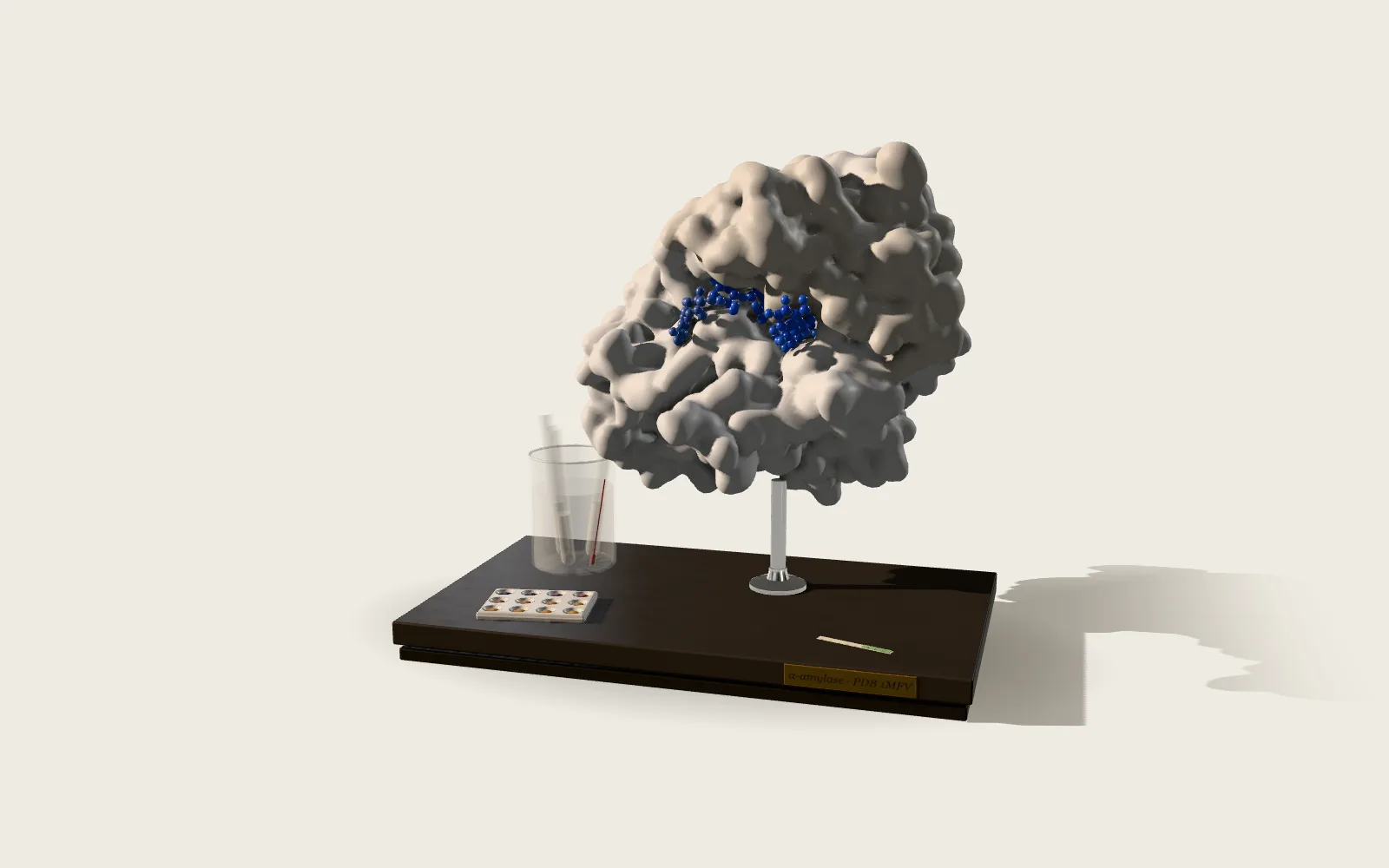 Plate 67Enzymes, Heat and pHThe α-amylase in saliva cuts starch into maltose and shorter chains. It is one chain of 496 amino acids folded so that a cleft opens in it; the sugar chain lies in the cleft and is cut between its −1 and +1 sugars. A little warmer and it cuts faster; too hot and the fold comes apart and the cleft is gone. pH changes the charges on its side chains, and away from about 7 it slows. On the plinth is a model built from the atoms in the Protein Data Bank, sixty million times life size; beside it, the school starch–iodine test.
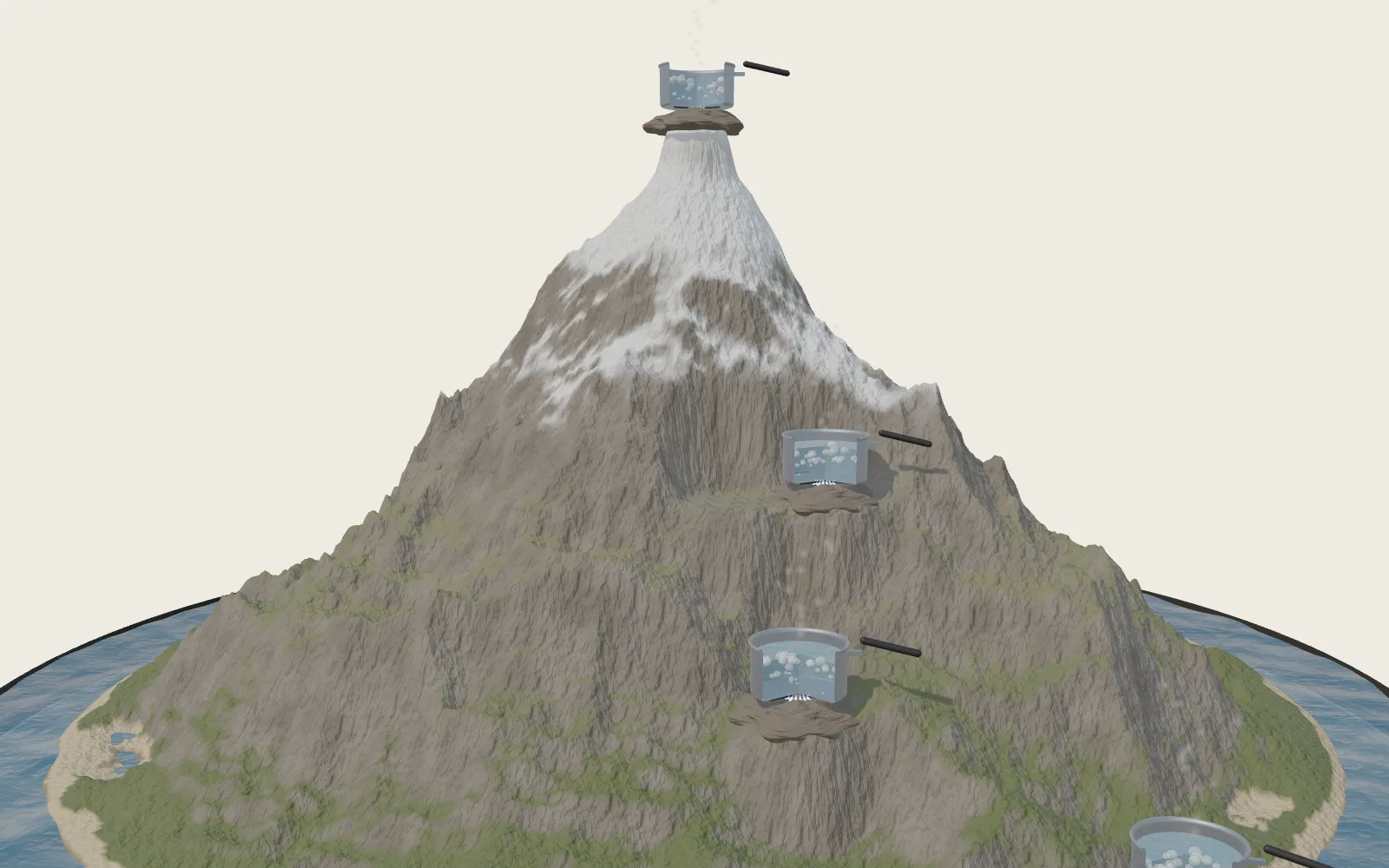 Plate 32Why Mountain Water Isn’t Hot EnoughAt the top of Everest, water boils at about 70°C — too cool to hard-boil an egg, however long you wait. The temperature water boils at depends on how much air is pressing down on it.