Pale in Ice, Dark in Heat
Three tubes sealed with the same gas: pale yellow in ice water, deep red-brown in hot. Two molecules keep turning into each other; the temperature sets how much of each.
Scroll
Three Matching Tubes
Three glass tubes hold the same amount of the same gas, each sealed shut. The page’s tubes are 25 mm across, at 0.3 bar inside at 25 °C.
One goes into ice water, one stays in water at 20 °C, one goes into water at 80 °C. The one in ice turns pale yellow; the one in hot water turns deep red-brown. Taken out, each drifts back to the brownish yellow of the room.
The colour comes only from nitrogen dioxide, NO₂: its molecule has one unpaired electron and absorbs violet and blue light. Two NO₂ molecules can pair into one dinitrogen tetroxide, N₂O₄, which absorbs almost no visible light and is colourless. How deep a tube’s colour looks counts the NO₂ molecules along the light’s path. Where the NO₂ comes from: Copper in Nitric Acid.
2NO₂ ⇌ N₂O₄ · NO₂ brown, N₂O₄ colourless · the page’s tube: 25 mm across, 0.3 bar at 25 °C · ice water 0 °C · 20 °C · hot water 80 °C
Balanced, Never Still
In the tube, NO₂ molecules keep pairing and N₂O₄ molecules keep splitting. When more pair than split, the NO₂ falls; when more split, it rises. When both run equally fast, the number of NO₂ stops changing, and so does the colour: chemical equilibrium. The reactions have not stopped; they run at the same rate both ways.
They are far too quick to see. From measured rate constants, at 20 °C an N₂O₄ molecule in the page’s tube lasts only 22–50 µs on average before it splits, and each NO₂ pairs about 50,000 to 110,000 times a second. An ultrasonic measurement of 1962 gives about 24 µs for this tube (at 25 °C), in the same range.
So a disturbed equilibrium settles again within microseconds. A tube put into hot water takes a while to darken because the glass and the gas take a while to warm; the reaction keeps up all the way.
2NO₂ ⇌ N₂O₄ · at 20 °C: an N₂O₄ lasts 22–50 µs on average · an NO₂ pairs about 50,000–110,000 times a second · back in balance about 4–8 µs after a disturbance (computed)
Heat Splits, Cold Pairs
When two NO₂ molecules pair into N₂O₄, heat comes out, about 57 kJ per mole; splitting N₂O₄ takes the same heat back in.
Warm it, and the equilibrium leans to the side that takes in heat: more splits, NO₂ rises, the colour deepens. Cool it, and it leans to the side that gives heat out: more pairs, the colour fades. By the page’s computation, about 14% of the nitrogen in the ice-water tube is in NO₂, 28% at 20 °C, 85% at 80 °C.
The tube in ice is not colourless: the NO₂ left still takes about four-fifths of the blue light at 450 nm through its middle, so it looks pale yellow. Nor does the hot one darken only because the gas is hot: the same tube of gas holds about six times as many NO₂ molecules in hot water as in ice.
2NO₂ → N₂O₄ gives out about 57 kJ/mol · nitrogen in NO₂: 0 °C 14% · 20 °C 28% · 80 °C 85% (the page’s tube, computed)
A Number Only Heat Moves
At equilibrium, the partial pressure of N₂O₄ divided by the square of the partial pressure of NO₂ is a fixed number, the equilibrium constant K. From the thermodynamic tables it is about 6.7 per bar at 25 °C.
Fill a tube with more gas or less and the share of NO₂ changes, but K does not: at 25 °C, a tube at 0.1 bar has 52% of its nitrogen in NO₂, one at 1 bar only 19%, and both give the same K. Squeezing the gas or adding NO₂ only shares the mixture out again; K stays.
Only temperature changes K: 55.6 per bar at 0 °C, 0.19 per bar at 80 °C, about 36 times smaller from 25 °C to 80 °C. Le Chatelier’s principle says which way the mixture shifts; how far comes from K.
K = p(N₂O₄) / p(NO₂)² · 0 °C 55.6 · 25 °C 6.74 · 80 °C 0.188, per bar (NIST-JANAF, computed)
Push the Plunger
The glass syringe holds the same gas, 0.5 bar at 25 °C, its nozzle capped. Push the plunger in to half the volume and the same molecules crowd into half the space: seen from the side, the NO₂ is at once twice as dense and the colour darkens.
Two NO₂ molecules pairing into one N₂O₄ leave one molecule fewer, taking less room, so after the squeeze the equilibrium leans towards N₂O₄. By the page’s computation, once the gas is back at 25 °C its NO₂ is about 1.5 times as dense as before: paler than just after the push, still darker than before it. Seen along the barrel, the path is half as long, and it ends up paler than at the start.
Many textbooks say the colour fades over a few seconds because the reaction is catching up. In fact the reaction catches up within microseconds. A quick push heats the gas by about 13 °C, which itself makes a little more NO₂; the fading over the next seconds is the gas giving its heat to the glass and cooling.
Half the volume: NO₂ density × 2 → × 2.2 while hot → × 1.5 back at 25 °C · along the barrel × 0.74 · 0.5 bar → 0.95 bar (computed)
Water and Chloride Compete for Cobalt
In water, a cobalt ion Co²⁺ from cobalt chloride is surrounded by six water molecules: pink [Co(H₂O)₆]²⁺. With plenty of chloride, four chloride ions take the place of the six waters: blue [CoCl₄]²⁻. Chloride ions are larger than water molecules, and six do not fit.
This is an equilibrium too. Add concentrated hydrochloric acid and the extra chloride shifts it to the blue side: the solution turns deep blue. Add water and it goes back to pink, only paler. Salt turns it bluer as well, but salt dissolves slowly.
The violet of the middle tubes in the rack is both kinds together, with forms in between that hold one or two chloride ions. The pink one absorbs green light near 525 nm; the blue one absorbs red near 680 nm.
[Co(H₂O)₆]²⁺ + 4Cl⁻ ⇌ [CoCl₄]²⁻ + 6H₂O · pink: six waters, octahedral · blue: four chlorides, tetrahedral · add chloride → blue · add water → pink
Heat Turns It Blue
Going from pink to blue takes in heat. So a violet solution turns blue in water above 90 °C and pink in ice water; swap the two tubes and the colours swap too. Measured at high temperature, the step takes in about 62 kJ per mole.
The solid changes colour the same way: anhydrous cobalt chloride is blue, and with water taken up as the hexahydrate, CoCl₂·6H₂O, it turns pink. Blue cobalt chloride paper turns pink in water, and indicating silica gel uses it to show damp.
Cobalt dichloride is classified in the EU as possibly causing cancer when breathed in, so indicating gel that holds it must be labelled and disposed of as hazardous. It has not been banned, but many humidity indicator cards now use indicators without cobalt dichloride.
Pink → blue takes in heat, about +62 kJ/mol measured at high temperature · above 90 °C blue, in ice water pink · anhydrous CoCl₂ blue, CoCl₂·6H₂O pink
Faster, Not Further
A catalyst speeds up both directions, and by the same factor. The equilibrium comes sooner, but it sits in the same place, and K is unchanged.
Ammonia’s makers set their conditions by the same reasoning: the reaction gives out heat and leaves fewer gas molecules, so ammonia is favoured by cold and high pressure; but in the cold it is far too slow, so a catalyst is used, at 400–500 °C and about 150–250 atmospheres, as a compromise. The industrial side: Nitrogen from the Air.
A catalyst speeds both ways alike, K unchanged · ammonia: N₂ + 3H₂ ⇌ 2NH₃ at 400–500 °C, about 150–250 atm
One Sentence from 1884
In 1884 van 't Hoff wrote down the rule for temperature: on cooling, an equilibrium shifts to the side whose forming gives out heat. In the same year Le Chatelier extended it to pressure and concentration: a system in stable equilibrium, changed from outside, can only undergo inner changes that would oppose that change. Today it is often put in one line: push a balance and it shifts to push back.
It gives a direction, not a cause, and no amount. Put the NO₂ tube in ice water and the equilibrium shifts to the pairing that gives out heat, yet the gas in the tube still cools to the temperature of the ice water.
It has exceptions, too. Add a little nitrogen to the ammonia equilibrium at constant temperature and pressure when nitrogen is already more than half the mixture, and, for ideal gases, the equilibrium shifts towards splitting ammonia. To know which way and how far, the reliable way is to compute with the equilibrium constant.
Le Chatelier, Comptes rendus 99 (1884) · van 't Hoff, Études de dynamique chimique (1884) · the principle for direction, K for amount
Nine Things on the Bench
Three glass tubes sealed with NO₂ and their water: ice water, water at 20 °C and water at 80 °C on a cork mat, each beaker with a red-spirit thermometer; a stainless rack of five tubes of cobalt chloride solution, pink to blue; and at the right end, a 50 mL glass syringe upright in a small stand, also sealed with NO₂.
Three sealed tubes · three beakers of water · three thermometers · rack · cobalt chloride · glass syringe
Set the Heat and the Volume
This is the page’s model, computed in the browser from the NIST-JANAF thermodynamic data for an ideal gas. The syringe holds NO₂ and N₂O₄ at 0.5 bar at 25 °C; set the temperature from 0 to 100 °C and squeeze the volume from 50 mL to 20 mL, and watch the share of NO₂, the pressure and the colour change together. Cold and squeezed hard, N₂O₄ condenses to a liquid; the readout says so.
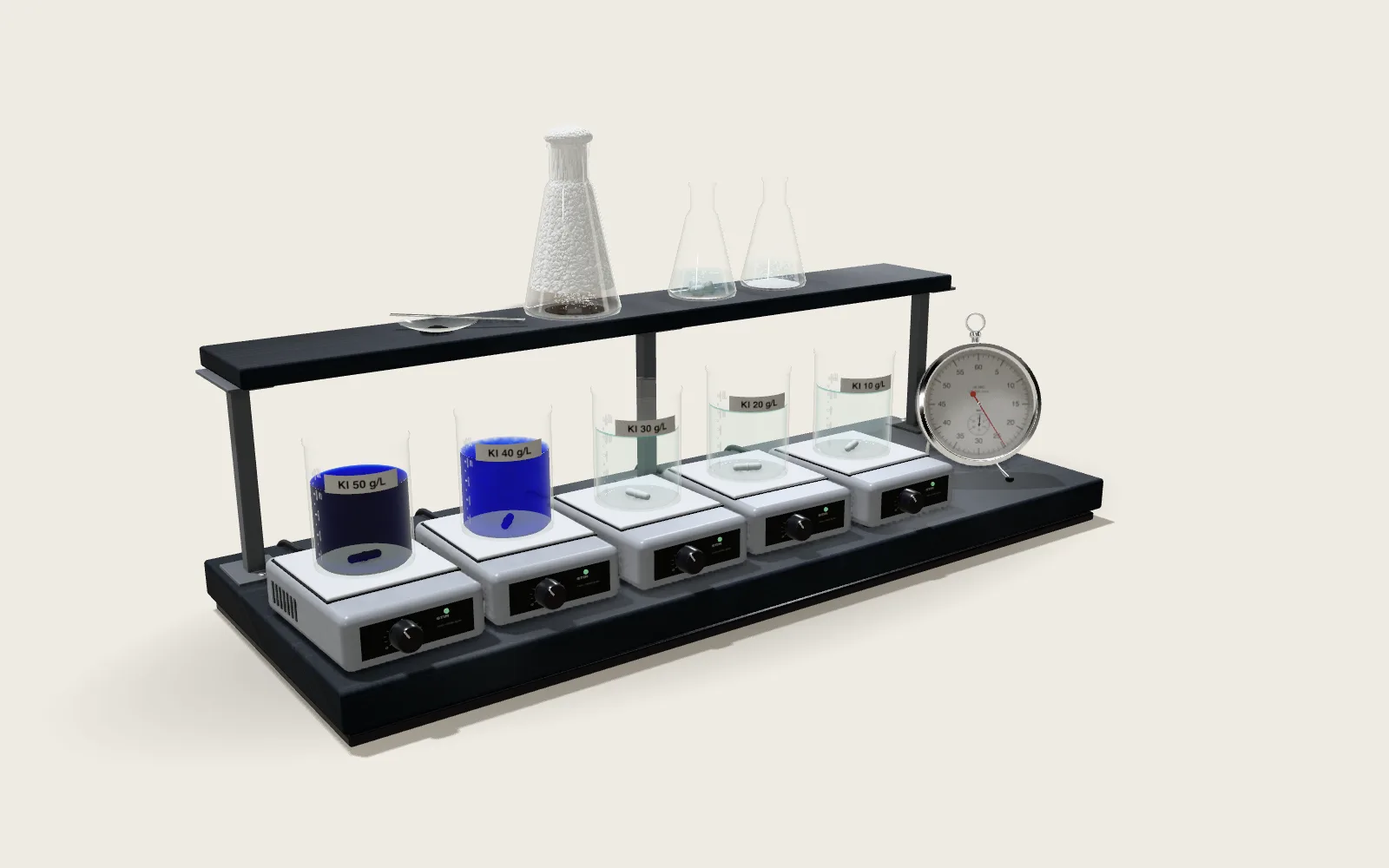
The middle cobalt tube in the rack shows the direction only: add concentrated hydrochloric acid or water, with the same temperature slider; the colour moves towards blue or pink, and the page does not compute how much of each there is.
The page’s model · K from NIST-JANAF · ideal gas · cobalt: direction only
Try thisIn the lab, squeeze the syringe from 50 mL to 25 mL: how far does the share of nitrogen in NO₂ fall? Then set 80 °C: what is it now?
What the model leaves out
The bench is a model of a demonstration: three 600 mL beakers, three sealed tubes of the page’s own size and filling (25 mm across, 1.3 mm wall, 0.3 bar at 25 °C), red-spirit thermometers, a stainless rack of five 16 × 150 mm test tubes and a 50 mL glass syringe; not a copy of any one set. The gas is coloured from NO₂’s cross sections in red, green and blue bands and the computed number of molecules; the cobalt colours, the steam, the ice and how long each change takes are the page’s own drawing. The cover shows the moment the tubes have just gone in: the hot one darkens from the foot. The gas is ideal, and K follows the NIST-JANAF data with temperature; the N₂O₄ in the ice-water tube does not condense (the page’s tube is filled lightly enough; checked). The rates of pairing and splitting are those measured with nitrogen as the collision partner, and 0 °C and 80 °C are extrapolations, so only ranges are given. The 13 °C of the syringe’s warming is the upper limit with no heat lost. Cobalt chloride also forms complexes with one or two chlorides; the page draws the change from pink to blue and does not compute how much of each there is. The molecules are drawn not to scale.
Easy to get wrong
At equilibrium the reactions have not stopped; they run at the same rate both ways. The colour deepens not because the gas itself is hot but because there are more NO₂ molecules; N₂O₄ absorbs only in the ultraviolet and is colourless in visible light. The tube in ice water is pale yellow, not colourless; the hot one is not all NO₂. Pairing (2NO₂ → N₂O₄) gives out heat and splitting takes it in, not the other way round. Squeezed and seen from the side, the colour first darkens, then fades somewhat as the gas cools, but stays darker than before; the seconds of fading are cooling, not a slow reaction. Pressure, concentration and catalysts do not change the equilibrium constant; only temperature does, and a catalyst does not shift the equilibrium either. Le Chatelier’s principle gives a direction, explains nothing and has exceptions. NO₂ is fatal if inhaled and cobalt chloride may cause cancer: the page shows sealed tubes only.
Common questions · 4
- Has the reaction stopped at equilibrium?
When both run equally fast, the number of NO₂ stops changing, and so does the colour: chemical equilibrium. The reactions have not stopped; they run at the same rate both ways.
02Balanced, Never Still ↑- Why does the tube darken in hot water?
Warm it, and the equilibrium leans to the side that takes in heat: more splits, NO₂ rises, the colour deepens.
03Heat Splits, Cold Pairs ↑- Why does the colour fade a few seconds after the squeeze?
In fact the reaction catches up within microseconds. A quick push heats the gas by about 13 °C, which itself makes a little more NO₂; the fading over the next seconds is the gas giving its heat to the glass and cooling.
05Push the Plunger ↑- Does a catalyst shift an equilibrium?
A catalyst speeds up both directions, and by the same factor. The equilibrium comes sooner, but it sits in the same place, and K is unchanged.
08Faster, Not Further ↑
Sources
- OpenStax: Chemistry 2e, 13.1 (equilibrium is dynamic: the forward and reverse reactions go on at the same rate; the reaction has not stopped)
- OpenStax: Chemistry 2e, 13.2 (the law of mass action: at a given temperature the reaction quotient at equilibrium is constant)
- OpenStax: Chemistry 2e, 13.3 (Le Chatelier’s principle; concentration and volume shift the position, temperature changes K; a catalyst leaves K unchanged; the conditions of ammonia synthesis)
- OpenStax: Chemistry 2e, 18.7 (NO₂’s colour comes from its unpaired electron; colourless N₂O₄ forms at low temperature)
- OpenStax: Chemistry 2e, 19.2 (the coordination number of [Co(H₂O)₆]²⁺ is six, octahedral)
- NIST-JANAF Thermochemical Tables (M. W. Chase, 1998; NO₂, N₂O₄ gas and liquid)
- NASA JPL: Chemical Kinetics and Photochemical Data, Evaluation No. 19 (J. B. Burkholder et al., JPL Publication 19-5; NO₂ cross sections, the equilibrium constant)
- MPI-Mainz UV/VIS Spectral Atlas: NO₂ cross sections (measurements of A. C. Vandaele et al., 1998)
- R. Atkinson et al. (IUPAC, 2004): Evaluated kinetic and photochemical data for atmospheric chemistry, Volume I (the pairing of NO₂ and the splitting of N₂O₄)
- M. Cher (1962): Rate of Dissociation of N₂O₄ by Ultrasonic Absorption Measurements, J. Chem. Phys. (the rate of splitting at 25 °C)
- I. A. Leenson (2000): Approaching Equilibrium in the N₂O₄–NO₂ System: A Common Mistake in Textbooks, J. Chem. Educ. 77 (heating on compression; relaxation within microseconds)
- Royal Society of Chemistry: The effect of pressure and temperature on equilibrium (NO₂ in ice and hot water; the syringe; only sealed containers on the open bench)
- Rutgers University: Lecture demonstration 1033, Temperature Effect (yellowish in ice water, brown at room temperature)
- CLEAPSS: Student Safety Sheet 53, Nitrogen oxides (fatal if inhaled)
- Royal Society of Chemistry: The equilibrium between two coloured cobalt species (blue with concentrated acid, pink with water; blue above 90 °C, pink in ice water; the forward reaction endothermic)
- Jim Clark: chemguide, Ligand exchange reactions (four chloride ions in place of six water molecules; “a dark rich blue”; pink again with water)
- Jim Clark: chemguide, Le Chatelier’s Principle (a useful guide that explains nothing; only temperature changes the equilibrium constant)
- R. Wood et al. (2025): Mechanistic Investigation of Co(II) Extraction by TODGA, Nucl. Sci. Eng. ([Co(H₂O)₆]²⁺ absorbs at 525 nm, [CoCl₄]²⁻ at 680 nm)
- T. W. Swaddle, L. Fabes (1980): Octahedral–tetrahedral equilibria in aqueous cobalt(II) solutions at high temperatures, Can. J. Chem. 58 (ΔH about +62 kJ/mol at high temperature)
- PubChem (US NIH): Cobalt dichloride, HSDB (blue when anhydrous, pink as the hexahydrate; a humidity indicator)
- Cobalt Institute: Classification of Cobalt substances under EU CLP (March 2026; cobalt dichloride Carc. 1B, H350i)
- US National Park Service: Conserve O Gram 2/15, Cobalt Indicating Silica Gel (2005; handled as hazardous, not banned)
- Clariant: Humitector humidity indicator cards (cards free of cobalt dichloride)
- H. Le Chatelier (1884): Sur un énoncé général des lois des équilibres chimiques, Comptes rendus 99, 786–789
- J. H. van ’t Hoff (1884): Études de dynamique chimique, p. 161 (“principe de l’équilibre mobile”)
- D. S. Corti, M. J. Uline (2007): on adding nitrogen to the ammonia equilibrium, J. Chem. Educ. 84 (an exception to Le Chatelier’s principle)
- D. Fleming (2017): Easier equilibrium, RSC Education in Chemistry (the principle does not reliably predict the shift on finite additions)
Data
The chemistry after OpenStax Chemistry 2e (Flowers, Theopold, Langley, Robinson; Rice University, 2019; access for free at openstax.org: 13.1–13.3, 18.7, 19.2); the thermodynamics of NO₂ and N₂O₄ from the NIST-JANAF Thermochemical Tables (M. W. Chase, 1998); NO₂’s cross sections from the NASA JPL evaluation No. 19 (J. B. Burkholder et al., JPL Publication 19-5) of the measurements of A. C. Vandaele et al. (1998), through the MPI-Mainz UV/VIS Spectral Atlas; the rates of pairing and splitting from the IUPAC evaluation of R. Atkinson et al. (2004) and M. Cher (1962); the squeezed syringe after I. A. Leenson (2000); the demonstrations after the Royal Society of Chemistry’s Education pages, Jim Clark’s chemguide and CLEAPSS Student Safety Sheet 53; cobalt after R. Wood et al. (2025), T. W. Swaddle and L. Fabes (1980) and PubChem’s HSDB records; its classification after the Cobalt Institute’s table of EU CLP entries; indicating silica gel after the US National Park Service’s Conserve O Gram 2/15; the history after H. Le Chatelier (Comptes rendus 99, 1884) and J. H. van ’t Hoff (Études de dynamique chimique, 1884). Every number the page computes (the shares, the constants, the colours, the lifetimes, the syringe) is computed here from those values. The bench is this page’s model of a demonstration: three 600 mL beakers, three sealed tubes of the page’s own size and filling (25 mm across, 0.3 bar at 25 °C), red-spirit thermometers, a stainless rack of five test tubes and a 50 mL glass syringe on a black resin slab; not a copy of any one set. The colours of the gas are computed from NO₂’s cross sections in three bands; the cobalt colours, the steam, the ice and the timing of every change are the page’s own drawing. Material presets and the model kit as on the site’s other model plates (public/looks/CREDITS.md).
The text, pictures and models on this page are licensed CC BY-NC 4.0: free to use and adapt for teaching and other non-commercial purposes, with credit to world.lapla.si. Third-party material listed above keeps its own licence.
Cite this plate
Laplace’s Mini World, Plate 92, “Pale in Ice, Dark in Heat”, https://world.lapla.si/en/equilibrium/, CC BY-NC 4.0, updated 2026-11-04.
Follow the question
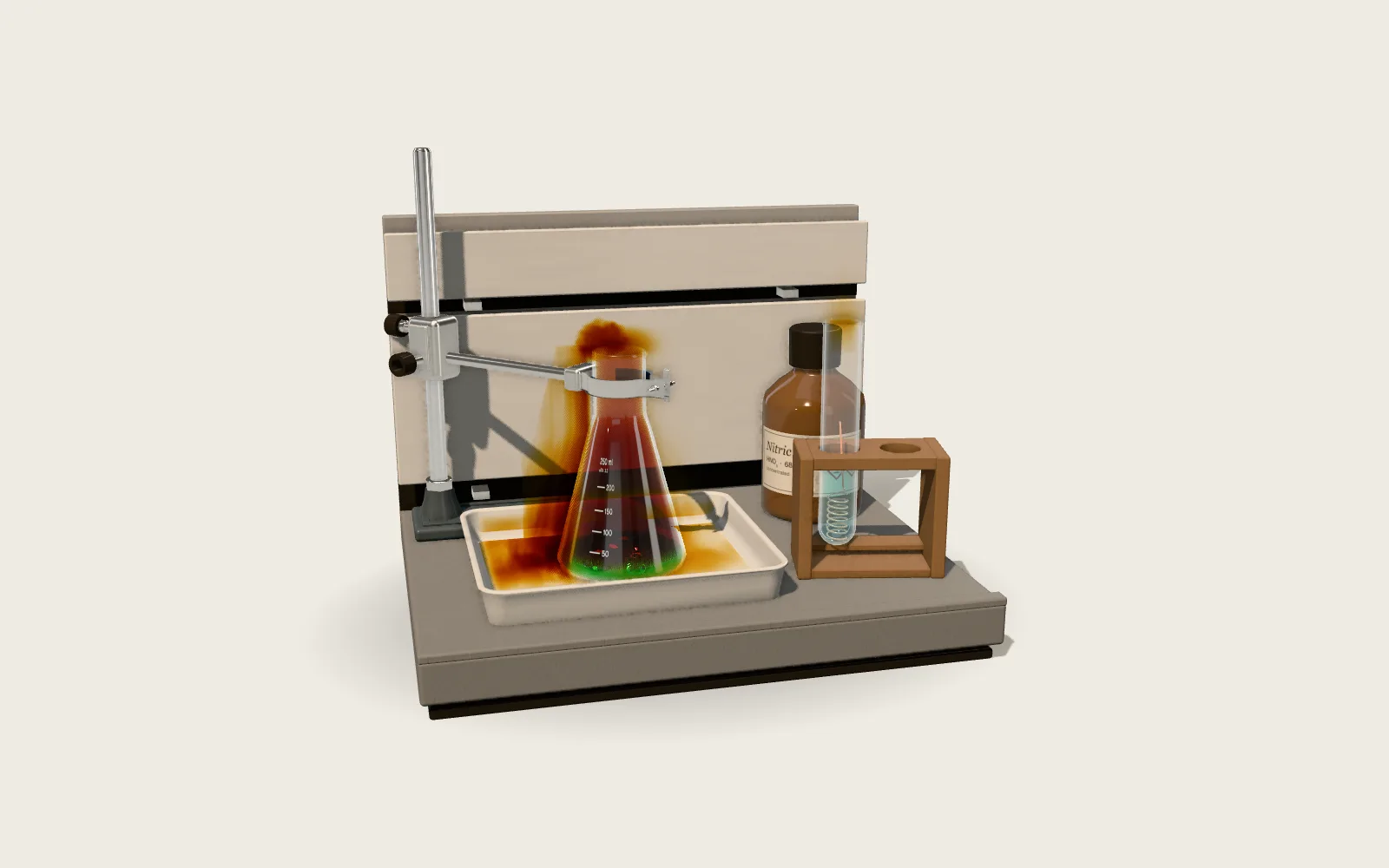 Plate 88Copper in Nitric AcidCopper turnings in concentrated nitric acid turn the liquid green and give off red-brown, toxic nitrogen dioxide: Cu + 4 HNO₃ → Cu(NO₃)₂ + 2 NO₂ + 2 H₂O. Heavier than air, it sinks over the lip of the flask. Diluted, the solution turns blue. In dilute acid the gas is mainly colourless nitric oxide, which browns only where it meets air. Air made very hot in engines and lightning makes the same two oxides; industry burns ammonia over platinum–rhodium gauze and turns the oxide into acid.
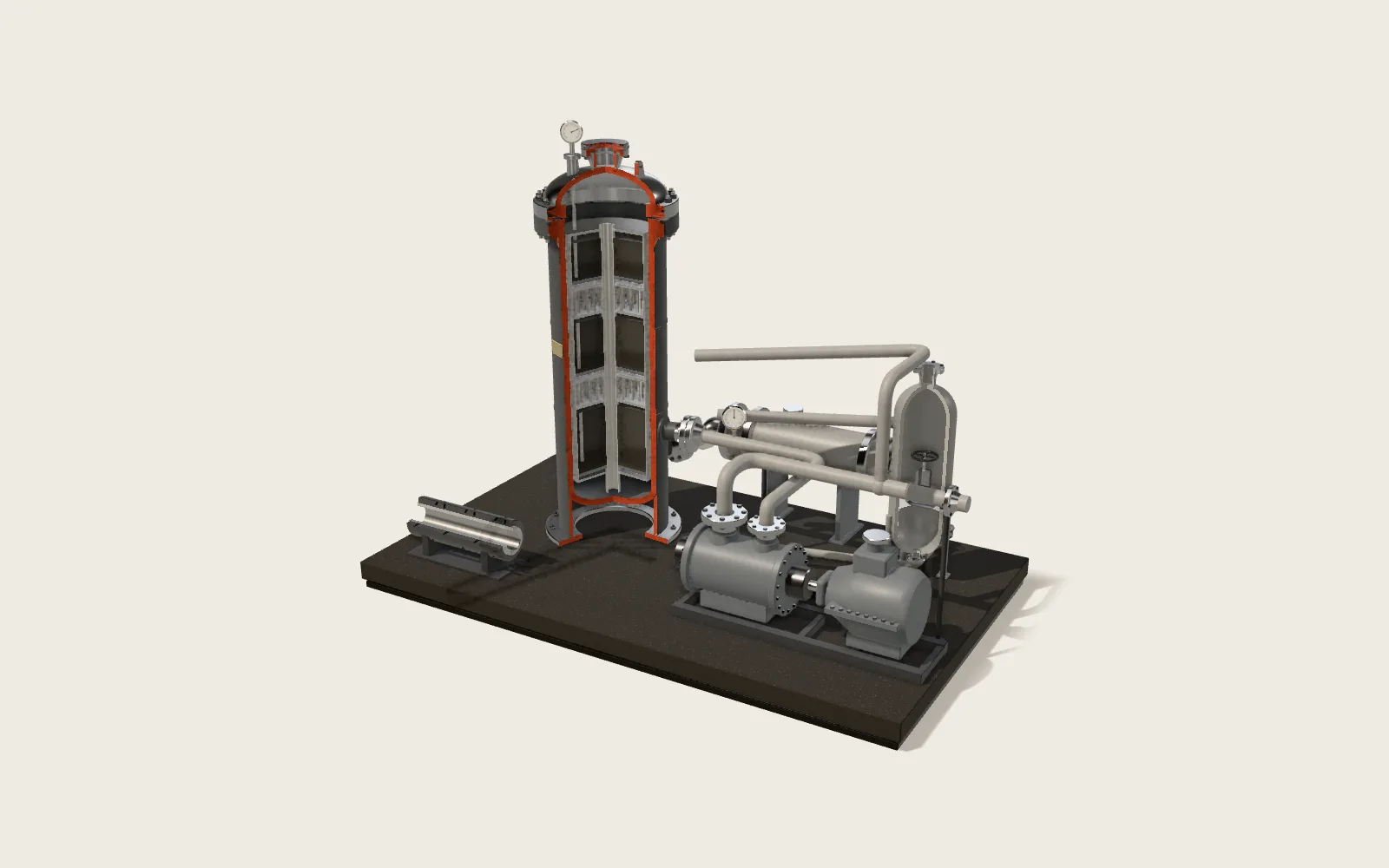 Plate 54Nitrogen from the AirAir is nearly four-fifths nitrogen, yet crops can’t use it: the nitrogen molecule’s triple bond is too strong. The Haber–Bosch process presses nitrogen and hydrogen to 100–250 bar, heats them to 350–550 °C and joins them on an iron catalyst to make ammonia. Cold, the equilibrium favours ammonia but the reaction crawls; hot, it runs fast but yields little, so plants settle on a compromise. Each pass converts only a fifth to a third, and the rest goes round again. About 70 % of the ammonia made today becomes fertiliser.