Atom-Interferometer Gravimeters
Cold atoms rise and fall in a vacuum tube, and three laser pulses send each along two paths at once. The phase between them gave g to three parts in a billion in a minute in 1999.
Scroll
Weighing gravity
A gravimeter measures the local acceleration of gravity, g, about 9.8 m/s². It changes from place to place and from hour to hour: more water or magma underground, less rock, the Moon and the Sun in another part of the sky, and g is slightly different. Geophysicists count in microgals: 1 µGal = 10⁻⁸ m/s², about a billionth of g.
The changes are small. Computed from the formulas: an extra layer of water 1 m thick underground adds about 42 µGal; raising the instrument by 1 cm takes away 3.1 µGal; a ball 2 m in radius, 1,000 kg/m³ denser than its surroundings and buried 5 m deep, adds about 9 µGal right above it. The tides at Stanford are about 2 × 10⁻⁷ g. To see these, an instrument must be right to a few parts in a billion.
1 µGal = 10⁻⁸ m/s² · 1 m of water: about 42 µGal · 1 cm higher: 3.1 µGal less (computed) · tides about 2 × 10⁻⁷ g
Cold atoms first
An atom interferometer starts with laser-cooled atoms. A magneto-optical trap catches them from a thin vapour of rubidium or caesium: six laser beams from three directions push against the atoms, a pair of coils adds a magnetic field, and hundreds of millions of atoms gather into a cloud in a fraction of a second. How lasers cool atoms: see the Bose–Einstein condensation plate.
The cold cloud is then pushed upward by the light. In Stanford’s 1999 instrument about 5 × 10⁸ caesium atoms were loaded into the trap in 600 ms, cooled to about 1.5 µK and launched at about 3.0 m/s, rising to about 46 cm above the trap.
about 5 × 10⁸ caesium atoms · loaded in 600 ms · about 1.5 µK · launched at about 3.0 m/s, to about 46 cm (1999)
Light as a beam splitter
While the atom flies through the vacuum, a pair of laser beams going opposite ways (the Raman beams) shines on it briefly: the atom absorbs a photon from one beam and gives one off into the other, gaining momentum the same way both times, and moves from one energy level to another. For ⁸⁷Rb the change of speed is 11.77 mm/s (computed).
Make the pulse just long enough for even odds (a π/2 pulse) and the atom ends up in a superposition of two states: one not pushed, still in the first level, and one pushed, in the other. The atom is not cut in half. Each atom flies at both speeds at once, and the two parts of its wave drift apart; a detector at the end always finds a whole atom.
k_eff = 4π/λ ≈ 1.61 × 10⁷ per metre (⁸⁷Rb, 780 nm) · a change of speed of 11.77 mm/s (computed) · π/2: half and half
A mirror, then a recombiner
A time T later comes a pulse twice as long (a π pulse): the two parts swap states, so the part that was pushed stops gaining and the part that wasn’t gets its push. After another T the two parts meet in the same place, and a third pulse, another π/2, brings them together.
Plot height against time and the two paths make a diamond, like a Mach–Zehnder interferometer in optics, except that the beam splitters and mirrors are light and what travels through is the atom’s wave. A light interferometer: see the gravitational-wave interferometer plate. The atom keeps falling, so the diamond’s sides bend into parabolas. For caesium at T = 160 ms the paths are at most about 1.1 mm apart (computed).
π/2 – π – π/2, each a time T apart · the paths at most v·T apart: caesium, T = 160 ms, about 1.1 mm (computed)
Where gravity hides
Each pulse prints the phase between the two beams onto the atom, and how much depends on where the atom is at that moment: the light’s ripples are a ruler with a mark every half wavelength (390 nm for rubidium). The interferometer adds the three readings as φ₁ − 2φ₂ + φ₃.
Without gravity the atom covers equal distances in equal times and the three readings cancel. With gravity it falls g T² further in the second interval than in the first, the readings no longer cancel, and Δφ = k_eff g T² is left: the launch speed and the light’s push both drop out, and only g remains. For caesium at T = 160 ms the phase is about 3.7 × 10⁶ radians; change g by a part in a billion and it moves by 3.7 mrad (computed).
Δφ = φ₁ − 2φ₂ + φ₃ = k_eff g T² · caesium, T = 160 ms: about 3.7 × 10⁶ rad · 10⁻⁹ g → 3.7 mrad (computed)
Counting atoms
Once the paths are joined, each atom lands in one of the two levels with odds set by the phase: P = (1 − C cos Δφ)/2, where C is the fringes’ contrast. The cloud falls back through the detection zone, light makes it glow, and the atoms in each level are counted from their light; the ratio is P.
The whole phase is millions of radians, far too many turns to count. Instead the instrument sweeps the beams’ frequency difference at a steady rate, about 25 MHz per second for rubidium, that cancels the phase gravity adds; reading off that rate α gives g = 2πα/k_eff. The 1999 instrument had a contrast of about 65 % and measured every 1.3 s: 2 × 10⁻⁸ g in one shot, 3 × 10⁻⁹ g in a minute, 1 × 10⁻¹⁰ g after two days.
P = (1 − C cos Δφ)/2 · a chirp of about 25 MHz/s (rubidium) · 1999: 2 × 10⁻⁸ g per shot, 3 × 10⁻⁹ g in a minute
Cut open
The atoms fly through a stainless-steel vacuum tube. Round the tube runs a long solenoid that gives the atoms a weak, even magnetic field; round that, two cylinders of mu-metal keep out the Earth’s field and the stray fields of the building.
The model on this page is a laboratory atomic-fountain gravimeter: the trap in a glass cell at the bottom, the detection zone and the ion pump above it, then an interferometer tube about 1.4 m long. The Raman light comes in by fibre at the top, is turned straight down through the whole tower and comes back off the mirror at its foot. The parts follow the common practice of the papers, not any one instrument’s drawings.
stainless vacuum tube · bias solenoid · two layers of mu-metal · Raman light in at the top, back off the mirror at the foot
The mirror is the ruler
Of the two Raman beams, one comes down from the top and the other is its reflection in the mirror at the foot of the tower. The light’s ripples are therefore pinned to the mirror: what the interferometer measures is the atom falling relative to that mirror. If the mirror shakes, so does the reading.
That is why the mirror sits on an active vibration isolator, which senses the ground’s motion and cancels it. In the 1999 instrument, without isolation the fringes vanished for T above 40 ms.
the light’s phase is set by the mirror · 1999: without isolation, no fringes for T > 40 ms
Taller is better
The phase grows as T²: double T and the same change of g gives four times the phase. The price is height. A symmetric fountain has to throw the atoms g T²/2 above the first pulse: 13 cm for T = 160 ms, 4.9 m for T = 1 s (computed).
Stanford has a 10 m atomic fountain. In 2020 its team launched ⁸⁵Rb and ⁸⁷Rb together to about 8.5 m, with 2T = 1,910 ms, and compared how the two fall: they differ by η = [1.6 ± 1.8 (stat) ± 3.4 (sys)] × 10⁻¹², consistent with zero, so the equivalence principle holds at the 10⁻¹² level.
the height needed, g T²/2: 13 cm at 160 ms, 4.9 m at 1 s (computed) · 2020: η = [1.6 ± 1.8 ± 3.4] × 10⁻¹²
Out of the lab
Atom gravimeters are now products you can move. Exail’s (formerly Muquans’) absolute quantum gravimeter uses ⁸⁷Rb with T = 60 ms and measures about twice a second; its sensitivity is 500 nm/s² per root hertz, and 40 minutes of averaging reach 10 nm/s² (1 µGal). Since August 2020 one has stood on Mount Etna, about 2.5 km from the summit craters, recording the changes of gravity that moving mass underground brings.
Bigger atom interferometers are being built. Fermilab’s MAGIS-100 will drop strontium atoms down a 100 m shaft to look for ultralight dark matter and to pave the way for future gravitational-wave detectors; its installation is planned to end in late 2027 and commissioning to begin in 2028. The UK’s AION plans to go from 10 m to 100 m and then to the kilometre scale. Neither has started measuring.
Exail AQG: ⁸⁷Rb, T = 60 ms · 10 nm/s² in 40 min · on Etna since 2020 · MAGIS-100: 100 m, being built
Taken apart
The mirror and isolator, the magneto-optical trap, the detection zone, the ion pump, the interferometer tube, the solenoid, the magnetic shield, the Raman optics on top and the laser rack, one by one.
Rest the pointer on a part (on a phone, tap it) and it rises alone and is named; the rest fade.
Laboratory
Set the pulse spacing T and bury a mass 5 m under the floor. It adds a little to g, Δg, and the phase moves by k_eff Δg T².
Every shot is noisy; here each has 0.041 rad of phase noise (at T = 60 ms and two shots a second, about 500 nm/s² per root hertz), and 400 shots are averaged one after another. The longer T, the sooner the same mass shows. Each press of “Measure again” measures afresh. This is this page’s model.
Try thisIn the lab, set the pulse spacing T to 60 ms and the buried mass to 35 t: how many milliradians does the phase move, and how many shots until it shows? Then set T to 180 ms: how many shots does the same mass take now?
What the model leaves out
The tower is a laboratory atomic-fountain gravimeter; its parts follow the common practice of the papers, not any one instrument’s drawings. The ConFlat flanges are to scale and the interferometer tube is about 1.4 m long. The atom cloud in the tower is drawn far larger than it is; while the interferometer runs it is drawn as two clouds, four times further apart than computed. In the animation the atoms fly with their real fall times, with T set to 0.3 s and the top about 1.56 m above the trap. The circle beside the tower is a diagram, the paths’ separation drawn far larger than it is. The beams’ colours stand for the light: 780 nm is barely visible. The laboratory is this page’s model: its noise is a fixed phase noise per shot, with no vibration, tilt or other errors.
Common misreadings
An atom is not cut in half: each atom is in a superposition of two speeds, and a detector always finds the whole atom at one output. The interferometer measures the atoms’ fall relative to the mirror at the foot, so the mirror’s vibration gets into the reading. “A few parts in a billion” is after averaging, not per shot: the 1999 instrument gave 2 × 10⁻⁸ g per shot and 3 × 10⁻⁹ g after a minute. The first such interferometer, in 1991, used sodium and resolved g to 3 × 10⁻⁶ after 1,000 s. MAGIS-100 and AION are being built or planned and have not detected anything.
Common questions · 5
- Does an atom interferometer cut atoms in half?
The atom is not cut in half. Each atom flies at both speeds at once, and the two parts of its wave drift apart; a detector at the end always finds a whole atom.
03Light as a beam splitter ↑- How does gravity get into an atom interferometer’s phase?
With gravity it falls g T² further in the second interval than in the first, the readings no longer cancel, and Δφ = k_eff g T² is left: the launch speed and the light’s push both drop out, and only g remains.
05Where gravity hides ↑- How precise is an atom gravimeter?
The 1999 instrument had a contrast of about 65 % and measured every 1.3 s: 2 × 10⁻⁸ g in one shot, 3 × 10⁻⁹ g in a minute, 1 × 10⁻¹⁰ g after two days.
06Counting atoms ↑- What does an atom gravimeter measure the fall against?
The light’s ripples are therefore pinned to the mirror: what the interferometer measures is the atom falling relative to that mirror. If the mirror shakes, so does the reading.
08The mirror is the ruler ↑- Why is a taller atom interferometer more sensitive?
The phase grows as T²: double T and the same change of g gives four times the phase. The price is height. A symmetric fountain has to throw the atoms g T²/2 above the first pulse: 13 cm for T = 160 ms, 4.9 m for T = 1 s (computed).
09Taller is better ↑
Sources
- Kasevich and Chu (1991): Atomic interferometry using stimulated Raman transitions, PRL 67, 181 (laser-cooled sodium; wave packets separated by up to 2.4 mm; g resolved to 3 × 10⁻⁶ after 1,000 s)
- Peters, Chung and Chu (1999): Measurement of gravitational acceleration by dropping atoms, Nature 400, 849 (caesium atoms; compared with an FG5 falling-corner-cube gravimeter)
- Peters, Chung and Chu (2001): High-precision gravity measurements using atom interferometry, Metrologia 38, 25 (about 5 × 10⁸ atoms loaded in 600 ms; about 1.5 µK; launched at about 3.0 m/s to about 46 cm; T = 160 ms; 65 % contrast; a 1.3 s cycle; 2 × 10⁻⁸ g per shot, 3 × 10⁻⁹ g in a minute, 1 × 10⁻¹⁰ g in two days; accuracy about 3 × 10⁻⁹; 7 ± 7 parts in 10⁹ from the FG5; fringes vanish for T > 40 ms without vibration isolation)
- Cronin, Schmiedmayer and Pritchard (2009): Optics and interferometry with atoms and molecules, RMP 81, 1051 (atoms in a coherent superposition of momentum states; sizes of gravity signals: tides at Stanford about 2 × 10⁻⁷ g)
- Geiger, Landragin, Merlet and Pereira Dos Santos (2020): High-accuracy inertial measurements with cold-atom sensors, arXiv:2003.12516 (ΔΦ = φ₁ − 2φ₂ + φ₃ = −k_eff·a T²)
- Steck: Rubidium 87 D Line Data and Cesium D Line Data (rev. 2.3.4, 2025; 780.241 nm and 852.347 nm; atomic masses)
- Asenbaum, Overstreet, Kim, Curti and Kasevich (2020): Atom-interferometric test of the equivalence principle at the 10⁻¹² level, PRL 125, 191101 (⁸⁵Rb and ⁸⁷Rb; 2 s of free fall, 2T = 1,910 ms; launch height about 8.5 m; η = [1.6 ± 1.8 (stat) ± 3.4 (sys)] × 10⁻¹²)
- Stanford University thesis: Atom interferometry in a 10 m fountain
- Exail: the absolute quantum gravimeter product page (500 nm/s²/√Hz; 50, 20 and 10 nm/s² in 1.5, 10 and 40 min; the company’s specification)
- Ménoret et al. (2018): Gravity measurements below 10⁻⁹ g with a transportable absolute quantum gravimeter, Sci. Rep. 8, 12300 (⁸⁷Rb; T = 60 ms; 2 Hz; 500 nm/s²/√Hz; a chirp of about 25 MHz/s)
- Antoni-Micollier et al. (2022): Detecting Volcano-Related Underground Mass Changes With a Quantum Gravimeter, GRL 49, e2022GL097814 (Mount Etna, about 2.5 km from the summit craters)
- Abe et al. (2021): Matter-wave Atomic Gradiometer Interferometric Sensor (MAGIS-100), Quantum Sci. Technol. 6, 044003 (under construction at Fermilab; a 100 m vertical vacuum pipe; strontium atoms)
- Fermilab (January 2026): the laser lab is complete; installation on track to end in late 2027, commissioning planned for 2028
- Badurina et al. (2020): AION: An Atom Interferometer Observatory and Network, JCAP 05, 011 (a proposed UK programme: 10 m, 100 m, km scale, space)
Data
The instrument is a laboratory atomic-fountain gravimeter as such labs describe them (a glass cell with a magneto-optical trap, a detection zone, an ion pump, a stainless interferometer tube in a bias solenoid inside two layers of mu-metal, a Raman beam from the top retro-reflected off a mirror on a vibration isolator), not any lab’s or company’s drawings. The phases, recoil speeds, heights, gravity signals and the laboratory’s averaging are computed by this page (src/topics/atomgrav/science.js, figure.js, tests/atomgrav.test.js) from the constants and formulas in its sources (Steck’s alkali data; the φ₁ − 2φ₂ + φ₃ rule as written by Geiger et al. and Peters et al.). The diagram of the two paths is not to scale; the laboratory is this page’s model. Material presets, parts and the softbox studio of the site’s model kit are ported from AirsupHQ/machine-skill (MIT, © 2026 Air Supply Technologies Inc.).
The text, pictures and models on this page are licensed CC BY-NC 4.0: free to use and adapt for teaching and other non-commercial purposes, with credit to world.lapla.si. Third-party material listed above keeps its own licence.
Cite this plate
Laplace’s Mini World, Plate F77, “Atom-Interferometer Gravimeters”, https://world.lapla.si/en/atomgrav/, CC BY-NC 4.0, updated 2026-11-06.
Follow the question
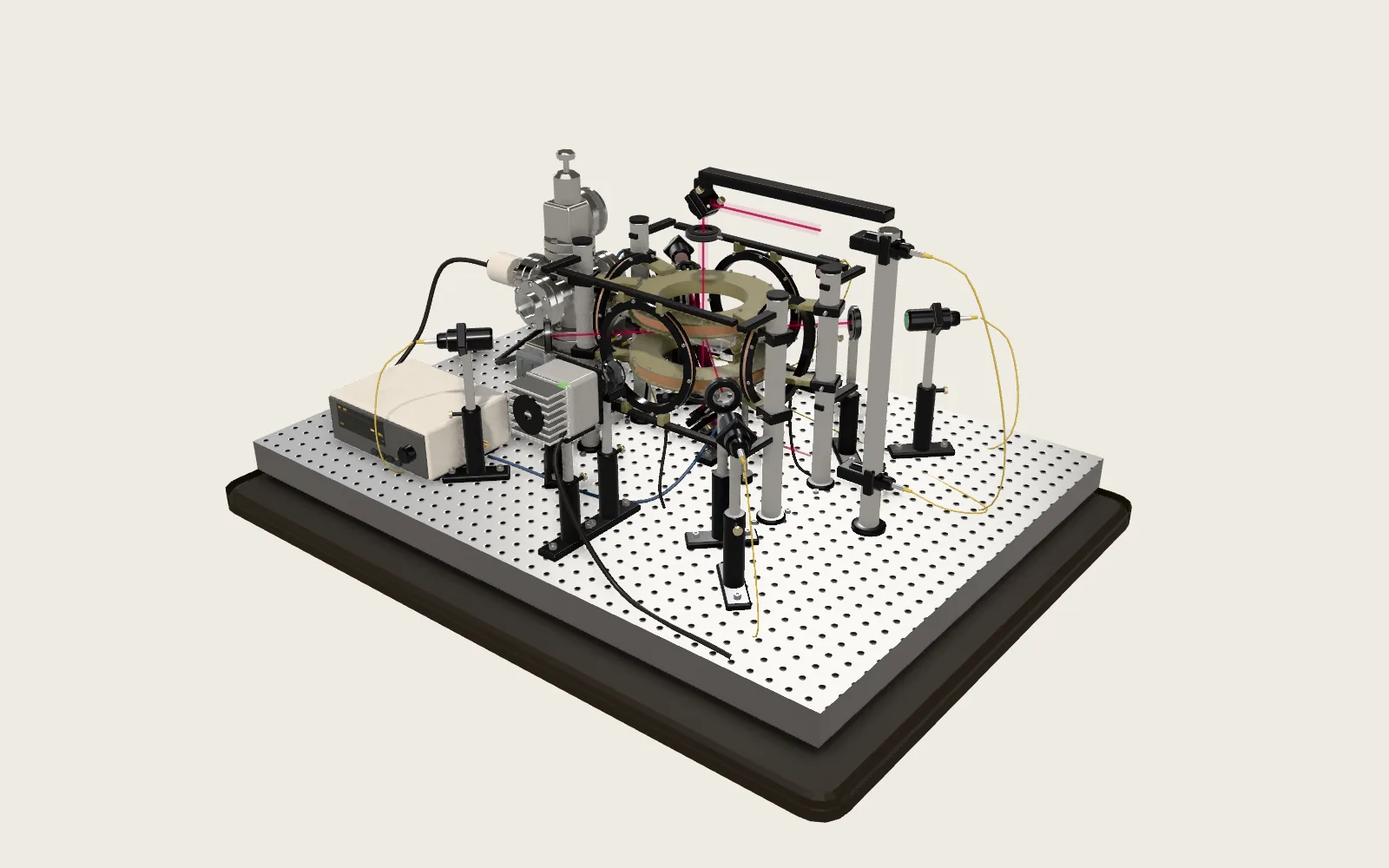 Plate F27Bose–Einstein Condensation of AtomsLasers cool atoms to some tens of microkelvin above absolute zero; a magnetic trap then lets the hottest ones “evaporate”, a few at a time. Near 170 nanokelvin, a few thousand rubidium atoms fell into the same quantum state and showed up as a peak in a picture.
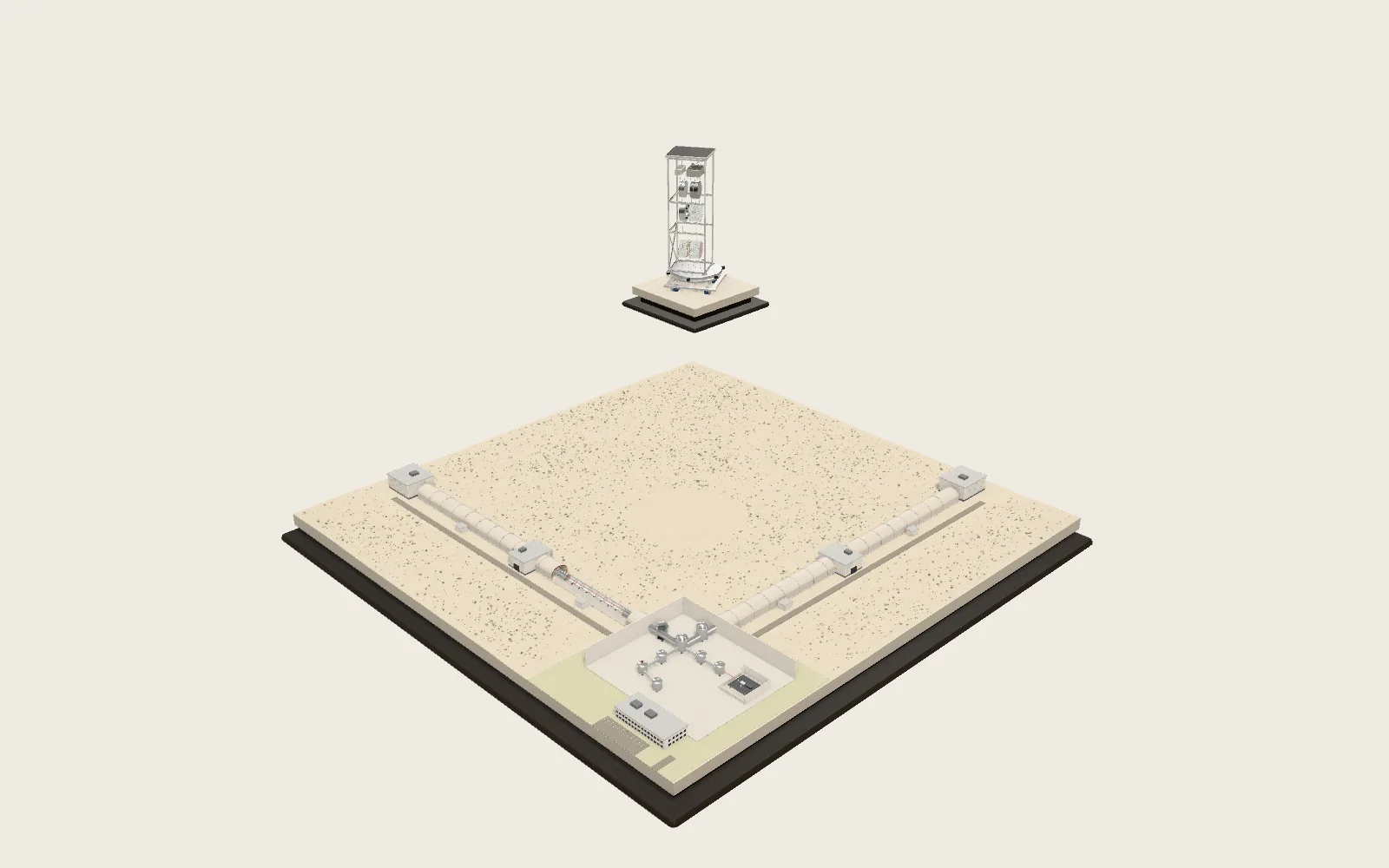 Plate F08The Gravitational-Wave InterferometerTwo arms 4 km long measure changes in length more than ten thousand times smaller than a proton. In 2015 it recorded, for the first time, the gravitational waves from two black holes merging.