Sodium in Water
A small piece of sodium on water floats, melts into a shining ball and skates about hissing, leaving pink trails behind it.
Scroll
A Metal Kept Under Oil
Sodium is a metal, yet soft enough to cut with a knife. A freshly cut face shines like a mirror, and within seconds it dulls to grey-white.
Sodium reacts with the oxygen and the water vapour in the air. Measurements show an oxide layer growing on the surface within the first 6.5 seconds. That is why sodium is kept under paraffin oil, and a piece is taken out only when it is needed.
A teacher does the demonstration. In the Royal Society of Chemistry’s version a 4 mm cube is cut, the oil blotted off with filter paper, and the piece put with forceps on a large bowl of water, behind safety screens, everyone in eye protection.
The lump · the freshly cut face · the stock jar under paraffin oil · filter paper · forceps
Lighter Than Water
On the water the sodium does not sink. Its density is 0.968 g per cubic centimetre, about 3% less than water’s. Molten it is lighter still: about 0.93 g at its melting point.
Lithium and potassium are lighter than water too: lithium about 0.53, little more than half of water’s; potassium about 0.86. All three float.
Density (g/cm³): lithium 0.534 · potassium 0.862 · sodium 0.968 · water 0.998 (20 °C)
A Ball of Liquid Metal
Sodium reacts as soon as it meets the water, and gives out heat. It melts at only 97.8 °C, so the small piece melts almost at once and pulls into a silvery ball.
This 4 mm cube of sodium weighs about 0.062 g and gives out about 500 J as it reacts; warming it from 20 °C to its melting point and melting it takes only about 13 J, about a thirty-eighth of that.
Most of the heat goes into the water. If about 3% of it stays in the metal, the metal melts.
This piece: about 500 J given out · about 13 J to melt it · about 2.7%
Skating on Its Own Gas
The molten ball runs about on the water, hissing and fizzing as it goes.
Under the ball, below the waterline, the reaction gives off hydrogen, and the jets of gas push it along. Where more comes out on one side it moves the other way, so it keeps turning, bumps the side of the dish and comes back. The reaction gives out heat, and as the sodium and the water round it warm, it goes faster and faster.
As it runs it shrinks: the sodium is turning into sodium ions dissolved in the water. In the page’s model this piece is gone in about 14 s.
The page’s model: 0.062 g of sodium, water at 20 °C, gone in about 14 s
The Gas Is Hydrogen
Sodium and water react: 2 Na + 2 H₂O → 2 NaOH + H₂. Every two sodium atoms set free one molecule of hydrogen.
This 0.062 g piece gives about 0.0013 mol of hydrogen: about 32 mL at 20 °C and one atmosphere, about two tablespoons.
Sodium on open water does not usually catch fire. If it sticks to the side of the dish, or lands on a floating scrap of filter paper, its heat cannot get away and the hydrogen may burn, with a yellow flame: sodium’s flame colour, on the page “Flame Tests and Spectra”.
2 Na + 2 H₂O → 2 NaOH + H₂ · 0.062 g of sodium → about 32 mL of hydrogen
Pink in Its Wake
Sodium is not pink, and nor is hydrogen. The water has a few drops of phenolphthalein in it, which turns pink in a base, as on the page “Ammonia Fountain”.
The sodium hydroxide the reaction makes dissolves in the water: a strong base. It is strongest where the ball has just been, so the pink follows its path, then slowly spreads.
With the whole piece in the dish’s 1.4 L of water, the hydroxide comes to about 0.002 mol per litre, a pH of about 11.3. Industry makes sodium hydroxide by electrolysing brine, on the page “Electrolysis of Brine”.
Phenolphthalein: colourless below pH 8.3, pink above · the dish ends at about pH 11.3
Lithium, Sodium, Potassium
Lithium, sodium and potassium sit in one column of the periodic table. Lithium floats and fizzes steadily, without melting or catching fire; sodium melts into a ball and skates; potassium melts faster still, and its heat sets the hydrogen alight with a lilac flame.
Each step down, the outermost electron is further from the nucleus and easier to take away. The energy it takes: lithium about 520, sodium about 496, potassium about 419 kJ/mol. A metal giving up electrons in a cell is the same thing.
Faster is not the same as more heat. Per mole, lithium gives out the most, about 223 kJ, against sodium’s 184 and potassium’s 197. Lithium gives its heat out slowly and melts only at 180.5 °C, so it never melts here, and it stays the calmest.
First ionisation energy: lithium about 520 · sodium about 496 · potassium about 419 kJ/mol · melting points 180.5 · 97.8 · 63.5 °C
Why Big Pieces Explode
A large lump of an alkali metal thrown into water explodes. The textbook account is heat, steam and the hydrogen catching fire. Yet from the very start, hydrogen and steam at the surface should keep the water away from the metal and slow the reaction down.
In 2015 a group filmed, at about ten thousand frames a second, drops of a sodium–potassium alloy, liquid at room temperature, falling into water: at about 0.3 to 0.4 ms, spikes of metal shot out of the drop, and the water round it turned blue with electrons dissolved in it.
In their simulations the surface atoms hand their electrons to the water within a few picoseconds; the positive ions left behind push one another apart and tear the drop open, a Coulomb explosion. Fresh metal keeps meeting the water, and the reaction cannot stop itself. They describe the first step of the explosion; whether solid sodium does the same is not yet clear.
Coulomb explosion · drops of sodium–potassium alloy · spikes at about 0.3–0.4 ms (drawn, not to time)
1807: Sodium by Electricity
Sodium is too reactive to be found as a metal in nature, only in its compounds. In October 1807 Humphry Davy put the current of a large voltaic battery through a small piece of caustic potash: at the negative wire, small globules with the shine of quicksilver appeared, and they were potassium. A few days later, with a stronger current, he got sodium from caustic soda.
In his lecture of 19 November he wrote that sodium thrown on water gave a violent effervescence with a loud hissing noise, but no light, while potassium meeting water exploded at once with a brilliant flame. The same difference shows in the demonstration today.
Put back on water, sodium turns into caustic soda again, sodium hydroxide: the very base that turns the dish’s phenolphthalein pink.
1807 · Humphry Davy · the electrolysis of caustic potash and caustic soda
Taken Apart, Piece by Piece
Seven things: the crystallising dish, the white tile, the lump of sodium, the scalpel, the forceps, the filter paper and the stock jar. What matters most is a small piece and a large dish, and that the sodium touches no hands and no other water.
Crystallising dish · white tile · lump of sodium · scalpel · forceps · filter paper · stock jar
Try Another Metal
This is the page’s model, computed in the page from the equations above: the piece is a ball that reacts over its surface at a steady rate; a share of the heat stays in the metal and the rest goes into the water; the metal loses heat to the water as a still ball does; it warms by its heat capacity, takes up its heat of fusion at its melting point and gets no hotter than its boiling point; above 500 °C, hydrogen’s autoignition temperature in air, the hydrogen catches fire. How fast each metal reacts and how much heat stays in it are the model’s own choices, picked so that a small piece in water at 20 °C does what the demonstrations show.
Each press of “Drop a piece in” starts afresh: choose the metal, the mass and the water’s temperature, and see whether it melts, how hot it gets in the model, how much hydrogen it gives and whether the hydrogen catches fire. It is a model on a web page, not a way to do the experiment.
The page’s model · heats and hydrogen from measured values · the rates are the model’s
Try thisIn the lab, take 0.06 g of potassium in water at 20 °C: does it melt, and does its hydrogen catch fire? And the same mass of lithium? Which gives the most hydrogen?
What the model leaves out
The bench is a model of a teacher’s demonstration: a 190 mm crystallising dish on a sheet of card, a white tile, a scalpel, forceps, filter paper and a stock jar, not a copy of any one set. The Royal Society of Chemistry uses a 5 L glass trough with universal indicator, behind two safety screens; this follows some American university demonstrations, with a crystallising dish and phenolphthalein, and the screens are not drawn. The piece is a ball that reacts equally fast all over; the rate and the heat that stays in the metal are the model’s own choices; it loses heat as a still ball would, with no gas cushion, no stirring and no heat from burning hydrogen. Sources give hydrogen’s autoignition temperature from 500 °C to about 574 °C; the model takes the lowest, 500 °C. The model’s temperatures only decide whether the metal melts and whether the hydrogen catches fire; they are not measured values. How the ball runs about and how the trails spread are drawn, not computed. The spikes in the chapter on the Coulomb explosion are a sketch, not to scale in shape or in time.
Easy to get wrong
Sodium on water does not usually burn: it melts, runs about and gives off hydrogen; only when it sticks to the side of the dish may its hydrogen catch fire. Potassium’s hydrogen does catch fire. The pink is not sodium’s colour but phenolphthalein’s in a solution of sodium hydroxide. Sodium floats because it is about 3% lighter than water; the hydrogen is what pushes it about. Lithium is the calmest not because it gives out less heat: per mole it gives out the most, only slowly. The 2015 study describes the first step in the explosion of drops of a sodium–potassium alloy; it does not say burning hydrogen plays no part.
Common questions · 5
- Why is sodium kept under oil?
Sodium reacts with the oxygen and the water vapour in the air. Measurements show an oxide layer growing on the surface within the first 6.5 seconds. That is why sodium is kept under paraffin oil, and a piece is taken out only when it is needed.
01A Metal Kept Under Oil ↑- Why does sodium float on water?
On the water the sodium does not sink. Its density is 0.968 g per cubic centimetre, about 3% less than water’s.
02Lighter Than Water ↑- Why does sodium melt into a ball on water?
Sodium reacts as soon as it meets the water, and gives out heat. It melts at only 97.8 °C, so the small piece melts almost at once and pulls into a silvery ball.
03A Ball of Liquid Metal ↑- Why does sodium skate about on water?
Under the ball, below the waterline, the reaction gives off hydrogen, and the jets of gas push it along. Where more comes out on one side it moves the other way, so it keeps turning, bumps the side of the dish and comes back.
04Skating on Its Own Gas ↑- What gas does sodium give off in water?
Sodium and water react: 2 Na + 2 H₂O → 2 NaOH + H₂. Every two sodium atoms set free one molecule of hydrogen.
05The Gas Is Hydrogen ↑
Sources
- Royal Society of Chemistry and Nuffield Foundation: Reactivity trends of the alkali metals (the demonstration, safety, what lithium, sodium and potassium do, lithium the hardest to cut)
- Royal Society of Chemistry: Reactivity series of metals, technician notes (2021; pieces of 5, 4 and 3 mm cubes for lithium, sodium and potassium)
- D. Fleming (2015): Exploding some myths, Education in Chemistry (why lithium is the calmest; the limits of the Coulomb explosion)
- CLEAPSS: Student Safety Sheet 80, Alkali metals (pieces the size of a grain of rice, forceps, eye protection, safety screens)
- University of Colorado Boulder lecture demonstrations: X818 Periodic Trends – Alkali Metals in Water (crystallising dishes, phenolphthalein, the pink trail)
- J. Clark: Chemguide, Reactions of the Group 1 elements with water (a silvery ball; lithium gives the most heat but slowly; potassium’s hydrogen catches fire)
- F. Senese: General Chemistry Online (Frostburg State University), Why is the reaction between sodium and water so spectacular? (jets of hydrogen below the waterline push it about)
- OpenStax: Chemistry 2e, 18.1 (the alkali metals: very soft, kept under mineral oil, react with water to give hydrogen and a base)
- OpenStax: Chemistry 2e, appendix G (standard enthalpies of formation)
- OpenStax: Chemistry 2e, 14.7 (phenolphthalein pink above pH 8.3)
- NIST Atomic Spectra Database: ionisation energies
- NIST-JANAF Thermochemical Tables (heat capacities, melting points and heats of fusion of lithium, sodium and potassium)
- PubChem: sodium (HSDB, after the Merck Index and the CRC Handbook: density, “lustrous when freshly cut; tarnishes on exposure to air”)
- J. K. Fink and L. Leibowitz (1995): Thermodynamic and Transport Properties of Sodium Liquid and Vapor, Argonne National Laboratory (liquid sodium’s density)
- NIST Chemistry WebBook: water’s density and thermal conductivity (IAPWS)
- IUPAC CIAAW: standard atomic weights
- NIST: CODATA 2022 values (the molar gas constant)
- F. Oliva et al. (2019): Study of the spontaneous oxidation of sodium in air by EPMA and Monte Carlo simulations, Appl. Surf. Sci. 480 (the oxide layer of the first 6.5 seconds)
- P. E. Mason, F. Uhlig, V. Vaněk, T. Buttersack, S. Bauerecker and P. Jungwirth (2015): Coulomb explosion during the early stages of the reaction of alkali metals with water, Nature Chemistry 7
- TU Braunschweig press release (2015, in German, via chemie.de): the violent reaction of the alkali metals with water
- H. Davy (1808): The Bakerian Lecture, on some new Phenomena of chemical Changes produced by Electricity, Phil. Trans. R. Soc. 98 (read on 19 November 1807)
Data
Densities of lithium, sodium and potassium from the CRC Handbook and the Merck Index (via PubChem’s HSDB records), liquid sodium’s from J. K. Fink and L. Leibowitz (Argonne National Laboratory, 1995); melting points, heat capacities and heats of fusion from the NIST-JANAF tables (M. W. Chase, 1998); standard enthalpies of formation from OpenStax Chemistry 2e (appendix G); first ionisation energies from the NIST Atomic Spectra Database; atomic weights from IUPAC’s CIAAW; water’s density and thermal conductivity from the NIST Chemistry WebBook (IAPWS); hydrogen’s autoignition temperature from the NFPA (via PubChem); R and the standard atmosphere are the exact CODATA 2022 values. The heats, the hydrogen, the pH and the run of the piece are computed here; the run is the page’s own model. The demonstration after the Royal Society of Chemistry’s Practical Chemistry pages and technician notes, CLEAPSS, the lecture demonstrations of the University of Colorado Boulder, and J. Clark’s Chemguide; the hydrogen’s jets after F. Senese (Frostburg State University); the Coulomb explosion after P. E. Mason, F. Uhlig, V. Vaněk, T. Buttersack, S. Bauerecker and P. Jungwirth, Nature Chemistry (2015), and TU Braunschweig’s release; D. Fleming in Education in Chemistry (2015); the first sodium after H. Davy’s Bakerian Lecture, read on 19 November 1807. The bench is this page’s model of a teacher’s demonstration: a 190 mm crystallising dish on a sheet of card, a white tile, a scalpel, forceps, filter paper and a stock jar under paraffin oil; not a copy of any one set. Material presets and the model kit as on the site’s other model plates (public/looks/CREDITS.md).
The text, pictures and models on this page are licensed CC BY-NC 4.0: free to use and adapt for teaching and other non-commercial purposes, with credit to world.lapla.si. Third-party material listed above keeps its own licence.
Cite this plate
Laplace’s Mini World, Plate 85, “Sodium in Water”, https://world.lapla.si/en/sodium/, CC BY-NC 4.0, updated 2026-11-03.
Follow the question
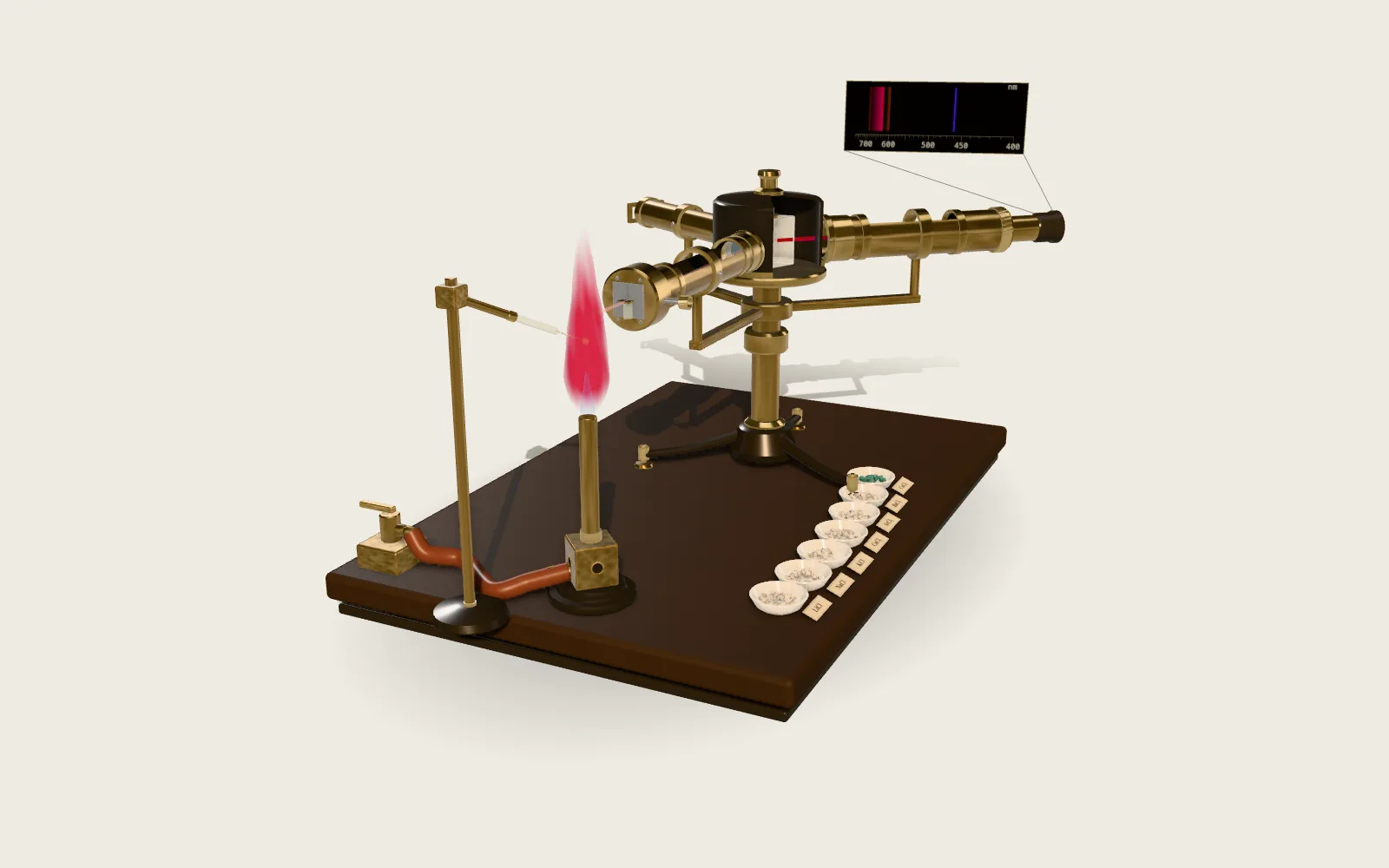 Plate 75Flame Tests and SpectraPut a little of a metal salt into a nearly colourless gas flame and the flame takes a colour: lithium crimson, sodium yellow, potassium lilac, strontium crimson, barium green, copper green or blue. The colour belongs to the metal, not to the salt’s other half or to the fire: the flame’s heat lifts electrons in the metal’s atoms to a higher level, and when they drop back they give off light at a few fixed wavelengths only. A spectroscope spreads that light out with a slit, a prism and a telescope, and every metal shows its own bright lines. In 1860 and 1861 Kirchhoff and Bunsen used it to find two new elements, caesium and rubidium, in spring water and lepidolite. Fireworks use the same metals.
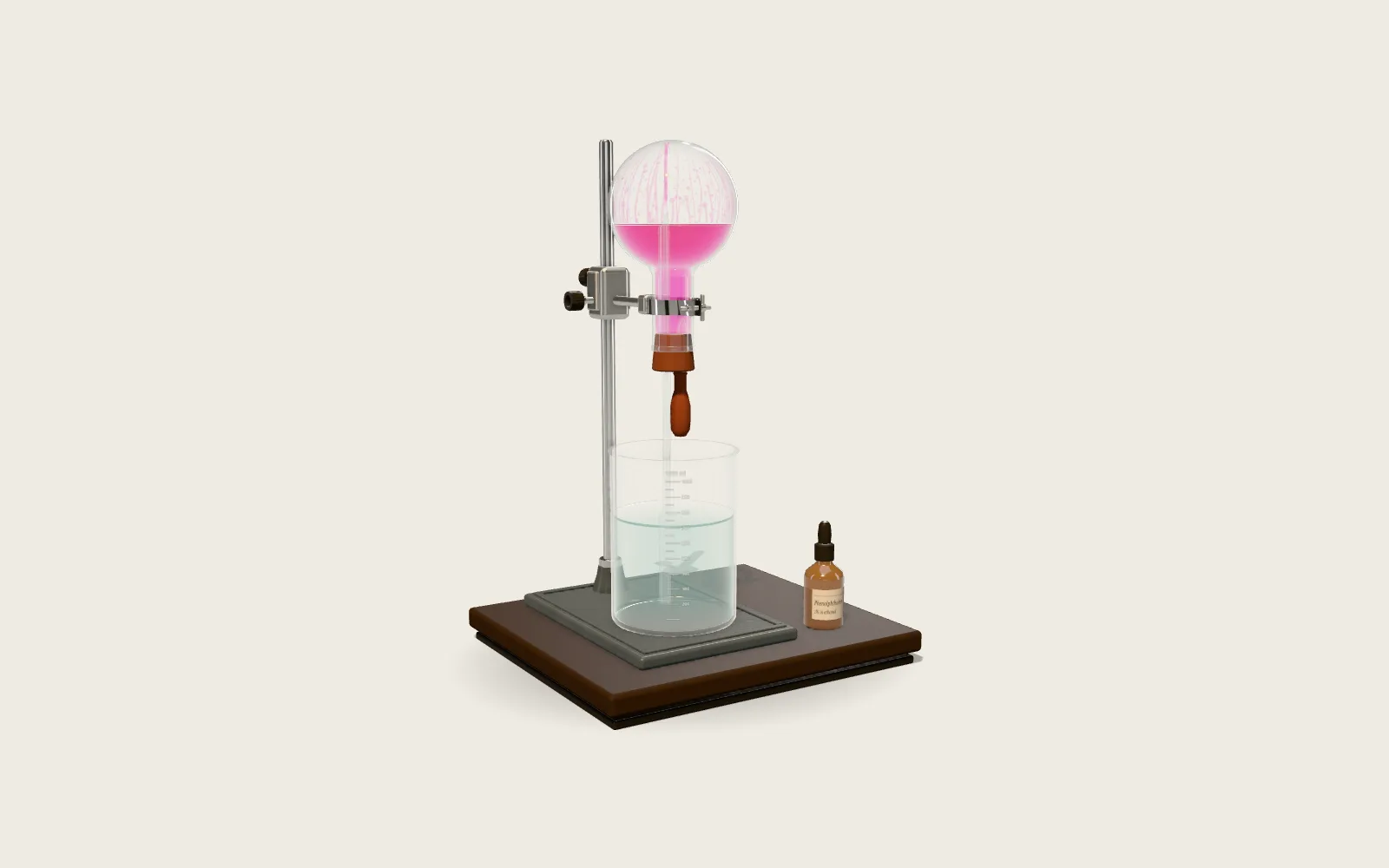 Plate 84Ammonia FountainA dry flask full of ammonia hangs upside down over a beaker of water. Squeeze in a few drops and so much ammonia dissolves that the pressure inside falls; the outside air pushes the water up the tube and into the flask as a jet, which turns pink where it meets the dissolved ammonia. At 20 °C one volume of water takes up over seven hundred volumes of ammonia; the pink is phenolphthalein in the water, since ammonia in water is a weak base. Hydrogen chloride does the same, and turns blue litmus red.