Ammonia Fountain
A flask of ammonia, a few drops of water, and the outside air pushes the beaker’s water up the tube into a pink fountain.
Scroll
Ammonia, Upside Down
A completely dry 500 mL round-bottom flask is filled with ammonia and clamped mouth down on a stand. A rubber stopper with two holes closes it.
Through one hole runs a glass tube, drawn at its top to a fine jet that reaches the centre of the flask; its lower end comes about 20 cm out of the flask and down into a beaker of water. Through the other is a dropper holding a little water. The Royal Society of Chemistry’s version uses a 10 mL syringe; Rutgers University’s demo uses a rubber bulb.
The water in the beaker has a few drops of phenolphthalein and is colourless. A teacher does this demo in a fume cupboard, with eye protection, and only in a thick round-bottom flask of borosilicate glass: other flasks may implode.
500 mL round-bottom flask · two-hole rubber stopper · jet tube · dropper · water with phenolphthalein
Lighter Than Air
Ammonia is lighter than air: a volume of it weighs about six tenths as much as the same volume of air. So the flask is filled mouth down, the ammonia led in from below, pushing the air out of the mouth.
The flask must be dry. Ammonia dissolves in water so readily that a little water on the glass would take up the gas before the demo starts, and it would fail.
In the lab, ammonia can be made by warming concentrated ammonia solution; how factories make it is on the page “Nitrogen from the Air”. Hydrogen chloride is heavier than air, so for the same demo the flask is filled mouth up, from the bottom.
Ammonia about 0.6 · air 1 · hydrogen chloride about 1.27 (the weight of equal volumes, air = 1)
A Squeeze of Water
A squeeze of the dropper puts a few drops of water into the flask. Ammonia dissolves in water in startling amounts: at 20 °C, 100 g of water takes up 52.6 g of it. Counting the gas at 20 °C, one volume of water takes up about 740 volumes of ammonia.
The same volume of water takes up only about 0.94 volumes of carbon dioxide and about 0.03 of oxygen. Hydrogen chloride dissolves very well too, about 480 volumes; sulphur dioxide about 42.
At that rate, half a millilitre of water at one atmosphere could hold about 370 mL of ammonia, nearly three quarters of the flask’s gas.
At 20 °C, volumes of gas taken up by one volume of water: ammonia about 740 · hydrogen chloride about 480 · sulphur dioxide about 42 · carbon dioxide about 0.94 · oxygen about 0.03
The Pressure Falls
When gas dissolves, fewer gas molecules are left in the same space, so the pressure falls: p·V = n·R·T.
The flask is closed, and as the pressure falls the water can hold less ammonia. Worked out from the vapour pressures of ammonia solutions that Perman measured in 1903, half a millilitre of water left to itself would bring a 500 mL flask of ammonia down to about half an atmosphere, with about half the ammonia dissolved in those few drops.
Far less is needed. In this set-up the jet is about 22 cm above the beaker’s surface, so the flask only has to fall about 2.2 kPa below the outside, about 2% of an atmosphere, for the water to reach the jet.
The page’s model: the pressure in the flask and the column in the tube · column height = pressure difference ÷ (ρg)
Pushed, Not Sucked
The flask does not suck the water up. The air presses on the beaker’s surface with about 10 newtons on every square centimetre; inside the flask the pressure is now lower, and the difference pushes the water up the tube.
In 1644 Torricelli wrote that the force holding up a column of mercury “comes from without”: the weight of the air outside. A drinking straw works the same way: lower the pressure in your mouth a little, and the air pushes the drink up.
There is a limit. Even with nothing at all left in the flask, the air could hold water up only about 10.35 m at 20 °C. In 1638 Galileo recorded that no pump could lift water above eighteen cubits, about 10.5 m.
One atmosphere holds up about 10.35 m of water (20 °C) · here only 22 cm is needed
A Fountain That Feeds Itself
Once the water reaches the jet it sprays into the flask in fine drops. Every drop meets ammonia and takes it up at once, so the more water comes in, the lower the pressure falls.
In the page’s model, a second or two after the fountain starts, less than a tenth of an atmosphere is left in the flask; the water leaves the 1.5 mm jet at about 10 m/s, strikes the top of the flask and runs down its walls.
When the ammonia is nearly all dissolved, what is left is the air that was mixed in. As the flask fills, that air is squeezed smaller, the pressure rises again and the fountain slows. How long it runs depends on the flask and the width of the jet: the Royal Society of Chemistry says some minutes; the page’s model takes about half a minute.
The page’s model: the water’s speed at the jet and the water in the flask · a 1.5 mm jet
Where the Pink Comes From
Ammonia is not pink. The beaker’s water has phenolphthalein in it, an indicator: colourless below pH 8.3, turning pink above it, and deep pink by about 10.
Ammonia in water is a weak base: NH₃ + H₂O ⇌ NH₄⁺ + OH⁻. Only a few of its molecules take a hydrogen ion, about 1.3% at 0.1 mol/L, yet the OH⁻ they give is enough to bring the pH to about 11.
So the water in the tube is still colourless, and turns pink only as it leaves the jet and meets the ammonia. With the whole flask of ammonia in about half a litre of water, the pH is about 10.9. Phenolphthalein fades again only in bases stronger than pH 14, beyond ammonia’s reach.
Phenolphthalein: colourless below pH 8.3, pink over 8.3–10 · the fountain’s water about pH 10.9
The Other Fountain
Hydrogen chloride makes a fountain too. At 20 °C one volume of water takes up about 480 volumes of it. In water it is a strong acid, almost wholly broken into ions, so once dissolved it stays dissolved.
In Newth’s book of lecture experiments of 1892 the water is coloured with blue litmus, and the fountain comes out red; the Royal Society of Chemistry now uses universal indicator, which turns red too. With the whole flask of hydrogen chloride in about half a litre of water, the pH is about 1.4.
The earliest account we found is in Karl Heumann’s demonstration handbook of 1876: a dry bottle of 2 to 3 litres full of ammonia, hung upside down, its tube drawn inside to a 2 mm jet; the water was coloured with litmus reddened by acid, and it rose as a blue fountain.
Hydrogen chloride about 480 volumes · blue litmus turns red in acid · pH about 1.4
The Bubble That Stays
When the fountain stops, a bubble always stays at the top: it is air. The Royal Society of Chemistry notes that its size shows how well the flask was filled. In the page’s model, a flask holding 5% air ends about 95% full; one holding 30% air, only about seven tenths.
A damp flask fails: the ammonia dissolves while it is being filled. A leak at the stopper or the tube fails too: air comes in, and the pressure never falls. That is why cork is not used.
Warmer water takes up less ammonia: at 50 °C, 100 g of water takes up 22.9 g, less than half the 20 °C figure. In the page’s model, though, a few drops at 50 °C still bring the flask down to about three quarters of an atmosphere, plenty to start the fountain. We found no source saying warm water stops it.
The page’s model: the air left in the flask and how full it ends
Taken Apart
Seven things: the flask, the stopper, the jet tube, the dropper, the clamp, the stand and the beaker. What matters most is that the stopper and the tubes do not leak, and that the flask is round-bottomed, thick-walled and dry.
Flask · stopper · jet tube · dropper · clamp · stand · beaker
Try Another Gas
This is the page’s model, computed in the page from the equations above: ideal gas, each gas’s measured solubility, and the water pushed up the tube by the difference in pressure. How fast the gas dissolves is the model’s own choice; it sets how quickly things happen, not where they end.
Each press of “Squeeze the dropper” starts afresh: choose the gas, the water’s temperature, how much water goes in and how much air is mixed in the flask, and see the pressure inside, the speed at the jet and how full the flask ends.
The page’s model · solubilities after Seidell 1919 · ammonia solutions after Perman 1903
Try thisIn the lab, switch the gas to carbon dioxide and squeeze in 0.5 mL of water: how far does the pressure in the flask fall? Does the water reach the jet? Why can the same few drops start a fountain with ammonia?
What the model leaves out
The apparatus on the board is a model of a school demo in the sizes of a DURAN 500 mL round-bottom flask, a PHYWE two-hole rubber stopper and a 1 L low-form beaker, not a copy of any one rig; the dropper follows Rutgers University’s rubber bulb, where the Royal Society of Chemistry uses a syringe. The run of the fountain is the page’s model: the water in the flask is taken as well mixed, and how fast the gas dissolves is the model’s choice; ammonia follows the vapour pressures Perman measured at 20 °C in 1903, moved to other temperatures by how its Henry’s law constant changes; hydrogen chloride is taken to dissolve wholly until the water holds its solubility at one atmosphere; carbon dioxide and oxygen follow Henry’s law. The gas in the flask is an ideal gas at 20 °C, and the heat given off as ammonia dissolves is left out (the whole flask warms half a litre of water by only about 0.35 °C on average, though the first few drops get much warmer). The jet’s resistance is a single factor. The jet is drawn a little thicker than its 1.5 mm bore, which at this size would be a hairline; the drops, the film and the rivulets on the glass are drawn, not computed.
Easy to get wrong
The flask does not suck the water up: the outside air pushes it, and the lower pressure inside only leaves the two sides out of balance. Ammonia gas is not pink; the pink is phenolphthalein in a basic solution. Ammonia in water does not all turn into NH₄⁺ and OH⁻: most of it stays as ammonia molecules, which is why it is a weak base. The flask never fills completely either: the air that was mixed in does not dissolve and stays as a bubble. The often-quoted “700 volumes of ammonia in one volume of water” depends on how the gas is counted: the same 20 °C measurement gives about 740 volumes with the gas at 20 °C, about 690 reduced to 0 °C.
Common questions · 5
- Does the flask suck the water up in the ammonia fountain?
The air presses on the beaker’s surface with about 10 newtons on every square centimetre; inside the flask the pressure is now lower, and the difference pushes the water up the tube.
05Pushed, Not Sucked ↑- How much ammonia can water dissolve?
Ammonia dissolves in water in startling amounts: at 20 °C, 100 g of water takes up 52.6 g of it.
03A Squeeze of Water ↑- Why is the ammonia fountain pink?
The beaker’s water has phenolphthalein in it, an indicator: colourless below pH 8.3, turning pink above it, and deep pink by about 10.
07Where the Pink Comes From ↑- Why must the flask be dry for the ammonia fountain?
Ammonia dissolves in water so readily that a little water on the glass would take up the gas before the demo starts, and it would fail.
02Lighter Than Air ↑- Why does a bubble stay at the top when the fountain stops?
When the fountain stops, a bubble always stays at the top: it is air.
09The Bubble That Stays ↑
Sources
- Royal Society of Chemistry and Nuffield Foundation: Ammonia fountain demonstration (the apparatus, keeping it dry, safety, “external air pressure will force water up the tube”, the air left at the end)
- A. Guy (2010): The ammonia fountain, Education in Chemistry (a pressure difference, not “suck”; the slightest leak causes problems)
- Royal Society of Chemistry: The properties of hydrogen chloride (the hydrogen chloride fountain, safety screens, how much air is left)
- Royal Society of Chemistry: Making and testing ammonia (the collecting apparatus must be dry)
- Rutgers University lecture demonstrations: Solubility of a Gas in Water – Ammonia Fountain (a 1 L flask, a rubber bulb; it will not work with air)
- A. Seidell (1919): Solubilities of Inorganic and Organic Compounds, 2nd ed. (the solubilities of ammonia, hydrogen chloride, carbon dioxide, oxygen and sulphur dioxide; Perman’s 1903 vapour pressures of ammonia solutions)
- R. Sander (2023): Compilation of Henry’s law constants (version 5.0.0) for water as solvent, Atmos. Chem. Phys. 23 (how ammonia’s constant changes with temperature)
- NIST Chemistry WebBook: water’s density and vapour pressure (IAPWS-95)
- NIST Chemistry WebBook: ammonia’s Henry’s law constants and molar mass
- NIST: CODATA 2022 values (the molar gas constant, the standard atmosphere, standard gravity)
- OpenStax: Chemistry 2e, 14.3 (ammonia and water in equilibrium)
- OpenStax: Chemistry 2e, appendix I (ionisation constants of weak bases, ammonia Kb = 1.8 × 10⁻⁵)
- OpenStax: Chemistry 2e, 14.7 (indicators: phenolphthalein, methyl orange, litmus)
- Royal Society of Chemistry: Acid-base indicators worksheet (phenolphthalein colourless to pink over pH 8.3–10.0)
- V. M. Petruševski and K. Risteska (2007): Behaviour of Phenolphthalein in Strongly Basic Media, Chemistry (Bulgaria) 16 (colourless again in strong bases)
- NIOSH Pocket Guide to Chemical Hazards: ammonia (lighter than air, exposure limits)
- NIOSH Pocket Guide to Chemical Hazards: hydrogen chloride (heavier than air)
- OpenStax: College Physics 2e, 11.4, Example 11.5 (10.3 m of water equals one atmosphere)
- Science Buddies (2015): A Really Long Straw, Scientific American (the air pushes the drink up the straw)
- Galileo (1638): Dialogues Concerning Two New Sciences, tr. Crew and de Salvio, 1914 (no pump lifts water above eighteen cubits)
- Torricelli to Ricci, 11 June 1644, in The Physical Treatises of Pascal, tr. Spiers, 1937 (“the force comes from without”)
- K. Heumann (1876): Anleitung zum Experimentiren bei Vorlesungen über anorganische Chemie, pp. 165–166 (the earliest account we found)
- G. S. Newth (1892): Chemical Lecture Experiments (the hydrogen chloride fountain, blue litmus turning red)
- DURAN round-bottom flasks, catalogue (via Hermes Lab; 500 mL: 105 mm across, 168 mm high, neck 34 mm)
- PHYWE: rubber stopper with two holes, 35 / 29 mm
Data
Solubilities from A. Seidell, Solubilities of Inorganic and Organic Compounds (2nd ed., 1919): ammonia after H. E. Roscoe and W. Dittmar and others, its solutions’ vapour pressures after E. P. Perman (1903), hydrogen chloride after Roscoe and Dittmar and Deicke, carbon dioxide after Bohr, oxygen after Winkler, sulphur dioxide after Schönfeld; the temperature slope of ammonia’s Henry’s law constant from R. Sander (Atmos. Chem. Phys., 2023). Water’s density and vapour pressure from the NIST Chemistry WebBook (IAPWS-95); R, the standard atmosphere and standard gravity are the exact CODATA 2022 values; molar masses from the NIST WebBook. Kb of ammonia from OpenStax Chemistry 2e; phenolphthalein’s range from the Royal Society of Chemistry; relative gas densities from the NIOSH Pocket Guide. The demo after the Royal Society of Chemistry’s Practical Chemistry pages (the ammonia fountain; the properties of hydrogen chloride), A. Guy in Education in Chemistry (2010) and Rutgers University’s lecture demonstrations; its history after K. Heumann (1876) and G. S. Newth (1892); Galileo (1638, tr. Crew and de Salvio, 1914) and Torricelli (1644, tr. Spiers, 1937) on the water column. The volumes of gas per volume of water, the pressures, the pH values and the run of the fountain are computed here; the run is the page’s own model. The apparatus is this page’s model of a school demo, in the sizes of a DURAN 500 mL round-bottom flask (105 mm across, 168 mm high), a PHYWE two-hole rubber stopper (35 / 29 mm) and a 1 L low-form beaker; not a copy of any one rig. Material presets and the model kit as on the site’s other model plates (public/looks/CREDITS.md).
The text, pictures and models on this page are licensed CC BY-NC 4.0: free to use and adapt for teaching and other non-commercial purposes, with credit to world.lapla.si. Third-party material listed above keeps its own licence.
Cite this plate
Laplace’s Mini World, Plate 84, “Ammonia Fountain”, https://world.lapla.si/en/fountain/, CC BY-NC 4.0, updated 2026-11-03.
Follow the question
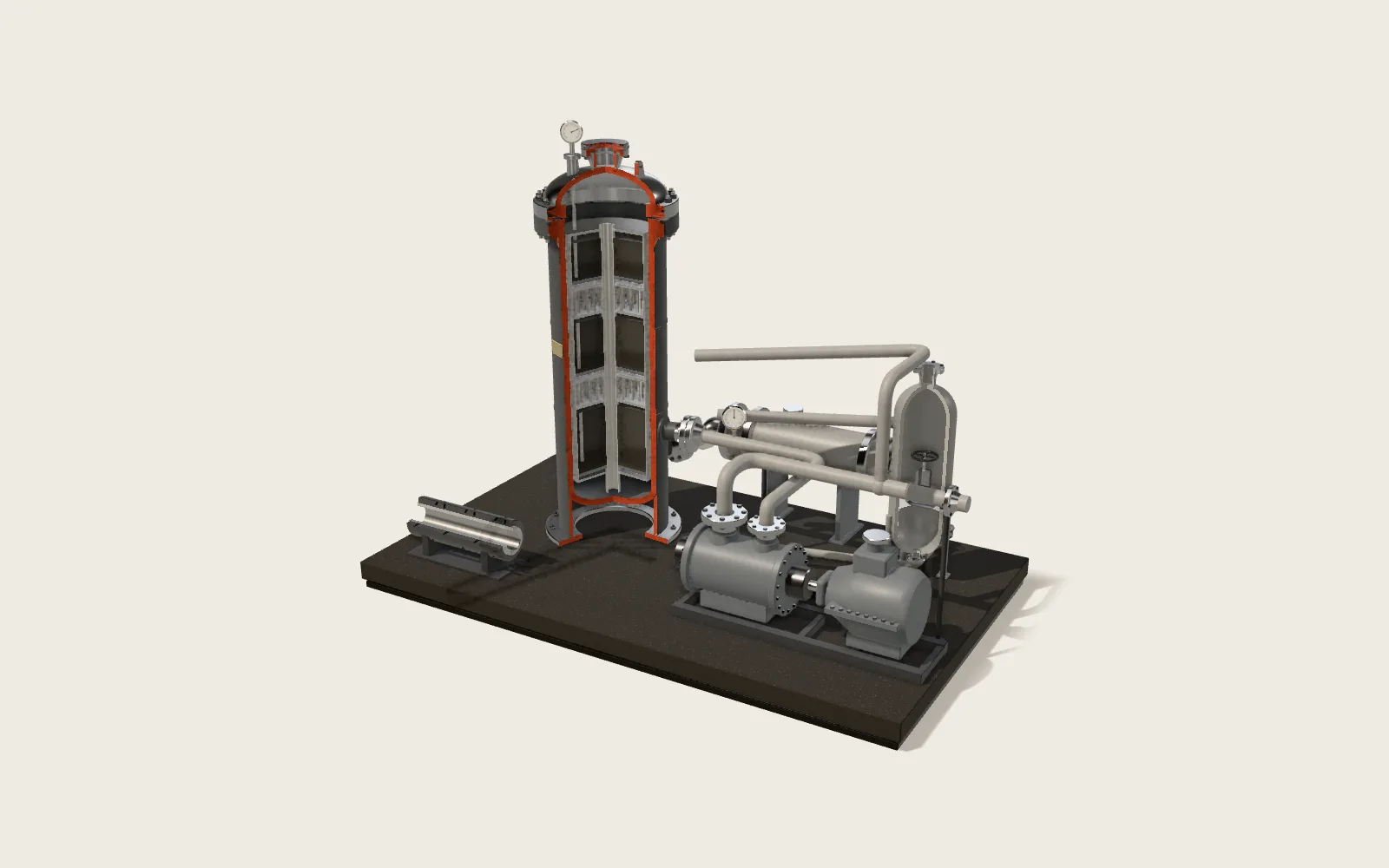 Plate 54Nitrogen from the AirAir is nearly four-fifths nitrogen, yet crops can’t use it: the nitrogen molecule’s triple bond is too strong. The Haber–Bosch process presses nitrogen and hydrogen to 100–250 bar, heats them to 350–550 °C and joins them on an iron catalyst to make ammonia. Cold, the equilibrium favours ammonia but the reaction crawls; hot, it runs fast but yields little, so plants settle on a compromise. Each pass converts only a fifth to a third, and the rest goes round again. About 70 % of the ammonia made today becomes fertiliser.
 Plate 34Why a Steel Ship FloatsDrop a lump of steel in water and it sinks at once, yet the same steel built into a ship floats with ten thousand tonnes of cargo aboard. The secret is how much water the ship pushes aside.