Superconducting Qubits and Error Correction
A superconducting qubit is an artificial atom: a small circuit of aluminium film, cooled close to absolute zero, using only its two lowest energy levels. It errs easily. Quantum error correction encodes many such qubits into one logical qubit. In 2024 an experiment by Google first made a logical qubit whose error fell by more than half each time it grew a size.
Scroll
Bigger Is Better
In 2024 Google Quantum AI ran a set of experiments on its Willow chip: grids of 3×3, 5×5 and 7×7 data qubits, each encoding one logical qubit, checked for errors every 1.1 µs.
The logical error per round fell from 0.65 % to 0.30 % to 0.14 %. Each step of 2 in distance divided it by about 2.14. In 2023 the same team had distance 5 beat distance 3 by only about 4 %; this time each step more than halved the error, and the distance-7 logical qubit outlived the chip’s best single qubit (291 µs against 119 µs).
Distance 3 → 5 → 7 · error per round 0.65 % → 0.30 % → 0.14 % · Λ = 2.14
An Artificial Atom
A capacitor and an inductor make an LC circuit, which oscillates. Cold enough to be quantum, its energy comes in steps, all equally spaced: a microwave that lifts it from level 0 to 1 lifts it from 1 to 2 just as well, so its lowest two levels can’t be used on their own.
Replace the inductor by a Josephson junction, two aluminium films with a layer of aluminium oxide one or two nanometres thick between them. Its inductance changes with the current, and each step is smaller than the one below. On this chip 0 to 1 is 5.01 GHz and 1 to 2 is 4.76 GHz. The lowest two levels alone are |0⟩ and |1⟩.
5 GHz corresponds to 0.24 K. So that heat can’t kick it, the chip hangs in a dilution refrigerator at about 10 to 20 mK.
0→1 5.01 GHz · 1→2 4.76 GHz · anharmonicity −246 MHz (this page’s circuit)
Cut Open: One Chip
The chip is a square of silicon 10 mm across and half a millimetre thick, coated with aluminium film about 100 nm thick. Narrow etched gaps draw the circuit: each qubit is a cross-shaped island of aluminium with 130 µm arms; one arm ends in two Josephson junctions to ground, each about 0.2 × 0.3 µm.
The chip sits in a pocket of a gold-plated copper box, framed by a circuit board. Over a hundred aluminium wires 25 µm thick join the pads at the chip’s edge to the board, whose traces run to microwave connectors in the walls. With the lid on, it is a small shielded box that hangs below the coldest plate of the fridge.
Silicon 10 × 10 × 0.5 mm · aluminium about 100 nm · junction about 0.2 × 0.3 µm · oxide 1–2 nm
Turned by Microwaves
A qubit’s state can be drawn as a point on a sphere: |0⟩ at the north pole, |1⟩ at the south. A microwave pulse at the qubit’s 5 GHz turns the point around the sphere, by an angle set by the pulse’s strength times its length.
Half a turn takes |0⟩ to |1⟩. A quarter turn stops on the equator: measured there, it gives 0 or 1 with equal chance. Where on the equator it sits (its phase) changes what later operations do. On Willow, a single-qubit operation takes 25 ns.
Angle ∝ strength × length · half a turn = 0↔1 · single-qubit gate 25 ns
Reading Out
Beside each qubit lies a folded readout resonator, near 7 GHz; the resonators on one feedline each have their own frequency, so they can be read together. Whether the qubit is in |0⟩ or |1⟩ pushes the resonator’s frequency a little one way or the other, here about 0.55 MHz.
A microwave tone near that frequency sent along the feedline comes out with a phase that depends on the qubit’s state. A cold amplifier boosts it, and within a few hundred nanoseconds it reads as 0 or 1. After the measurement the qubit is in the state that was found.
Resonator 7 GHz · shift ±χ ≈ 0.55 MHz · measurement about 500 ns
Where Errors Come From
A qubit in |1⟩ leaks its energy to its surroundings and falls to |0⟩, with a time constant called T1; the phase on the equator slowly wanders, with a time constant T2. On Willow’s error-correction chip, T1 averages 68 µs and T2 89 µs.
Each operation is imperfect too: a single-qubit gate errs about 0.035 % of the time, a two-qubit gate about 0.33 %, a measurement about 0.77 %. Useful quantum algorithms need hundreds of millions of operations in a row. Single qubits are nowhere near; only error correction can close the gap.
T1 68 µs · T2 89 µs · two-qubit gate error 0.33 % (Willow averages)
Redundancy Without Copies
The simplest classical error correction copies: store a bit three times, and if one copy flips, the majority puts it right. A quantum state can’t be copied (the no-cloning theorem), and measuring it directly destroys it.
The way round is to ask only about neighbours’ parity: are these two the same? An extra measure qubit asks, and learns only “same” or “different”, not what either one holds, so the stored information is untouched. Where an error happens, the checks on either side turn to “different”.
No cloning · measure parities, never values
The Surface Code
The surface code lays its data qubits in a d×d square, with measure qubits between them: half check the X parity of the data qubits around them, half the Z parity (four in the middle, two at the edge). One error lights the checks on either side of it; a chain of errors lights only its two ends.
A computer works out the likeliest errors from where the lights are, and corrects them; this is decoding. d is the fewest errors that can fool the code, and a code of distance d corrects any (d−1)/2. Distances 3, 5 and 7 use 17, 49 and 97 qubits.
Distance d uses 2d² − 1 qubits · 3 → 17 · 5 → 49 · 7 → 97
Below Threshold
A bigger code can correct more errors, but it also has more places to go wrong. Only when each qubit’s error rate is below a “threshold” does a bigger distance pay; the further below, the more each step of 2 gains.
This page ran the numbers for a model in which every operation errs with the same chance: the threshold comes out near 1.2 %. At a physical error rate of 0.5 % each step of 2 halves the logical error, close to Willow’s 2.14; at 0.1 % it divides it by ten. Real chips don’t have uniform noise, so there is no single threshold.
This page’s simulation: threshold about 1.2 % · Λ ≈ 2.0 at p = 0.5 % · Λ ≈ 10 at p = 0.1 %
How Far to Go
Willow’s logical qubit only held a state; it did no operations between logical qubits. About once an hour, the experiment saw a burst of correlated errors whose cause is not yet understood. Extrapolating, the paper puts an error per round of one in a million at distance 27: 1,457 physical qubits per logical qubit.
One estimate puts factoring a 2048-bit RSA number at under a million physical qubits for under a week, assuming each operation errs 0.1 % of the time, about three times better than Willow’s two-qubit gate. Every qubit needs lines from room temperature down, and decoding has to keep up with a round every microsecond.
Target 10⁻⁶: distance 27, 1,457 qubits per logical qubit · RSA-2048: < 1 million qubits (estimate)
Taken Apart
The lid, the board, the chip with its wires, the connectors and the copper base come apart, layer by layer.
Whichever part the pointer rests on is lifted out and named; left alone, the parts take turns.
The Correction Bench
A patch of surface code on the chip. The lever is the physical error rate: each round, each data qubit takes an X or a Z error with that chance. The lit checks are paired up (minimum-weight perfect matching) and corrected along the shortest paths; if what is left runs right across the patch, the logical qubit has flipped, and a failure is counted.
Errors can also be placed by hand on the chip’s data qubits. The curve beside it is the logical error per round from a circuit-level simulation run when the page was built.
Try thisAt a physical error rate of 0.3 %, going from distance 3 to distance 7 cuts the logical error rate by what factor?
What the model leaves out
This is a model of the principle, not of Willow or anyone’s chip. The die holds exactly the 97 qubits a distance-7 patch needs, on the usual square grid; the crosses, couplers, resonators and feedlines follow published planar chips. On a real chip this size the control lines run on a second chip or in several wiring layers; only a few at the edge are drawn. The aluminium film’s thickness shows only as light and shade, and the wires are drawn a little thicker than 25 µm. The levels and the shift are worked out for one set of typical parameters (E_J/E_C ≈ 71), not measured on any chip. The bench lets only data qubits err, never the measurements; the curve beside it comes from a fuller circuit-level simulation (every gate, reset and measurement can err), so the two don’t match exactly.
Some common misreadings
A qubit is not “0 and 1 at once, working out every answer at the same time”. A superposition is one definite state, which gives 0 or 1 with set chances when measured; quantum algorithms work by making the amplitudes of wrong answers cancel, and that helps only for particular problems. 0.14 % is the error per round of correction (1.1 µs), not per operation. “Below threshold” means the error falls as the code grows, not that errors are gone; the threshold’s value depends on the noise model and the decoder (the same data with another decoder gives 0.17 %). Cold alone is not enough: aluminium superconducts below about 1.2 K, but the qubit needs to be far below 0.24 K for thermal excitation to be rare.
Common questions · 3
- Why must a superconducting qubit be cooled to about 10 mK?
5 GHz corresponds to 0.24 K. So that heat can’t kick it, the chip hangs in a dilution refrigerator at about 10 to 20 mK.
02An Artificial Atom ↑- If quantum states can’t be copied, how are errors corrected?
The way round is to ask only about neighbours’ parity: are these two the same? An extra measure qubit asks, and learns only “same” or “different”, not what either one holds, so the stored information is untouched.
07Redundancy Without Copies ↑- How many errors can a surface code correct?
d is the fewest errors that can fool the code, and a code of distance d corrects any (d−1)/2. Distances 3, 5 and 7 use 17, 49 and 97 qubits.
08The Surface Code ↑
Sources
- J. Koch et al. (2007): Charge-insensitive qubit design derived from the Cooper pair box, PRA 76, 042319 (the transmon: Hamiltonian, E01 ≈ √(8EJEC) − EC, α ≈ −EC, charge dispersion)
- R. Barends et al. (2013): Coherent Josephson qubit suitable for scalable quantum integrated circuits, PRL 111, 080502 (the cross-shaped Xmon, 130/165 µm arms, 0.30 × 0.20 µm junction, about 100 nm aluminium)
- P. Krantz et al. (2019): A quantum engineer’s guide to superconducting qubits, Applied Physics Reviews 6, 021318 (about 5 GHz, EJ/EC ≥ 50, rotation angle and pulses, dispersive readout, several resonators read on one feedline)
- A. Blais et al. (2021): Circuit quantum electrodynamics, Rev. Mod. Phys. 93, 025005 (the resonator takes the qubit-state dependent value ω_r ± χ)
- Google Quantum AI and collaborators (2025): Quantum error correction below the surface code threshold, Nature 638, 920 (distances 3/5/7, 0.143 %, Λ = 2.14, 1.1 µs, T1 68 µs, T2 89 µs, 25 ns single-qubit gates, logical lifetime 291 µs against the best physical qubit’s 119 µs, correlated bursts, distance-27 extrapolation)
- Google Quantum AI: Willow spec sheet (single-qubit gate 0.035 %, two-qubit gate 0.33 %, measurement 0.77 %)
- Google Quantum AI (2023): Suppressing quantum errors by scaling a surface code logical qubit, Nature 614, 676 (distance 5 against 3: 2.914 % against 3.028 % per round; 500 ns measurement)
- A. G. Fowler et al. (2012): Surface codes: Towards practical large-scale quantum computation, PRA 86, 032324 (threshold, P_L ∝ (p/p_th)^((d+1)/2))
- E. Dennis, A. Kitaev, A. Landahl, J. Preskill (2002): Topological quantum memory, J. Math. Phys. 43, 4452
- W. K. Wootters, W. H. Zurek (1982): A single quantum cannot be cloned, Nature 299, 802
- P. W. Shor (1995): Scheme for reducing decoherence in quantum computer memory, PRA 52, R2493
- C. Gidney (2025): How to factor 2048 bit RSA integers with less than a million noisy qubits, arXiv 2505.15917 (preprint; 0.1 % gate error, 1 µs cycle)
- C. Gidney, M. Ekerå (2021): How to factor 2048 bit RSA integers in 8 hours using 20 million noisy qubits, Quantum 5, 433
- S. Bravyi et al. (2024): High-threshold and low-overhead fault-tolerant quantum memory, Nature 627, 778 (another family of codes: 12 logical qubits in 288)
- A. P. M. Place et al. (2021): New material platform for superconducting transmon qubits with coherence times exceeding 0.3 milliseconds, Nature Communications 12, 1779
- C. Gidney (2021): Stim: a fast stabilizer circuit simulator, Quantum 5, 497 (the simulation behind this page’s threshold curves)
- O. Higgott, C. Gidney (2025): Sparse Blossom, Quantum 9, 1600 (PyMatching, minimum-weight perfect matching)
- NIST: fundamental physical constants (h, k)
The text, pictures and models on this page are licensed CC BY-NC 4.0: free to use and adapt for teaching and other non-commercial purposes, with credit to world.lapla.si. Third-party material listed above keeps its own licence.
Cite this plate
Laplace’s Mini World, Plate F17, “Superconducting Qubits and Error Correction”, https://world.lapla.si/en/qubit/, CC BY-NC 4.0, updated 2026-10-18.
Follow the question
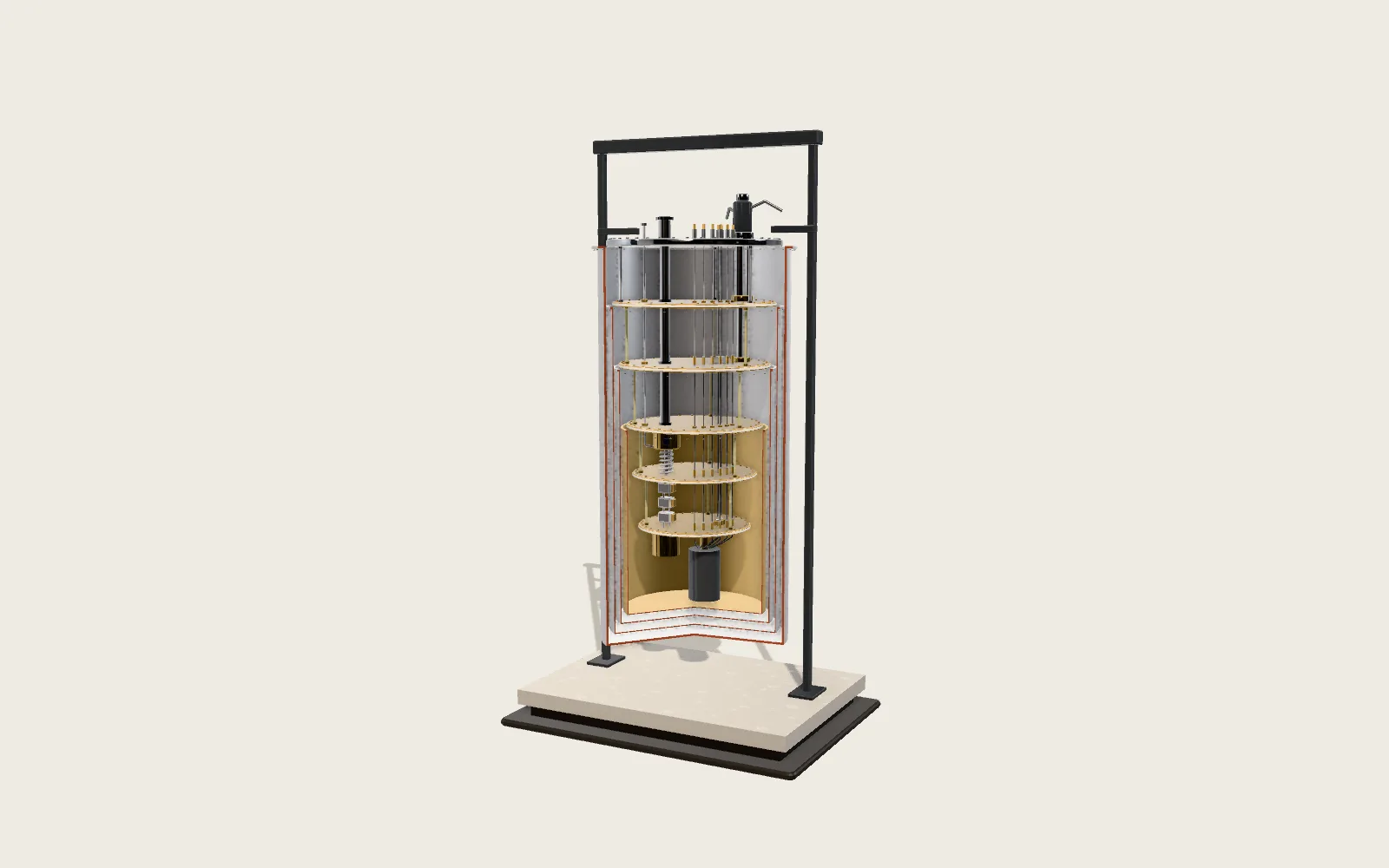 Plate F05The Dilution RefrigeratorA superconducting quantum computer hangs from a gold-plated “chandelier”. Each stage is colder than the one above; the last is about 10 mK, hundreds of times colder than space.
 Plate 43More Features Than NeuronsA single neuron in a neural network often stands for several unrelated things. A model with just two neurons can arrange five features into a pentagon and keep them all.