The Neutron Lifetime Puzzle
A free neutron decays in about a quarter of an hour. Counted in a bottle, it lives 877.8 s; counted by the protons it leaves in a beam, 887.7 s.
Chapters · 15
- 019.9 Seconds Apart
- 02A Free Neutron Decays
- 03Why the Seconds Matter
- 04Slow Enough to Bottle
- 05Counting What Is Left
- 06Cut Open: the Magnet Bathtub
- 07Lowering the Detector
- 08Counting What Appears
- 09Cut Open: the Proton Trap
- 10Counting the Neutrons
- 11Decades of Readings
- 12What Could Be Missing
- 13What Comes Next
- 14Taken Apart
- 15The Laboratory
Scroll
9.9 Seconds Apart
Los Alamos National Laboratory’s UCNτ holds ultracold neutrons in a magnetic field and counts how many are left after a while; its final result, published in 2025, is 877.83 s, with a statistical error of ±0.22 s and a systematic error of +0.20/−0.17 s. The National Institute of Standards and Technology (NIST) sends a beam of cold neutrons through a proton trap and counts the protons the decays make; its 2013 result is 887.7 s, ±1.2 s statistical and ±1.9 s systematic.
The two differ by 9.87 s; their errors combined come to about ±2.27 s, and the gap is 4.4 times that (this page’s arithmetic). Averages tell the same story: the Particle Data Group’s 2025 value, which averages only bottle results, is 878.4 ± 0.5 s; the two proton-beam experiments average 888.0 ± 2.0 s, 9.6 s higher. How many standard deviations depends on which results are compared; the usual figure is about four.
bottle 877.8 s · beam 887.7 s · 9.9 s apart, about 4.4σ (this page’s arithmetic)
A Free Neutron Decays
A neutron is 1.293 MeV heavier than a proton (CODATA 2022). On its own it turns into a proton, giving off an electron and an electron antineutrino: n → p + e⁻ + ν̄ₑ. Less the electron’s mass, each decay releases about 0.782 MeV, shared among the three. Tritium’s beta decay is the same event inside a nucleus; see the plate “Weighing the Neutrino”.
A free neutron’s mean lifetime is about 878 s, or 14.6 minutes; half of a sample is gone after about 10.2 minutes (this page’s arithmetic). A neutron in a stable nucleus does not decay: what the decay would leave behind weighs more than the nucleus it started from, so there is no energy to pay for it. A neutron in a deuteron, for example, is about 1.44 MeV short (this page’s arithmetic from CODATA 2022 masses).
n → p + e⁻ + ν̄ₑ · about 0.782 MeV released · mean lifetime about 14.6 minutes
Why the Seconds Matter
In the universe’s first minutes, protons and neutrons had to wait for the temperature to fall before they could join into nuclei, and while they waited, neutrons decayed. Nearly all that survived ended up in helium-4. A longer lifetime leaves more neutrons and so more helium: by Pitrou and colleagues’ 2018 calculation, each extra second raises the primordial helium mass fraction Yₚ (about 0.247) by about 0.0002, so 9.9 s by about 0.002 (this page’s arithmetic).
The lifetime is also tied to the constants of the weak force. With Czarnecki and colleagues’ 2018 relation τ(1 + 3gA²) = 5,172.0 s, the gA measured by PERKEO III gives 878.4 ± 0.7 s, close to the bottle result (this page’s arithmetic). The measured values of gA do not all agree with one another either.
Yₚ: about 0.0002 per second · τ(1 + 3gA²) = 5,172.0 s · PERKEO III → 878.4 ± 0.7 s
Slow Enough to Bottle
Ultracold neutrons carry less than about 300 neV of kinetic energy and move at under 8 m/s; many materials bounce them back from any angle. Rising 1 m costs 102.5 neV, so a 300 neV neutron climbs about 3 m at most. A neutron is a small magnet, 60.3 neV per tesla, and a strong field pushes away the neutrons of one spin direction (this page’s arithmetic from CODATA 2022).
UCNτ’s ultracold neutrons come from the Los Alamos Neutron Science Center: 800 MeV protons strike a tungsten target, and the neutrons slow down in solid deuterium. A 5.5 T superconducting solenoid lets through only one spin, and a spin flipper turns it into the kind a field pushes away. The trap keeps only neutrons below about 50 neV: about 3.1 m/s, too slow to clear 50 cm.
ultracold: below 300 neV, under 8 m/s · gravity 102.5 neV / m · magnetism 60.3 neV / T
Counting What Is Left
A run goes like this: neutrons come in through a door in the floor for 150 to 300 s; the cleaner sits 38 cm above the floor and for 50 s removes neutrons with too much energy, which would leak out slowly; then it rises 5 cm, the door closes and the neutrons are stored for 20 to 1,550 s; finally the detector is lowered in to count how many are left.
The lifetime comes from a short and a long hold: τ = (t₂ − t₁) ÷ ln(N₁ ÷ N₂), 1 the short one and 2 the long one, each count with its background removed and scaled by the monitors. The 2017 and 2018 runs counted about 38 million surviving neutrons; the 2025 result combines five years of data, 2017 to 2022.
stored 20–1,550 s · a short and a long hold, in pairs · about 38 million in 2017–2018
Cut Open: the Magnet Bathtub
The tub is lined with 5,310 neodymium-iron-boron magnets, each 5.08 cm long, 1.27 cm wide and 2.54 cm deep, with about 1 T at their surface. They form a Halbach array: along the tub each row’s magnetisation is turned 90° from the last, so the field gathers on the inner side and fades within about a centimetre. Neutrons below about 50 neV bounce off this skin of field; the top is open, and gravity is the lid.
The shape is two half-tori: along the tub the floor is an arc of radius 1.5 m; across it, one side rises on a 0.5 m circle and the other on a 1 m circle, meeting smoothly at the bottom. Cut off 50 cm up, the opening is about 2.24 × 1.37 m and the volume about 670 L (692 L by this page’s arithmetic). The asymmetry scrambles the neutrons’ orbits, so the too-energetic ones leave sooner. Ten coils outside add a holding field of about 6 to 12 mT, so that no neutron flips its spin where the field would fall to zero.
5,310 blocks · about 1 T at the surface · 50 cm deep · about 670 L · holding field 6–12 mT · arrows on the cut: each block’s magnetisation, schematic
Lowering the Detector
The detector that counts them is called the dagger: an upright acrylic paddle coated on both faces with zinc sulfide and boron-10, 750 cm² a side. A neutron that meets boron-10 is absorbed and throws out an alpha particle and a lithium-7, which make the zinc sulfide flash; wavelength-shifting fibres carry the light to photomultipliers.
It goes down in steps: 40 s at the cleaners’ height, 20 s in the middle, then 150 s with its edge 1 cm above the floor (the 2021 paper). At the bottom it takes up the stored neutrons with a time constant of about 8 s and an efficiency of about 96 %. The neutrons are counted where they are stored, without draining them out of the trap.
750 cm² a side · down to 1 cm above the floor · time constant about 8 s
Counting What Appears
The beam method turns it round: instead of the neutrons that are left, it counts the protons the decays make. In a stretch of beam of known length, the decays each second equal the neutrons in it divided by the lifetime, τ = N ÷ (dN/dt). So two things must be known: how many neutrons are in that stretch, and how many decay each second.
NIST’s neutrons come from a 20 MW research reactor and are slowed in a liquid-hydrogen cold source at 20 K, to a mean wavelength of about 0.45 nm, about 840 to 930 m/s; nickel-58-coated guides carry them about 68 m. The beam is only 7 to 8.4 mm across; some 20 to 50 million neutrons pass each second, and the trap counts about 4 protons a second.
τ = N ÷ (dN/dt) · about 2–5 × 10⁷ neutrons a second · about 4 protons
Cut Open: the Proton Trap
The beam runs along the axis of a superconducting solenoid, where the field is 4.6 T. On the axis sit 16 gold-coated fused-quartz ring electrodes, each 18.6 mm long with a 26 mm bore. The first three, the door, and the last three, the mirror, are held at +800 V; the 3 to 10 grounded ones between them are the trap. A decay’s proton has at most 751 eV, too little to climb the 800 V walls, and the field winds it round the axis, so it stays.
After about 10 ms the door drops to ground and the protons follow the field lines out. At the door end the lines bend by 9.5° and lead the protons to a silicon detector beside the beam, held at −25 to −35 kV, which counts nearly every one. The trap’s length is changed from run to run: the ends have the same effective length for every trap, so following how the count changes with length removes them.
4.6 T · 16 electrodes · door and mirror at +800 V · a 9.5° bend · −25 to −35 kV
Counting the Neutrons
How many neutrons are in the beam is counted by the neutron monitor downstream of the trap: a 50 mm silicon wafer with a deposit of lithium-6 fluoride 38 mm across. A neutron that strikes lithium-6 breaks it into an alpha particle and a triton, and four silicon detectors count them through precision apertures.
The chance that lithium-6 catches a neutron falls as the neutron gets faster, and so does the chance that it decays in the trap, which grows with the time it spends there. Dividing one by the other, the beam’s spread of speeds cancels out. In 2005 this was the largest uncertainty (2.7 s); in 2013 the Alpha-Gamma device measured the monitor’s efficiency directly to 0.057 %, which moved the lifetime by +1.4 s, to 887.7 s.
⁶LiF, 38 mm across · efficiency ∝ 1/v · calibrated to 0.057 % in 2013
Decades of Readings
In 1980 the Particle Data Group’s average was 917 ± 14 s; in 1990, 888.6 ± 3.5 s; from 2002 to 2012 it stood at 885.7 ± 0.8 s; today it is 878.4 ± 0.5 s. The bottle results since 2005 all lie between 877 and 883 s; the proton-counting beam results of 1996 and 2013 are 889.2 and 887.7 s.
The Particle Data Group now averages only the eight results made with ultracold neutrons; they do not fully agree with one another either, so its error is enlarged 1.8-fold. Including NIST’s beam result gives 878.6 ± 0.6 s, with the factor up to 2.2.
1980: 917 s · 1990: 888.6 s · 2002–2012: 885.7 s · today: 878.4 ± 0.5 s
What Could Be Missing
The possible answers come in two kinds: a decay without a proton, which a bottle counts and a beam misses, or an effect not yet accounted for in one of the methods. To explain 9.9 s the first way, about 1.1 % of decays would have to be invisible (this page’s arithmetic). In 2018 a decay into a dark-matter particle and a photon was proposed; experiments since found neither the photon nor an electron–positron pair, and the measured gA limits invisible decays to about 0.27 % (95 % confidence).
Another idea was that neutrons turn into “mirror neutrons” in NIST’s 4.6 T field; a 2022 search at 6.6 T excluded it. Both methods’ systematics have been checked: in a bottle, too-energetic neutrons that leak out slowly make the lifetime short if they are not cleaned out (about 15 s short with no cleaning at all); a beam must count neutrons and protons exactly, and a 2025 study of charge exchange with leftover hydrogen found it unlikely to matter. None of it is settled.
needed: about 1.1 % unseen · limit from gA: about 0.27 % · photon, electron pairs, mirror neutrons: none found
What Comes Next
At Japan’s J-PARC a beam experiment counts not protons but the electrons from decays, in a time projection chamber with a trace of helium-3; its 2024 preprint gives 877.2 s, ±1.7 s statistical and +4.0/−3.6 s systematic: in line with the bottles, 2.3 standard deviations from the proton-beam average. It can be measured from space too: the Lunar Prospector’s neutron spectrometer gave 887 ± 14 s, not yet enough to choose.
NIST has repeated its beam experiment with an improved apparatus on a new beam line (BL2), not yet published; its successor BL3 is to run from 2027 and aims for better than 0.3 s. UCNτ is moving to “elevator” loading, with 5 to 10 times more neutrons and a goal of about 0.1 s; UCNProβe will count the decay electrons inside a bottle, to compare beta decay with every way a neutron disappears.
J-PARC 2024: 877.2 s (preprint) · Lunar Prospector: 887 ± 14 s · BL3: aiming below 0.3 s
Taken Apart
The detector swings away, and the cleaners, the magnet bathtub and the coils lift one by one out of the vacuum jacket; on the other side the solenoid rises off the proton trap.
Rest the pointer on a part (tap it on a phone) and it lifts on its own, named, while the rest fades.
The Laboratory
Two sliders: how long the neutrons are stored in the bottle, and what share of decays makes no proton and is seen by nobody. The readouts are how many are left after the hold, the lifetime each method measures, and the gap; “Run again” draws a new set of counts.
This is this page’s model, not any experiment’s analysis: the neutron’s beta-decay lifetime is set to 887.7 s; invisible decays make neutrons vanish from the bottle faster, so it reads 887.7 s × (1 − share), while the beam counts only protons and is unaffected. The counts are sized by UCNτ’s 2017–2018 total of about 38 million and NIST’s 2013 statistical error, and the errors include both groups’ published systematic errors.
Try thisIn the lab, set the decays nobody sees to 0: how far apart are the two lifetimes? And at 1.1 %?
What the model leaves out
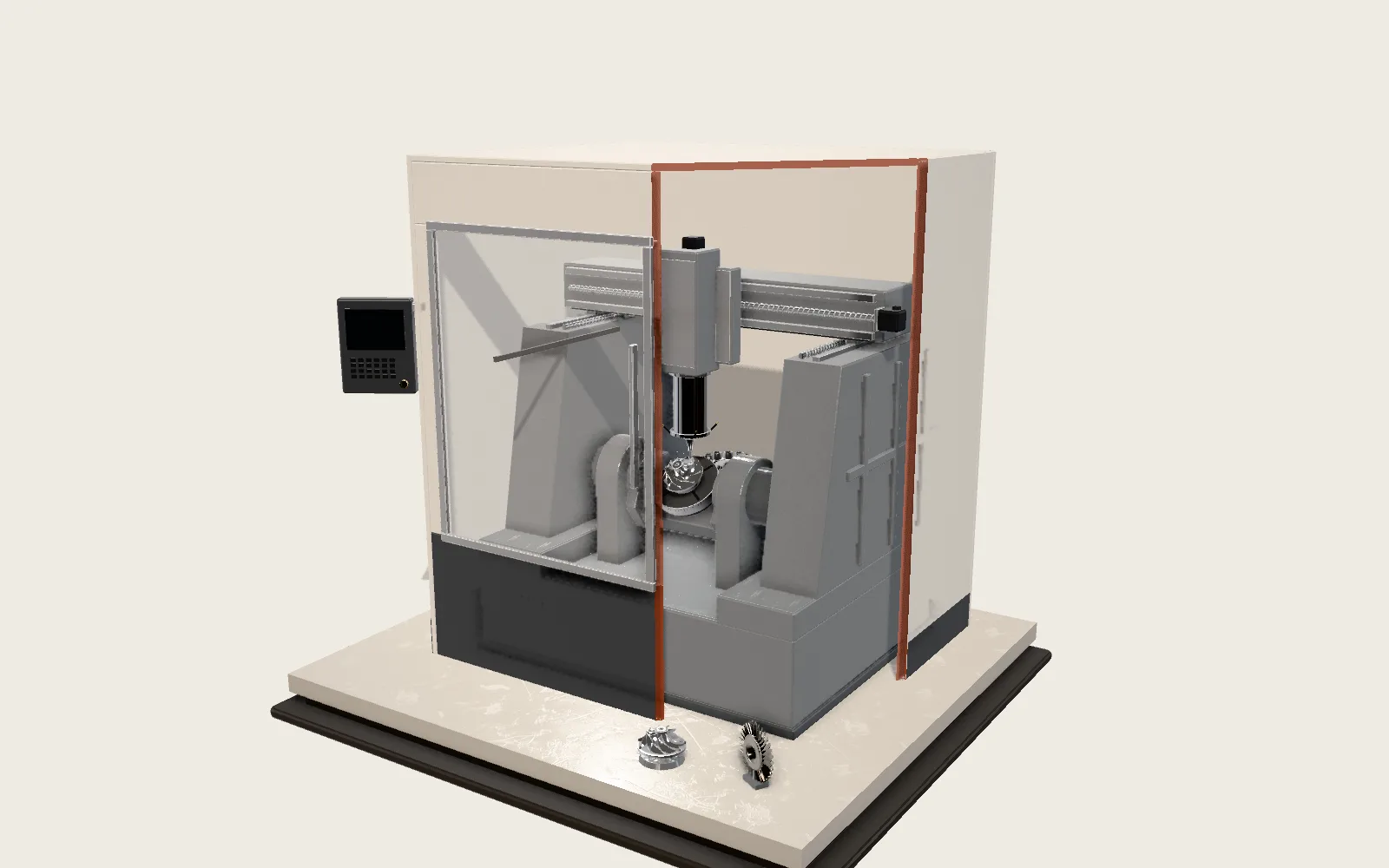
The two machines stand on one plinth at the same scale; they are really in two laboratories in the United States (Los Alamos and NIST). The magnet bathtub follows the papers’ two half-tori, cut off at 50 cm; the model lays 5,084 magnets (the papers: 5,310), each 5.08 cm long, 1.27 cm wide and 2.54 cm deep, in rows read off the papers’ figures. The magnets’ coating is not stated in the papers. The vacuum jacket’s outline, the coils’ section, the cleaners’ and the detector’s supports, the guides and the polariser are read off the figures, and the detector is drawn as one paddle (in 2022 it was split into four). No dimensions of NIST’s solenoid and cryostat are published; they are drawn round the 16 electrodes (342.6 mm in all) and the 9.5° bend, and the guides, collimation, shielding and beam stop are schematic. The neutrons are drawn far larger than life: the dots in the bathtub fly at real speeds (a few metres a second), while the beam’s neutrons are drawn far slower than their real 900 m/s or so; the protons’ circles round the field lines are drawn larger. The laboratory is this page’s model.
Common misunderstandings
877.8 s and 887.7 s are mean lifetimes, not half-lives (the half-life is about 10.2 minutes). Their gap is a disagreement between two methods, not evidence of new physics; how many standard deviations it is depends on which results are compared. The Particle Data Group’s 878.4 s averages only bottle results; it is not a compromise between the two. The disagreement is between proton-counting beams and bottles: J-PARC’s electron-counting beam agrees with the bottles. Dark decays are not ruled out outright, but the channels searched showed nothing, and gA limits them to about 0.27 %, far below the 1.1 % needed. Ultracold neutrons are not frozen: they fly at a few metres a second, and “millikelvin” describes their energy; the bathtub itself is at room temperature. UCNτ’s 38 million are surviving neutrons counted over two years, not one fill.
Common questions · 5
- What neutron lifetime did UCNτ measure?
Los Alamos National Laboratory’s UCNτ holds ultracold neutrons in a magnetic field and counts how many are left after a while; its final result, published in 2025, is 877.83 s, with a statistical error of ±0.22 s and a systematic error of +0.20/−0.17 s.
019.9 Seconds Apart ↑- Why does a neutron in a stable nucleus not decay?
A neutron in a stable nucleus does not decay: what the decay would leave behind weighs more than the nucleus it started from, so there is no energy to pay for it.
02A Free Neutron Decays ↑- How many magnets line the UCNτ bathtub?
The tub is lined with 5,310 neodymium-iron-boron magnets, each 5.08 cm long, 1.27 cm wide and 2.54 cm deep, with about 1 T at their surface.
06Cut Open: the Magnet Bathtub ↑- How does the beam method measure the neutron lifetime?
The beam method turns it round: instead of the neutrons that are left, it counts the protons the decays make. In a stretch of beam of known length, the decays each second equal the neutrons in it divided by the lifetime, τ = N ÷ (dN/dt).
08Counting What Appears ↑- Can a dark-matter decay explain the neutron lifetime puzzle?
In 2018 a decay into a dark-matter particle and a photon was proposed; experiments since found neither the photon nor an electron–positron pair, and the measured gA limits invisible decays to about 0.27 % (95 % confidence).
12What Could Be Missing ↑
Sources
- Musedinovic et al. (UCNτ, 2025): Measurement of the free neutron lifetime in a magneto-gravitational trap with in situ detection, Phys. Rev. C 111, 045501 (877.83 ± 0.22 +0.20/−0.17 s; 2017–2022)
- Gonzalez et al. (UCNτ, 2021): Improved Neutron Lifetime Measurement with UCNτ, Phys. Rev. Lett. 127, 162501 (about 38 million surviving neutrons; storage 20–1,550 s; cleaning; the detector’s steps; 5.5 T; 60–120 G holding field)
- Pattie et al. (2018): Measurement of the neutron lifetime using a magneto-gravitational trap and in situ detection, Science 360, 627 (magnet size, 1 T, the two tori; cleaner at 38 cm; detector 750 cm² a side, about 8 s, 96 %)
- Salvat et al. (2014): Storage of ultracold neutrons in the UCNτ magneto-gravitational trap, Phys. Rev. C 89, 052501 (5,310 magnets; about 670 L; 50 cm deep; the 15 × 15 cm door; 300 A coils; why asymmetric)
- Callahan et al. (2019): Monte Carlo simulations of trapped ultracold neutrons in the UCNτ experiment, Phys. Rev. C 100, 015501, arXiv:1810.07691 (r + R = 1.5 m, swapped across; ten coils; the detector housing)
- Morris et al. (2017): A new method for measuring the neutron lifetime using an in situ neutron detector, Rev. Sci. Instrum. 88, 053508 (wavelength-shifting fibres)
- Los Alamos National Laboratory (2025): New Measurement of Free Neutron Lifetime Achieves World-Record Precision (the “bathtub”)
- Yue et al. (2013): Improved Determination of the Neutron Lifetime, Phys. Rev. Lett. 111, 222501 (887.7 ± 1.2 ± 1.9 s; Alpha-Gamma; 0.057 %; 2.7 s in 2005)
- Nico et al. (2005): Measurement of the neutron lifetime by counting trapped protons in a cold neutron beam, Phys. Rev. C 71, 055502 (4.6 T; 16 electrodes; +800 V; 751 eV; 9.5°; ⁶LiF; 20 K cold source; about 4 protons a second)
- Caylor et al. (2025): Detection of molecular hydrogen in a neutron beam lifetime experiment, Phys. Rev. C 112, 065501, arXiv:2506.01682
- Fuwa et al. (2024): Improved measurements of neutron lifetime with cold neutron beam at J-PARC, arXiv:2412.19519 (preprint; 877.2 s; 2.3σ)
- Particle Data Group (2025): the n listing (878.4 ± 0.5 s, S = 1.8; results over the years)
- Czarnecki, Marciano, Sirlin (2018): Neutron Lifetime and Axial Coupling Connection, Phys. Rev. Lett. 120, 202002 (τ(1 + 3gA²) = 5,172.0 s; beam average 888.0 ± 2.0 s; 0.27 %)
- Märkisch et al. (PERKEO III, 2019), Phys. Rev. Lett. 122, 242501 (λ = −1.27641)
- Pitrou et al. (2018): Precision big bang nucleosynthesis with improved Helium-4 predictions, Phys. Rep. 754, 1 (how Yₚ depends on τ)
- Fields et al. (2020): Big-Bang Nucleosynthesis after Planck, JCAP 03, 010 (the averages over the years)
- Fornal, Grinstein (2018): Dark Matter Interpretation of the Neutron Decay Anomaly, Phys. Rev. Lett. 120, 191801
- Tang et al. (2018), Phys. Rev. Lett. 121, 022505 (the photon: excluded at over 4σ); Sun et al. (UCNA, 2018), Phys. Rev. C 97, 052501 (electron–positron pairs)
- Baym et al. (2018): Testing dark decays of baryons in neutron stars, Phys. Rev. Lett. 121, 061801
- Dubbers et al. (2019): Exotic decay channels are not the cause of the neutron lifetime anomaly, Phys. Lett. B 791, 6 (0.28 %)
- Broussard et al. (2022): the mirror-neutron search, Phys. Rev. Lett. 128, 212503 (6.6 T)
- Wilson et al. (2021): the Lunar Prospector neutron spectrometer, Phys. Rev. C 104, 045501 (887 ± 14 s)
- Alarcon et al. (2023): Fundamental Neutron Physics: a White Paper, arXiv:2308.09059 (BL3, UCNProβe)
- Dubbers, Schmidt (2011): The neutron and its role in cosmology and particle physics, Rev. Mod. Phys. 83, 1111 (what ultracold means; about 15 minutes)
- CODATA 2022: the neutron–proton mass difference (1.293 332 51 MeV)
Data
The bottle follows the UCNτ collaboration’s published descriptions: the two half-tori and the 50 cm cut (Pattie et al., Science 360, 627 (2018); Callahan et al., Phys. Rev. C 100, 015501 (2019)), the 2.54 × 5.08 × 1.27 cm magnets, the trap door, cleaners, holding-field coils and dagger detector (Salvat et al., Phys. Rev. C 89, 052501 (2014); Gonzalez et al., Phys. Rev. Lett. 127, 162501 (2021)). The beam follows Nico et al., Phys. Rev. C 71, 055502 (2005): the 16 electrodes, the 9.5° bend, the ⁶LiF monitor. The rest is read off their figures, and the notes list what is simplified. The trap’s volume, the gap between the results, the survival curves, the energies and the laboratory’s model are computed by this page (science.js, tests/neutron.test.js); the laboratory is a model, not any experiment’s analysis. Material presets, parts and the softbox studio of the site’s model kit are ported from AirsupHQ/machine-skill (MIT, © 2026 Air Supply Technologies Inc.).
The text, pictures and models on this page are licensed CC BY-NC 4.0: free to use and adapt for teaching and other non-commercial purposes, with credit to world.lapla.si. Third-party material listed above keeps its own licence.
Cite this plate
Laplace’s Mini World, Plate F66, “The Neutron Lifetime Puzzle”, https://world.lapla.si/en/neutron/, CC BY-NC 4.0, updated 2026-11-05.
Follow the question
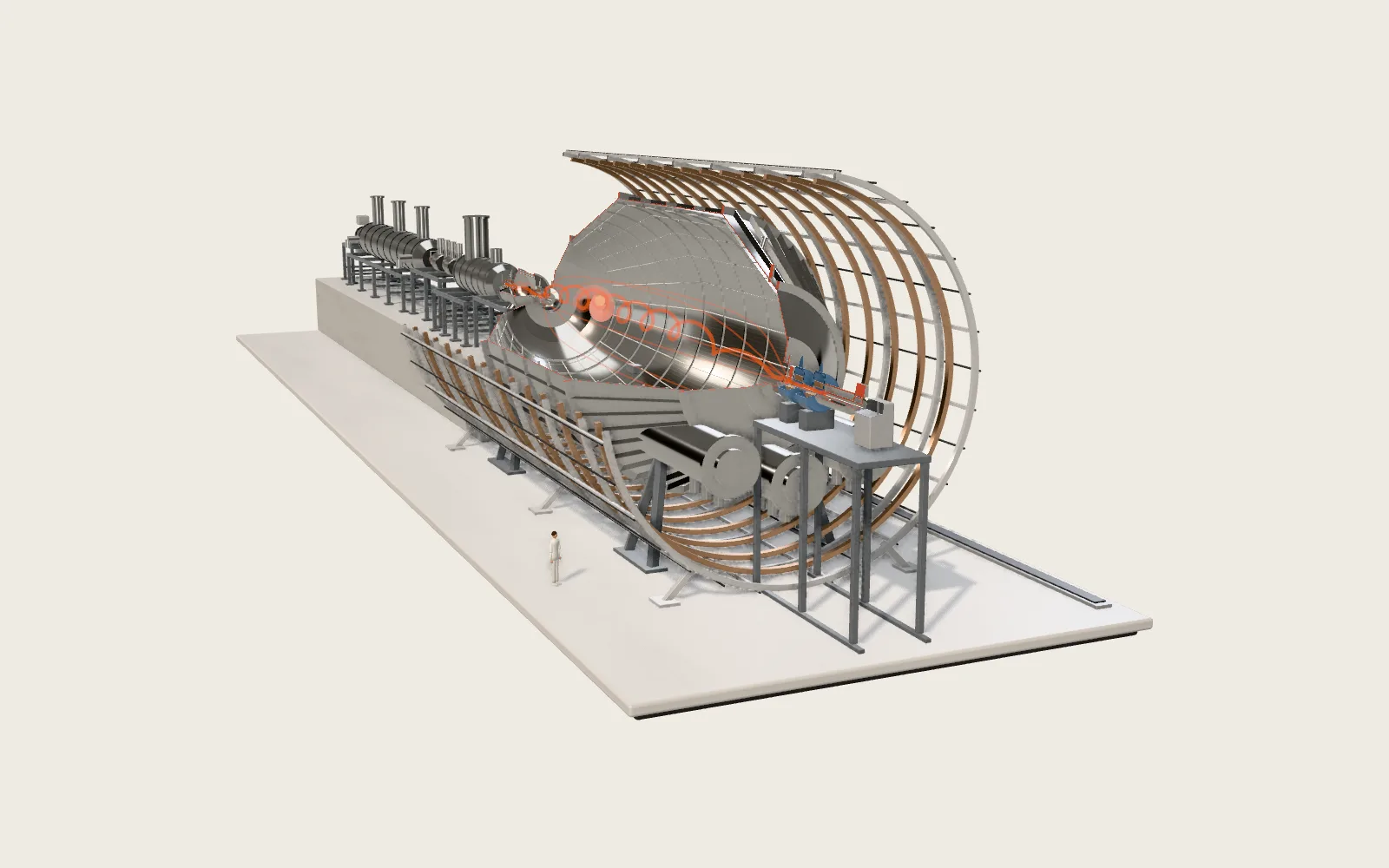 Plate F61Weighing the NeutrinoKATRIN in Karlsruhe weighs the neutrino with tritium’s beta decay: the decay’s energy is shared between an electron and an antineutrino, and if the neutrino has mass the fastest electrons fall short of the spectrum’s end. The electrons travel down a 70 m line into a stainless tank 23 m long and 9.8 m across, which lets through only those with enough energy. The 2025 result: the neutrino’s mass is below 0.45 eV (90 % confidence); the electron is more than a million times heavier.
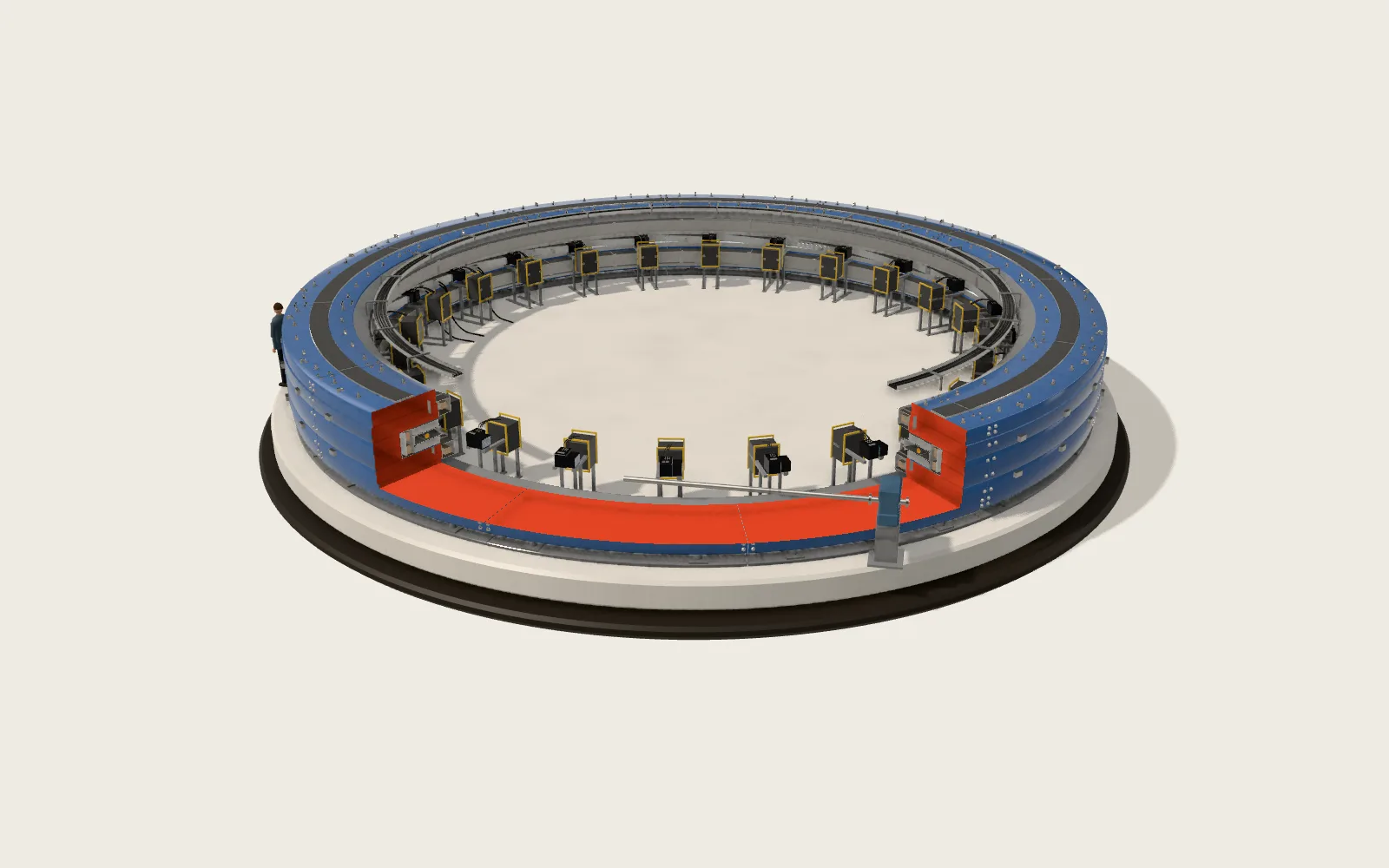 Plate F38Muon g−2A superconducting storage ring 15 m across keeps muons circling until they decay, counts the positrons they throw off, and pins down the small extra in the muon’s magnetism to 127 parts per billion.