Mechanical Energy
Lift a thing and its energy is stored in its height; let go and the height turns into speed. Without friction, the sum stays the same.
Scroll
Height into Speed
Lifting a thing takes work. The work is stored in its height as gravitational potential energy, mgh: mass times the acceleration of gravity times height. Let go, and it falls faster and faster as that energy becomes the energy of motion, kinetic energy, ½mv².
The steel ball on the post falls 36 cm into the cup in 0.27 s and arrives at 2.66 m a second.
mgh = ½mv²: the mass cancels, leaving v = √(2gh). Without air, the speed depends only on the height fallen, not on how heavy the ball is.
Where height is measured from is a choice; only differences of height enter the sums. Here it is measured from where the ball rests in the cup.
A 36 cm fall · 0.27 s · 2.66 m/s at the cup · a flash every 1/30 s · slowed 4 times
Back to the Same Height
In the Third Day of Two New Sciences (1638), Galileo assumed that one body coming down planes of equal height but different slopes gains the same speed. He argued it with a pendulum: let go on one side, the bob swings almost back up to the same horizontal line on the other; drive a nail into the wall where the thread passes, and the bob, swinging round the nail on a tighter arc, still rises to that line.
He also wrote that a body coming down one incline and going up another rises to the height it started from, whether the two slopes are the same or not.
The steel ball in the channel is let go 18 cm up on the left. The left side slopes at 35°, the right at 20°: on the right it has to run farther to rise the same 18 cm. Let go from rest, with nothing to push it, it cannot rise any higher.
Left 35° · right 20° · 18 cm on both sides · the page’s model, no friction
A Little Lower Each Time
A real ball rises a little lower each time. Galileo wrote too that the bob falls just short of the line, held back by the air and the thread, and that after many swings it comes to rest.
The energy is not lost. Friction and air turn part of the mechanical energy into heat, and a little sound; the channel, the ball and the air end up slightly, unnoticeably warmer. Heat once spread out cannot all be turned back into height and speed.
Add friction in the channel (the page’s model: a force always against the motion, 2 % of the pressing force): let go at 18 cm, the ball rises to 16.4, 14.9, 13.5, 12.3 cm … The energy each pass turns into heat is in proportion to the level distance it covers.
The page’s model · friction 2 % of the pressing force · 18 → 16.4 → 14.9 → 13.5 → 12.3 cm
Spinning Takes a Share
The ball and the wheel are let go together from the same height. The ball falls its 36 cm in 0.27 s; the wheel takes 4.7 s.
The wheel hangs from two cords wound on its axle. As it falls the cords unwind and the wheel has to spin, and spinning takes energy. Its rim is heavy and far from the axle, and the axle is thin: at the bottom it moves down at just 0.15 m a second but turns 5.7 times a second. Of its kinetic energy, 99.7 % is in the spin.
v = √(2gh / (1 + I/(mr²))): I is the moment of inertia, r the radius the cords unwind from. The larger I/(mr²), the bigger the spin’s share. A solid ball rolling without slipping on a flat surface puts 2/7 into its spin, so it comes down a slope slower than a block sliding without friction.
Let go together from one height · ball 0.27 s, 2.66 m/s · wheel 4.7 s, 0.15 m/s, 5.7 turns a second · spin 99.7 %
It Winds Itself Back Up
At the bottom the cords are fully unwound and the wheel is still spinning fast. It carries on turning the same way, winds the cords up over the other side of the axle and climbs, slower and slower, its spin turning back into height.
The device is called Maxwell’s wheel. In 1905 Eb. Gieseler of Bonn wrote that in Cambridge he had been told it was James Clerk Maxwell’s favourite apparatus for showing the conservation of energy; the one he had made took 12 s to fall 50 cm.
It does not climb back to 36 cm. B. Pecori and G. Torzo published a recorded run of a lab Maxwell wheel: each time down and up it regained 94.8 % of its last height (worked out here from their record). The page’s model keeps that ratio: 36, 34.1, 32.4, 30.7, 29.1 cm … The rest turns to heat in the friction between axle and cords, in the air, and in the jolt on the cords at the bottom.
Each cycle regains 94.8 % · 36 → 34.1 → 32.4 → 30.7 → 29.1 cm
The Apparatus, Taken Apart
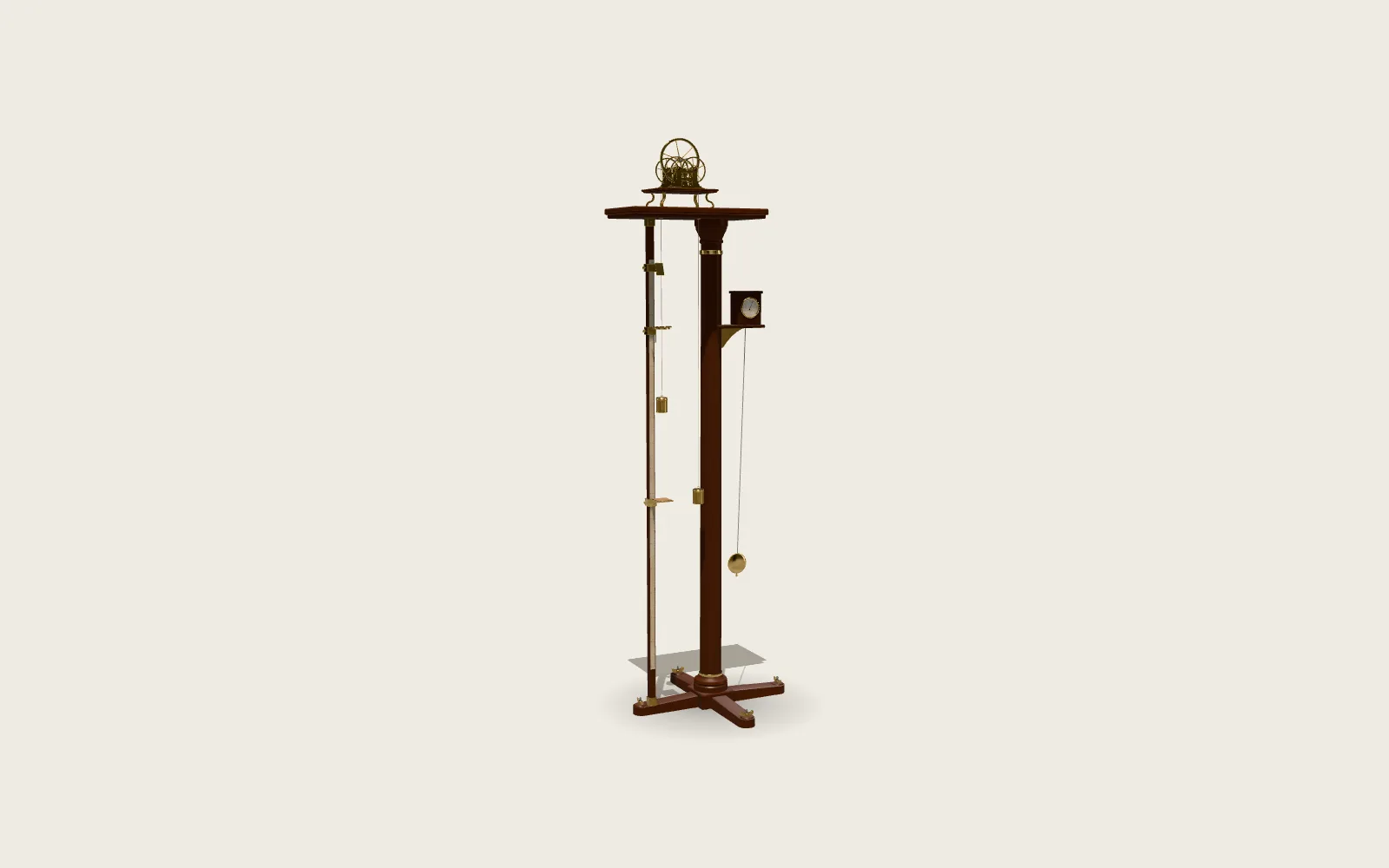
The wheel’s stand comes apart in eight pieces: the base, the post, the arm, the cord clamps, the wheel, the scale, the catch and the cup.
Rest the pointer on one and it is lifted out and named; left alone, all eight are named beside it.
Base · post · arm · cord clamps · wheel · scale · catch · cup
Electricity Kept as Height
Winding the wheel back up 36 cm stores the work done in its height: about 3.6 J for this 1.02 kg wheel. A pumped-storage plant does the same thing on a far larger scale: when there is spare electricity it pumps water up from a lower reservoir to one on a hill, and when electricity is needed it lets the water down through turbines.
Kyushu Electric’s Omarugawa plant in Miyazaki, Japan, has an effective head of 646.2 m and 5.6 million m³ of usable water in its upper reservoir. By mgh that water holds about 9.86 GWh. The operator says it can generate 1,200 MW for 7 hours, 8.4 GWh: 85 %. The rest turns to heat in the waterways, turbines and generators.
Pumping loses some too. By the design figures Xinhua reported, China’s Fengning plant uses 8.716 TWh a year to pump and generates 6.612 TWh: about three quarters of the electricity comes back.
Omarugawa: head 646.2 m · 5.6 million m³ usable · about 9.86 GWh worked out · 1,200 MW × 7 h = 8.4 GWh generated
A Roller Coaster
The block slides down from the top of the channel’s left side (the page’s model, no friction): fastest at the bottom, it climbs back to the same height on the right.
Nagashima Spa Land’s Steel Dragon 2000 is hauled by a chain to a crest 97 m high; its largest drop is 93.5 m. Without friction, a 93.5 m drop gives √(2gh) = 42.8 m a second, about 154.2 km/h. The park gives its top speed as 153 km/h.
That is 0.8 % slower, about 1.5 % less energy, the equivalent of some 1.4 m of the drop: the spin of the wheels, friction in the wheels and bearings, the air, and the train’s middle falling a little less than the track all sit in that small gap. Use the drop, not the height of the crest: 97 m would give 157 km/h.
Drop 93.5 m · without friction 154.2 km/h · quoted 153 km/h · about 1.5 % of the energy apart
Height, Body and Friction
This is the page’s model: let a body go on the channel’s left side and watch it run back and forth. The block slides without rolling; the steel ball rolls on the flat floor; the small wheel’s thin axle rolls on the two brass strips along the walls, and most of its energy goes into the spin.
Friction is worked out as a force always against the motion, a fraction of the pressing force, the same way for all three bodies. The four energies (height, motion, spin, heat) always add up to 100 % of what it had when let go.
The page’s model · height, motion, spin and heat add up to the same
Try thisIn the lab, let the ball go from 20 cm with no friction: how high does it climb on the right? And the wheel?
What the model leaves out
The wheel and the channel are this page’s model after 19th-century instruments: the wheel after Max Kohl’s “Inertia Pendulum (Maxwell’s)” in a catalogue of about 1909–1911 and a wheel of about 1880 at the University of Innsbruck; the channel and its small wheel on a thin axle after a modified Galilean channel Gieseler described in 1905. Sizes and materials are ours. The wheel weighs 1.02 kg and its cords unwind from a radius of 4.25 mm; its times and speeds are worked out from the model. The 94.8 % regained each cycle comes from a measured lab wheel, and the page spreads that loss evenly along the way; the turn at the bottom is drawn as the axle swinging half a turn round the cords’ ends. The ball falls without air. Friction in the channel is the page’s simplification: a force against the motion in proportion to the pressing force, leaving out the extra pressing on the curve. The pumped-storage and roller-coaster figures are the operators’; the sums leave out the changing water levels, the train’s length and its speed at the crest. Slow motion, the flashes and the ball’s little hop in the cup are there to make things visible.
Easy to get wrong
Energy is not “used up”; it changes form. Friction turns mechanical energy into heat and sound, and spread-out heat cannot all be turned back. A body let go from rest, with nothing else pushing it, cannot rise above where it started. Gravitational potential energy needs a chosen zero, and any zero will do: only differences of height count; and the energy belongs not to the body alone but to the body and the Earth together. Rolling without slipping does not itself use up energy: a rolling body is slower because part of its energy is in the spin, which turns back into height on the way up. Mechanical energy is conserved only where friction and air can be left out; counting the heat, the total energy always is.
Common questions · 5
- How does the speed of a falling body depend on the height?
mgh = ½mv²: the mass cancels, leaving v = √(2gh). Without air, the speed depends only on the height fallen, not on how heavy the ball is.
01Height into Speed ↑- Can a ball let go from rest rise higher than where it started?
Let go from rest, with nothing to push it, it cannot rise any higher.
02Back to the Same Height ↑- Does friction destroy energy?
The energy is not lost. Friction and air turn part of the mechanical energy into heat, and a little sound; the channel, the ball and the air end up slightly, unnoticeably warmer.
03A Little Lower Each Time ↑- Why does Maxwell’s wheel fall so slowly?
As it falls the cords unwind and the wheel has to spin, and spinning takes energy.
04Spinning Takes a Share ↑- How does a pumped-storage plant store electricity?
when there is spare electricity it pumps water up from a lower reservoir to one on a hill, and when electricity is needed it lets the water down through turbines.
07Electricity Kept as Height ↑
Sources
- G. Galilei (1638): Discorsi e dimostrazioni matematiche intorno a due nuove scienze (Two New Sciences), transl. H. Crew and A. de Salvio (1914), Third Day
- T. Young (1807): A Course of Lectures on Natural Philosophy and the Mechanical Arts, vol. 1, Lecture V
- Eb. Gieseler (1905): Die ersten Versuche über Reibung, Wirkungsgrade und Fallgeschwindigkeit, Zeitschrift für den physikalischen und chemischen Unterricht 18
- Max Kohl A.G. (about 1909–1911): Price list No. 50, p. 251, No. 51,766 “Inertia Pendulum (Maxwell’s)”
- University of Innsbruck, Institute of Experimental Physics: historical instruments, “Maxwell’s Rad”, about 1880, Inv. IV 259
- University of Vienna, Faculty of Physics, historical collection: “Historisches Maxwellrad” (video notes)
- Leybold (1964): Physics Apparatus for Teaching Purposes, 331 22 Maxwell’s wheel
- OpenStax: University Physics, vol. 1, 7.2 Kinetic Energy
- OpenStax: University Physics, vol. 1, 8.1 Potential Energy of a System (the zero is a choice; only differences count)
- OpenStax: University Physics, vol. 1, 8.3 Conservation of Energy
- OpenStax: University Physics, vol. 1, 10.4 Moment of Inertia and Rotational Kinetic Energy
- OpenStax: University Physics, vol. 1, 11.1 Rolling Motion
- OpenStax: College Physics 2e, 7.5 Nonconservative Forces (friction turns mechanical energy into heat)
- B. Pecori and G. Torzo (1998): A closer look at yo-yos and bouncing balls (GIREP conference paper)
- The same: their recorded run of a Maxwell wheel (the heights it regained worked out here)
- BCIT Physics Demonstration Manual: DLD17 Maxwell’s Wheel
- PHYWE: 02425-00 Maxwell wheel (catalogue entry)
- Nagashima Spa Land: Steel Dragon 2000 (drop, top speed)
- Roller Coaster DataBase: Steel Dragon 2000
- Kyushu Electric Power: Omarugawa pumped-storage power station (pamphlet, September 2026)
- Kyushu Electric Power: press release of 10 July 2007 (Omarugawa unit 1; usable water and hours of generation)
- Xinhua (31 December 2024): Fengning pumped-storage plant in full operation (design yearly generation and pumping)
- NIST: standard acceleration of gravity (a defined value)
Data
Galileo Galilei, Two New Sciences (Leiden, 1638), Third Day, in the English of H. Crew and A. de Salvio (1914); T. Young, A Course of Lectures on Natural Philosophy (1807). The wheel’s history after Eb. Gieseler, Zeitschrift für den physikalischen und chemischen Unterricht 18 (1905), Max Kohl A.G., Price list No. 50 (Chemnitz, about 1909–1911), the University of Innsbruck’s collection of historical instruments (Inv. IV 259) and the University of Vienna’s historical collection. Standard gravity as defined by the CGPM (NIST); the energy relations as in OpenStax University Physics and College Physics; the height a lab Maxwell wheel regains from the run B. Pecori and G. Torzo published with their 1998 paper; the lab wheels’ sizes from PHYWE, Leybold and BCIT. Steel Dragon 2000 from Nagashima Spa Land and the Roller Coaster DataBase; Omarugawa from Kyushu Electric Power; Fengning as reported by Xinhua. Every motion on the page is computed from these (computed.py and sim.js). The wheel, its stand, the valley track and its bodies are this page’s model after the period instruments, not copies of any one; their sizes and materials are ours. Material presets and the model kit as on the site’s other model plates (public/looks/CREDITS.md).
The text, pictures and models on this page are licensed CC BY-NC 4.0: free to use and adapt for teaching and other non-commercial purposes, with credit to world.lapla.si. Third-party material listed above keeps its own licence.
Cite this plate
Laplace’s Mini World, Plate 81, “Mechanical Energy”, https://world.lapla.si/en/mechanical/, CC BY-NC 4.0, updated 2026-11-02.
Follow the question
 Plate 79Projectile MotionA ball that leaves a table’s edge keeps its sideways speed, and falls exactly as fast as a ball simply let go. The two motions do not interfere; together they trace a parabola. As the historian Stillman Drake read his notes, around 1608 Galileo let balls roll from different heights on a table, fly off its edge and land, and checked how far they went against how high they started; in 1638 he proved that a projectile’s path is a parabola, and that without air a launch at 45° goes farthest. Air shortens the path, steepens its second half and lowers the angle that carries farthest.
 Plate 22Why a Foucault Pendulum TurnsA long pendulum swings back and forth, and the line of its swing slowly turns. What turns is the floor beneath it, and the Earth beneath the floor.